Wednesday, February 22, 2017

Puerto Rico Winter Tour Y2K16: Refugio de Vida Silvestre de Boquerón, Cabo Rojo


It's been a weird winter here in the bay area. It seems to rain constantly, and I am in a persistant daze due to the newborn baby that strangely requires frequent attention. However, I can't bitch about not getting to the tropics this winter, because it was only back in December that our group from MAX REBO BIRDING TOURS were slaying Caribbean birds in Puerto Rico. The trip report must go on...

It is about time I posted a picture of one of my first lifers of the trip...Greater Antillean Grackle. I somehow did not get to crush them as well as I could, so I had to settle with photographing them while sitting around eating lunch after we birded Laguna Cartagena. An old lady with bad Parkinson's was feeding them rice, so I stole a few grackle souls.


These are one of the most abundant native birds of Puerto Rico. They are quite small, more like a Common than a Great-tailed, and haven't totally abandoned native habitats in favor of streets and parking lots. They are also much less cacophonous and obtrusive than Great-tailed...I ended up liking them a lot, considering they are literally a trash bird.

After lunch we decided to check out Silvestre de Boqueron, a coastal site that is not mentioned in a single trip report that I could find, but boasts a very robust (for Puerto Rico) site list in eBird. We found the entrance road easily enough and parked at the admin buildings. Here, there is a boardwalk trail through the mangroves, and longer trails that go to the south and to the west. We chose to walk the southern trail, which ended up being very rewarding...almost immediately we got our first White-crowned Pigeon of the trip, which was a lifer both Officer Searcy and Dipper Dan. They turned out to be fairly common there, and one of the dudes who works at the refuge says they nest next to the other trail that we did not take.


White-crowned Pigeon did not turn out to be the highlight though...a few minutes later, we were blessed with an increasingly rare group lifer (#grouplifer)...at long last, we had found a Lesser Antillean Pewee!  YESSSSSSSSSS!!!!!! This was a major target bird of the trip (again, all Caribbean species were targets for us), and I was getting worried that we might end up dipping on it. The Puerto Rican birds population may be treated as their own species someday, so it was a very bankable bird as well.


We saw multiple pewees on this trail, in a habitat where none of us were expecting them...they are not exactly considered a mangrove species from what I could tell. Though the birds would rarely sit in crushable light, they were bizarrely cooperative, which I appreciated very much. Their buffy underparts and trusting ways were most mellowing. We would not go on to see them anywhere else, though I did hear one at Bosque Susua.


Puerto Rican Woodpeckers were common and widespread. This eye-catching endemic is built to last, occupying many different habitats...unfortunately I never got the crush that this bird deserves. It is much, much more interesting than your average Melanerpes.


The most surprising thing about our time at Silvestre de Boquerón was how fucking birdy the place was. Almost everywhere we birded on the island was somewhere between not birdy and kinda birdy, but there was a lot of activity here. Northern Parulas were very common, showing up in almost every mixed flock we crossed paths with.


As with most sites, Puerto Rican Flycatchers were holding it down.
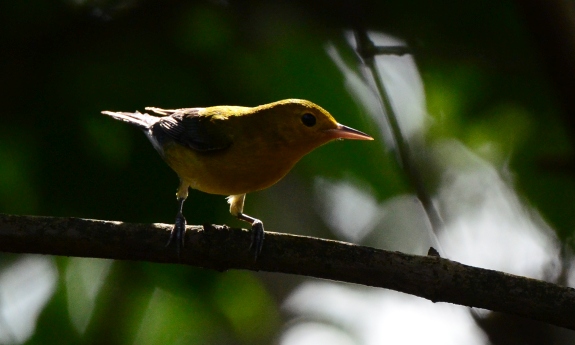

Unlike the pewee, Prothonotary Warblers are known to be lovers of swamps and mangroves. This dimly-lit (but still facemelting) rarity was another excellent trip bird; a Black-and-white Warbler near the parking area was another new North American migrant for the trip list. Good times at this place...if you are interested in checking out this site, our eBird checklist can be viewed right here. Note that during the hunting season the refuge is not accessible seven days a week. We were also told that it was ok to park outside the entrance gate and walk in to bird outside of normal hours.

We had some daylight left, so it was back to Cabo Rojo to continue the never-ending search for trip birds (other than the mythical Masked Duck, we had run out of lifers to get in immediate area). Our spot that previously produced a huge peep flock and Franklin's Gull earlier was almost devoid of birds, which did not surprise any of us. Still a bummer though.


This friendly Merlin provided some consolation. I don't know about ya'll, but friendly Merlins are few and far between out here. Oh, and while I think of it, how come Merlins seem to be so unpopular with falconers? Seems like the next logical bird to graduate to after a kestrel, and they are fun as hell to watch hunt. Oh well, leave them in the wild, suits me.

Our search for waterbirds took us all the way to the end of the road, at the parking area for the hella popular beach. Despite a great deal of good habitat, there was little to see...maybe the tide was too high?


We did see some cool terrestrial snails at least. Who doesn't appreciate a good snail?

On the way back we pulled over where some shorebirds and a group of icterids were roosting; Dipper Dan noticed some Yellow-shouldered Blackbirds in the flock, so we hung out and looked around.


The trees along this stretch of road were clearly the site of a significant night roost for Icterids. It was fantastic to see Yellow-shouldered Blackbirds in a more natural setting than the La Parguera hardware store.


A little while later, we refound the Franklin's Gull picking at shit out in the lagoon...a nice bird, but there was a lot more to look at...the closer to sunset it got, the more and more birds we noticed began to arrive...and that is when we realized it was happening.


Thousands of icterids flew south down the peninsula to roost next to where we had parked. Shiny Cowbirds (above) comprised a large portion of these birds, which I had mixed feelings about; they are a major factor in the decline of the blackbird...but they were also a bird I had just lifered only days before. We also started seeing Prairie Warblers fly in to roost (!), which was a most fetching thing to watch.


Luckily for us, Yellow-shouldered Blackbirds came streaming in over our heads with the grackles and cowbirds. Ace.


Amazing looks at these hell of rare birds. While it is easy to think of them as just a Red-winged Blackbird with a different wing patch, there is another major difference between the two species, phenologically speaking...the sexes have identical plumage. Yup, these might be females. Astounding, no? I wonder how this unisex plumage evolved.


Flocks of Stilt Sandpipers and Lesser Yellowlegs wheeled around over the laguna while we watched the blackbirds fly in, adding to the birding ambiance.


The laguna and distant Guanica Dry Forest glowed beneath afternoon storm clouds in the fading light. Our time here at the blackbird roost was one of the definite highlights of the trip, and I would highly recommend attempting to see the blackbirds here (17.954779°, -67.198514°) in the late afternoon instead of the mutant bread-lovers at the hardware store.

Tuesday, February 14, 2017

The Birder's Guide To The Internet, 2017 Edition

1994. That was the year I officially became a birder. It was a good time to be a birder, but everything was much, much harder. You think birding is hard now? Well back then, you could get lost! You got around using actual paper maps! You didn't have field guides and bird songs in your cell phones...people didn't even have cell phones! The only computer that would answer to your voice commands was aboard the USS Enterprise. It sounds like the stone age, and while the world didn't look that much different from today, the tools we have at our fingertips now seem light years ahead. The myriad of online resources available to birders have, for some, changed everything.

As the #7 birder in the United States (as ranked by the Global Birder Ranking System), I feel like I should lift up the birding community. I will pick you up and carry you on my back, like a birding horse. Even with so many tools these days, we must still be honest with ourselves...birders need so much help. Many birders just don't know what is out there, don't know that they can answer a great many of their questions themselves if they are willing to spare a few minutes of their time. They need to be uplifted, and that is why I am here today. In that spirit, here is a list of some of my fav websites that can help you learn more about birds, and help you see more of them.


Compulsively checking Sialia over and over again will eventually pay off for you in a big way...that is how seeing this MEGUH Marsh Sandpiper was made possible.

Sialia/ABA Birding News - Listservs are nothing new, but are still absolutely crucial. Most grizzled veteran birders know that if you find a rare bird, you don't put it on Facebook first, you don't put it on eBird first, you slap that thing on the listerv ASAP. Do you live in an area where multiple listservs have coverage nearby? Want to see all the listservs in one place? Check Sialia (my preference) or ABA Birding News. I've seen a number of fantastic birds here in northern California simply because I compulsively check Sialia for breaking news of Meguhs.

Xeno-canto - A vast and totally free library of bird vocalizations that grows on the daily. Most of the material is downloadable. Ace. Something like this was inconceivable 20 years ago.

Birdingpal - Travelling someplace? Want to have someone basically act as your guide for a minimal cost? Check out Birdingpal! Or you can just hit up a birder for the info you are looking for. You can also use this site to hire "real" guides for a nonminimal cost.


The more users eBird gets, the better it gets as a tool for birders. Among the many services it provides, eBird is rapidly becoming a great resource for birders looking to know where to get in the field south of the border...for example, without it we would not have had crippling looks at Rufous-bellied Chachalaca in Lo de Marcos, Nayarit, Mexico.

eBird - eBird is imperfect, it is flawed, and it is still the best thing since sliced bread...and you know how important sliced bread is. You also know what eBird is and what eBird can do for you already, so I'll leave you to it. eBird.

Cloudbirders and Surfbirds - Trip reports, trip reports, trip reports. If you are planning a birding trip someplace, not only do you want to utilize the tried and true "birder's guide", you want trip reports to find new information on an area. These two sites are great resources. Note that trip reports by some tour companies (both included on these websites, and elsewhere) vary in the amount of details provided...some tour companies will provide a lot of detail on where they bird (very helpful), while others lamely will keep their hotspots "secret", and may not even mention where they stay. Weak.


Last year the nerds and I stayed at the fantastic Rancho Primavera in El Tuito (Jalisco, Mexico), where we could nonchalantly watch a Blue Mockingbird pig out at a feeding platform from the deck of our rental house. I never would have found out about the place if not for coming across it in a blog post.

Blogs - Talk about old-fashioned...yes, even blogs like this one can still be resources for the birder! What do you think this post is for? Since birding blogs can and do cover all things bird, we can potentially help you with identification issues, trip report material, you name it. One of my favorite blogs is the vastly underappreciated Birds of Passage; if you are considering birding anywhere from Mexico to Ecuador, you need to read up on their material. The Budget Birders have traveled a lot and provide a lot of helpful information as well. Of course, Earbirding has a lot of great content on bird vox. Obviously, there are too many good blogs out there to list; check out the sidebar on the left for more.

Migration forecasts - We don't use these much here on the west coast (though there is a Portland site) due to the nature of migration here (the nature of which is incredibly boring compared to many states...but California gets the best vague runts, so it evens out), but in a large part of the country this is something worth getting addicted to during spring and fall migration. Maybe some of you eastern birders take it for granted by now, but I think it is incredible that there are people who can forecast how good (or bad) the birding may be on a particular day in a particular area using traditional weather radar. If you would have told 1997 me that this would be a thing, you probably also could have convinced me that aliens were real and that I was going to be abducted. Hey, I was watching a lot of X-Files at the time. Anyways, Birdcast is a good place to start, but there are multiple region-specific sites.


Google Streetview, which can be toggled on and off using Google Maps or Google Earth, is fascinating. Here is where I used to live on Midway! Yes, those are albatross in the yard.

Google Earth and Google Maps - These are great tools for planning a birding trip or scouting an area without being on the ground. Do you know how amazing it is to bring up sharp satellite imagery on command? I would have killed for that ability for some of my early field work back in the day. Want to know where I saw my first Short-tailed Albatross? Well put these coordinates (28.199202°, -177.383157°) into Google Maps, turn on the satellite imagery, and you can see exactly where I was. I think it's brilliant. Anyways, Google Earth is free to download and you can do even more with it than Google Maps, so check it out if you have much of a map fetish. You probably already look at Google Maps on the regular and have the app installed on your phone, but for the few of you who don't, you are missing out.

Reserve America - Wanna camp? Don't know where to go? Then this is the site for you. Find campgrounds all across the country, reserve your site. Though not all campgrounds are listed here, it's a good place to start.

Airbnb - Staying in a house is better than staying in a motel. That house might even have some good birding on the property. I've used Airbnb on birding trips to Colorado, Maine and Puerto Rico so far with great success, and I'm sure I'll be using it on many future trips. Use Airbnb for birding, business, family vacays, wild sex parties, it's your call.

Not every birding site is created equal, however. You will notice that I omitted Facebook groups - this was done on purpose. Though you certainly can get helpful information in these groups, as a general rule some of the most frequent posters (be it in regional groups, gull ID, etc.) are self-proclaimed experts whose advice can be counterproductive at best. Indeed, if you are a legend in your own mind, then there is no better place to broadcast your "expertise". Google Images are also dangerous to work with, which BB&B has previously covered in Adventures In Birding Online. I also have mixed feelings about the always-improving Merlin app; while it could be (already is?) incredibly helpful for rank beginners, I could easily see it becoming a crutch. It also requires the observer to have a reasonably good camera, which is definitely not necessary to get into birding. At any rate, neither you or I want our primary contribution to the birding community to be "ID please" posts, know what I'm saying?

I'm sure I left something out. If you have any other recommendations, please share! I may be #7, but only #1 knows everything.

Wednesday, February 8, 2017

Roadside Attractions, A Particular Cuteness, Sustained Facemelt, Dorsal or Death


One of the good birding opportunities that comes packaged with going to SoCal every year is my favorite rest stop on Highway 101. That's right, the Patagonia rest stop is not my favorite rest stop...ya'll can have that one. If I hear someone describe the Patagonia Picnic Table Effect one more time like it's some novel new idea, said someone will be destroyed. Anyhow, I want the rest stop with Yellow-billed Magpies.


Those that live in the valley may get to see a lot of magpies on the regular, but for those of us who don't (which is most of us), they are not a trash bird by any means...they are a glorious endemic, and are aesthetically superior to the continent's other magpie. Just look at this especially leggy individual with yellow eyeliner.


Another quick stop off Highway 101 on the way south was productive; this FOY/LOY Ross's Goose had been living at a dirty little duck pond at the Gonzales Winery for several years. Like every Ross's Goose, it was small and mellowing. A few Ross's have been known to make this tradeoff in California in the past, seemingly exchanging the chance to pass on their genes for endless free handouts. Interesting approach.


Though I haven't lived there since the year 2000, my Ventura County list is still higher than any other county list I maintain...and though that statement was supposed to reflect on how good birding can be in Ventura at times, it probably reflects more on how pathetic I am at county listing, which I am very proud of. Anyhow...aside from success with the Little Gull, I managed to get a modest amount of additional birding in. Burrowing Owls winter in low numbers on the Oxnard Plain, sometimes right next to poison dispensers meant to kill their ground-squirrel friends. Yikes.


Unfortunately, life is not all Yellow-billed Magpies, Little Gulls and Burrowing Owls. Life primarily consists of Savannah Sparrows. That's right, life is Savannah Sparrows. Your average day is a Savannah Sparrow, a bird that is neither that good or that bad, and ultimately not incredibly memorable. Photographed at Arnold Road on the Oxnard Plain.


My parents' yard in east Ventura has been made into a hummingbird magnet of sorts since I moved away...though they are still waiting for a Broad-billed or Violet-crowned (which is a way overdue bird to be refound in the state), they do get a pretty good showing of the expected California species. I never got a Calliope in Ventura County, but a number of them have passed through their yard...there is nothing like getting gripped off by your own flesh and blood. They get multiple Costa's Hummingbirds every year, one or two of which often overwinter.


Aside from the typical field marks, female Costa's have a particular "cute" quality overall that female Anna's and Black-chinned lack. These species, which are admittedly very similar, are frequent sources of confusion for birders in the western states, particularly in geri-bound Arizona, where there are a great many hummingbirds and a great many birders unable to identify them very well.


If a jet of hot sugary hummingbird pee being fired out of an Anna's Hummingbird is the sort of thing you're into, then I don't have to convince you to spend some time looking at this graphic photo.


After seeing many thousands of Anna's Hummingbirds over the years, I can tell you that the facemelt wrought by an adult male Anna's is still alive and well.


Isn't this absurd???


As one of LA's leading lights of birding recently pointed out via listserv, this angle is not at all helpful in identifying male Allen's or Rufous Hummingbirds...give me dorsal or give me death. Though some could be tricked into thinking that this a Rufous Hummingbird, this is actually a very typical-looking Allen's Hummingbird when viewed at other angles.


Here is a immature male Allen's, displaying no real helpful field marks at all. These days Allen's are much more common year-round residents at my parents' place than 20 years ago; I think there's a lot more overwintering in east Ventura overall now.


In a bid to bring BB&B even more fame and fortune, let's wrap this post up with a bird that almost no one has any interest in...a hen American Wigeon. No one is at fault for that, since this lawn-loving grazing machine aesthetically brings little to the table. This individual doesn't have much of a black gape border, which is a field mark that can help differentiate female Americans from Eurasians. The popularity of this field mark has always been a bit of mystery to me, because if you are close enough to see this obscure bit of coloring you shouldn't be struggling to tell the two species apart. Photographed in Conejo Creek Park, Thousand Oaks, CA.

Thursday, February 2, 2017

Bourbon, A Bastard, and Birds.


Many have whined about the lack of bourbon coverage on this blog over the years. While I do drink a lot of it, and it is a sensational and most inspirational spirit, this is a birding blog...if you want to see closeup photos of alcohol for some reason, please try Instagram or Facebook, where crushers of pints and cocktails abound.

What no one has accused me of is the lack of bastards. I know a great many bastards, though only in the loose sense of the word. They appear here regularly. However, I am very committed to bastards...I have a true bastard girlfriend, whom I love very much. In fact, we just made our own bastard daughter together, out of wedlock! Her name is Annabelle, she makes cute noises and likes milk very much. Elijah Craig and Sibley are there for scale. I doubt she will ever want to be a birder, and that is totally fine...her job, for now, is drinking milk and doing cute shit. Oh, and sleeping, hopefully she will excel at that.

I finally did it...bourbon, bastards, and birds, all in one post! Close enough anyway.