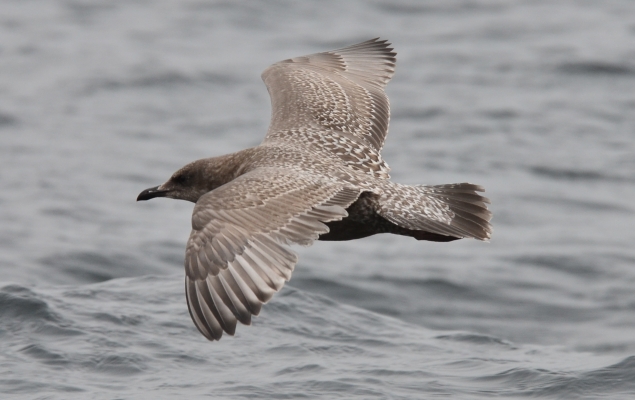
Showing posts with label Glaucous-winged X Western Gull. Show all posts

Monday, February 3, 2020

South Bay Winter Slumber


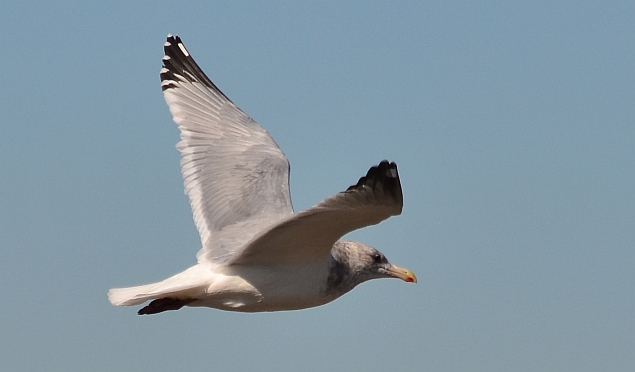
While Santa Clara is not known as one of the premiere gulling counties in the state, that is not because there are a lack of gulls. There are many thousands of Herring Gulls (like the one above) in the county right now, and where there are Herring Gulls there are rare gulls...sometimes anyway. I have at least managed a Santa Clara Glaucous Gull already this year and a 5MR Western Gull, which I didn't see in the radius until November last year. Photographed at Don Edwards NWR.

Uhhhhhhhhhhhhhhhhhhh it's February. I don't know how I feel about that. It sure got here quickly, and as I say in BB&B pretty much every year I'm leery of March birding around these parts. Things have been pretty slow this winter here in Santa Clara, especially if you opt to not attempt feverish county year birding and rechase all the rarities you already chased a month or two ago, or the previous winter. But! But. BUT...the middle of winter is generally a great time to be birding around these parts. If you really need to see a rarity or a year bird or whatever every time you go birding, then just give up birding and be honest with yourself and everyone else...you are not a birder. You are a chaser. You don't enjoy the activity of birdwatching, you like birdchasing.

I think the quasi-elitist and increasingly obsolete notion that listing is something to scoff at now borders on being something to scoff at itself. Let's face it, most of us have bird lists that we care about. Listing is not the problem here, heck chasing isn't even the problem. I happily chase stuff on the reg and recommend it highly. The problem is when you get so locked into certain lists that they dictate that you run after other people's birds every time you go out. Going out with the hopes of finding something interesting yourself, once standard practice when one went out birding, is becoming increasingly uncommon and comparatively bold.

Is it time for a great schism in birding? Is it time for the strict chasers to separate themselves from the rest of us? There is already a large and still growing subset of photogs who seem to chase every rarity but never find anything rare themselves. Something to ponder on a cool February day.

But now that I've begun to peel back the lid on that can of worms, I'm going to put it back on the proverbial shelf for another post. That was not a road I intended to go down! Shifting gears (but probably still instilling some butthurt anyway), I've really been enjoying my new CANON gear after kicking Nikon to the curb. With the assistance of CANON, here is a sampling of our winter birds from along the edge of the South Bay.


Iceland Gulls can be be quite common at certain sites right now. Here is a particularly eye-catching bird with a big dark hood. Photographed at Don Edwards NWR.


Here is a more typical looking Iceland (darker eye, whiter face) photographed from the same spot. Photographed at Don Edwards NWR.


While Herring x Glaucous-winged are often the most common hybrid in Santa Clara gull flocks, along the bay Western x Glaucous-winged like this one can be more abundant. The Olympic Gull is a particularly unpleasant creature and I have nothing more to say about them. Photographed at Don Edwards NWR.


Mew Gulls, with their small size and delicate build, are absolutely delightful in comparison. They should have named Daymaker Gulls. Photographed at Don Edwards NWR.


I thought this COMBO was worthy of posting, a ring-billed Mew Gull and a ring-billed Ring-billed Gull. Photographed at Don Edwards NWR.


The occasional close pass by a Northern Harrier is always appreciated. Photographed at Don Edwards NWR.


Familiarity breeds contempt, but as common as they are Turkey Vultures are still cool to see close up. Photographed at Don Edwards NWR.


Santa Clara is not a very goosey county, but we get a light smattering of non-Canadas every fall and winter. Here is part of a family group of Snow Geese that have been wintering next to Shoreline Lake near Mountain View. Photographed at the Shoreline Park kite flying area.


A group of Greater White-fronted Geese is also wintering in the same area and are similarly acclimated to people, no doubt due in large part to the large flocks of JUDAS GEESE (nonnative/tame Canada Geese) here. I like the lawn-mowing lineup.


Sometimes, I think about grebes. Luminous beings are grebes. I am a fan of Horned Grebes, but it is one of those species that makes me wonder why, know what I mean? Like if someone could do a brain scan while I looked at a Horned Grebe vs a Western, there would probably be more HOGR-related brain activity even though WEGRs sound way cooler and have a legendary courtship display. Maybe it all goes back to when I first started birding, where HOGRs are harder to come by. I'm sure a great many of my feelings and opinions about certain birds, and birding in general, are heavily colored by those early years more than I realize. Photographed at Shoreline Lake.


EARED GREBE/HORNED GREBE COMBO!!!!!!! The HOGR is showing off its flatter crown, thicker bill, and more contrasting face/neck/flank pattern.


While I think of it, I wanted to mention another aspect of my new Canon gear that I forgot to bring up in my previous post about it. For all previous combos and iterations of Nikon bodies and lenses I've used (which are numerous), one flaw that all of them had was that when the subject was on a flat surface (i.e. sitting on or flying low over water, on mudflats, in short grass) and not close up, the camera invariably have a very difficult time focusing on the intended subject. I could shoot 50 similar frames and sometimes less than 10 would have the subject acceptably sharp with good light and good settings and a near-stationary bird, which is a really shitty ratio. I have no such problem now with the Canon 90D/100-400mm II and couldn't be happier. Photographed at Shoreline Lake.


These Western Sandpipers just had to probe the same exact spot. Must be awkward to bump bills under the mud. Photographed at Charleston Slough.


Let's wrap things up with some avocets, photographed at Charleston Slough. Avocets simultaneously look gangly and awkward in flight, but somehow also striking and graceful. There are a shitload of avocets in the South Bay and I'm pretty happy about it. 

Sunday, March 1, 2015

Winter Birding In Humboldt: Pipers of Rock to Suckers of Sap


Winter birding in Humboldt County is always rewarding, with a little effort.  Even on days when you want to bash your own skull in with a rock because you did not see BRAMBRING, the birding is solid.  One of the spots worth checking is the North Jetty of Humboldt Bay, which is where everyone goes for seawatching and rockpipers.  The South Jetty is equally as good, but it takes a hell of a long time to get out there in comparison.  One of my favorite non-BRAMBRINGs species we saw was Rock Sandpiper, which are hella localized in California.


Even though there are always, without exception, Rock Sandpipers at the mouth of Humboldt Bay in the winter, that doesn't mean you will actually see one.  They are fickle birds...go at the wrong tide and you have a good chance of dipping.  I maintain that low tides are best, but I suspect not everyone is in agreement about that.  At any rate, not only did we see Rock Sandpipers, we saw fearless Rock Sandpipers, which were valiantly trying to take the notion of "confiding" birds to a whole new level.


I've never had such good looks at one, even in the Aleutian Islands where they are common. Confiding rockpipers are not unusual on the jetty....along with Rock Sandpipers, Surfbirds and Black Turnstones are common in winter, and a few Black Oystercatchers are often around as well.  In migration, Ruddy Turnstones and Wandering Tattlers join the party.


Here is a second individual, with more white above the eye, enjoying some salt spray.


Although not a pelagic bird, Rock Sandpipers likely go for months at a time without ever having fresh water available to drink.  While this bird looks like it is experiencing a catastrophic, possibly lethal sneeze, it's actually just expelling salt water filtered out by the salt glands in its head.

The humble Surfbird is always popular with birders who don't get to the west coast very often.  It is a basic, utilitarian bird, lacking any bells and whistles.  Birds in alternate plumage are very striking, but for much of the year Surfbirds are fiercely loyal devotees to The Economy of Style.

This sculpin is not stoked, which you can probably deduce by its horrible facial expression and the fact that it is on land...something it likely has not suffered through before.  It is experiencing a long, painful, drawn out death at the hands of this interestingly marked gull.


While much of this gull leaves the impression that it came out of the Western Gull factory (black primaries, yellow orbital ring, dark back), the amount of duskiness on the head, back, and side of the neck seems excessive for a Western...on the back, it looks like there is some horizontal barring.  I think this Western Gull has some Glaucous-winged Gull components.


For those of you distressed about the doom of the sculpin, I offer you some comfort: we will all end up this way.  That is the way of things.  The way of the sculpin.


Unlike the sculpin-gobbling beast above, this Olympic Gull is not disguising itself as a Western.


Black-legged Kittiwakes are reliable from North Jetty in the winter, and they are not unusual to see inside Humboldt Bay either.  This is a very tough bird to get from shore south of Humboldt County, so go to the jetty and enjoy them...no scope required.  There were also a handful of Ancient Murrelets further out this day, and all three species of scoter.  Not bad.  Don't go out there when the surf is big though, as you can be swept off and drown.  Not joking.


We did ok with some other local rarities, relocating a Tricolored Blackbird and Loggerhead Shrike, but the highlight for me was this Red-naped Sapsucker at College of the Redwoods.  This was a sight for sore eyes, as besides dipping on BRAMBRING we had also dipped on the 2 Red-naped Sapsuckers that were living in the same neighborhood.


This bird was easy to find and hella cooperative.  Interesting to me was how the throat pattern on the left side of the bird was classic for Red-naped (muddled black and red border), while the right side of bird featured a typical Yellow-bellied pattern...which is not suggestive of anything, I think, except that sapsuckers are variable.


It's a striking bird, no?  Even in the daze of a catastrophic dip, birding in Humboldt can always lift the spirits.  

Wednesday, December 10, 2014

Clam Cravers, The Majestic Scale, Winter Gulls


Birding is happening. I'm taking a lot of time off work this month, and more birding is in the forecast. I'm currently writing this from Ventura, so expect some slightly different stuff in the next couple weeks. This post is all about birding the bay area though...and no, I did not see the Rustic Bunting, it was found the day I left Oakland (reported widely the day after that), so I appreciate everyone's concern but I die a little bit inside whenever someone asks me if I saw it...however, it's not a life bird or an ABA bird for me, so I can manage to keep it together...barely. So that aside, this is the first White-winged Scoter I have ever photographed, and I was stoked to get some crushing in. San Leandro Marina, San Leandro, CA.

White-winged Scoters are uncommon in much of California, and rarely seem to be close to shore. This bird was actually present here last year and I kept missing the damn thing, so it was good that we could finally meet. San Leandro Marina, CA.


Come to think of it, this is the best look I've ever had of a White-winged Scoter anywhere. I've definitely never known that they had purple heads (look behind the white eyeliner). Great success. San Leandro Marina, CA.


Scoters are crazy. They just wolf down entire shellfish...just swallow that shit whole. People admire vultures for their ability to digest carrion, but I think scoters deserve some digestive credit too...they must have insanely strong innards to be able to internally pulverize the shell without shredding their entire digestive tract. San Leandro Marina, CA.


A jubilant clam craver. San Leandro Marina, CA.


This White-tailed Kite got aggro on a passing Merlin. This is the first time I ever photographed a kite and a Merlin in the same frame, and I expect it will be my last. Mount Trashmore, Hayward, CA.


I have never completely understood those isolated black spots on the underwing of White-tailed Kites...none of our other raptors show anything similar. How did that evolve? Is there any functionality associated with them? They do look good, I have to say.


While roaming around for longspurs, this Golden Eagle periodically passed overhead. I hope it got to nail a Canada Goose for a Thanksgiving feast. Photographed at Mt. Trashmore.


Whenever I get to see a GOEA up close (which is not very often), I am always struck by how freaking big their talons are. No wonder they can take down a deer. This is one the leading birds on the "majestic" scale, as far as I'm concerned.


And on the opposite end of the majestic spectrum, we have the Lapland Longspur. Oddly, aside from my time in Alaska (where they were everywhere), I have put far more time and effort into finding longspurs than Golden Eagles. I hope that somewhere a hawk counter is reading this and is completely disgusted by that statement. Photographed on Mount Trashmore.


I don't think I saw a single longspur last year, of any species. Pathetic. Now I can say I saw 3 Lapland Longspurs this year, which feels much better.


Now we are really getting away from majesty...but Thayer's Gull has a solid fanbase, myself included. Lake Merced, San Francisco, CA.


Here's an attractive Western X Glacous-winged Gull hybrid (I think)...they normally don't appear this nice and frosty, but they are a winning gull when they do. San Leandro Marina, CA.


I hardly ever post California Gulls on here...but it's not because I'm not seeing them, I assure you. They are fun to watch at Mono Lake, where they dip for brine shrimp and charge clouds of brine flies, but on the coast they are a parking lot bird. Thankfully, they are not big on hybridizing, but they have not been able to convince their larger relatives to stop doing that. Photographed at Lake Merced, CA.

Tuesday, February 18, 2014

Often Sought, Often Misidentified: The Thayer's Gull


Adult Thayer's and a Mew Gull. Something to remember when attempting to ID adult gulls is to keep in mind how lighting, posture and digital photography can affect mantle color; note how pale the scapulars look on the Thayer's compared to the the rest of the wing. Miller-Knox Regional Shoreline, Richmond, CA.

Nothing brings more fear and loathing to the North American birder than gulls. True, birds like storm-petrels and Empidonax flycatchers can be vexing, but they just don't have the amount of staggering variation that "pure" gulls display in their many plumages, let alone the dizzying ensemble of hybrids that are out there.

One of the birds I am most often asked about for ID assistance (and see people constantly struggle with elsewhere) is Thayer's Gull. It is much sought-after by visiting birders, and even the birders that live here struggle with picking them out. Many seek this species, and many misidentify other gulls in the process. Here in the bay area, they are fairly common in winter, and occasionally can be found in large concentrations. So rather than flog the dead horse of Kumlien's vs. Iceland vs. Thayer's, I'm just going to throw up a bunch of pictures of Thayer's and what they are most often confused with here; Herring, Glaucous-winged X Western Gull, and Glaucous-winged X Herring hybrids.

This post isn't going to rewrite the book on Thayer's and I'm not into completely recycling what can be found in field guides, but hopefully this will be helpful/educational to someone down the line.


Same Thayer's, different Mew. This is a classic individual...long-winged, dark-eyed, round-headed, moderate markings on the head and breast. The bill is short and small with a indistinct gonydeal angle.


Another typical bird, with a slightly longer bill, which one would expect in a male. Gulls are sexually dimorphic, which explains a lot of the variation in size and structure within species. This photo also illustrates the pink-purple orbital ring, and most importantly, the inside of the folded primaries. Note the contrast between the whitish undersides of the primaries on the left wing and the standard black and white pattern on the upperside of the primaries of the right wing. This is a very useful field mark for identifying adult Thayer's. Photographed at Lake Merritt, Oakland, CA.


A heavily-marked bird. Even just that sliver of primaries visible from the right wing goes a long way to confirm this bird's identity as a Thayer's. Photographed at Golden Gate Park, San Francisco, CA.


Thayer's on the right, with a California Gull for comparison. Miller-Knox Regional Shoreline.


Light-eyed Thayer's Gulls are not uncommon in the bay area; use the underwing pattern and orbital color to tell them apart from Herring Gulls. Herrings are usually larger, but there is considerable size overlap. Golden Gate Park, San Francisco, CA.


This is the same bird as above. Although "string-of-pearls" is a phrase birders usually associate with Slaty-backed Gull, it's also what you want to see on the open wing of Thayer's Gulls.


Gulling would be a lot easier if you could get every bird to do this pose. The underside of the primary on p10 is a little dark (left wing) but I don't think that is unusual. Miller-Knox Regional Shoreline.


Here's the upperwing pattern of the same Lake Merritt Thayer's from above, for variety's sake.

I don't have much in the way of third cycle birds, so on to second cycles. As with younger birds, key in on the contrast between the inner and outer webs of the outer primaries to differentiate these from Herring Gulls. This bird was photographed at Golden Gate Park.


Same bird as above. Note the small, mellow bill and round head, creating a big-eyed look. This bird has slightly paler primaries than what I'm used to for second-cycle.


This isn't a particularly educational photo, I just like it a lot. Second-cycle Thayer's Gull, Golden Gate Park (different individual than previous photos).


Second-cycle. Marin Civic Center, CA


First-cycle with a lot of pink coming in on the bill. This is not unusual to see by mid-winter, although this bird is showing more than most. Photographed in Golden Gate Park.


Another first-cycle. Photographed in Golden Gate Park.


Same bird as above. This is typically what primaries of first-cycle Thayer's Gulls look like in mid-winter; long, dark brown with pale edges.


Another standard-issue first-cycle. Miller-Knox Regional Shoreline.


Similar to the above bird, but with more pink coming in on the bill. Miller-Knox Regional Shoreline.


Here is a very fresh, relatively dark bird photographed in mid-October, which is when Thayer's start arriving in the region. In fact, when I first saw the bird sitting on the water I thought it was a Herring because of how dark the primaries were. Note the pale inner primary panel and pale inner webs to the outer primaries, which separates this bird from Herring. This bird was far offshore, so those going on late-season pelagic trips should be on the lookout for Thayer's and other interesting gulls in the chum line. Photographed off Bodega Bay, CA.


Remember that dead horse I talked about? I guess I'll give it a kick after all. In the bay area, in late winter it is not unusual to see very worn and bleached Thayer's Gulls that look disturbingly whitish. Don't be fooled by these Kumlien's imposters. Photographed at Golden Gate Park.


Unlike the above bird, this one has feathers in good condition and is not heavily bleached. This creature has much more white in the coverts and flight feathers than the typical Thayer's. Could it be a Kumlien's? Maybe. Would birders in the eastern U.S. call it  Kumlien's? Maybe. Would California's Bird Police accept it as a Kumlien's? Nope. Do I know what it is? Not really, but I like it. Lake Merced, San Francisco, CA.


First-cycle Herring Gull. This individual is structurally very similar to Thayer's (many are not), but has a whitish head, extensive pink in the bill, and black primaries. Photographed in Golden Gate Park.


This Herring Gullish monstrosity bears more than a mild resemblance to first-cycle Vega Gull (note the white uppertail...more photos are available), but has a distinctly Thayer's Gull pattern to the outer primaries, and some bizarre mottling going on in the pale inner primary panel that doesn't belong on anything that I know of (double click for a closer look). I don't know what this bird is, but it's worth mentioning that given the tendency for large white-headed gulls to interbreed, we just don't know if/how much Thayer's Gulls are interbreeding with other species, as their breeding grounds are largely inaccessible. Seriously though...any ideas? Miller-Knox Regional Shoreline.


Here's a typical Herring Gull. Note the yellow orbital ring and obvious black and white pattern on the underside of p10 on the left wing. Golden Gate Park.


Olympic Gulls (Glaucous-winged X Western) are common in the bay area in winter. This bird is superficially similar to Thayer's in plumage but not in structure; it has short wings and a big bill that could give a smaller bird a brutal pummeling. Note the back pattern is somewhat sloppy and there are some new, dark gray feathers molting in on the mantle. Although this bird is pretty typical for a first-cycle Olympic Gull, its important to keep in mind that hybrids are incredibly variable. Olympic Gulls tend to be almost always larger and bulkier than Thayer's though (as there parent species are), so are not quite as challenging as Glaucous-winged X Herring, which to me show much more range in size. Miller-Knox Regional Shoreline.


Here is a putative Glaucous-winged X Herring hybrid. They are excellent impersonators of Thayer's Gulls, and can come in many shapes and sizes. On this one, note the heavier bill and indistinct patterning on the back; Thayer's are usually more boldly marked with primaries a tad darker, although with wear and bleaching that may not be the case. Golden Gate Park.


Another Glaucous-winged X Herring type (I don't think first-cycle GWGU x WEGU would get so much pink in the bill), perhaps resembling Thayer's more in plumage than the above bird, but with an even heavier bill and a small-eyed look. The tertials on this one appear very long compared to the length of the primaries, which is not something I associate with Thayer's. Miller-Knox Regional Shoreline.


An attractive Glaucous-winged X Herring adult. It could be confused with a pale-eyed Thayer's, but the gray primaries give away its hybrid vigor. Miller-Knox Regional Shoreline.


Here's a bird doing a good Thayer's impression...but look at the color of the underside of p10 on the right wing. It's too dark! When it took flight it confirmed an unlikely wing pattern for Thayer's Gull...I would guess this bird is also carrying a mix of Glaucous-winged and Herring genes, although in the field I thought the mantle seemed dark for that. I'm open to ideas. San Leandro Marina, San Leandro, CA.


Same bird as above. Note the extensive black in both the underside and upperside of the primaries (no string of pearls). The gonydeal angle looks very pronounced in this photo as well.


Thayer's have a reputation for being very small among those who don't actually see many of them, but in my experience that is not always the case. For example, take this light-mantled bird in front of these Western Gulls. I strongly suspect it is a big male Thayer's, but it could be a dark-primaried Glaucous-winged X Herring hybrid (or backcross) like the previous bird, as I didn't get a look at the wing pattern. Oyster Bay Regional Shoreline, San Leandro, CA.

Phew. That's a lot of gulls. If you would care to argue about any of the IDs I made in these photos, feel free to leave a comment. I'm ALWAYS willing to learn more about gulls, and for most of these individuals I have additional photos. At any rate, I hope you found this post educational, or at the very least, accurate. Gulling is a bitch.