Showing posts with label black-throated sparrow. Show all posts

Tuesday, September 5, 2017

Mojave National Preserve Part 1: The Pilgrimage, The Relifer, The Desert Blooms

For those of you without kids, yes, having a baby is as hard as you think it is. However, there are upsides. One of the big perks earlier this year was taking a long leave from work when Annabelle was born, much of it paid. Billy and I debated about whether we should take some kind of trip or not while we were both on leave, but we were both really tired with frayed nerves...at that time, any kind of overnight trip seemed like a daunting, serious undertaking.

Which turned out to be meaningless in the end, because we decided it would be best to drive all the way out to the Mojave National Preserve. Neither of us had been there before, it had birds and wildflowers, and seeing thousands of "superbloom" posts on social media for the previous month had only fueled our desire to return to the desert. Billy booked us a room at a casino's hotel in Primm, and we were off.

The Mojave National Preserve is a massive parcel of land on the California-Nevada border. Anyone driving between Las Vegas and southern California goes right by the northern edge of the preserve. It is decidedly less crowded than Joshua Tree and Anza Borrego, the two most popular desert destinations in California for birders and nonbirders alike. Although the preserve lacks particularly good migrant traps (with the notable exception of Zzyzx on the west side), it does feature some birds that are very local in California: Gilded Flicker, Woodhouse's Scrub-Jay, Juniper Titmouse and Bendire's Thrasher. This is the only reliable place for the flicker in the entire state, so California birders who relish their state lists are destined to make the pilgrimage here if they are around long enough. The time had come for yours truly...I donned the ceremonial flicker pilgrimage garb, said some ceremonial words ("An unturned stone, an undiscovered door leading to the gift of hope renewed, eternity for you, the masses of humanity will always have to suffer..."), and drank ceremonial goat blood straight from the jugular of a living goat, which was painted to look like a Gilded Flicker. Yes, birders have a rich history of birding the preserve, and our ways are steeped in tradition. Demonic, heartless tradition, but tradition nonetheless...call me old-fashioned.

Goat blood downed with relish, we were off to the desert!


Wildflowers were good but not superbloom status, but they were more than enough to keep me entertained and we found some really good patches here and there throughout the weekend. This was the first time I'd ever spent springtime in the desert with someone who knew their plants (that would be Billy), so it was nice to know what I was looking at for a change. This is Fremont's phacelia.


Desert dandelion was by far the most abundant wildflower of the trip.


Do you know what is even harder to experience than lifering? Relifering. I had seen one Bendire's Thrasher, over 20 years ago, at Sycamore Canyon in Ventura County. It was a high quality Vague Runt that was quite confiding and stuck around for a while. I had never managed to see another anywhere else, but on our first morning in the preserve I found a couple pretty easily from the roadside. I didn't expect this kind of luck with such a major target bird...relifering ain't easy. No crushes, but good scope views. Can't complain!
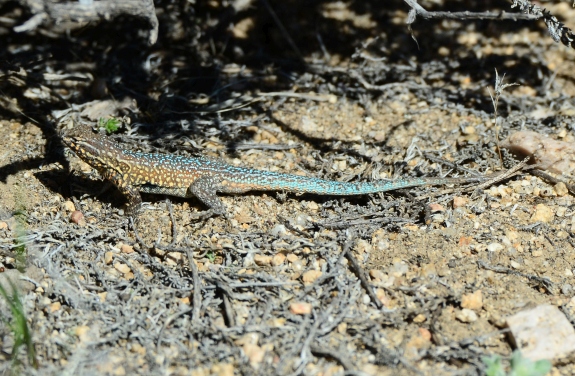

Side-blotched lizards are one of the most common reptiles in California, but the blue-backed individuals like still grab my attention.


A panoramic view from the Teutonia Peak Trail, which is on the north side of the bizarre and fascinating Cima Dome. Few geographic features so large are so...subtle. I actually didn't shrink this image, feel free to double click to see a larger version.


Mojave mound cactus was one of the best plants of the trip. We found a few thriving clumps in bloom here and there.


Luckily, Black-throated Sparrow was one of the most abundant birds in the preserve. This is not unexpected, but it was a good bird to reconnect with.


Another avian highlight of the trip was finding a pair of Crissal Thrashers on the Teutonia Peak Trail. This wasn't even a bird I was looking for, as they are uncommon in the area, with no highly reliable spot to find them (at least, not from what I could see in eBird). This was no relifer, but I hadn't seen one in seven years, back when I was point counting in southeast Arizona. Crissal and Bendire's Thrasher in one morning...that's a pretty great combo, at least in California.


I love me a good bird combo, but I can also appreciate this flower that I can't identify, and this similarly mysterious butterfly. I would rather see combos of rare and uncommon birds though.


I followed this large, humorously shaped bug for a while as it scurried around with surprising speed at Kelso Depot. Nerds, if you know what this is, clue me in.


Desert lily! This was my favorite plant of the trip.


This patch of hundreds of blooming plants was growing roadside just south of Kelso Depot. I was impressed.


The Kelso Dunes...scenic from a distance, not so much going on up close. They may have been raging with wildflowers earlier in the spring, but not while we were there. But more importantly, I found a LeConte's Thrasher on the way back to the car...holy shit! LeConte's, Crissal, and Bendire's all in the same day? In California? What are the chances??? This combo will be remembered for years to come. The desert never ceases to surprise and amaze.


We saw at least a couple of different primrose species, but not many of this big-blossomed thing.


Bladderpod! Few shrubs are as entertaining as the bladderpod. So many bells and whistles.


Purple mat, mmmmmmmmm.


Why not stick with the pink theme? Pretty sure this crippling bloom is sprouting from a hedgehog cactus.


Beavertail cactus has a similar facemelting blossom, but looks much less threatening when you look at the rest of the plant.


It's not difficult to spot a blooming beavertail from a great distance away in this bleak landscape.


Life in a beavertail blossom.


My bastards. More Mojave coverage coming soon!

Sunday, September 27, 2015

Clear Eyes, Full Hearts, County Birds


O, what I would not give to see a county bird!
I would part with my first child, my second child,
and quite willfully my third!

 Alameda, San Francisco, Marin,
I plunder your migrant traps with gleeful abandon,
whilst craving rarities like it should be sin!

That phrase, of course, is from the twisted mind of deranged poet-ornithologist, Felonious Jive. He has had a lot of kids, but strangely I've never met any of them. He seems to see a lot of good birds though.

It is the end of September, and birders have been out flogging the brush like there is no tomorrow. It is the season for Vague Runts all across the land...anything can happen. You never know. Birding is hard and often ponderous, but it gets a little bit easier this time of year. Here on the west coast, the more hours in the field you spend in September and October, the more you will be rewarded. You don't have to be #7 to know that.

Unlike with Felonious Jive, the Great Ornithologist, the Vague Runt gods have not been heaping rewards on me lately...which is ok, because I have not been getting totally stiffed. I've seen some birds...nothing good enough to soil myself, but one cannot go around soiling themselves every day while birding. In the name of county birding, here's a few bay area birds I've recently been introduced to.


This Indigo Bunting in heavy molt has been holding it down in Golden Gate Park for over a month now. It was a sweet sweet San Francisco County bird. There was a juicy little eBird/listserv rumour that started getting out of hand, where birders were thinking that more and more Indigo Buntings were actually at this site, even nesting! This never occurred. I was happy with this one bird, for I am a humble birder who needs not bend to sinful cravings of rarities.


This Mew Gull is certainly not a county bird, but it is rare as fuck this time of year. This bird summered at Lake Merced...I did not believe all the eBird reports I saw of it for weeks, but lo and behold it is bona fide. Most late summer "Mew Gulls" that get reported here are young Ring-billed Gulls with wittle itty bitty bills.


This San Francisco county bird (!!!) was one I've been searching for a long time, a long time. I can cruise out to Point Reyes and see thousands of this declining and wonderful bird, but their abundance is a whole different story on the other side of the Golden Gate. This bird was at Lake Merced, where they turn up intermittently.


Blackbirds undergo their big molt in fall, so this scaly bird is a pretty typical looking adult male for this time of year. The famous white epaulet edge often looks quite buffy for a few months, which can confound those not familiar with Tricolored Blackbird molt (99.9999% of living humans).


This is a male Bicolored Blackbird, our local form of Red-winged Blackbird. He has no extravagant contrasting epaulet border. Note the shorter, stouter bill he has compared to the Tricolored above.


Now that September has come (and almost gone...what the fuck?), we finally have a nice variety of warblers around. Unlike last year, but very much like two years ago, this fall hasn't been very big on eastern Vague Runts in the bay area, so I must give pause when a friendly Wilson's Warbler chooses to lurk nearby. Coyote Hills Regional Park, CA.


Local birders perk up when they see a Black-throated Gray Warbler, and I sure as fuck did when I saw this nectary COUNTY BIRD...my Alameda list isn't really worth bragging about, I'll be the first one to admit that. Black-throated Grays are uncommon, sometimes fairly common fall migrants in the bay area when they get up the gumption to not overfly us.


This confiding bird spent several minutes flogging a large moth to death on the ground in front of me. I love confiding birds. Photographed at Coyote Hills Regional Park.


Let's keep the stripey-face theme going. Up until last week, this was the rarest terrestrial bird I've seen this fall. This Black-throated Sparrow, a hell of a bird in both appearance and rarity, spent a number of days at Coyote Hills Regional Park.


It's not a crush by any means, but I was more than happy to see one of these birds (which many birders describe as "handsome", have you noticed that?) without going to the middle of fucking nowhere, which is where they prefer to spend their time here in California. I didn't expect an adult to drift all the way up here, it should know better, but who am I to question a Vague Runt who clearly migrated all the way to Alameda County for me to see it? This is a juicy county bird.


This Lesser Yellowlegs has three legs! Photographed at Coyote Hills.

Sunday, September 14, 2014

Arizona Part II: Beyond Chuffed or Lifers For Slick


Scott's Orioles are not known for being the most cooperative members of their tribe. But in Ash Canyon, they are jelly junkies, and it's easy to get quality looks.

I had come to Ash Canyon for two reasons: Lucifer Hummingbird, and geri-birding. It was hot, it was mid-afternoon, so what else is there to do but sit on your ass and let the birds come to you? Unfortunately Lucifer didn't show that day, but decent geri-birding was had.


Cooperative Lark Sparrow, with a bit of an overbite.


Acorn Woodpeckers are often described as being "clownish", which is too bad, because no one likes clowns and everyone likes Acorn Woodpeckers.


It's easy to take Acorn Woodpeckers for granted as a westerner. But just because something is easy means we should embrace it. Familiarity does breed contempt, but this is one of the great charismatic upland birds of the west, and they make everything better.


This young male Scott's Oriole is already a jelly addict. What is the world coming to?


Mexican Jays litter the mountains and hills of southeast Arizona. They are one of my favorite kinds of litter. 

After a night in Tucson, I got my shit together and rapidly lurked down to Florida Canyon, my old home from a few years ago. A Plain-capped Starthroat had been reported there recently, and it would be a solid ABA bird for me. The starthroat and residentish Black-capped Gnatcatchers didn't show, but it was a nice morning of Summer Tanagers, Varied Buntings, Gray Hawk (unusual there) and Northern Beardless-Tyrannulets.


Broad-billed Hummingbird is both crippling and common in the area. Florida Canyon, AZ.

Eventually I decided to hike up canyon, to revisit the Rufous-capped Warblers. Florida Canyon is the only place in the country where this species is reliable, and they have been here for several years now. Encountering no one on the trail was nice, because there are shitloads of birders in Arizona, and you are better off not encountering most of them. Eventually I heard a quiet, unusual song across the stream but could not locate it...I was momentarily distracted by a female Summer Tanager when she did me a solid and landed right next to the singing Rufous-capped Warbler. This is all part of being #7, you see.

It quickly skulked off, but I was happy. A few minutes later my avian company was replaced by a haggard-looking dude with a massive camera set up, his arms covered in cuts. He was sweating profusely, had a thick southern accent and kept calling me "Slick", which I'd never heard before outside of movies. He had obviously been trying really hard to see/photograph the Rufous-capped Warbler, and despite being there for hours had failed up to that point in the morning.

"It used to come into tapes," he said, with obvious disappointment in his voice.
"Well yeah. When everyone is using tapes on a bird, it will tape the bird out", I observantly pointed out to him.

I told him where I last had the bird and he stumbled over to the spot, looking forlornly at the slope that the warbler had previously occupied a few minutes earlier. Eventually he came back to me and said, "Hey Slick. I drove 3,000 miles for this, I'm going to play a tape." I responded unenthusiastically and got the fuck out of there.


There are few heartening things left in this world. One of them is watching a Black-throated Sparrow feeding a fledgling. Try it some time. Florida Canyon.


Later in the day, I rolled up to the Kubo Cabins, former home of the most dependable Flame-colored Tanager in the country. He must have passed away, but he was at those cabins for so many years that he must have had a nice, long, facemelting life...I was lucky to see him for many of those years. Good birds are still to be found there though...the guys I was geri-birding with at Ash Canyon the day before told me about an easy Whiskered Screech-Owl that sat in a cavity across the street from the cabins. It only took a couple minutes to find it, and I was a bit chuffed. In fact, before I knew it, I was beyond chuffed...I was fucking stoked.

This was my Arizona nemesis bird. I have birded the area extensively and have heard countless Whiskered Screech-Owls, but I could never actually see one...I don't count heard-only birds on my life list, so listening to them torture me at night was not going to cut it. And at long last, here it was, in broad daylight, right in front of me...sleeping.


This is one of the sleepier life birds I've gotten. Madera Canyon, AZ.


After the screech-owl success, it was time to take on Proctor Road. Proctor Road had the star attraction: a reliable, accessible Buff-collared Nightjar. Already happy with my victory over my nemesis earlier in the day, I would have been happy with just hearing the thing (I had no experience with them, aside from fondling a freshly deceased one in a shoe box in California...seriously).

As I arrived at the appointed spot, I came upon a familiar face.

"Hey Slick!", the familiar face beamed at me.

Are we in Men in Black? Are you Tommy Lee Fucking Jones? Do I look like Will Smith to you???? I wasn't surprised to see Tapey McGee there, but I was kind of bummed. Fortunately, he took off well before the time the bird was expected to begin calling (who knows why). Despite all of this, I'm glad there are still people out there calling people "Slick".

Having previously done field work in the area, I knew that I could get closer to the bird without getting too close...there was no reason to stick to the road, unless I wanted to be annoyed by other birders. So I lurked off into the bushes toward the nightjar's favored hill and waited. Eventually a birder from New York walked in to the shrubbery as well, and while we chatted the bird began calling. Great success! Shrewdly picking up on the fact that I was wallowing in the mesquite because I was trying to avoid birders, he headed back to the road. If only all birders were so adept on picking up social cues.

After he left, the bird began calling in earnest, and I could tell the bird had moved off the hill and was coming closer and closer. I drooled horribly, knowing that I had a chance of actually getting eyes on the thing. But as the suspense mounted, I heard some other birders pull up on the road behind me. They were not good birders. The nightjar was singing loudly, almost incessantly, and from the snippets of conversation I could hear it was obvious that the new birders had no clue they were listening to it (New York birder eventually pointed this out to them). New York birder later told me that they then asked if they could do playback, New York birder said "no", and they responded by saying they had driven too far and they were going to do it anyway. Sound familiar, Slick?

And so they began blasting nightjar song while the bird was still singing, and of course it immediately shut up. Heads were about to roll. But then the truly unexpected happened...the bird flew right by me, at eye level, and started singing again a couple hundred meters away before shutting up again. Holy shit!!!! It wasn't exactly a crippling view, but I quickly rocketed from chuffed to stoked to something like awe. What luck! I had almost no expectations of seeing it, and I ended up being the only person who saw the bird that night.

The playback dudes left, and I walked further down Proctor Road by myself. It was a beautiful, peaceful night. Soon other night birds began calling...Common Poorwills, a Lesser Nighthawk, an Elf owl, a Whiskered Screech-Owl. Eventually the Buff-collared Nightjar returned to the roadside and started calling, while another bird countersang in the distance. Such nightbirds! Two Buff-collared Nightjars (yes, I am positive it wasn't another birder using playback) and a whole suite of others. It was a good night. It was also my birthday...that night I camped in Bog Springs Campground in Madera Canyon and drank an impressive amount of bourbon.


These are Arizona Sisters. They look like California Sisters. But they are no more California Sisters than I am California Sisters. Madera Canyon.

The next day I hiked up Madera Canyon, all the way to the Carrie Nation Mine, where I don't think I've been before. I had some nice year birds...Red-faced Warbler, Cordilleran and Sulphur-bellied Flycatchers...and then it was time to leave. Although I prefer birding southeast Arizona during the monsoons, it was a hell of a trip, and I will be back. If you missed it, here is Arizona Part I.


Crushing songbirds can be difficult, so I recommend crushing other life forms in their stead. From time to time.


Unlike most songbirds, Yellow-eyed Juncos are eminently crushable, which pleases me. They are fearless birds, for reasons that I have only begun to grasp. I also am pleased with how closely they resemble Baird's (of Mexico) and Volcano Juncos (of Costa Rica and Panama), not to mention "red-backed" Dark-eyed Juncos. Madera Canyon.


I watched this junco thrash this lep into little bitty pieces. It was intensely violent and fun to see. Nerd points to anyone who can identify the prey.


Ever since that day, I wake up every morning and am grateful that I am not a medium-sized lepidopteran that dwells in high-elevation springs of the sky islands of southeast Arizona. Junco-bashing must be a rough way to go.


The harmful bellow of a Plumbeous Vireo is truly something to avoid. At least it is uttered more intermittently than Cassin's. Madera Canyon.


For the herpers, here is a Yarrow's Spiny Lizard (I think). Madera Canyon.