Showing posts with label Bare-throated Tiger-Heron. Show all posts

Tuesday, February 9, 2016

Winter Mexican Tour Y2K16, Day 6: Chenchoing Part II


In a post-Rufous-necked Wood-Rail bliss, we plunged deep into the dark and quiet mangrove forest. It wasn't particularly birdy, but it was a bizarre and beautiful and peaceful ride. Tranquilo. Green Kingfishers were far more cooperative than I'm used to, which was a nice surprise. But with Chencho at the helm, it should not have been. No good birds should be a surprise if you are in a boat with Chencho.


There are hella crocodiles living in the marshes around San Blas. This little one had climbed up onto a nice perch to sun itself.


This larger one was substantially more impressive.


Crocodiles seem considerably more imposing than alligators...maybe because they kill way more people?


This behemoth was Croc of the Trip...this photo doesn't really capture its size, but trust me this is not a creature you would want to wrong.


Another creature you would not want to wrong is the Mangrove Yellow Warbler, but for different reasons of course. Will this mini-crippler ever be split?


After the mangrove maze opened up a bit, we lurked up onto a little roost of sleepy herons. We got nice and cozy with this Yellow-crowned Night-Heron.
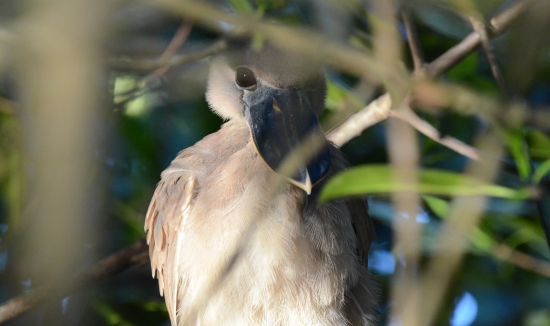

Some more interesting birds accompanied the night-herons...Boat-billed Herons! Though not improbably rare (they are just probable), they are absolutely an improbable bird.


What fucking cool birds. I'd only seen them once in Costa Rica before, so it was very fulfilling to come within optimal crushing distance of them without the birds really caring.


Did you know Boat-billed Herons are coy? Well, they are. This photo proves it.


What a bizarre bill...apparently they feed not unlike other herons, with the added method of scooping. Makes sense.


I wonder if one will ever be found in Texas...they are found in Tamaulipas, after all, and there are mangroves in south Texas. But who cares? Go to San Blas and let Chencho show them to you.


I didn't even know I took photos of this bird, an adult Bare-throated Tiger-Heron. I must have blacked out for a little bit, because there was another interesting bird sitting directly above it...


Northern Potoo! Northern fucking potoo! While this wasn't exactly unexpected (Chencho is famous for his potoo-spotting skills), this bird really delivered. A lot of potoo-hype had been built up over the past week, and this massive, utterly bizarre bird really delivered.


After our time with the grand, monolithic potoo, we coasted up to another Green Kingfisher.


Talk about a confiding bird...I was more than happy to put the crush on this diminutive gem.


Eventually we emerged from the mangroves and the river and vegetation opened up a bit. Some approachable Snail Kites loafed beside the river in the waning light.


Snail kites are a relatively new addition to the avifauna of Nayarit, having only arrived in numbers in the last 15-20 years or so if I am not mistaken. I wish my state would be colonized by rogue Snail Kites.


Let us all be grateful for large, snail-eating raptors.


After the sun had set, we came upon a big mixed roost of Tropical Kingbirds and Orchard Orioles on the river...it was trippy. This kingbird, being plucked by a Merlin, will not be joining that roost again. Shortly afterward we heard one or two Spotted Rails calling...things were getting interesting.


Once it was totally dark, we turned around to begin the trip back down river. Chencho turned on his big spotlight and immediately we could see the eyeshine of a very large bird downstream from us. "Surely, this is an interesting large owl", I thought incorrectly. You will not be surprised to find out it was actually another potoo, which are massive birds. I can't emphasize that enough.


We ogled potoo after potoo....they just kept coming. They liked foraging along the river, hawking insects from exposed perches (in complete darkness) like mutant flycatchers. Their eyes...their eyes were absurd, bulging out of their heads like nothing I've ever seen before. This was truly a fantastic bird.


This one even adopted the classic "stick pose" for us. The night was complete.


A couple Limpkins on the way back were a nice pickup, for Dan had never seen one and Stilt kept insisting that we had been hearing them everywhere the past few days. As a bonus to you, beloved reader, here is an Art Limpkin that you can look at.

The boat ride was one of the standout highlights of the trip, and I can't recommend it highly enough...check out our eBird checklist. Going back downriver at night through the mangrove maze, with an escort of hundreds of bats, was mesmerizing. Shortly after getting back to town, tequila ensued. It was our last night in San Blas, and to sum up San Blas birding succinctly, it was incredible as advertised. Go! Go bird there!

Wednesday, February 3, 2016

Winter Mexican Tour Y2K16, Day 6: Chacalilla and Chenchoing Part I


On the morning of Day 6, we returned to Chacalilla, parking at a random spot near the north end of town and birding our way out along the main road that leads directly north (out of town) until we ran out of decent habitat. We did pretty well, and I got a life bird (Elegant Quail), though that is definitely going on the "better views desired" list. We had also seen them them on the east side of town a couple days earlier, but I got shit looks. I suspect there might be better roads to bird in the area than the northern one but we did end up with a pretty impressive species list that morning. Along with some big mixed flocks in town, there were also a number of grackle-esque Sinaloa Crows, which never failed to hold my interest despite being crows.


Great-tailed Grackle on the left, grackleesque Sinaloa Crow on the right.


Along with Sinaloa Crows, one of the most abundant local specialties in the area is Golden-cheeked Woodpecker. They are loud, conspicuous, and seemingly everywhere.


Our first Bare-throated Tiger-Heron of the trip was perched on a snag in a dry field, scanning/lording over its domain.


Weird birds. Such thick necks. We got to hear them doing their low grunting sounds at Lower Singayta, which was a nice lifer vocalization.


Cinnamon Hummingbirds are very common in the lowlands of Nayarit, Jalisco and Colima. Go there and you will see many, and inevitably begin cursing their abundance when you begin struggling with finding other hummingbird species.


Cursed abundance aside, it is a very attractive bird with an attractive tongue.


I find Groove-billed Anis to be fascinating. Anyone else feel this way? I can always stop and look at anis, even when there is more facemelting stuff available.


There were a good number of raptors in the area...here is an immature Zone-tailed Hawk, which were a fairly common bird to find during the trip. You can view our heavy eBird checklist from the morning here. Definitely consider birding around Chacalilla if you ever bird San Blas, it has hella species and is a quick drive from San Blas.


Here is Flycatcher Jen, gently caressing the love of her life, Campana. Campana lives, more or less, at the Bucanero (our motel in San Blas). Campana is one of the perks.

As we finished up our morning of birding at Chacalilla, we weren't sure how the rest of the day would play out. What we wanted to do was go on a boat trip with Chencho, the now world-famous guide who is notoriously good at showing birders waterbirds, which he knows the names of in English. Chencho could get us Northern Potoo. Chencho could get us Rufous-necked Wood-Rail. Chencho was a birding god as far as we were concerned. We did not want to go with anyone but Chencho...however, we made no prior arrangements with him. I was told he could be reached through Hotel Canela Garza, so we went there, but the lady working the desk did not acknowledge knowing of his existence. Then we went to the spot next to the bridge where a lot of tours leave from...but we were told that Chencho launches from the other side of the bridge. So we went over there, and of course Chencho wasn't there. Then we got Chencho's cell number from Mark Stackhouse, but our motel didn't have a phone we could use. This all happened over several days. Chencho was becoming a mythical figure. Finally, on the way back to town from Chacalilla, we went back to Chencho's launch. Dipper Dan talked to a guide there who knew Chencho, who then drove away on a bike to get Chencho, who then returned with Chencho's son (also named Chencho, I believe), who then told us that Chencho Sr. would meet us later in the afternoon for a bird trip. It was a Mexican Miracle.

If any of you want to try a similarly unplanned, haphazard way of finding Chencho, he launches from a spot on the west side of the river next to San Blas, just south of the bridge into town, at the end of the only paved street that gets anywhere near the base of the bridge. Its easy to find. Chencho said he works in a cooperativo, and that there are only two other bird guides who do river trips, I think they were Oscar and "Huevos"? Why "Huevos", I don't know. Anyways, if Chencho can't take you I guess look for them.

Chencho did show up that afternoon, giant spotlight in hand, and it was all smooth sailing from there.


Great Blue Herons hunted in the shadows of the mangroves.


Ospreys soared with the frigatebirds above the river.


Anhingas offered some more exotic flavor.


Anhinga feet. I don't think I've really looked closely at Anhinga feet before...they're yellow, weird and muscular. What cankles.


Very early on in the boat tour, we were dealt one of the highlights of the trip, in the form of Rufous-necked Wood-Rail. Astonishingly, we saw two different Rufous-necked Wood-Rails on opposite sides of the river. It was astounding. I couldn't fucking believe we got to see two of these things, let alone one, and no playback was required. I really didn't think we would see one, and this was one of the top target birds of the entire trip. Dipper Dan spotted both of them, and he all got extra sloppy HJs from us that night. I'm no wood-rail expert, but I'm pretty sure the only reason we saw them is because we were looking for them at a lowish tide; if the tide was too high the birds would be back in the dense mangroves and thus not visible.

Although this photo is absolutely not worth bragging about (though seeing this species is), I'm amazed I even have an image that is recognizable; I managed one frame, focused on nothing but pitch black shadows, and somehow got something. They look much, much better than this in real life, I assure you.

More birds provided by Chencho coming soon.

Friday, December 13, 2013

Carara National Park and Tarcoles (Part 1)


What to say about Carara National Park? Carara's "river trail" is often touted as some of the best birding in Costa Rica, if not the very best. Well, I can't say it was the best, but it was very, very good...and we did not even get there early. Within a couple hundred feet of the trailhead we ran into a mixed flock, which included our first Black-hooded Antshrikes (that's a female above).


Yet again, we were slaying lifer after lifer as we made our way down the trail. We eventually made it down to the old oxbow, where one of the park guides had told us we could find the legendary Boat-billed Herons. He was right...awesome birds.


Dot-winged Antwrens were one of the most abundant species along the river trail. Here is a female, which is actually a lot fancier looking than the male.


The aptly-named Eye-ringed Flatbill. There isn't much to say about Eye-ringed Flatbills, I didn't see enough of them to really get to know them. Their name sounds like that of a fake bird.


Cooperative but not crushable were a couple Baird's Trogons. Not that you can see here, but these birds really turn into cripplers when they dare venture into the sunlight.


Streaked Flycatcher! By the time we saw this bird we were exhausted. The river trail is very easy walking (at least in the dry season), but that was some of the most intense humidity I've ever experienced. We were all delirious by the time we got back to the car. Someone even hallucinated a Rufescent Tiger-Heron afterwards. This should go without saying, but be sure to bring water out on these trails.


The Tarcoles River downstream from Carara is, well, tranquilo. We actually did attempt to do a river tour, but we were completely unsuccessful in locating the preferred operator listed in the birder's guide we were using...either something was up with the map provided or the road had been washed out. You might want to try calling ahead if this is something you are planning on doing. There is good birding in the area (including mangrove specialties), although it lacks the intensity of the weird and crippling avefauna of Carara.


Rose-throated Becard are fairly common in Costa Rica and you can expect to find them in a variety of locations. This richly colored bird with a pleasant demeanor is a female. Photographed near Tarcoles.


Here is the male Rose-throated Becard, which may disturb you. Yes, Rose-throated Becards do not have rose throats in Costa Rica. Photographed near Tarcoles.


Costa Rica isn't known for its diversity of sparrows, although there are some cool ones. The fantastically-marked Stripe-headed Sparrow was a much-welcomed lifer. Stripe-headed Sparrow is a member of Peucaea, which also includes the more familiar Cassin's, Botteri's, Rufous-winged, and Bachman's Sparrows. Photographed near Tarcoles.


Bare-throated Tiger-Heron is a really cool bird that birders will come across regularly in Costa Rica. It reminds me of a giant, fancy bittern. Such fine patterning. Such the bare throat. Photographed near Tarcoles.


My sad attempt at a Chestnut-backed Antbird photo. This thing was flitting around just a few feet away and I did not have what it took to get a real crush out of it...truly a shameful performance on my part. But look at that bird! And what a bird it is. This is the antbird species we ran into most frequently throughout the country; it's a real looker. I think the only other species I laid eyes on was a Bicolored at Quebrada Gonzales. Photographed at Carara National Park.