Showing posts with label Brown-crested Flycatcher. Show all posts

Wednesday, August 20, 2014

Bravery Applauded: July Quiz Answers


Birding is hard. Quizzes are hard. I know. I applaud the bravery of the disturbingly few birders who submitted answers to last month's quiz, whether publicly or in private. Birders, being nerds, often don't have much going for them outside the birding world, and so it is understandable that many tremble at the thought of publicly misidentifying a bird. If they wrap up their entire identity in their birding skills, and those skills are shown to be lacking...then what is the desperate birder left with? Nothing.

However, my wonderful readers, you have a precious resource available to you. You may have heard of it. It's called, "#7". Since I am, in fact, #7, let me offer you some advice...it's ok to be wrong. Believe it or not, I have been wrong...many times. It's fine. Let go of that horrible, putrid, nerdy arrogance, and allow yourself to be vulnerable. It's amazing what people can learn, with minds and hearts open wide. That's how you get to the next level. If a birder deludes himself/herself into thinking that they are the absolute shit (and most birds are definitively not that), then their capacity for soaking up and being able to use new information is severely diminished. I hope the next BB&B quiz gets more participation.


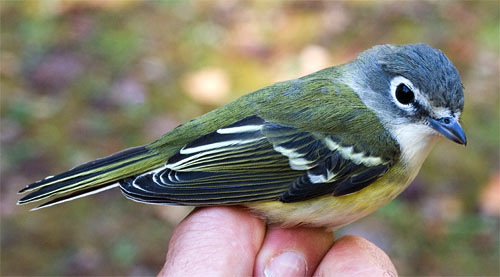
On to the quiz results. A few people guessed White-eyed Vireo for Quiz bird #1, but White-eyed  typcially have more strongly-colored backs and yellower/greener secondaries. The vireo above was photographed on South Padre Island, TX, in the spring of this year. I am comfortable with identifying it as a Blue-headed Vireo, the expected "Solitary" Vireo there, from the drabbest end of the spectrum. The contrast with the throat and head is quite strong, as is the color in the flanks...otherwise, it looks very much like a Cassin's Vireo. The back is somewhere inbetween gray and yellow, and the head is certainly not any shade of blue. If this bird was found in California and submitted to the bird police as a Blue-headed Vireo, would it be accepted? I would wager it would not. That said, I feel a lot of west coast birders do not have a strong grasp of the variability Blue-headed can show...they tend to have their hands full with Cassin's vs. Plumbeous.

I would like to mention at this point how dissatisfied I am with how National Geographic Field Guide to Birds of North America (6th edish) treats the Solitary Vireo complex. For starters, the illustrations suck, and each species only gets one paltry, sucky illustration. On top of that, the web of ID problems these birds can present is not really addressed in the text. Blue-headed Vireos are alleged to have "yellow-tinged wing bars and tertials", when obviously that is not always the case (take a look at this bird...or this bird or this bird). "Greenish yellow edges to dark secondaries", also listed as a Blue-headed field mark, is frequently found on Cassin's. I generally like the Natty Geo guide (it is the only book I've been recommending to other birders since the 90's), but the Solitary Vireo section needs some serious work.

Now, in the interest of embracing being Wrong, let me know if you have a convincing argument for this being a vagrant CAVI instead of BHVI. We can talk this out. The bird does sport "distinct white on outer tail", visible in other photos, but I'm not sure how unique that feature actually is to BHVI. Where is my Pyle guide???


Quiz bird #2 was, admittedly, fucked up. You could see a strongly colored Empid, gray-headed and yellow-bellied, with a solid eye ring and dark throat. These are helpful field marks, but you could not see the bill or primaries. One could deduce that the bill wasn't particularly long, but even that was a bit of a stretch.

Several people did guess correctly, despite that it was almost not possible in that photo to distinguish between Hammond's and Dusky Flycatcher. The dark gray throat, however, is characteristic of fall Hammond's Flycatchers, not Dusky. This Hammond's Flycatcher, photographed in the fall (when Empids are often the most colorful) was at Coyote Hills Regional Park, Fremont, CA.

For the record, I consider HAFL vs. DUFL to be the most difficult ID problem of "common" passerines that we have to face in California. Both species are significantly more difficult to find during fall migration than in spring, so I thought it would be nice to put up a plumage we don't get to see very often.
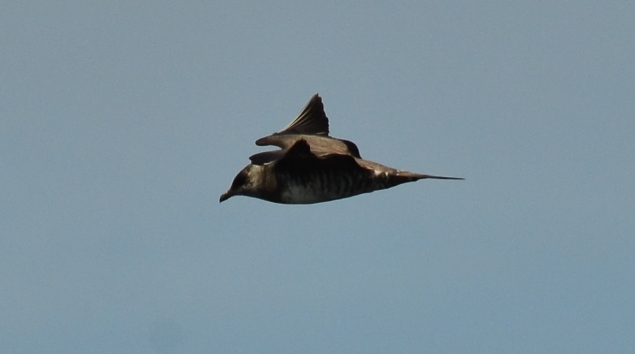

This jaeger suddenly becomes easily identifiable with the wings at a slightly different position. The dark secondaries scream Long-tailed Jaeger, as does the small bill. Bodega Bay CA.


Quiz 4? It's a Brown-crested Flycatcher. Texas birds have relatively petite bills compared to BCFLs further west, similar in size and shape to Great Crested but thicker than Dusky-capped. Ash-throated, of course, lacks the strong yellow coloration on the belly. Hidalgo County, TX.


This is a pretty typical Herring X Glaucous-winged Gull. It has the bulkiness of a GWGU, but the bill pattern of a HERG. The primaries are perfectly intermediate in color between what we expect in HERG and GWGU. This hybrid can be quite common in northern California in winter. Golden Gate Park, San Francisco, CA.

So there we have it. Thanks everyone for checking these birds, and we'll see you again soon.

Thursday, July 17, 2014

Sic Semper Tyrannus


Yellow-bellied Flycatcher is an Empid I hold, for some reason, in high regard. I first met the species in Pennsylvania back in 2009, and we have since crossed paths in Florida, Mexico, Costa Rica, and now Texas. Photographed at South Padre Island, TX.

Texas is a state rich in flycatchers...with only one exception (Gray Kingbird), every flycatcher that breeds east of Texas is found regularly in the state. And then there are Scissor-tails, and the valley species, and all the vagrants they have been blessed to receive over the years. I'm not ambitious enough to post pics of every flycatcher species I saw out there last spring...but I can do most of them.

Are flycatchers a major headache migraine? Does looking at them make you feel stupid? Do high-ranking birders with mysterious motives make false statements about how often they vocalize? Yes! But that is part of what makes them so great. You don't have to worry about them hybridizing (much) and they are a group of birds that your new birding app won't be able to identify for you for a very, very long time. And they do stuff. Good stuff.

When you get to the end of the post and are drenched in sweat, feel free to cruise over to The Powdermill Reserve (the only place I've seen Yellow-bellied Flycatcher in hand) for a nice post on more eastern flycatchers.


I'm itching to find one out here in California...most (not all) of the individuals I've seen have been pretty easy to ID, and they tend to stand out...they are yellow (er...olive and faintly yellowish) and have a call that isn't a damn "whit" note. South Padre Island, TX.


Least Flycatcher...the gray flycatcher of the east. It is the most basic Empid of the east, in terms of color and abundance. South Padre Island, TX.


Least Flycatcher, probably the same individual as above. Note the amount of darkness on the mandible (or lower mandible, as most of us say), which is atypical. I've always found the amount of paleness here to be dependably variable in many Empid species, and a field guide could potentially lead the birder astray with this character. South Padre Island, TX.


Acadian Flycatcher has a big head and big bill, a true loggerhead of the Empidonax. South Padre Island, TX.


Traill's Flycatcher (the pre-split name of Alder and Willow Flycatchers) is one of the most troubling species-pairs that eastern birders have to face. Even California birders are pained by this problem, as a handful of legit Alders have been documented in the state over the years...and guess what? We want more. South Padre Island, TX.


This is the same bird as above. Note the overall gray-brown on the upperparts that does not contrast with the throat, rendering it quite dull even by Empidonax standards. There is an eyering present, but it is extremely narrow, which is to be expected in eastern Willow Flycatchers. There doesn't appear to be any greenish coloration from this angle, aside from the inside of the folded wing; it is remarkably drab. By all accounts, this is a Willow Flycatcher.


Here is a different Traill's from South Padre Island. This bird is a bit greener and more contrasty in the throat than the above individual, has a more pronounced eyering and seemingly has a shorter bill. It actually looks considerably different than the above bird. I'm going with Alder Flycatcher on this one. Of course, empids can look quite a bit different in fall, so there's only so far one can go with some of these field marks without hearing a vocalization...but it never hurts to try. South Padre Island, TX.


Eastern Wood-Pewee has the distinction of being one of the most misidentified flycatchers in the U.S., despite being one of the most abundant. Learn the pewees, and then you will love them. Until then, you will not have a healthy relationship. South Padre Island, TX.


Couch's Kingbird. This is a typical brightly-colored bird with a smallish bill. Atypical is how the tail appears completely unnotched. Willacy County, TX.


Couch's Kingbird. There is variation in bill structure in this species, and you can see that this bird has a heavier bill than the above individual, being especially deep toward the base. I reckon Tropical Kingbirds have a more consistent bill length, and still appear longer-billed (and not so big at the base) than this individual. Sabal Palm Sanctuary, Brownsville, TX.


Eastern Kingbird, a true feel-good flycatcher. Everyone can love an Eastern Kingbird. South Padre Island, TX.


Brown-crested Flycatcher. This is cooperi, the subspecies found in Texas, and is less beefy than the magister that reside in Arizona. Note the unimpressive size of the bill. Hidalgo County, TX.


Great Crested Flycatcher. God, look at the tapering of the white border of the first tertial feather! That's what I'm fucking talking about. What I'm not talking about is why Great Crested Flycatcher and Brown-crested Flycatcher have more structural differences in the grammar of their names than the birds do in reality. South Padre Island, TX.

Sunday, July 19, 2009

Shut The Door So I Can Leave


An epic Madera Canyon sunset was a solid crowd-pleaser.

Well.....it seems Ive made it. I write to you, late on a Saturday night, from the Hidden Valley Four Seasons Resort, a posh piece of property that I would normally have no business on, seeing that A) I am not of the Elite and B) I have no interest, of any kind, that would motivate me to be here even if I could afford it.....although the trap and skeet range does strike my on-again off-again fancy with firearms.

What am I doing here? Monday I start my new job with Bat Conservation International, whom I will be working for until the middle of October.....and for reasons that I have yet to fully understand, the field housing for the project is located exclusively at this resort. I'm holed up in this condo, complete with loft, fireplace, a big stack of firewood, and all the essential furniture items, kitchenware, etc. Aside from the food and alcohol situation (which really is a whole situation in and of itself.....I'll explain later), I'm completely self-contained.

The journey out here, of course, was far more interesting than the destination....so far. But there are a lot of pictures.....so many pictures......so in order to capture the nerdy spirit of the thing I will just post a bunch of nonhuman (Inhuman?) pictures from Southeast Arizona, one of the birding meccas of United States.


A Monsoonbow off of Hwy 19, north of Madera Canyon.


The resident male Flame-Colored Tanager outside Madera Kubo Cabins.


Gobble Gobble Gobble Gobble Gobble Gobble Gobble.....

I got to a bird around Southeast Arizona with a bunch of half-crazies, the stars of which were veterans from the 2007/2008 Imperial Valley Burrowing Owl seasons. It was a breezy experience, to say the least. Berylline Hummingbirds and Buff-breasted Flycatchers were both new to me.....and I think it is safe to say, at this juncture, that things will never be the same. To put it bluntly, southeastern Arizona is a facemelting place to look at birds, and can test you physically and mentally....I've found myself Out There, on that high, jagged edge, more than once over the years. The intense heat and rigorous schedule of trying to see as much as you can in just a few days can do a number on you......but nothing a little rattlesnake won't cure, you know what I'm sayin'?

I start work tomorrow out here in the PA, I'll let you know how it goes. Otherwise, I'll post some more All-American Goodness from The Road in the near future.......until then, hold it down!


A bloodthirsty Brown-crested Flycatcher delivers its defeated prey to its bloodthirstier nestlings in the power pole. Shortly after this picture was taken, the flycatcher pair were documented attempting to stuff a small child into a cavity.


Two or three White-eared Hummingbirds were holding down the feeders at Beatty's in Miller Canyon. A truly awesome creature.


A Berylline Hummingbird in the process of assembling a giant, chewbaccaesque figure. No one quite understands the reasons for this.


A bedazzling male Broad-billed Hummingbird.


A Black-chinned Hummingbird shows off its chin-bling.


Although not a good picture, I kind of like it. Beware the Hooded Oriole that attacks by lamplight.