Showing posts with label Least Sandpiper. Show all posts

Monday, December 11, 2017

Rarities Return, Featuring: Parakeet Auklet, Little and Red-necked Stints!


Every now and then a birding community will be struck by a rarity so bizarre and unlikely that we are left running around slamming into walls, foaming at the mouth, bleeding from headwonds, uttering incoherently about needing to be somewhere, at any cost. A Parakeet Auklet in July (July!) in San Francisco did exactly that, smashing the 2017 summer doldrums into oblivion and sending birders scurrying to SF. The story of how this vague runt was found was truly unlikely; a birder found it in the water off Sutro Baths in the summer of 2016, but it was never seen again...a year later, the same birder relocated the bird while kayaking less than a half mile further up the coast. This time, the bird was seen sitting on seastacks and cliffs, which as far as I know is the first time a healthy individual has been seen on solid ground in the state. There is a good chance the bird was doing the same thing the previous year, but no one saw it!

I appreciate a good Parakeet Auklet, and this being a good Parakeet Auklet (and a state bird) I dragged the family up to the city kicking and screaming for a chance at this bird...but despite staking it out for hours, it never showed. It was a tough dip to swallow, and most everyone who actually dips will tell you that all dip is tough to swallow to begin with...I'm talking about chewing tobacco of course, but hey it applies to birds as well.

While doing the drive of shame back to San Jose, I analyzed my chances of getting the bird the next morning if I made another chase attempt and decided against it...which I immediately regretted the next day when the bird was relocated quickly. My heart was filled with hate. By mid afternoon I was twitching uncontrollably from the constant updates of resightings, said "fuck it" and rocketed back north. This time I found the bird in about 30 seconds, circling behind Mile Rock. It eventually landed on a distant rock just a stone's throw from the shoreline, which I pointed out to several birders who were clearly there for the same reason as me.


Incredibly, one of the birders I updated totally ignored what I had just said, and instead told me that he believed the bird was currently sitting on a seastack right below us. Keep in mind I had a spotting scope and he did not, so I must have seemed absolutely incompetent to him. Friends, do I give off an air of complete ineffectiveness? For those of you who haven't met me, next time you encounter a birder in the field that you believe has utterly no idea what they are doing, just go ahead and assume it is Seagull Steve.

I had to look at this man's auklet, of course. It turned out to be not a guillemot, or an oystercatcher, or a black bird of any sort...it was a shadow. A shadow.

I booked it to where the actual bird had been sitting and eventually ended up below it, as it had flwon from its rock and was roosting high up on a cliff. Talk about something I never expected to see outside of Alaska. July in San Francisco? Get out of here. State bird! Though California has accrued quite a few records now, this is a very unreliable bird to see anywhere in the state....as Flycatcher Jen would tell you, good times.


July isn't all state birds and Parakeet Auklets though. Least Sandpiper is much more typical birding fare around these parts, and much more confiding as well. Photographed at Don Edwards NWR.


My god...could it be? SHARP-TAILED GROUSE???

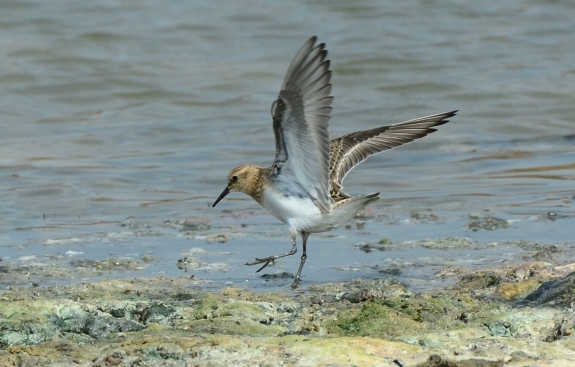
No, it can't be, but this Least Sandpiper is striking a pose remarkably similar to what displaying Sharp-tailed Grouse are known for. This bird was having a territorial dispute with another Least.


Remember the barren dowitcherless times? It sure is nice to have dowitchers again, especially pink and orange ones. I think these are all Long-billed.


On another July day, I was out birding and saw a report of an alternate plumage Little Stint that was within easy driving distance. It wasn't a lifer/state/county bird, but seeing as I had gotten to look at all of one (1) before, I picked up the scope and hustled back to the car. The instincts that made me the Global Birder Ranking System's #7 US birder made me stop and scan a blackbird flock just long enough to find my county Yellow-headed Blackbird on the way back, and I was still able to make it back to the car quickly. Things were going splendidly. Unfortunately, at that point my instincts ceased to serve me well...in my haste to get on the road, I broke off TWO door handles to my car. What the fuck?! Who does that? This wasn't even for a life bird. That's what those two gray things are in my palm, freakin door handles.

And to top it off, later that day I was playing bass and I ripped off the plug to the amp from the power cord. Nerd strength was just pumping through my veins that day.


But hey, I saw the Little Stint! Talk about a completely rubbish photo (digiscoped). The light wasn't great and the bird wasn't very close, but I did get really nice, prolonged views. Lifer plumage! Year bird! It was nice to continue my long running streak of taking terrible stint photos.


A few days later I went back to see if the stint was still around (it was not), but I did find a very interesting peep that had me confused for a bit. Not that you can tell, but the bird's back was very bright and boldly marked, with lots of orange and red tones. With the short, straight, tapered bill, it was an intriguing combination, but at the end of the day it was just a Semipalmated Sandpiper.

Just a Semipalmated Sandpiper? That's a bit of an understatement...despite a great deal of looking at peeps all around the bay for many years now, until this bird I have never been able to find one in any bay area county. Anyone who has birded much around here would find that baffling, and they would be right. This was a hard-won bird, thus you are forced to look at a photo (digiscoped) so awful that it is, in fact, art. It was also the most colorful individual I have ever seen, but again you cannot make that out whatsoever. Because art.


Sorry about the run of appalling photos. Here is an alternate Western Sandpiper pondering life in its reflection. This looks to be a male, judging by the relatively short and straight bill.


This adult has already acquired a lot of basic plumage, but retains some old summer chevrons on the breast. More of a femaley bill on this bird.


Oh why hello RED-NECKED STINT. It sure is nice to see Red-necked and Little Stint in the same week! That's California birding for you. This one was at Elsie Roemer Bird Sanctuary in Alameda. As I mentioned back in 2015, this place had been due for a great bird! As with my other Red-necked Stint experiences in California, nice prolonged looks at a spiffy alternate bird that was either distant or in crap light. Not sure how that keeps happening, but when one is looking at a stint one cannot complain. But now I really, really need to get a good photo of some kind of stint eventually...

Although they don't inspire the panic of a stint, Baird's Sandpiper is a refreshing fall migrant that only has a short window here. They are refreshing birds in and of themselves, but their presence is always a tasty precursor of things to come...if you are looking at a Baird's Sandpiper in California, chances are you are only a few weeks away from experiencing that holiest of months, SEPTEMBER.

I know, I know, you can roll your eyes, we are far removed from September, but I'm getting there! I won't say that blogging is hard (it isn't, despite everyone who starts one and then gives up), but I will tell you that blogging with a baby is hard. As Corey Finger rightly pointed out to me last year, it's not that you won't have time to bird anymore once you have a baby, it's that you won't have time to blog. This is true.


Refreshing birds are often found in disgusting places. That's not a gross mudflat the birds are on, it is a much filthier floating mat of algae. Juvenile Least Sandpiper on the left for comparison.


Has any bird mastered the filthy floating mat dance like the Baird's Sandpiper? Unlikely.


Ok, I'll throw in a token resident bird, and one that BB&B doesn't cover much. This juvenile California Gull was also holding down the algae mat along with the peeps. I know birders in most states don't get to see this short-lived plumage very often, and we are balls-deep in gull season right now, so enjoy! The Baird'seses and the gull were at Coyote Hills Regional Park in Fremont, CA.

Monday, November 27, 2017

On Summer Sorrows (Doldrummer)


One day last summer, one of Rancho de Bastardo's Mourning Doves would repeatedly raise one wing above its head - it looked like some sort of display. It was bizarre. Did it think it was a Rock Sandpiper, or was this a cry for help? Even Mourning Doves need to be rescued from triple digit temperatures and drearily slow birding.

With Thanksgiving just behind us, I think now is a good time for a little reflection. A facet of life that I always want to improve on is appreciating experiences; not taking the positive aspects of my life for granted. So much of what we experience on a daily basis falls on the mediocre or crappy side of things (life is pain) that I try my best to not let those better moments go by without looking them in the eye, even if just in passing.

So what am I thankful for this year? Well, Annabelle is doing great, so that is awesome. I work from home, which is fantastic. There is a really good bottle of mezcal in the kitchen. I still get to see friends, despite being banished to the bowels of San Jose. But inevitably, the subject of birding must be broached. Of course, now that I am a father (which is still weird to say) I don't have nearly as much time to blog as I used to...BUT I still get to bird hella, and that is something I can really appreciate. The freedom to go flog the shrubbery and indulge my most basic nerd instincts is near and dear to me.


Oak Titmouse is a pleasant, dependable bird, always hanging tough through the summers.

Another thing I'm grateful for is the good birding around here. For months now, I get to see something rare/interesting pretty much every weekend. I don't take this for granted at all, I'm pretty lucky. What has made me, the #7 birder in the United States, so modest and humble? What has given me the ability to relish fall birding in the bay area?

It wasn't some epiphany, a major breakthrough, a conquering of the urge to loathe the familiar. The answer is simple...summer. I have been forced to spend a number of summers in the bay area now, and the birding can be so dull that as I write this sentence my mind is trying to think of something more interesting to focus its energies on. Will Giancarlo Stanton be traded to the Giants? Is Repeater still my favorite Fugazi album? If I really needed to obtain heroin for some reason, how long would it take me? Tacos sound good right now...mmmm, tacos.


Like the dove and the titmouse, some cheerful Bewick's Wrens holds it down at Rancho de Bastardos over summer. However, I am beginning to detect some sort of a pattern here...

As I don't live in northern latitudes and am without mountains of appreciable elevation nearby, the summer birding doldrums are not to be scoffed at. I'm not just talking about the dearth of warbler species that breed in Santa Clara County, or even the massive urban sprawl that eats up habitat like a disease. There are other factors at work. Unlike here, Californians living near the immediate coast experience the following conditions during the warmest months of the year: Graypril, May Gray, June Gloom, Gray Sky July, and Fogust. I long for that kind of summer. Where I live, we have no such luck. Overcast days are rare and precious, and there was not a lot of that going on in June or July. San Jose is sunny and hot as fuck, which is maddening considering there is an ocean nearby. Silicon Valley is not where you want to find yourself those months unless you are bringing home a staggering paycheck from a tech firm...or southbound shorebirds have returned. Climate change is a bitch, but so is geography. San Jose is on the hot side of the coastal range, and when migration is seemingly at a standstill, the summer doldrums are real.


Northern Rough-winged Swallow, another common bird of summer here at Rancho and across the state. Wait a second...why is every bird I've posted so far gray and brown? Is that seriously what all of our summer birds look like? That is awful. I can't tell you the relief I felt when we got a couple weeks into July and the shorebird floodgates opened up.


Well, maybe not all our summer birds are dirt-colored. Caspian Terns and their horrific, violent calls helped get me through to the other side. I've said it before, but it bears repeating...this is a nice yard bird.


A lot of our resident Anna's Hummingbirds were doing some pretty intensive molting in July. I'm glad we have them of course, but it will be a triumphant day when a second hummingbird species is added to the yard list.


I was a bit surprised to see this fledgling Tree Swallow (oh great, a new brown bird to recruit into the current brown bird population) at the Los Capitancillos Ponds, considering they are far outnumbered here by the other expected swallow species. I'm not sure if it was hatched here or wandered from another part of the south bay.


Thankfully, Calocortus rages against the dying of spring long after many other wildflowers have withered under the relentless sun. Canada del Oro Open Space Preserve, Santa Clara County, CA.


Now this is a brown bird of summer I can really back - Common Poorwill! I went some years without seeing any...though it is a pleasant heard-only, I'm glad that drought is over. Thankfully, there is a dependable area for them just a few minutes from Rancho. Brown it up! Photographed along the Calero Creek Trail in San Jose, CA.


Every year, early in July, the bird gods open the spigot of the shorebird tap. Least Sandpipers are one of the first species to return, and though they are still brown brown brown as can be, these first returning birds are a sight for sore eyes. Don Edwards National Wildlife Refuge, CA.


Seeing your first mixed shorebird flocks in July is the light at the end of the summer tunnel of darkness. A lot of the avocets are probably locals, but the dowitchers came from afar.


Hint: If you want people to think you are god's gift to bird photography, don't ever post photos this bad (this was digiscoped). It's embarrassing...but I am not embarrassed to say that this is the weirdest avocet I've ever seen. It was essentially all white except for its primaries, giving it a Snow Goose look. Rad.


Yip-yip-yip-yip...father stilt made it very clear to me that he does not want me near his chicks, although he is always right next to the boardwalk so I don't know what he expects.


Stilt offspring! I usually see them when they are younger and fluffier, this inbetween stage (apparently characterized by fat cankles) does not last very long. I like the brown covert edgings.


Anise Swallowtail, I reckon. You know, for all the great success Rancho de Bastardos has had with birds, it has been completely miserable for butterflies. I'm not exactly happy about that. I guess I am doomed to start attracting them to my yard, as geri birders like myself tend to do.

Great! I think this post pretty much recounts falling into, and climbing out of, 2017's summer doldrums...covering those are always a tough blogging assignment every year, because it's basically a bunch of whining and some pictures of common birds. Better to limit that, eh? 

Thursday, May 25, 2017

The Emperor Does Not Share Your Optimistic Appraisal Of The Situation


Fuck, Vader sure had some good lines didn't he? That was from one of my favorites scenes in Return of the Jedi. I guess he can credit The Dark Side for imbuing him with a dry sense of humor, which he clearly lacked as Anakin Skywalker. Anakin was a tool.

Over the winter I read a listserv message about an Aleutian Cackling Goose being seen at a coastal golf course. This news, neither unusual nor unexpected, was not exactly on par with learning that Emperor Palpatine was going to come for a visit to potentially force-murder you for your underwhelming project management skills. In other words, I thought "cool story, bro" and moved on.

The next day a very apologetic birder wrote back to the list, saying what he had meant to say was that it was an EMPEROR GOOSE, and that he had a massive brain-shart due to sleep deprivation and wrote the wrong species in his email. Emperor Goose is an Aleutian goose, after all. As expected, the chase wagons were subsequently fired up and the bird was relocated immediately, and following this success the original observer was celebrated instead of crucified.


The Emperor's arrival coincided with the birth of my daughter, but eventually I was able to make it out to the coast to pay my respects. The bird was a lovely adult, no sign of any dark smudging on the immaculate white head. It wasn't in great light, but birders are not allowed to have any complaints when they see an Emperor Goose.


The Emperor kept the local nonnative Canadas for company, which were not impressed by their new, totally superior member of their flock. You can't really blame them...almost any bird looks like shit when it has to stand next to an Emperor Goose.

This was the southernmost Emperor I have ever seen, and the southernmost to show up in California in a long time...a long time. Talk about a quality year bird. Sharp Park, Pacifica, CA.


On the way back I made a detour to a place with nice lawns and a shitload of dead bodies...it had been far too long since I had birded a cemetery. Who doesn't like birding cemeteries??? Anyways, a Vermilion Flycatcher was wintering there and it did not take long to find. While Vermilions are becoming increasingly common in southern California (a very good thing), they are still powerful rarities this far north. "Only Sleeping" indeed...Cypress Lawn Cemetery, Colma, CA.


Roosting American Avocet flocks have a mellowing effect on the soul when viewed at close range. Serenity now. Albany Mudflats, Albany, CA.


Regular Northern Pintail crushings are healthy, especially when you can catch the purple iridescence on their heads. We are balls deep in molting Mallard season now, but soon they'll be back, and in greater numbers. Albany Mudflats, Albany, CA.


California is blessed with huge numbers of Bushtits. They are practically everywhere. If you look at an ebird abundance/distribution map, the state is almost black with Bushtit. They make chickadees look like unadaptive niche-specialists in comparison. Luckily for birders, Bushtits are great. We may complain about Yellow-rumped Warblers, but no one talks shit on Bushtits. Albany Bulb, Albany, CA.


An interesting thing about Bushtits is their lack of repertoire that the human ear can pick out. It sounds as if they have a contact call and an alarm call, nothing more. They don't really have a typical song per se, but they are quite noisey birds.


Look at this diminutive little bastard. I have crushed Least Sandpipers a great many times, and I will continue to do so indefinitely. Maybe one day it will lead me to a Long-toed Stint, which I nominate for "most overlooked Sibe in the U.S.". The Lower 48 is long overdue for another LTST...will this be the year? Richmond Marina, Richmond, CA.


Greater Scaup coming in for a landing, with a bonus Red-throated Loon lurking in the background. Richmond Marina, Richmond, CA.


Such majesty, such scootsmanship, as some would say. Anthropomorphizing is a bitch, but it's hard to accept that waterfowl may not enjoy landing on water. They get to brake, skate and scoot to a stop. Then they shake their tails, and let out some kind of quack/honk/whistle, looking all cute and shit. Come on waterfowl, tone it down.


Perhaps this is where I should have said, "They'll soon be back, and in greater numbers." Eh? EH? GET IT????


Don't worry, I wasn't going to start this post with a crippling rarity then drive it into the ground with abundant brown birds, we can talk about this Peregrine Falcon instead. This very smart-looking bird was at the mouth of Pilarcitos Creek, in Half Moon Bay, CA.


I've seen a lot of Peregrines over the years. The only ones I've seen really closely were either really sick or were trying to behead me because I was too close to a nest. This one was neither. It was mellow. However, due to the location, I had to wonder if this was one of the Ross's Gull murderers. The scene of the crime was about 4 miles away, but this could have been a different bird.


The bird, quite unexpectedly, did not give a fuck about me. Decent photo ops suddenly turned into prolonged bursts of shutter fire when I realized it might be a great many years before a falcon was this nonchalant again. Eventually it began to crumble under the relentless torrent of crushes I unleashed upon it. It surrendered, signaled by flashing the underside of its foot and lowering its head weirdly. How often does one observe the underside of a Peregrine foot?


I'm not sure why the bird was so unwary that morning. It was bloody cold, but falcons are not reptiles. I did appreciate the killer looks though.


Awesome bird! I've never even had a kestrel be this confiding. Random aside: one of my first birding memories was walking out to the mouth of the Santa Clara River Estuary with my dad when I was a kid. It was winter, we didn't see shit except for a Sanderling, which was flushed by a Peregrine and chased with great persistence and glee. This was a very exciting event for adolescent Steve. Back and forth they went; it seemed like the falcon was just terrorizing the Sanderling for fun, as it was such a tiny prey item. Anyways, it was a facemelting experience for me, thought you should know.

Tuesday, September 20, 2016

Plovers, Peeps, Goose-like Wingbeats


This adult Black-bellied Plover still has some appeal, but lacks in crispness/crispiness. In August, adult southbound shorebirds still wear the ragged remains of their once-impressive plumage they sported on the tundra or taiga. Sometimes it can present an ID challenge (i.e., with adult golden-plovers), at other times it is a simple statement...migration is on, the birds are back, and you need to be out looking for that rare shit. Elsie Roemer Bird Sanctuary, Alameda, CA.

It's September now, and I've been cruising. Unlike last year, when hoped-for rarities did not seem to start materializing until the very end of the month, things have been going swimmingly so far. Vague runts seem relatively plentiful, and disappointments have been few.

But as I said, there is much to catch up with. Before September, there was August. Here in the bay area, the birding has just gotten better and better...June is boring, July is better (shorebirds return), and August brings pelagic trips and plentiful shorebirds, not to mention a whole lot of suspense around the big question seasoned California birders ask each other (in trembling voices) every year...what will September bring? In other words, August birding is exciting again, and I thought I would pay respects to some of the birds of shore (not just shorebirds) prominently featured during the month.

Oh, and before we get in too deep, think of a bird (not a goose) with goose-like wingbeats. Got it? Now put it in your pocket and we will take it out for another look at the end of the post.


Snowy Plovers are patchily distributed around the bay area, favoring salt ponds and a few select beaches along the coast. This adult was washing off the salt at Frank's Dump in Hayward, CA.


Despite being adorable and intensely, Snowy Plovers are very territorial and often chase each other off or do battle if it is called for. The faded bird snuck up on the unsuspecting bather and chased it off. There were still a couple of broods of tiny, downy chicks out here this day (which seemed a bit odd...it was late August), so the aggression was not a surprise.


The Global Birder Ranking System (GBRS) lists me as the #7 U.S. birder, based on hundreds of factors. One of those factors is my ability to pass on knowledge, to not just hoard what I have learned. In that spirit, I want to let you you in on a secret...Semipalmated Plovers have white outer retrices. Did you know that? Middle Harbor Shoreline Park, Oakland, CA.


I may be #7, but I am just like you in a lot of ways...I have fears. Not of slipping to #8 or anything absurd like that, but genuine concerns that I dwell on, that keep me up at night. For example, I have seen many thousands of Semipalmated Plovers...could one of those have been a Common Ringed Plover? Talk about a bird that would be easy to overlook...at any rate, this is a standard Semipalmated.


In August, the mudflats at this park were inundated by Least Terns, mostly from the nearby Alameda colony (I assume) but possibly from elsewhere in the bay. I counted 190 individuals one day at the beginning of August, which to me is a staggering number to see away from a breeding colony. There were a lot of juveniles around (which is good news, as Least Terns are federally listed in the state) and a lot of strange looking molting birds, like this one. Almost no tail on this bird...why????


This fresh juvenile was not confusing, only encouraging. It was good to see Least Terns in something other than alternate plumage, because they get the hell out of dodge almost as soon as breeding is complete so it's not often we get to see much variation in these birds, beyond full alternate. I'm sure I've already seen my last Least Terns of the year already...it's been real.


A great many Western Sandpipers use San Francisco Bay during migration, which I am very grateful for. Here is a typical juvenile male, showing rusty scapulars and a relatively short bill. I've spent an inordinate amount of time this fall sorting through Westerns, looking for a Semipalmated, as it would be a year bird and I've never been able to find one in the bay area...how embarrassing. The search has been in vein, but the search for other vague runts continues.


Now that I think about it, I've spent a not insignificant part of my life sorting through Western Sandpipers. I'm ok with that. It's more enjoyable than sorting through Least Sandpipers.


Ah, the homely Least Sandpiper. They don't get a lot of love. If someone asked you, "What would you rather, have American Redstarts go extinct or have Least Sandpipers go extinct", you know you would pick the sandpiper over the vast majority of other birds. It's not their fault they are so drab and abundant, and they certainly aren't obnoxious or anything. They're just being Least Sandpipers. I liked the cracked mud this one was coursing over. 


Now that I've lulled you to sleep with common birds, how about something else...do you see a godwit (the startling pale one...on the left) that is not like the others? Bolinas Lagoon, Bolinas, CA.


Bolinas Lagoon hosted this Bar-tailed Godwit for about a week, which we were able to see from Highway 1. I've only seen one in the state before, so when Peter Pyle reported this bird, the drool started flowing in earnest. Though it never came particularly close, the bird readily stood out from the Marbleds, even at great distance. Seeing a Sibe always feels like a major accomplishment, and this bird brought the warm and fuzzy rarity endorphins I knew it would. Also present were a Ruddy Turnstone (oddly, somewhat of a rarity in Marin) and a fantastically distant golden-plover, which Peter and others had previously identified as an American.


A lone Long-billed Curlew provided the godwitting birders close company on the shore of the lagoon. Sibley notes "goose-like wingbeats" and "foraging movements graceful"; neither of these thoughts have ever occurred to me, though I won't go on record as denying them.


Perhaps he will note "forceful bellowing" in the next edition.