Showing posts with label osprey. Show all posts

Monday, February 11, 2019

Belize! Part III: Crooked Tree Lagoon by Boat


Birding on foot at Crooked Tree can be very good, but no visiting birder comes here without taking a boat trip on Crooked Tree Lagoon and heading up Spanish Creek...I think that is what they usually do anyway. One morning Billy and Annabelle and I all got on a boat with a Euro family who also had a toddler, which sounds like a potential birding disaster but remarkably worked out pretty well. Also, with that many people on board, the whole thing only cost $35 US per adult...what value! Such savings! Bird's Eye View Lodge organizes these trips and have their boats docked right outside - they also do boat trips to Lamanai, which from what I understand can be very good and potentially offer a chance to see a lot of the same specialty birds (plus Yucatan Nightjar sometimes?), and you get to bird the Lamanai ruins.

We were at Crooked Tree before the thousands of water birds crammed into the area (the level of the lagoon was too high), but the birding was still ace, Leonard was a very solid guide and I recommend it highly.


Let's start with a Snail Kite snailing it up. I never knew I would ever be someplace where Snail Kite was one of the most common birds, but I have now been to such a place. The density of Snail Kites here is really impressive...there aren't ungodly hordes of them, but there are hella. Of course, the reason for this is the abundance of apple snails.

Most of the individuals we saw were immatures or females, but we did see a couple crispy male Snail Kites...or, if you prefer, snale mail kites.

Incredibly, Snail Kite is not the only molluscivorous kite in Belize...Hook-billed Kites specialize on tree snails, though they are known to consume nonmolluscs as well. The notable fact that we have both mollsuc-loving kites here in the U.S. is lost on far too many, for our obtuse, mollusc-blind culture does not place enough value on molluscs, let alone hardcore molluscivores.


Limpkins, on the other hand, place a premium on molluscs. They live here in staggering abundance. There really are ungodly hordes of them...their numbers were a revelation. They are so common that it makes you wonder how there can be places in the world that don't have Limpkins, or how one would actually need to expend energy to find them. At times you can hear them calling constantly from the lodge, but it is much easier to actually see them by boat.


Of course, the Limpkins are here for the same reason as the kites...they love apple snails. This Limpkin was caught in the act, snailing it up.


Some juicy apple snail eggs for your edification. Apple snails crawl out of the water at night to lay their eggs on emergent vegetation above the waterline, then apparently try to beat it back below the waterline before they get eaten by Limpkins and Snail Kites in the morning.


Ringed Kingfisher was another surprisingly common bird here, THANK THE MAKER. Of the 4 species of kingfishers I saw at Crooked Tree, Ringed was the most abundant, followed closely by Belted.

True to form, the Belted Kingfishers at Crooked Tree are just as adverse to being photographed as they are everywhere else. Why a common bird that is so happy sitting out in the open yet is so consistently uncomfortable being around people is one of the great avian mysteries of the world.


Luckily, we did not go to Belize to look at Belted Kingfishers, and I was really happy with getting lots of quality looks at their giant cousins instead.


We also saw a number of Green Kingfishers from the boat as well. This is a female - males have the rufous breast band, which is the opposite color scheme that Belted Kingfishers use.


I can appreciate a good Little Blue Heron (this one was good) and there are no shortage of them here for you to appreciate at will. At close range, I've found that gazing at the mellowing blues and purples of this bird can lead to interminable pondering of color, perception, the universe, and why certain bird names are hyphenated and other equitable birds are not. I don't mean Red-breasted Merganser, that is actually a pretty standard format, more like Northern Pygmy-Owl (why the hyphen?) or Great Black Hawk, which until recently was Great Black-Hawk. Speaking of which...


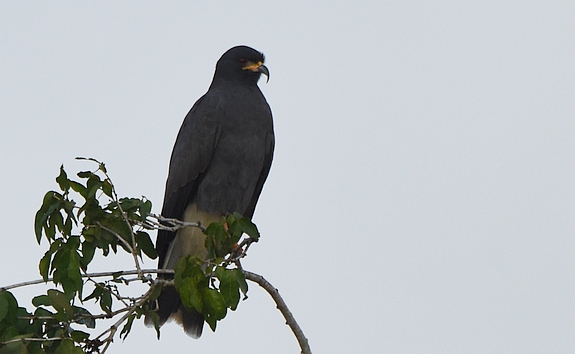
Another species I was hoping to connect with on this trip was Great Black Hawk, which I had only seen once before. This really confiding bird was the first adult I've ever seen. Up close, it has quite a different look to it than a Common Black-Hawk, though at the same time I'm not sure I can put my finger on it...there's more majesty there. Cool to see the fine white barring on the thigh so easily.


In Belize, sorting Common from Great Black Hawks is relatively easy, as Common Black Hawks largely stick to coastal areas, with Great Black Hawks dominating everywhere else. We did not find any birds of either species that deviated from this pattern.


If this bird looks familiar to you, you've either birded in the Neotropics before or you've seen too many pictures of the Maine Great Black Hawk (rest in peace) on Facebook. This immature can be easily told from Common Black Hawk by the lack of a malar stripe.


The last time I saw one of these, it was still called a Gray-necked Wood-Rail. Now, it's a Russet-naped Wood-Rail - it's new sister species, Gray-cowled Wood-Rail, only comes as far north as Costa Rica. You don't need to go on a boat to see these, but these flashy things are hard to ignore.


A species I knew we could see from the boat, but I did not expect to see, was SUNGREBE. If there is a bird with an air of mystery about them, it is the Sungrebe. Don't believe me? Well, they are the only member of the tiny and bizarre Finfoot family in the New World and - apparently - the males allegedly have pouches under their wings where they can carry chicks...while flying.

WTF

This boggles the mind. I had seen Sungrebe before, but this was news to me. If your mind is not boggled by this fact, even if you already know it, then you are clearly operating with some kind of defect and I suggest you seek help. I found a recent blog post on this exact subject if you care to learn more...it turns out to be something ripe for further investigation.


As I said, this is a bird of mystery. It was invigorating to get to see these bizarre river lurkers again after almost a decade. Oh, apparently they have crazy striped feet too, which I have yet to see IRL but I think it adds to their weird goodness/good weirdness.


The Crooked Tree boat trips are legendary for consistently finding Jabiru, and we did find one at the very end of the trip. My photos won't go down in the long and storied history of Jabiru crushes, but it doesn't matter...Jabiru Jabiru Jabiru Jabiru Jabiru yeeeeeeeeeahhhhhhhhooowwwwwwwwww what a good bird.


Things haven't quite been the same since seeing Jabirus. I think I am now in the post-Jabiru era of my life. In these times that seem so constantly filled with fear and loathing, it's comforting to know that there are massive Jabirus out there doing fascinating Jabiru things.


Here's another photo of a bird I mentioned lifering in a previous post, a Black-collared Hawk. These range from eastern Mexico down into South America, but are very patchily distributed in Central America. There are so many species of raptors to be found in Central America, but this is one of the most unique! It is the only member of its genus, Busarellus, it eats fish, and it is shaped like a Black-Hawk but is mostly rufous with a white head. Brilliant.


Of course, Crooked Tree isn't someplace a more familiar fish-eating raptor would pass up and we saw a handful of Ospreys.


Everyone loves Boat-billed Herons. Those who don't have simply never seen one...or have no soul, one or the other. Boat-billed Herons are not uncommon and are pretty widespread in the Neotropics, but are usually much easier to see by boat than on foot due to their preferences for roosting sites. I'd really like to see that boat/giant black oil sunflower seed of a bill in action someday. We saw a few Boat-billeds and I gather they are very reliable on Crooked Tree boat trips, I only regret not telling Leonard to get closer for crushing purposes.


And just when you might think that Northern Jacana is a reasonable, unremarkable bird....


...out come the LONG TOES and the charade is over. Unbelievable. And don't get me started about the weird nub-spurs on their wings.

Phew, I think these photos cover the boat trip pretty well, but should also mention that the passerine birding isn't half bad either. Crucially, this boat can deliver Agami Heron, one of my most wanted birds, but through that day none had been seen the entire winter...no, the first Agami Heron of the year was found on a boat that went out the next day. Fuck! Fuck! Need to see that bird something fierce, I don't understand why it isn't talked about more. Can someone tell me what it is like to see an Agami Heron? Do they make you a cry a lot? Pretty sure that's what I would do.

Even without Agami, birding the lagoon by boat was extravagantly good. Do it if you get the chance!

Thursday, July 28, 2016

Sierra Summer Birding Part II


Ahhh...this next batch of blogs is going to be very refreshing. Refreshing like how this Osprey feels when diving into a lake at 9,770 feet at Virginia Lakes. You see, I've largely managed to escape the "summer doldrums" this year, which is an important thing to avoid if you want to keep your birding sanity. Mountains have everything to do with it, not to mention early fall shorebirds...but that is for a later post. For now, its back to the Sierras.

After breakfast with the rosy-finches, Billy and I rolled down to the Bodie Hills to track down Pinyon Jays and Juniper Titmice. A jay abided, the tits did not. We did get a quality wildflower show, and Billy managed to find a solitaire nest under a boulder...a lifer nest! After leaving the hills, it was north to Bridgeport Reservoir, which I hadn't birded in many years. The south end was very birdy and coughed up a few county birds, the best of which was a distant Bald Eagle. In the afternoon Lee Vining Creek Delta (just north of Lee Vining, on Mono Lake) relinquished a few more interesting birds, in the form of Whimbrel, Caspian Tern, and some Great-tailed Grackles.

The following day we birded along the south shore of the lake and the "Mono Mills" area. Navy Beach was hella birdy, but since it was early June the diversity of species was abhorrent. Bleak, but as all the local birders must know, the potential here is real.

All in all it was a solid trip. We birded, we camped, we drank, we transported Art, and I turned 34. I'll just put up some photos now.


MacGillivray's Warblers were everywhere in the mountains. This bird was vigorously singing at our campground in Lee Vining Canyon, former home of The Grub. The Grub now lives at a nearby undisclosed location, where he has hummingbird feeders up that are currently being very well attended. That's right, The Grub has become a Geribirder.


This bird had raging hormones and let me approach as close as I could while it sang away...pretty crippling looks, probably the best I'll have of the bird this year. And who was MacGillivray you ask? William MacGillivray was a Scottish ornithologist. John James Audubon was his bro (brornithologist), and named the bird after Willie Mac. The species was actually discovered by John Kirk Townsend (of solitaire and warbler fame).


This Gray Flycatcher was south of Mono Lake, just west of the big Jeffrey Pine forest, out in the sage flats. We also had another Pinyon Jay out here, which is pretty typical despite the fact that we don't associate them with treeless areas.


As the #7 U.S. birder (according to the Global Birder Ranking System), I have something to admit to you all...aside from Buff-breasted Flycatcher, Gray Flycatcher is the easiest Empidonax to identify north of Mexico. Think about it...Willows look like Alders, Leasts can look like all sorts of things, Duskies look like Hammond's, Pacific-slopes and Cordillerans are identical, Yellow-bellieds can look like Leasts and Westerns, and Acadians can resemble all manner of things if seen poorly enough. Unlike these other species, Gray Flycatchers look incredibly consistent...in my experience they display little variability in color of the lower mandible and overall plumage. The long bill, dull color, stubby primaries, and amount of orange/yellow in the bill are very dependable field marks...the most variable field mark to me is the eyering, which can be weak to moderately bold. I reckon it is a pretty easy bird to identify, even without their distinctive summer/winter habitat preferences and tail-dipping habit that a lot of birders like to key in on.


The Jeffrey Pine forest south of Mono Lake was carpeted in Dwarf Monkeyflower. It was most mellow. This is a Pinyon Jay stronghold, the most reliable place to get them that I can think of. I imagine that every Pinyon Jays knows of this place, for it is sacred to them.


Huge blankets of the stuff turned the forest floor pink. Facemelting.


I thought this was a boldly-marked Sagebrush Lizard at the time, but now am not so confident about that. Birding is hard.


The Mono Basin is filled to the brim with Sage Thrashers in spring and summer. Funny how out-of-range Sage Thrashers tend to be so approachable, but they have always kept their distance from me in the places they "belong". One thing is for certain though...they belong in my heart.


Absurd numbers of Violet-green Swallows breed around Mono Lake. Tufa towers make very good homes apparently.


They also make good perches. For crushing. This Violet-green is not only sitting on tufa...it is being framed by tufa. Does anyone want to see my exif data for this photo? This was not in Colorado. And if any of you get that joke, my work is done here.


Ok, my work is almost done here. I'll leave you today with an excerpt from William Dawson, who has no equal in the realm of birdwriting.

What shall we do for the Violet-green Swallows? Simply this: we will call them children of heaven. 

To appear to the best advantage, this child of heaven should be seen on a typical California day, burning bright, when the livid green of back and crown may reflect the ardent glances of the sun with a delicate golden sheen. The violet of upper tail-coverts and rump comes to view only in changing flashes; but one catches such visions as a beggar flung coins, and adds image to image until he has a full concept of this rainbow hue. At such a time, if one is clambering about the skirting of some rugged precipice in Yosemite, he feels as if the dwellers of Olympus had come down in appropriate guise to inquire his earth-born business. Not, however, that these lovely creatures are either meddlesome or shrewish. Even when the nest is threatened by the strange presence, the birds seem unable to form any conception of harm, and pursue their way in sunny disregard. Especially pleasing to the eye is the pure white of the bird's underparts, rising high on flanks and cheeks, and sharply contrasting with the pattern of violet and green, in such fashion that, if Nature had invited us to "remold it nearer to the heart's desire," we must have declined the task. 

Wednesday, February 3, 2016

Winter Mexican Tour Y2K16, Day 6: Chacalilla and Chenchoing Part I


On the morning of Day 6, we returned to Chacalilla, parking at a random spot near the north end of town and birding our way out along the main road that leads directly north (out of town) until we ran out of decent habitat. We did pretty well, and I got a life bird (Elegant Quail), though that is definitely going on the "better views desired" list. We had also seen them them on the east side of town a couple days earlier, but I got shit looks. I suspect there might be better roads to bird in the area than the northern one but we did end up with a pretty impressive species list that morning. Along with some big mixed flocks in town, there were also a number of grackle-esque Sinaloa Crows, which never failed to hold my interest despite being crows.


Great-tailed Grackle on the left, grackleesque Sinaloa Crow on the right.


Along with Sinaloa Crows, one of the most abundant local specialties in the area is Golden-cheeked Woodpecker. They are loud, conspicuous, and seemingly everywhere.


Our first Bare-throated Tiger-Heron of the trip was perched on a snag in a dry field, scanning/lording over its domain.


Weird birds. Such thick necks. We got to hear them doing their low grunting sounds at Lower Singayta, which was a nice lifer vocalization.


Cinnamon Hummingbirds are very common in the lowlands of Nayarit, Jalisco and Colima. Go there and you will see many, and inevitably begin cursing their abundance when you begin struggling with finding other hummingbird species.


Cursed abundance aside, it is a very attractive bird with an attractive tongue.


I find Groove-billed Anis to be fascinating. Anyone else feel this way? I can always stop and look at anis, even when there is more facemelting stuff available.


There were a good number of raptors in the area...here is an immature Zone-tailed Hawk, which were a fairly common bird to find during the trip. You can view our heavy eBird checklist from the morning here. Definitely consider birding around Chacalilla if you ever bird San Blas, it has hella species and is a quick drive from San Blas.


Here is Flycatcher Jen, gently caressing the love of her life, Campana. Campana lives, more or less, at the Bucanero (our motel in San Blas). Campana is one of the perks.

As we finished up our morning of birding at Chacalilla, we weren't sure how the rest of the day would play out. What we wanted to do was go on a boat trip with Chencho, the now world-famous guide who is notoriously good at showing birders waterbirds, which he knows the names of in English. Chencho could get us Northern Potoo. Chencho could get us Rufous-necked Wood-Rail. Chencho was a birding god as far as we were concerned. We did not want to go with anyone but Chencho...however, we made no prior arrangements with him. I was told he could be reached through Hotel Canela Garza, so we went there, but the lady working the desk did not acknowledge knowing of his existence. Then we went to the spot next to the bridge where a lot of tours leave from...but we were told that Chencho launches from the other side of the bridge. So we went over there, and of course Chencho wasn't there. Then we got Chencho's cell number from Mark Stackhouse, but our motel didn't have a phone we could use. This all happened over several days. Chencho was becoming a mythical figure. Finally, on the way back to town from Chacalilla, we went back to Chencho's launch. Dipper Dan talked to a guide there who knew Chencho, who then drove away on a bike to get Chencho, who then returned with Chencho's son (also named Chencho, I believe), who then told us that Chencho Sr. would meet us later in the afternoon for a bird trip. It was a Mexican Miracle.

If any of you want to try a similarly unplanned, haphazard way of finding Chencho, he launches from a spot on the west side of the river next to San Blas, just south of the bridge into town, at the end of the only paved street that gets anywhere near the base of the bridge. Its easy to find. Chencho said he works in a cooperativo, and that there are only two other bird guides who do river trips, I think they were Oscar and "Huevos"? Why "Huevos", I don't know. Anyways, if Chencho can't take you I guess look for them.

Chencho did show up that afternoon, giant spotlight in hand, and it was all smooth sailing from there.


Great Blue Herons hunted in the shadows of the mangroves.


Ospreys soared with the frigatebirds above the river.


Anhingas offered some more exotic flavor.


Anhinga feet. I don't think I've really looked closely at Anhinga feet before...they're yellow, weird and muscular. What cankles.


Very early on in the boat tour, we were dealt one of the highlights of the trip, in the form of Rufous-necked Wood-Rail. Astonishingly, we saw two different Rufous-necked Wood-Rails on opposite sides of the river. It was astounding. I couldn't fucking believe we got to see two of these things, let alone one, and no playback was required. I really didn't think we would see one, and this was one of the top target birds of the entire trip. Dipper Dan spotted both of them, and he all got extra sloppy HJs from us that night. I'm no wood-rail expert, but I'm pretty sure the only reason we saw them is because we were looking for them at a lowish tide; if the tide was too high the birds would be back in the dense mangroves and thus not visible.

Although this photo is absolutely not worth bragging about (though seeing this species is), I'm amazed I even have an image that is recognizable; I managed one frame, focused on nothing but pitch black shadows, and somehow got something. They look much, much better than this in real life, I assure you.

More birds provided by Chencho coming soon.