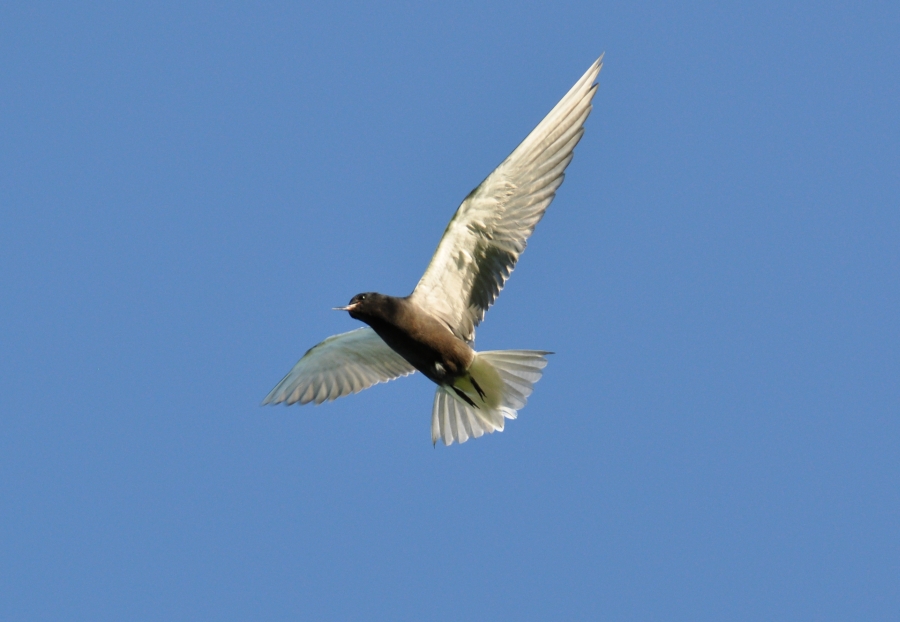
Showing posts with label Semipalmated sandpiper. Show all posts

Monday, December 11, 2017

Rarities Return, Featuring: Parakeet Auklet, Little and Red-necked Stints!


Every now and then a birding community will be struck by a rarity so bizarre and unlikely that we are left running around slamming into walls, foaming at the mouth, bleeding from headwonds, uttering incoherently about needing to be somewhere, at any cost. A Parakeet Auklet in July (July!) in San Francisco did exactly that, smashing the 2017 summer doldrums into oblivion and sending birders scurrying to SF. The story of how this vague runt was found was truly unlikely; a birder found it in the water off Sutro Baths in the summer of 2016, but it was never seen again...a year later, the same birder relocated the bird while kayaking less than a half mile further up the coast. This time, the bird was seen sitting on seastacks and cliffs, which as far as I know is the first time a healthy individual has been seen on solid ground in the state. There is a good chance the bird was doing the same thing the previous year, but no one saw it!

I appreciate a good Parakeet Auklet, and this being a good Parakeet Auklet (and a state bird) I dragged the family up to the city kicking and screaming for a chance at this bird...but despite staking it out for hours, it never showed. It was a tough dip to swallow, and most everyone who actually dips will tell you that all dip is tough to swallow to begin with...I'm talking about chewing tobacco of course, but hey it applies to birds as well.

While doing the drive of shame back to San Jose, I analyzed my chances of getting the bird the next morning if I made another chase attempt and decided against it...which I immediately regretted the next day when the bird was relocated quickly. My heart was filled with hate. By mid afternoon I was twitching uncontrollably from the constant updates of resightings, said "fuck it" and rocketed back north. This time I found the bird in about 30 seconds, circling behind Mile Rock. It eventually landed on a distant rock just a stone's throw from the shoreline, which I pointed out to several birders who were clearly there for the same reason as me.


Incredibly, one of the birders I updated totally ignored what I had just said, and instead told me that he believed the bird was currently sitting on a seastack right below us. Keep in mind I had a spotting scope and he did not, so I must have seemed absolutely incompetent to him. Friends, do I give off an air of complete ineffectiveness? For those of you who haven't met me, next time you encounter a birder in the field that you believe has utterly no idea what they are doing, just go ahead and assume it is Seagull Steve.

I had to look at this man's auklet, of course. It turned out to be not a guillemot, or an oystercatcher, or a black bird of any sort...it was a shadow. A shadow.

I booked it to where the actual bird had been sitting and eventually ended up below it, as it had flwon from its rock and was roosting high up on a cliff. Talk about something I never expected to see outside of Alaska. July in San Francisco? Get out of here. State bird! Though California has accrued quite a few records now, this is a very unreliable bird to see anywhere in the state....as Flycatcher Jen would tell you, good times.


July isn't all state birds and Parakeet Auklets though. Least Sandpiper is much more typical birding fare around these parts, and much more confiding as well. Photographed at Don Edwards NWR.


My god...could it be? SHARP-TAILED GROUSE???

No, it can't be, but this Least Sandpiper is striking a pose remarkably similar to what displaying Sharp-tailed Grouse are known for. This bird was having a territorial dispute with another Least.


Remember the barren dowitcherless times? It sure is nice to have dowitchers again, especially pink and orange ones. I think these are all Long-billed.


On another July day, I was out birding and saw a report of an alternate plumage Little Stint that was within easy driving distance. It wasn't a lifer/state/county bird, but seeing as I had gotten to look at all of one (1) before, I picked up the scope and hustled back to the car. The instincts that made me the Global Birder Ranking System's #7 US birder made me stop and scan a blackbird flock just long enough to find my county Yellow-headed Blackbird on the way back, and I was still able to make it back to the car quickly. Things were going splendidly. Unfortunately, at that point my instincts ceased to serve me well...in my haste to get on the road, I broke off TWO door handles to my car. What the fuck?! Who does that? This wasn't even for a life bird. That's what those two gray things are in my palm, freakin door handles.

And to top it off, later that day I was playing bass and I ripped off the plug to the amp from the power cord. Nerd strength was just pumping through my veins that day.


But hey, I saw the Little Stint! Talk about a completely rubbish photo (digiscoped). The light wasn't great and the bird wasn't very close, but I did get really nice, prolonged views. Lifer plumage! Year bird! It was nice to continue my long running streak of taking terrible stint photos.


A few days later I went back to see if the stint was still around (it was not), but I did find a very interesting peep that had me confused for a bit. Not that you can tell, but the bird's back was very bright and boldly marked, with lots of orange and red tones. With the short, straight, tapered bill, it was an intriguing combination, but at the end of the day it was just a Semipalmated Sandpiper.

Just a Semipalmated Sandpiper? That's a bit of an understatement...despite a great deal of looking at peeps all around the bay for many years now, until this bird I have never been able to find one in any bay area county. Anyone who has birded much around here would find that baffling, and they would be right. This was a hard-won bird, thus you are forced to look at a photo (digiscoped) so awful that it is, in fact, art. It was also the most colorful individual I have ever seen, but again you cannot make that out whatsoever. Because art.


Sorry about the run of appalling photos. Here is an alternate Western Sandpiper pondering life in its reflection. This looks to be a male, judging by the relatively short and straight bill.


This adult has already acquired a lot of basic plumage, but retains some old summer chevrons on the breast. More of a femaley bill on this bird.


Oh why hello RED-NECKED STINT. It sure is nice to see Red-necked and Little Stint in the same week! That's California birding for you. This one was at Elsie Roemer Bird Sanctuary in Alameda. As I mentioned back in 2015, this place had been due for a great bird! As with my other Red-necked Stint experiences in California, nice prolonged looks at a spiffy alternate bird that was either distant or in crap light. Not sure how that keeps happening, but when one is looking at a stint one cannot complain. But now I really, really need to get a good photo of some kind of stint eventually...
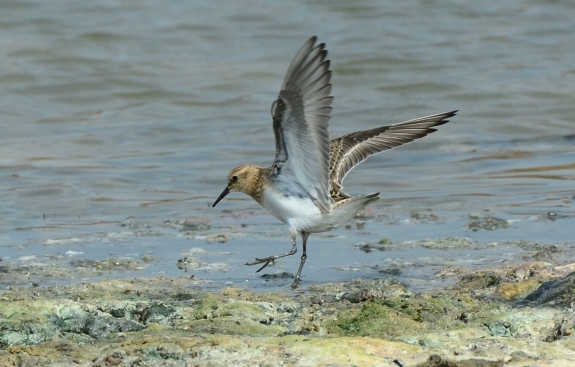

Although they don't inspire the panic of a stint, Baird's Sandpiper is a refreshing fall migrant that only has a short window here. They are refreshing birds in and of themselves, but their presence is always a tasty precursor of things to come...if you are looking at a Baird's Sandpiper in California, chances are you are only a few weeks away from experiencing that holiest of months, SEPTEMBER.

I know, I know, you can roll your eyes, we are far removed from September, but I'm getting there! I won't say that blogging is hard (it isn't, despite everyone who starts one and then gives up), but I will tell you that blogging with a baby is hard. As Corey Finger rightly pointed out to me last year, it's not that you won't have time to bird anymore once you have a baby, it's that you won't have time to blog. This is true.


Refreshing birds are often found in disgusting places. That's not a gross mudflat the birds are on, it is a much filthier floating mat of algae. Juvenile Least Sandpiper on the left for comparison.


Has any bird mastered the filthy floating mat dance like the Baird's Sandpiper? Unlikely.


Ok, I'll throw in a token resident bird, and one that BB&B doesn't cover much. This juvenile California Gull was also holding down the algae mat along with the peeps. I know birders in most states don't get to see this short-lived plumage very often, and we are balls-deep in gull season right now, so enjoy! The Baird'seses and the gull were at Coyote Hills Regional Park in Fremont, CA.

Thursday, September 20, 2012

Salton Birdscapes


From left to right: Semipalmated Sandpiper, Western Sandpiper, Wilson's Phalarope. The sandpipers would frequently fight over a desired piece of mudflat, while the phalarope would referee.

When discussing birding the Salton Sea with nonlocal birders, a common response is wide eyes, a slack jaw, and incoherent jabber about bird-related jealousy. This routine typically winds up with "I've been meaning to go there for years now" or "I would kill 6 infant children with a hammer for the opportunity to bird the Salton Sea".

The fact is that you don't need to be a high-ranking power-birder, or murderer, to get access to the sea. It's right there, waiting to be birded. But with (generally) retreating water levels and ongoing salinity increases, its unclear how long it will remain the hotspot that it is. What are you waiting for?

Aside from the quality of birds there and high vagrant potential, the sheer numbers of birds there is a spectacle in and of itself, which I guess will serve as a loose theme for today's photos.


American White Pelicans. Lots of them. Photographed at the west end of Bowles Road.

Yellow-footed Gulls and Snowy Egrets. Interestingly, the bird on the right is much smaller-billed in comparison to the others...I'm not sure what to make of that. South end of the Salton Sea.


Tens of thousands of birds. West end of Bowles Road.


Staggering numbers...the mind reels. Bowles Road.


A Stilt Sandpiper shuns its comparatively abundant dowitcher bretheren. The Salton Sea is the best place on the Pacific Flyway (at least, in the Lower 48) to find this species in numbers. Bowles Road.


The sea is saturated with Black-necked Stilts. Wister Unit of Sonny Bono Salton Sea NWR.


American White Pelicans and Snowy Egrets. West end of Young Road.


This is a classic Imperial Valley scene. White-faced Ibis, alfalfa fields, geothermal power plant, bleak martian landscape in the distance.


This Black Tern formation looked like they were trying to tell me something. Stay positive? Photographed from the north end of Garst Road.


Black Terns and assorted shorebirds litter the mudflats. North end of Garst Road.


A big group of Gull-billed Terns. Look carefully and you may be able to pick out some Stilt Sandpipers in with the dowitchers. In fact, you are not allowed to look away from this photo until you do. West end of Bowles Road.


Not a good picture, but the cormorant on the right is a Neotropic Cormorant, one of 2 that I oogled  and ogled that day. This olivaceous shag is a very rare bird in California, but the Imperial Valley is a great place to look for them. South end of the Salton Sea.

Sunday, September 16, 2012

The Wrong End of the Rarity Spectrum


Red-necked Phalarope. Hopefully I'll be drowning in their Red (yes, Communist) cousins on Saturday in Monterey Bay. Point Mugu, CA.

I write this after a long and mixed-bag kinda day out on Point Reyes. I did manage to get 2 year birds (Blackpoll Warbler and American Redstart), but was hoping for something more on the MEGA-CRIPPLER end of the spectrum. The fog was not conducive to that. Nine (9) warbler species was nice though, and I couldn't even find an Orange-crown.

You will be reading this the day after what will probably be my last pelagic trip of the year. Photos and stories of Epic Glory (or Tragic Woe) to come soon. See you next week!

My first (and last?!) Semipalmated Sandpiper of the year. Obviously, I haven't been as mobile in 2012 as previous years...that will all be changing soon. South end of the Salton Sea, CA. 


Here is an Osprey doing its best phalarope impression. I don't blame it, it was hot out. South end of the Salton Sea, CA.


Tuesday, August 28, 2012

Felonious Jive Ensnared In Birding Row


The Salton Sea trip was, in Borat parlance, Great Success. My car did not die, I saw a lot of birds, a few rare birds, and I even got a year bird; this Semipalmated Sandpiper (photographed at McDonald Road).

While I was away, The Great Ornithologist Felonious Jive made a few notes on how to be a better online birder at 10,000 Birds. Some pundits have considered his notes to be a formal declaration of hatred of all nonbirding humanity. Is this really what he said? I'll let you decide.

Thursday, March 15, 2012

When I Knew To Stop Looking

In an instant this first-year Herring Gull has transformed from a disgusting garbage-eater to a mind-boggling contortionist. Note that the preen gland on it's upper tail is exposed. Lake Merced, San Francisco, CA.

Good Thursday to you nerds. The only loose theme running through all these pictures today are birds doing some interesting poses...I purposefully avoided posting anything too graceful (well, except for the terns) as it would just be too easy to slap a bunch of herons and egrets in here and call it a day. Oh yeah, no flight shots either, them's the rules.

The crystal ball that is seasonal bird work is beginning to clear...my destiny grows easier to see by the day...an official migration announcement should happen soon!

A Bobolink takes a break from being Lord Of The Prairie and stretches out. Do you see how sharp it's tail feathers are? They have rapidly evolved in the past few decades to stab bird banders...interestingly, their distress calls given while in the hand sound uncannily like "I'm giving you tons of bird lice right now" and "I'll see you in Hell". Lostwood National Wildlife Refuge, North Dakota.


Since they are so big-bodied, Canvasbacks often appear somewhat stubby-winged. This female is trying to buck the trend...I think she pulls it off. Lake Merritt, Oakland, CA.

Of course, courtship and territorial displays frequently entail some bizarre posturing. These male Great-tailed Grackles are both telling each other "Why don't you come at me bro?". Chavarrillo, Veracruz, MEX.

While appearing superficially gull-like on land (and somewhat confused to be on land in the first place), albatross become entirely different beasts when it comes to dancing. These Black-footed Albatross were seducing each other with their sick moves at Midway Atoll.

White Terns look good, there is no denying it. But when it comes down to making babies, they make it look more like a miracle. I can't tell you how many tears I shed watching this...eventually I ran out of water and cried blood. That's when I knew to stop looking. Midway Atoll.

Going from no-necked to fully extended, a Thick-billed Murre takes a gander at something on the cliff below. In a moment it will return from its moment of quasi-elegance to being fat, squat and cute. Buldir Island, AK.

Other birds aren't blessed with such long necks. This is about as far as a Clay-colored Sparrow can stick it's head out. It still a good-looking bird though (obvi). Des Lacs National Wildlife Refuge, ND.


A Double-crested Cormorant throws it's wings out for air brakes and balance as it makes a brilliant landing. Lake Merced, CA.


While many sandpipers are comfortable being cloaca-deep in putrid mud, this Semipalmated Sandpiper is apparently a bit too dainty to get it's feathers dirty. It's wings are out for balance, to keep from sinking in too deep. White Lake, ND.


I know what you are thinking..."Whoa. I am really drawn to this image...it's affecting the shit out of me. It is a thing of beauty. I've never seen anything like it." Yeah, you guessed it, this is absolutely ART. That's why you are feeling so many emotions right now. You may also be feeling some jealousy, since this is actually a Slaty-backed Gull. Buldir Island, AK.


Some birds just aren't cut out for being graceful. This soggy Black-crowned Night-Heron was photographed at Lake Merritt.

Saturday, August 6, 2011

Thou Shalt Not Partake of Decaf


Black Tern. If White Terns were almost renamed Angel Terns....then this would have to become Reaper Tern, or simply Angel Of Death. If you're going to go giving birds Christian names, you gotta go all the way.

Good day to you, Bourbon, Bastard and Birder. While you are most likely relishing the taste of juicy freedom that is Saturday, I've got a big storm keeping me indoors...so far its been a day of coffee, bagel, Descendents, Drag The River and the internets. Tomorrow I'm heading out to check on our very last Piping Plover brood of the summer, and then it's going to be essentially killing time before I take off for Yellowstone National Park in a few weeks. I'm pretty stoked.

Here's some assorted North Dakota and Montana photos. Have a great weekend nerds.


Nobody wants to get stuck in the mud, just ask this Semipalmated Sandpiper.


An Eastern Kingbird, complete with skirt.


The backyard. Lostwood National Wildlife Refuge, ND.


Mountain Bluebirds invented their own shade of blue.


Red-winged Blackbird. They nice.

 My, what eyes you have dragonfly. The dragonfly densities in North Dakota dwarf anyplace I've ever been, although I think we passed the peak of the season. They are still flying around attached to eachother though, making sweet sweet dragonfly love. Can you imagine going for a walk while having sex? I can't either.


Blue-winged Teal seem to be the commonest waterfowl around these parts...none of them look like this anymore though. All of the ducks are now in their hideous eclipse plumage now, they make me sick.


North Dakota Home Entertainment System.