
Someone recently suggested that this Tufted Duck was a hybrid because of the tiny gray patch at the rear of the bird's flank, which came across as a real facepalm moment. This is part of a disturbing trend, and it must be stopped. Photographed at Lake Merritt, Oakland, CA.
Hybrid Theory: The assertion that an identification cannot be made because the bird in question does not conform to readily available field guides. Therefore, said bird must be a hybrid. Proponents of hybrid theory often do not take into account natural variations in plumage, leucism, pollen stains, etc. that could render a bird to appear differently than in field guides.
Birders are in to birding for many reasons, some of which rank higher on the moral and spiritual scale than others. But one thing all of us can agree on, whether you are the nation's #7 birder or a noob, is that we enjoy being correct...specifically, correctly identifying a bird.
Correctly identifying a bird, be it by eye or by ear (and for some bird-wizards, by smell), serves two purposes. One is that bird identification is a skill we all want to be good at, and we can't enjoy new and unusual (or old and ordinary) birds if we don't know them when they are right in front of us. Two, since birders are rooted deeply in nerddom, we really, really just want to be right. The latter tendency frequently manifests itself in the forms of petty fights on forums and listservs, which you are all familiar with, for good or ill.

But what happens when you don't have the chops to make a tough identification? Rather than abstain from identifying the bird at all (often a very respectable decision, I might add), a birder succumbs to his/her urge to put some kind of name on bird. Alas, the confused birder calls it a hybrid.
Perhaps you knew all this already...but BB&B is here today to make the bold assertion that the increasing use of Hybrid Theory is not a result of increased hybridzation among birds or an increased wealth of knowledge about interbreeding...unfortunately, it is nothing but good old fashioned laziness.

This sparrow looks like a Clay-colored sparrow...but the unusual dark mark above the eye points to a mixed ancestry...right? No. Missing feathers (often caused by a close call with a predator) can significantly alter a birds appearance. Photographed at Sutro Heights Park, San Francisco, CA.

This albatross looks like a Black-footed...but the excessive amount of white on the head points to a mixed ancestry...right? No. Feather wear and sun bleach can significantly alter a bird's appearance. Photographed off of Monterey, CA.

This hummingbird looks like a Costa's...but the excessive amount of darkness on the throat points to a mixed ancestry...right? No. Immature birds are frequently in a state of molt not well-illustrated in field guides. Young male Costa's typically show a dark throat patch. Photographed at Agua Caliente County Park (in Anza Borrego State Park), CA.
Even with the HUGE caveat that yes, large gulls get it on with just about anything that has a cloaca (ducks and geese aren't exactly picky either), I am astounded by how often birders seem to go with the Hybrid Theory whenever they are faced with an unusual bird. Despite how things are now, it has not always been this way. Generally speaking, hybrid birds are pretty rare. Much more likely are birds that simply don't match the field guides for whatever reason. Think about it; field guides attempt to encapsulate species that may have populations of millions with 3 or 4 pictures or illustrations...no matter the quality, the books are bound to fail for some individuals.
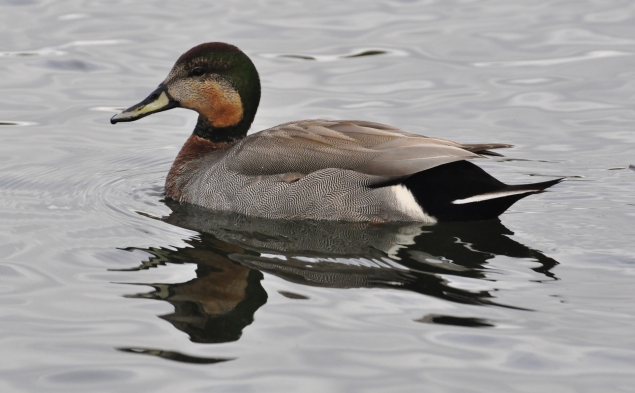
Now for some real hybirds...here is well-known one, a Mallard X Gadwall. Mallards will breed with practically anything, given the chance. Let's hope that they do not begin interbreeding with gulls...then all hope for birdkind will truly be lost. Photographed at Santee Lakes, Santee, CA.

American X Black Oystercatcher, one of at least two who have made this site their home for the last couple of years. I can think of at least one well-known county lister who giddily ticked off this bird on their county list as an American Oystercatcher...but of course, that is called "stringing", not Hybrid Theory. Photographed at the Ventura Harbor, Ventura, CA.

Lazuli X Indigo Buntings turn up from time to time. This bird was photographed near Pierre, South Dakota. Photographed by Caity Reiland-Smith.
Some commoner North American hybrids aside from gulls and waterfowl: Anna's X Costa's Hummingbirds, Red-breasted X Red-naped Sapsucker, Black-capped X Carolina Chickadee (Master Sibley gives good info on this brutal intergrade here), Hermit X Townsend's Warbler, Golden-winged X Blue-winged Warbler, Tropical X Northern Parula, Eastern X Spotted Towhee and Bullock's X Baltimore Oriole. That may sound like a lot hybrids, but compared the thousands of feasible combinations of bastard bird hybrids out there, it's really not much.
My advice? Don't go with the Hybrid Theory unless the bird is clearly riddled with intermediate characters. Scrutinize the shit out of the bird. Learn about what hybrids regularly occur, and what they look like. Unless you are intimately familiar with the published literature (I'm talking scientific papers here, not run-of-the-mill field guides) regarding the appearance of hybrids and variation in the parental species, you should know you are probably on uncertain ground when going the hybrid route...but of course, if you have a high ranking on the Global Birder Ranking Scale, people will most likely believe whatever you say.

Of course, the legit unexpected hybrid does happen from time to time. This apparent Philadelphia X Red-eyed Vireo showed up on Southeast Farallon Island, CA. Photo by Matt Brady.

It helps to have excellent documentation, such as in-hand measurements, when reporting difficult birds like this. For those interested, the bird has some diffuse yellow blotches on the breast, nothing like the strong yellow wash of the typical Philadelphia. Photo by Matt Brady.

