Showing posts with label Dry Tortugas National Park. Show all posts

Thursday, December 20, 2012

The American Mothmasher, The Good Vireo, and The Dixie Warbler


It is December, and I still am not done stoking/bumming people out (depending on your attitudes towards jealousy) on my October Dry Tortugas trip. Hopefully I'm throwing enough other birds in the blog cocktail to keep things interesting...anyways, although American Redstart is one of the most abundant North American warblers, you don't hear anyone complaining. No one doubts the face-melting power of an adult male.


Moths are a popular item for destruction by migrant passerines on Garden Key. They are often a bit big for warblers and vireos to immediately gulp down, so it was not infrequent to see birds brutally bashing them to bits to make them a more manageable size for consumption.


Never have I witnessed such an act of ruthless moth-bashing, but I have to give credit to the redstart for being effective. Next time I am faced with a piece of living food that is too big to swallow whole, I will simply hit it against things over and over again until is smaller.


Booby Brittany photographed this Philadelphia Vireo with a point and shoot. We walked right up to it. Like a dumbass, I did not have my camera on me for some reason. In case you are wondering, yellow vireos are good vireos. In fact, this is one of those species that is often on birders lists for having a crappy name (this is not a particularly common bird in Philly)...why not "Good Vireo"? No one doubts the instrinsic goodness of this uncommon, exceptionally positive bird.


Magnolia Warblers are best observed when on the ground, 10 feet in front of you. This is a bird that warms the heart.


Fort Jefferson. From the outside, looking in.


From the inside, looking out.


Indigo Bunting, probably a hatch year bird. It will be a long stretch of buntingless months before they start reoccupying the country in April.


Why hello Ovenbird. No, I don't mind you hopping around my feet like a goddamn House Sparrow, make yourself at home.


Prairie Warbler is another one of those misnamed birds, although "prairie" does have a nice ring to it. I propose it be rechristened Dixie Warbler. Now that really has a ring to it. Only saw 1 or 2 on Garden Key, although they must move through in big numbers.


One of the most unexpected birds I found on Garden Key was this American Coot. It takes a lot for a coot to make it to the hallowed pages of BB&B, but since this one had found itself in the middle of nowhere, that's good enough for me.

Tuesday, December 11, 2012

Running Amok Around Garden Key


Running amok around Garden Key may or may not yield many birds...but there will always be Sandwich Terns. Well, in fall, at least.

I have crossed the Rubicon (or was it the Eel River?), and finally have returned to Humboldt County, where birds and birders and plentiful and everyone is high (especially the birders). I won't be here much longer, but its been good times. This place has been riddled with birders for years, and its been good to see a bunch of familiar faces again. My 2012 year list has grown to be even more corpulent in the last week, but with Bostick taking a trip to Hawaii, he is back in the lead again. Fuck. Maybe I will end up winning the year in the NIB category (that's Non-Introduced Birds, for you less nerdy people), but he may take the overall cake. Time will tell.

Here's some more scenes from the Dry Tortugas. Its easier to take pictures there than in Humboldt County.


Meet the first Swainson's Thrush to grace the pages of BB&B. This indelible Catharus of catharsis spent a day tamely hopping through our campsite, deftly avoiding the enormous hermit crabs that littered the ground.


Look at this White-eyed Vireo. It looks like it's teleporting into another dimension. That's where they really go in winter.


More teleporting. This one looks more like a Blue-eyed Vireo (***MEGA***).


The outer wall and moat at Fort Jefferson. Not a bad perch up there.


American Kestrels are another one of those birds that can be hard to talk about, because everyone knows what a kestrel is and how great they are. The roof of Fort Jefferson turned out to be a good place to get flight shots of them as they zoomed around having territorial battles.


Northern Parula sez: NOMNOMNOMNOMNOMNOMNOMNOMNOMNOM
NOMNOMNOMNOMNOMNOMNOMNOMNOMNOMNOMNOMNOMNOMNOMNOMNOMNOMNOMNOM


A barracuda making faces.


What a sweetheart.


This was the lone Northern Harrier that made it to Garden Key during my trip. I found her in a frigatebird flock.


Magnificent Frigatebird. The first one you see will trigger an agonizing reappraisal of all the birds you have previously seen that you hold so dear...they can really put the kibosh down on any motivation to watch non-charismatic avefauna.

Wednesday, December 5, 2012

The Tortugan Crocodile Smiles & A Disgusting Mystery Bird


I did not expect to find a crocodile on the Dry Tortugas. The Tortugas are a long swim away from any other islands, and lack any kind of mangrove or otherwise swampy habitat, but I guess that didn't deter this beast. Booby Brittany and I watched it for over a half hour as it bashed, thrashed, and half-swallowed its way through this big bird. It was a bit distant, so the tourists swimming around Garden Key were completely oblivious. A few Key West locals were really impressed I managed to photograph the Tortugan crocodile, as it seems to have a kind of Loch Ness Monster mystique about it. Well, here it is, documented killing the hell out of something.

By the way, much respect given to anyone who can identify the bird that lies between the crocodile's teeth.


This Great Blue Heron stood captivated for the whole grisly affair. It showed no fear of the crocodile.


A Peregrine Falcon was also watching the gory action the entire time. When you have the eyes of a falcon you don't need to be up close.


The Great Blue Heron had the best front row seat though.

Friday, November 30, 2012

Mas Tortugas


White-eyed Vireos were one of the commoner migrants, with at least one anchoring almost every mixed flock I came across...which was frequent, considering I was *ahem* not on a birding trip.

Since I didn't go snorkeling while I was at the Dry Tortugas (land team), I mostly did loops around Garden Key for four days straight, although I did eventually end up swimming for a while on the last day. It was legit, and I didn't even get any jellyfish stings.

As you can expect, I took a lot of pictures, the best of which you will be seeing on here on and off for the next several weeks. Maybe they will compel you to make a trip out there, spring or fall. The birds on this trip left me a bit weak in the knees, which is a feeling any birder lives for. Come to think of it, they will die for it too.


Bay-breasted Warbler (year bird). I only saw 2-3, which is not enough but will have to do for now. I typically go years at a time without seeing these buffy-flanked beasts, they are not easy to come by in California. 


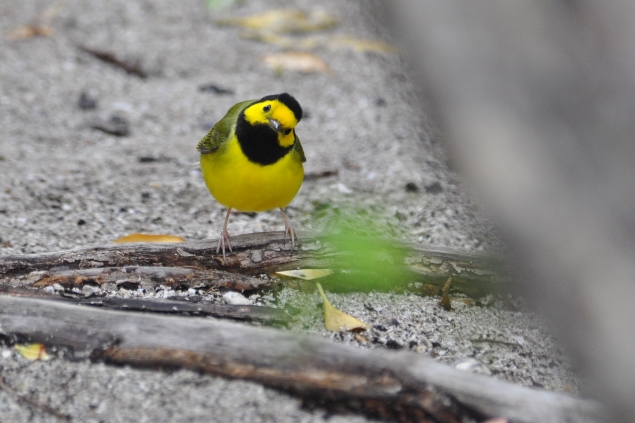
Another shot of the Hooded Warbler that appeared in the first Tortugan blog post. A snazzy bird, which has been documented to cause birders to stutter and foam disgustingly from the mouth.


Normal people on Garden Key would not be happy about this, but ominous skies are a good sign for birders....rain is likely to bring migrating birds down to the islands. 


The seas surrounding Garden Key have the classic hue that any island paradise should.


Mmmmmm, Palm Warbler. There was no shortage of them on Garden Key, but strangely I only saw a couple on my first day, when there were the most birds around.


Brown Boobies aren't very abundant in the Tortugas, but they are really easy to see, since they favor perching on the channel markers that are scattered around Garden Key. As is the case with their bigger, more exotic Masked relatives, the Tortugas is the best place in the continental U.S. to see this species. This is as close as I got to one on this trip.


A number of Great Blue Herons were on Garden Key and Bush Key. This one was relishing having some fresh water after a storm...getting all your water from just eating salty fish probably gets old after a while.


If herons could slurp, this one would be slurping.


See? Here is a fish. If I was birding all the time, I would not have seen this fish. This is some kind of awesome parrotfish. We saw a lot of these around Garden Key and in Key West. They get much bigger than this one. Aside from their brilliant colors that can melt a human face in the blink of an eye, they are known for eating coral and having sandy poop. Can you imagine eating a bunch of coral and then having to pass it? Ouch though.


Warblers aren't the only weary birds that need to take a mid-migration rest, raptors do too. Lots of Accipiters stopped in Garden Key, although I didn't see any Buteos. I'm not sure, but this Sharp-shinned Hawk may be the first one to make it on BB&B.

I lost count of the number of catbirds I saw meet their fate in the talons of Accipiters and Merlins while I was there. The death-squeal of a catbird is not a pleasant sound. The grassy roof of Fort Jefferson is in the background; it's a good place to watch raptors, frigatebirds, and other migrants come in off the ocean.

Monday, November 26, 2012

Fall Birding in Dry Tortugas National Park


Dry Tortugas National Park is doubtlessly one of the most famous and crushingly good birding hotspots in North America. It is mentioned in the same breath as any incredible place birders swarm to for migration...Cape May, Magee Marsh, High Island...you get the picture. Ever since I was a teenager, I drooled about someday going (yes, I also drooled about girls too). Being out in the open ocean, the Tortugas are a migrant vacuum for landbirds...this is one of the few places you can reasonably hope for real fallout. Equally as stoke-inducing is the great collection of nesting and visiting seabirds as well.

Of course, almost all birders go in spring. That's just how it's always been done. That's when warblers are the brightest, that's when fallouts happen, and that's when you have the best chance at seeing the high-quality terns....Sooty, Bridled, Roseate, and Brown and Black Noddies. Fall in the Dry Tortugas is not something birders seem to know much about...so being the Number 7 Birder in the nation, I decided to do something about it.

In the predawn hours of October 17, Booby Brittany and I managed to make it on to the Yankee Freedom III (after I was almost stranded on a sailboat that was NOT going to the Tortugas, but that's another story). Despite my enthusiastic (bordering on desperate) efforts to find any shearwaters or pelagic terns, the boat ride there (and back) was uneventfu beyond a few boobies and frigatebirds. The only surprising thing was the tens of thousands (hundreds of thousands are more likely) of lobster traps that carpet the ocean between Key West and the Dry Tortugas...I can't imagine that's a very sustainable fishery.

As we arrived at the Tortugas, so did a rainstorm. As we passed Brown Boobies on channel markers and the mini Masked Booby (year bird) colony on Hospital Key, a sizeable flock of birds appeared out of the rain. As they crossed the bow, I got a good enough look to see they were thrushes...a good sign.


The skies can get quite congested above Fort Jefferson, with frigatebirds and raptors being the most obvious. The Tortugas are probably the best and most reliable place for Magnificent Frigatebirds in the U.S., as they are persent in numbers throughout the year. The white-headed bird is an immature, the black-headed bird a female.


Garden Key has a good roosting spot for gulls, terns and shorebirds. A Piping Plover (year bird) roosts with Black-bellied Plovers.

A flock of Magnificent Frigatebirds met us as we docked at Garden Key, and Booby Brittany and I quickly made our way to the campground to stake out a good spot...we were to stay 3 nights, and wanted to pick a place with shelter from the rain. We wound our way through the tame flock of Ruddy Turnstones and Eurasian Collared-Doves (what a weird mixed flock) and finally settled on a spot, where a Gray Catbird eyed us with anxiety. It was a precursor of things to come.

After getting camp set up, we took a walk into Fort Jefferson in the pouring rain. The first bird we ran into was a Hooded Warbler (year bird), followed by a redstart, then a Clay-colored Sparrow...then Peregrine Falcons, Merlins, Cooper's and Sharp-shinned Hawks, a flock of Tricolored Herons, and hundreds of Gray Catbirds. Catbirds seemed to be ravaging the place...practically every tree had its own catbird flock. Finally the storm let up, and I was free to bird unrestrained...to put it lightly, it was intense. I knew things were going to be good when we walked right up to a Philadelphia Vireo (year bird), which paid us no attention at all. There were a lot of birds around, which I finally realized was a result of the storm.

The next day was almost just as birdy (another storm rolled in overnight), but with clear skies things really mellowed on days 3 and 4, although it was not hard to figure out that birds were arriving and leaving throughout the day regardless of the weather. I watched birds like Cave Swallow (year bird), Chimney Swift (year bird), and White-winged Dove fly in off the ocean, only to never be seen again. As always, its great to watch migration in action.


A Black-throated Blue Warbler was one of many birds that caused carnage to my adrenal gland. This was our campsite buddy for a day.


This was the one and only Veery I saw while out there. I like it's facial expression. Despite the sizeable thrush flock that flew over as I arrived, the only thrushes present were this Veery and a few Swainson's.

The campground turned out to be one of the best spots on the island. At one point I watched a Swainson's Thrush hop past my feet and into our tent. A male Black-throated Blue Warbler spent a whole day in and around our campsite, brushing me with its wing as it flew past at one point. Ovenbirds strutted under the picnic table while we sat playing cards. Hooded, Canada (year bird), Worm-eating, Blackburnian, Orange-crowned, Magnolia, Palm, American Redstart, etc. all popped in to our campsite as well...not the campground as a whole, mind you, just at our little campsite. A couple of Piping Plovers roosted with the small shorebird flock at the coaling dock, a stone's throw away.

A couple of Blackburnian Warblers came in with one of the rainstorms and foraged point blank. Some birds out there went beyond "confiding" and far into the realm of "not giving a fuck". Awesome.


This crippling adult male Hooded Warbler was one of the brightest birds at Garden Key during my visit.

All in all it was a completely successful trip. My face was left badly disfigured, almost completely melted off by the avian brilliance, and I have had to spend thousands of dollars on plastic surgery since then. Vireo Vita and Booby Brittany had an amazing time snorkeling, and from shore I was happy to see enormous groupers (bigger than people!), parrotfish and angelfish, barracudas, and even the fabled Tortuga Crocodile, which I understand has Loch Ness Monster status among Key West locals (undoctored photos to come soon). In 4 days I tallied 77 species of birds, including 21 species of warblers...pretty good for a 400 X 500 meter island! It would be awesome to get to explore Bush Key or Loggerhead Key, but that's not something many birders get to do.


Sandwich and Royal Terns roost on one of the the old coaling docks. Both coaling docks are quality snorkel sites as well. Bush Island is in the background; that's where the Sooty Terns and Brown Noddies nest in season.


A Northern Parula takes a break from moth-catching to collect itself.

I would definitely recommend camping on Garden Key, although you have to bring all of your supplies (they do have bathrooms though)...but that's just part of the fun if you ask me. Also, the Yankee Freedom III is docked at Garden Key most of the day, and you are welcome to buy lunch, beer, etc. on board, so you are not really 100% roughing it. It's really nice before and after the boat is around though, because there are fewer people around. Biting insects were few and far between.

Birders should check the campground, the trees inside the fort, and the patch of vegetation that lies north of the campground, outside the fort. Both coaling docks should be checked, and don't forget to frequently look up for incoming wayward migrants. Birds come and go throughout the day so it's a good idea to do the rounds regularly (what else do you have to do?). Hope and prepare for rain. As of my visit the famous water fountain in the fort courtyard was not being used in the fall...Booby Brittany overheard a park employee saying something ridiculous about leaving it off so migrant birds don't try to winter there and die.

The conclusion: the Dry Tortugas have huge potential during fall migration. Of course, now I want to go back in spring...