Showing posts with label Everglades National Park. Show all posts

Wednesday, November 14, 2012

Ospreys, Flycatchers With Forked Tails, and The Manatee Inhales


Good day to you birders. How have you been handling November? Hopefully you are getting sparrowed enough to properly cope with SWAD (Seasonal Warbler Affective Disorder, which seems to only strike birders). Of course, some places are stiill blessed with some warbler diversity, but most of us are drowning in the brown/gray/white sea of Yellow-rumped Warblers that has flooded much of the United States. 

Attempting to escape SWAD, I have been birding a bit locally...my last year bird was a Harris' Sparrow, which I finally nailed on my third attempt...an inspiring Zonotrichia to be sure...photos to follow.

I rewatched The Big Year with Booby Brittany last night, so she could potentially understand my addiction better. Well, as Bostick puts it...its more of a "calling". If you are a birder (or just have the shame of personally knowing one), it's worth watching, although its leaves a lot to be desired. Still waiting, as always, for the Christopher Guest movie.

Right. Here is the last of the Everglades shots.

Florida is blessed with a plethora of Osprey. Flamingo, in Everglades National Park, is a great place to watch them close up.

Ospreys rank in the top 10 species that nonbirders ask me about. This is one of the few relatively noticeable birds someone will notice on a drunken river trip.

Ospreys lack the humungo feet of eagles, but look at the length of those talons! Who knows how many fish have met their fate in the grips of this bird.


Less than a mile outside Everglades National Park, I looked up and saw a couple Scissor-tailed Flycatchers (year bird) perched on the power lines. This is a young bird, lacking the insanely long tail feathers of an adult, but an adrenaline-producing site nonetheless.


Scissor-tailed Flycatcher is a rare but regular visitor (even uncommon?) to south Florida. I also saw one in the Everglades on my previous trip, so it seems to be a good place to find them.


Perched with the Scissor-tails was a Gray Kingbird, which seemed quite late to be remaining in Florida (this was on October 16). Note the deeply-forked tail and excessive drabness. They do have a red crown, but they keep it well-hidden most of the time.


Just the slightest tinge of yellow on the underwing.


I was pretty pleased to run into this bird. I can now claim that I have seen three (3) Gray Kingbirds...this is a great number, because I expected to come back with none at all.


Although the water is murky, manatees are easy to spot at the Flamingo marina. These amazing, incredibly fat creatures are unwary of people here...you can stand right above them on the docks. A tiny calf was among the adults while I was there.


A young Green Heron borrows a pose from the bitterns.


The Everglades are not a "must" for birders (unless you are crazy enough to look for flamingos), but they have many area specialties and are definitely worth checking out.  Hopefully, I will have the sense to go during the dry season next time.

Sunday, November 11, 2012

A Lack of Pronounced Eye Ridges, The Umbrella Move, A Calming Calm


American Crocodile. In the United States, crocs are only found in extreme southern Florida...probably the easiest place to see them is in the marina area and Buttonwood Canal at Flamingo in Everglades National Park. Crocs can be told from gators by their pointed snout, lack of pronounced eye ridges, obvious teeth sticking out, and their preference for salt (and sometimes brackish) water.

How do you like that? Starting off a post with a nonavian organism? Yeah, we get pretty crazy around here, no question.

Now that we know exactly what a birder is, here's another slough of photos from the Everglades for your enjoyment.


I somehow managed to not photograph an alligator while in the Everglades this time, although we saw (and heard!) a few. Crocodiles are listed as "Threatened" in the U.S.


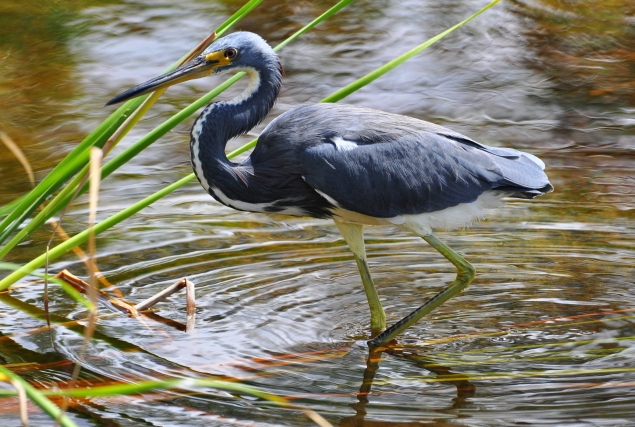
I did not expect Mrazek Pond to be particularly birdy, but there was a lot going on. This Tricolored Heron was feeding hyperactively right next to the road.


Yup, it even busted out the classic umbrella move. Reddish Egrets aren't the only waders that can dance. Nice primaries eh?


Showing off it's tricoloredness while Blue-winged Teal lurk in the shadows.


I really like how the water appears in this picture, even though the heron is a bit backlit. They really are striking birds.


Red-shouldered Hawk is another South Florida classic...it even has it's own subspecies (extimus). They are common and unwary in a lot of places. 


The hawk scans its sawgrassy domain.


The top end of the Buttonwood Canal, nicely framed by mangroves. You need a craft of water to get here...the calm water is indeed calming. Also worth mentioning are the hundreds of White-crowned Pigeons that flew over on the way to this spot.


I think this is some kind of Needlefish (Belonidae). They seem to be everywhere in South Florida and the keys, often right on the water's surface.


White-eyed Vireos are hard to miss in Florida, as with much of the southeast. Their songs are fun to hear, they seem to be gifted with a larger repertoire than other vireos. Whoever named them should get an award for common sense.

Wednesday, November 7, 2012

Everglader


Tricolored Herons are one of those birds I never tire of, they are simply too good looking. Check out that glowing purple nape. I'm glad I lifered with this bird at a young age...if I did it now, the shock could be too much for me to take.

After a week of Key West, Booby Brittany and I struck out for Everglades National Park for a change of scenery. As with my last trip there (also in October), the park was mildly to moderately birdy...because of abundant water within the park, concentrations of birds were few and far between. However, I did up pick up a substantial number of year birds, including a number of species I did not expect to get (i.e. Northern Bobwhite, Brown-headed Nuthatch, Barred Owl). Luckily, I did not relive the death march out to Snake Bight to scan for flamingos...if you ever want to experience a place that makes you long for death, you should try that trail out during the wet season. It is Florida's own Trail of Tears...completely brutal.

All photos in this post are from Everglades National Park.


I like how this Great Egret is slightly backlit...it makes that big bill glow like an avian jack-o-lantern, and makes the nape appear deceptively fuzzy.


An adult Green Heron along the Anhinga Trail; this skulker is just as approachable in parts as Florida as its bigger, flashier relatives.


An immature White Ibis. I don't know how Floridians chose Northern Mockingbird as their state bird, I would have gone the ibis route.


White Ibis stretch and shake.


Immature Broad-winged Hawk. Note the stubbier and (ironically?) narrower wings, which help separate it from the very similar immature Red-shouldered Hawk.


There be dragons...everywhere in Florida. This is a Halloween Pennant (Thanks to ABQbirding for the ID). I can see the appeal in getting into dragonfly listing, although I'm still holding off on that.


Ah, the Anhinga (year bird). This is another one of those classic southern species that really seem to liven up any place they occupy. Although superficially designed like a cormorant, they do their best to set themselves apart. On this trip, they were constantly croaking and bellowing from their mangrove perches. 

Female Anhinga. She reminds me of an old homeless lady in this photo for some reason. Look at the length of that neck! 


This stately Little Blue Heron was one of several misidentified birds given on the boat tour that leaves from Flamingo. Aside from bird problems, the dude giving the tour was corny as hell but had a lot of information on the park's recent history and mangrove forests. I also saw hundreds of White-crowned Pigeons from the boat, which left me in a state of shock and awe.


This Cattle Egret had a gimpy (maybe dislocated?) leg. I'm always impressed by handicapped wildlife that manage to beat the odds and keep on living...reminds me of the stubby Snowy Plover I saw earlier this year that had no feet.