Showing posts with label Yellow-bellied Sapsucker. Show all posts

Wednesday, March 13, 2019

Radius Rarities, Glaucous Glory, Springing


Hey, an uncropped photo! Mourning Dove with a rainbow for a backdrop...MODOBOW. Photographed at the legendary and singular Rancho de Bastardos.

Aside from Belize, the vast majority of the birding I've done this year has been in the 5MR. My sweet, sweet radius, the radius that shelters me. Nourishes me. Asserts its dominance on me...after all, I am but the learner now, not the radial master. I've been checking out new spots, hitting up places I typically neglect, getting a better idea of where to go at the very edges of the radius ("the outer rim"), and of course looking for both new and 5MR year birds for the 5MR Challenge. As with birding in general, there have been ups, like getting my first self found rarity of the year, and downs, like actually exerting effort to find Brewer's Blackbirds...and failing. My radius is neither glorious, nor does it suck...I actually get a fair amount of habitat diversity that I'm pretty stoked about. I also benefit from a moderate amount of coverage from other birders...


Prior to going to Belize, I had dipped a couple of different times on a wintering Summer Tanager that I had seen before the new year...and when I came back, someone had found a new Summer Tanager somewhere else! It was a particularly confiding one too. Photographed at Vasona Lake County Park.


In January, I got three sapscucker species in the radius, Red-breasted, Red-naped and this Yellow-bellied Sapsucker, which has been present since last fall and is probably still present as of this writing. There can't be many other radii out there with triple sapsuckers on the year (none outside California?). Photographed at the Santa Clara Water District.


Clark's Grebe was a new radius bird, one of only a handful so far in 2019. Aechmophorus grebes are plenty common in the county, but noteworthy birds here in my zone. Photographed at Almaden Lake.


Almaden Lake has also hosted some American White Pelicans recently (first these two, now up to four), which are also rare in the area and not something I thought I would see in the radius this year...I was prescient enough to be out checking for grebes, but these illustrious fishlords took me by surprise.


Shorebirds are extremely hard in my 5MR, but at least I have gulls! A great many gulls. Shitloads of gulls on good days, about 98% of which are California, Herring, Glaucous-winged, Herring X Glaucous-winged and Iceland. Like last winter, I've spent a lot of time combing through flocks in the hopes of finding a proper rarity. Photographed at Almaden Lake...again...which is turning out to be more interesting than I thought it was.


Perseverance (agony?) finally rewarded me with a Glaucous Gull. It's been a great many years since I found one of these on my own, I was due, and after so much local gulling I am chuffed that it was here in my radius. It was a really nice looking one, slightly darker than the average first cycle but with heaps of white on the wings and some very delicate covert patterning. Photographed at Almaden Lake.


This is definitely my favorite 5MR bird of the year so far. The gull window will be closing soon, but after seeing this pasty wonder I am sated.

It is odd to have seen a Glaucous Gull down the street this year, but not a Mew or a Western. Yes, I live in a county with salt water and can get find flocks of thousands of gulls in my radius, but Western Gulls are somehow elusive....what gives? Why are Brewer's Blackbirds and Western Gulls so hard to find? Is the fast food in our mall parking lots not savory enough? I don't get it. I've also failed to find an Allen's Hummingbird at all, which is confounding. But it's all part of the still-nascent 5MR experience, you get a better sense of what is found here regularly, and a better sense of what birds are actually as difficult as you think they are. For example, I have recently come to the conclusion that there are no easily accessible native conifers accessible in my radius, which is pretty crushing and has dire implications.


I'm lucky enough to have some grasslands in my 5MR, which isn't exactly a common habitat in most of California. I was recently turned on to an extensive secret-not-secret piece of private property that contains a lot of grassland and could provide some great radius birding and potentially produce some species I've yet to record here, as this Western Meadowlark can attest to. Photographed at secret-not-secret spot.

So where do I stand? This time last year, I was at 114 species. Right now I'm at 119. Not a big difference considering I have 5MR tunnel vision in 2019, and not an increase that fills my heart with hubris and joy...but not bad either since I lost a lot of potential radius time to Belize (which, not gonna lie, was way way better) and bad weather. I've missed a number of winter birds that I mostly won't have a chance again with until next fall, which vary from radius rare (American Bittern, Ferruginous Hawk, Prairie Falcon) to readily findable with minimal effort (American Wigeon). What is also apparent is that this fall/winter was very poor locally for irruptive species like Red-breasted Nuthatch, Golden-crowned Kinglet, Varied Thrush and Pine Siskin, so I'll have to hope that next fall and winter is better for them. The window is closing now for a lot of species, but opening for others.

So here we are in March...March. Most years, unless I have a trip to the desert planned, its not a month that is super exciting. The chance of finding rarities plummets in most places and, here in the bay area, until the last week the number of northbound migrants is a slow trickle compared to the big April push that is going to be featuring all the FOY birds you got in March plus a whole lot more.

But this year is different. This is the year of the 5MR, and there is work to be done. Not only are there radius year birds to track down, there are a whole bunch of potentially new species I should be looking for this spring. To wit:

Allen's Hummingbird - I'm holding out for one to show up in my yard...I do have a geri birding situation in effect, after all. According to eBird data, ALHU are very uncommon in my 5MR but March is a great time to pick one up. Looking at the region on a larger scale, they are more abundant in every other bay area county....what gives?

Western Screech-Owl - Probably fairly common in the southern part of my radius, just need to go owling. This month should be as good of a time as any to get one.

Olive-sided Flycatcher - Decent chance of getting one in the mountainish part of my radius later in the spring.

Western Kingbird - You show me grass and I will show you a Western Kingbird. I have grass. They may start arriving/passing through any day now.

Swainson's Thrush - These are surprisingly uncommon in Santa Clara County but my 5MR has the riparian to lure in some migrants.

Nashville, Hermit, and MacGillivray's Warblers - All are uncommon in the county, but at the same time I think they are most likely all annual migrants in my radius...MacGillivray's could be easier in fall than spring though?

Other potentially new 5MR birds I'll be keeping an eye out for in the next couple months, in no particular order, are Hammond's Flycatcher, Bank Swallow, Purple Martin, Lawrence's Goldfinch, and Swainson's Hawk. I don't expect any of those, but I am the Global Birder Ranking System's #7 birder in the country, so it's not like I am exactly incapable of finding them either.


Of course, since I am a raging nerd, I suffer from pretty crazy pollen allergies, and March marks the first month of suffering those, which lasts into summer. It's total bullshit...not pleased about being allergic to my own radius. How embarrassing right? Well I may be in for allergies but March also means wildflowers finally. Since my radius is more than just bleak agricultural hellscape or urban climax dystopia, I am lucky enough to get some cool native plants in the spring. I think this is white fairy lantern, Calochortus albus, photographed last year along Hicks Road.


The Rancho de Bastardos 5MR is not going to win any awards for wren diversity, but at least we have an abundance of Bewick's Wrens throughout the year. I don't see anyone singing their praises (or just saying praises normally), but living here has increased my fondness for them, as there is a pair that lives in the yard and I can actually see one on the suet feeder - maybe the same one on this picture - as I type this. They are very curious and confiding, bordering on friendly. Familiarity does not always breed contempt.


Yeah, yeah, making fun of ICP is so ten years ago...BUT...apparently there is at least one juggalo or juggalette in my radius?!! I was shocked to find this conclusive evidence of juggalism, I haven't even seen "genuine, dee-licious" Faygo in stores here. We are not within core ninja range here...a remarkable find.

That sums up recent events in the 5MR. For those of you who have been toiling in your radius these past few months in colder climes, new birds are on their way! The myopathic birding atmosphere that can be early March will soon melt away, and birding...at least in your radius...may never be the same.

p.s. have any of you tried Faygo?

Wednesday, May 31, 2017

The Human Birdwatcher Project Presents: Big Year Fatigue


This Buller's Shearwater was photographed in 2012, off Half Moon Bay, CA. We had a great many of them that day, which I don't think has happened in a few years here. My YOHOMBSLBFTINFOLF is currently without this species.

For some reason, rabid county listing in all 58 of California counties sounds inane and empty to me. No offense, just being honest. Why anyone would want to drive hours to chase a locally uncommon bird in Amador instead of putting that time and money towards a trip to a Nome or a Oaxaca or a Cuba or a Ecuador is beyond me. I do not care if you have seen Surf Scoter in 20 inland counties, especially if none of those birds were self-found.

I have never been one to really bash county listing or any other kind of listing though. As far as I know, no one appreciates day birds and trip birds more than me. I list the hell out of things, but year birds...I can really get behind year birds. Doesn't it seem like a good idea to try and see a species once a year? It is, I assure you. I love yearbirding, even though the last time I did any sort of big year was almost 20 years ago. I set the Ventura County big year record back when I was still a minor (which was subsequently demolished the next year), so I've got a little bit of history with this.

Yearbirding, of course, goes hand in hand with full-fledged big years, and in the U.S. you can't talk about big years without bringing up ABA big years. The Great Ornithologist Felonious Jive and I were talking about this very thing the other day, and Felonious had some interesting thoughts on the subject. I suggested that he put a post up, and this is what he had to say. Remember, if you finish this post fuming and butthurt, please direct all animosity toward Felonious. - Seagull Steve

With 2016 now well in the rearview, what has also passed in birding circles is the constant chatter of what the 4 ABA big year birders were doing last year. To cut to the chase...it is somehow a relief to not be hearing about so and so flying from Alaska to Florida and back to Alaska to get a few ticks, and to not read some sort of rubbish about it being some mystical, spiritual journey. I know that I'm not the only one who has lost my appetite for this sort of thing. I've never been one to get very excited about ABA big years, but they always seemed interesting to some degree. However, by the end of 2016, I was over it entirely. I had Big Year Fatigue.


In 2013 I found myself crushing this Black-capped Flycatcher in Costa Rica's Talamancas. I can rest assured that I will not see one of these for my YOHOMBSLBFTINFOLF that I'm doing this year.

I don't care what anyone's ABA list is, be it one put together in a year or within a lifetime. Those who have really high ABA lists generally have access to wealth, or are tour guides, or both. Sure, if you have 800+ species I am going to be envious of some of your experiences, but it's not like I equate one's list size with happiness. I could actually argue that the inverse of this is true...but that is for another time.

In 2016 I found myself going back to the same topics repeatedly whenever big years came up in conversation, and Seagull Steve thought it was time I shared them with a wider audience. I present them to you now, not as birding gospel but merely birding food for birding thought.

Conservation: Birding in all its forms is great, but conservation is more important. Without conservation, there is no birding, only evil and Rock Pigeons. Personally, if I was going to spend a whole year and a great deal of money birding and burning gas, I couldn't do it without some kind of conservation tie-in. Most big year birders don't do this, though I know at least one ABA yearbirder put his money where his mouth was last year. I respect that. In other cases, it seems like conservation was given lip service and nothing more. Conversation is great, but it's not the same thing as conservation.

Time: A Big Year on an ABA level, or in a big birdy state like California, requires you to be birding constantly. There are very few stretches that are not conducive to adding birds that you might not see again for the rest of the year. It's essentially a full-time job when you figure in the absurd amount of travel time it is necessary to put in, so you have to be in the envious position of being retired or unemployed, or have a job that will let you take a lot of leave for an entire year yet somehow pays well enough to finance this absurd pursuit. Most of us aren't lucky enough to have this kind of time, which is one reason why I find really ambitious big years somewhat difficult to relate to.


White-tailed Hawks were nice to see on the regular back in 2014. Though my YOHOMBSLBFTINFOLF features a modest number of hawks, this hawk is not included. Photographed in McCook, Hidalgo County, Texas.

$$$: Money is a huge factor in big years. It's a lot like politics...the more money you have to spend, the more likely it is you will have success. Think about it...for the typical ABA Big Year, you are taking dozens of flights, with destinations from Gambell to Miami, St. Johns to San Diego. The costs of flights, lodging, tours, gas, rentals must be astronomical. Even if you are doing a Big Year on a state level, you are putting a great number of miles on your car...the costs of constant frantic birding can add up in a big way, no matter what the scale. A large pool of disposal income, another thing most of us do not have access to, is highly conducive to the kind of success you can achieve, though obviously not everyone who does a big year drops in on a rarity with a golden parachute and silver spoon in hand.

Social constraints: Some birders exist in a vacuum...no sick relative to help, no significant other, no close friends nearby that would be missed. No children to raise, or they are already grown and out of the house. Some people never find themselves in a position to do a big year, even if they have the time and money. The big year birder is either very fortunate in this regard, or they have little regard for other people (a common trait in birders).


In 2015, I picked up this nice male Yellow-bellied Sapsucker early in the year. No such luck for my ongoing YOHOMBSLBFTINFOLF. Photographed at Casto Valley Regional Park, Castro Valley, CA.

Reputation: If you are going to do a serious big year, whether it be in a single county or for the entire planet, you want to have the respect of your peers. You are probably trying to set some kind of record, after all. If that is the case, you should be a good birder. I don't think that is a controversial thing to say, but there are not many people out there saying it in public...but hey, that's what BB&B is here for, right? Right. There are records and all involved here that a lot of folks actually take seriously and for this reason, stringers should not be doing big years. However, with the Dunning-Kruger effect in play, we can't exactly expect birders to be policing themselves in this matter. It is also preferable that when you are using tour guides (inevitable in a ABA big year) that you can actually identify the birds that the guides are showing you. Just because your guide saw that Willow Warbler well doesn't mean you can automatically count it. Well you totally can, but in case no one has told you yet, that is really lame.

Hype: We heard about 2016's ABA big year birders constantly from both interested folks and from some of the birders themselves, who varied in their self-promotional habits between seemingly doing none at all (a breath of fresh air) to constantly making themselves as visible as possible online. It's true that if you portray yourself as a big deal that some people will actually believe you...just look at Seagull Steve, the #7 birder in the United States. He would know.

As I said, big year birders are highly variable in the amount of attention they want to draw to themselves...it would not be fair of me at all to try to make any sweeping generalizations about that. I mean, compare the press of Noah Strycker's world big year with Arjan Dwarshuis'. Do you even know who Arjan is? If not, that illustrates my point perfectly...he saw hundreds more species than Noah did in 2016, completely demolishing Noah's impressive record set the year before. Yet there was almost no buzz around what Arjan was doing, at least not in 'murica. So you can go about your business like Arjan did, or have people create buzz for you like Noah did, or you can really make it about yourself and pull some Swallowgate tactics. I think I prefer the under the radar style, but maybe relentless attempts for attention are more your thing.

The book: Many a big year birder has gone on to write a book. This is now about as predictable as Sanderlings flying north in spring and south in fall. While everyone always welcomes a Sanderling when it arrives, the same cannot be said about another big year book. It's a cliché, let's be honest. I'm not saying that all these books are terrible or even bad at all, but it seems like behind almost every big year is a book being written. How many more of these books, which by necessity have the exact same plot, will be written? Of course, many speaking engagements will be planned as well....there's no publicity for a birder like a big year.


I've seen a modest number of green birds, and Mexican Parrotlet is by far the most leaf-like. There are two of them in this photo, you know. I have not yet seen this species for the current YOHOMBSLBFTINFOLF. Photographed in 2016 at Lower Singayta, Nayarit, Mexico.

The big year modifier: Speaking of clichés...as a leading tastemaker in birding, I officially am announcing that the phrase "little big year" has been a tired and uninteresting cliché for a long time, a long time. Just like I put an end to the phrase "Birds have wings. They use them.", it is now time that we put little big years on the proverbial shelf for a couple decades so some of their freshness may be restored. Consider some alternatives, such as shitty big year, fake big year, regular year, modest big year, kinda large year, swollen but not uncomfortably so year, or call it what it usually is...YOHOMBSLBFTINFOLF (Year Of Hopefully Observing Many Bird Species Locally Because Frequent Travel Is Not Financially Or Logistically Feasible).

I do have one resoundingly positive thing to say about the 2016 ABA big years though - the big year deathmarch did have one unique aspect to it. It was not a well-kept secret that the big year birders were not one big happy family, which two of them acknowledged repeatedly on their respective blogs. BB&B, being who we are, fully endorses this. Fear and loathing? Allegations of stringing? Bitter birding rivalries? Where?! Point the way! While some leading birders attempt to portray birdwatchers as one big happy family, BB&B has no such illusions. That's why you are here now. So thanks, 2016 ABA yearbirders, for keeping it real.


Black-legged Kittiwake was a bird I didn't get to see last year, but luckily they were readily available to gobble up for this year's YOHOMBSLBFTINFOLF! Photographed earlier this year at the Pilarcitos Creek mouth, Half Moon Bay, CA.

No need to go on forever about this, I've said my piece. I'm not against big years, I just am not really excited about them anymore, at least on the scale of the ABA Area. Perhaps there are more interesting things to be excited about, no need to get offended. Maybe the fatigue will wear off. At least there is one thing about big years we can all agree on...despite the crazy-good cast, The Big Year was a major disappointment. It sure gave birding a lot of publicity though!


Tuesday, May 19, 2015

Total Chaos


It's been a while since I've done one of these posts, and I will go ahead and admit it up front: this post is nothing but old-fashioned TOTAL CHAOS.  Anyone remember that band?  Not sure why anyone liked them.  Anyways, this post is nothing but random birds that have not yet found their way into any other posts yet, but here they are.  There is no rhyme or reason, just a smorgasboard of bay area birds from earlier this spring.

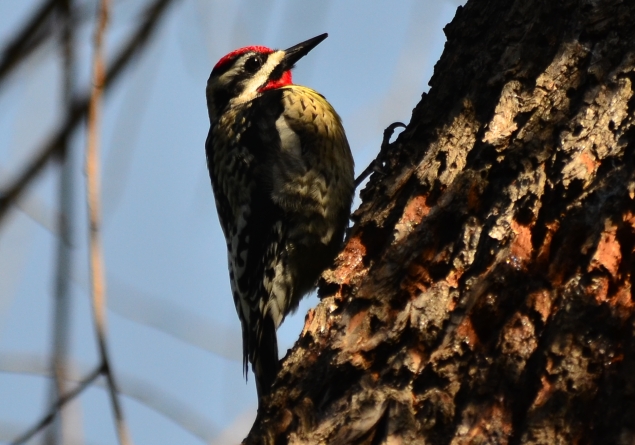
Let's lead things off with a Yellow-bellied Sapsucker.  Yellow-bellied Sapsucker is a rare bird here...nothing anyone would shit their pants over, but it's a good bird to bat leadoff in today's post. This bird has wintered at Don Castro Regional Recreation Area the past few years and I thought it would be best to pay it a visit.


It was hella cooperative, loafing on a tree next to the trail, occasionally sidling over to its sap wells for some sugary goodness.


Did someone say...gulls?  No?  Phew.  Can you imagine if it was gull season year round?  Fuck, that would be brutal.  Luckily, despite how well-adapted gulls are to humanity, they still migrate away from where I live for half the year.  This male Thayer's Gull is a long, long way from here right now.


Despite the identification challenges involved, birders love Thayer's Gulls.  They really do.  That's why I post so many of them on here.  Unlike most birders, I have the opportunity to walk right up to them and crush them with reckless abandon, without any regard to my personal safety.  Why do I do it? Because being scared of a Thayer's Gull is a ridiculous notion.


Far less inspiring, I am also not afraid to get close to Herring X Glaucous-winged Gull hybrids.  It's pretty gross though...I am always left feeling so...impure.  Note the yellowish orbital on this abomination.


Like silent gulls, silent dowitchers can always provide an identification challenge.  The bird coming into alternate plumage on the left (yes, the one with the short bill) has distinct, fine spotting on the breast, which is mellow for Short-billed Dowitcher.  The bird on the right has some different patterning on the breast, but since it is molting I'm not quite sure what to make of it.

A dowitcher is half the size of a Marbled Godwit, if that, though that doesn't seem to prevent them from wanting to unnecessarily roost inches away from one another...maybe the dowitcher was using the godwit as a wind break? At any rate, if this scene doesn't represent total chaos, then I don't know what does.


From one vantage point at a local park here in the east bay, the voyeuristic birder can watch feeding shorebirds directly beneath you on the rising or falling tide.  Western Sandpipers in high spring fashion have fantastically intricate back patterns that are hard to ignore.  I've said it before, but I don't understand the birder who doesn't have the stomach for sorting through shorebird flocks.


Look at those linear chevron patterns on the mantle.  This is really an underrated bird if you ask #7...look at one of these little cripplers for too long, and it will break your will to look at any other birds the rest of the day, abundance be damned.  Feeding in bubbles isn't helping things.


Forster's Terns have finally quit looking horrible and regained their simple yet elegant form of spring.


Up Mendocino way, this Golden Eagle greeted our crew of vagrant-starved nerds as we set out to see the Brownish Shrike.  As far as omens go, it's hard to top a Golden Eagle, and the cooperative shrike popped up after only a couple minutes of waiting.


You may look upon this image and think to yourself, "well this is certainly rubbish"...but you would be wrong.  For this is not a terrible picture of an American Robin, it is actually a profound photograph of a Varied Thrush.  The Varied Thrush is a bird of the ground, and a bird of the shadows.  This image captures the very essence of the Varied Thrush, and you know what that means...you are looking upon art.

Tuesday, March 4, 2014

So Long California


Sometimes a bird will be so used to people that it maddeningly won't acknowledge your presence. If a bird can't be bothered to look at you, then the best thing to do is to crush the rest of its body. Great Blue Heron, Marin Civic Center, San Rafael, CA.

I've noticed that most of my posts lately have had some kind of central subject or theme to them, which is very unlike me...it's high time I do a potpourri (aka diarrhea) post. I don't do a very good job at keeping BB&B in sync with current events and photos that I take, so here's some randomness from the last couple of months...it may be my last California post for a while.

I haven't done that much birding lately...my year list could be a lot higher than it is, but that is something I can live with. If it wasn't for time spent in Baja, it would be borderline pathetic. Maybe that's not something the nation's #7 birder should readily admit to, but such is life. Of course, not being able to live with this fact would be shameful...I am not just a creature of lists and ticking. Tomorrow I embark on my road trip to the Lower Rio Grande Valley, so all that will change soon. My eBird rarity alerts no longer feature counties like Alameda, San Francisco and Marin...instead they are set to unfamiliar names like Cameron, Hidalgo, and Starr. The winds of change are blowing strong.

If you missed it, The Great Ornithologist Felonious Jive posted at 10,000 Birds on his feelings about being birding's ambassador, and how you too can share the stage. I can offer my own advice on the matter...more bourbon, less bitching.


Watching birds take baths is always fun. There seems to be a tangible enjoyment that they take in it...although I have seen a couple night-herons that seemed completely dismal about it. Snowy Egret, Marin Civic Center.


More plumes. I don't think of American White Pelicans as a tufted bird, but that's because I'm an idiot. Photographed at Lake Merritt, Oakland, CA. This is a free-flying bird, not Hank (a non-flying bird).


There is more than one tufted fowl that allows crushes at Lake Merritt.


I generally don't bother photographing this bird until February every year, because it just kind of looks like shit earlier in the season. It's flanks are now pristine and it's tuft grows more voluptuous by the day. I reckon it will be around for at least a couple more weeks.


It took me a few years to get a decent open-wing shot; this one works for me.


Birds are funny. Great Egret, Lake Merritt.


I am unhappy with all the Barnacle Geese that show up in the northeast every winter now. Not because I think they are all escapees, but because thousands of birders are gripping me off. At least we have Ross's Geese. Marin Civic Center.


Why the rippley neck? One of the great mysteries of the universe.


A drake Gadwall displays his bulging, scallopy breast. It's hard to look away. Marin Civic Center.


So majestic. Soon, I will find myself beleaguered by Mottled Ducks, which has been nominated for Most Boring Native Bird. Of course, two species of whistling-duck will be providing me company as well.


If Slartibartfast designed ducks instead of continents, there is no doubt he would get an award for Northern Pintail. Golden Gate Park, San Francisco, CA.


This Yellow-bellied Sapsucker (a BB&B first) was a cripple. Not a crippler, since it's pretty shoddy looking, but a cripple; it's right wing is pretty mangled and only useful in that it can aid in fluttering to the ground so the sapsucker could make it's way to the next closest tree. Canada Larga Road, Ventura County, CA.


Hopefully the wing injury wasn't permanent; at least the bird had a good food source.


Loggerhead Shrike is a fairly common bird that I love that I just have not administered a brutal crushing to yet. I'm working on it though. Canada Larga Road.


Cropped differently than the above photo. I think I like this version better.


Shorebird enjoyment: one of the handful of "family-friendly" activities that I can also condone. Middle Harbor Shoreline Park, Oakland, CA.


Dunlin and Western Sandpipers comprise the bulk of the big sandpiper flocks in the bay area in winter. The economy of style is almost too much to handle...thankfully, most other birds don't wear such dismal attire. Middle Harbor Shoreline Park.


American Avocets were one of the first birds I was really fond of before I became a birder. Not a trigger bird per se, but a solid gateway species. Middle Harbor Shoreline Park.


I get dangerously accustomed to Heermann's Gulls sometimes. They really are striking, and we are lucky to have them. Berkeley Fishing Pier, Berkeley, CA.


This gull had put on some eyeshadow to get the cat-eyed look that's popular with the ladies these days. It will undoubtedly be participating in numerous copulations once it gets to Baja.