Showing posts with label Eastern Kingbird. Show all posts

Monday, August 26, 2019

Adventures In Geri Birding


I was once what they call a "young birder"...but no longer. I may still be younger than the average birder - much younger - but I can't identify with being a young birder anymore, or even just young. As my youth and vitality slowly drain from my body and mind, leaving aches and pains and codgery notions and inclinations in their wake, I am reminded more and more each year that middle age has crested the distant horizon and is quickly coming for me.

The past few years have bore all the signs of being left by the wayside of youth. I have worked the same job for over five years. There has been less travel...less socializing...finding a new band to embrace has become a huge challenge...and whether I care or not, I am really losing track of what is, or is supposed to be, remotely cool. Of course, there are more responsibilities too, even a child!

Are you there, Perpetual Weekend? It's me, Steve.

But there are benefits to being 37 and not 27. Like I am hungover way less, I'm not broke, I drink better bourbon, 5MR birding exists now, I'm a little wiser, and with Annie here with us I am never, ever bored. But one benefit that I am now reaping every day at this age is GERI BIRDING.

Yes, geri birding. Although some people scoff at geri birding, I have always reveled in it. Really, the main downside (which can also be an upside, depending on your sense of humor or appreciation of irony) of geri birding is that you are often forced to do it in a confined space with other birders, and you have to overhear their conversations or unwillingly get sucked into them. Something that has always stuck in my mind (I think it was from some standup comedy bit) for years now is that almost every random snippet of conversation you overhear from strangers ends up sounding completely idiotic. I have found that anecdote to be unnervingly accurate - most conversations I overhear sound somewhere between incredibly boring, trite, recycled, or utterly moronic, and that percentile is no different when you gather a bunch of birders together at some feeders...in fact, it is probably worse, and all but impossible to tune out. Satre said "Hell is other people!" and that is hard to argue with if you spend enough time geri birding where other birders congregate. You are going to hear some excruciatingly vapid exchanges, people who live to hear themselves talk, incorrect scientific and bird facts, abhorrent misidentifications...often, all at the same time!

But geri birding is not just something you only do in southeast Arizona or at some rainforest lodge, there are geri birding opportunities almost anywhere...if you build it, they will come. In the sanctuary of your own yard, you don't have to deal with all of those, well, geris. Although I definitely miss going to cool places for field jobs, I have found in my increasingly middling age that having a yard to bird from is pretty great. Yes, Rancho de Bastardos happens to be situated in a uniquely awesome location for yard birding purposes (the ponds behind my fence really ups my yardbirding game), but the feeders and garden bring a lot of species in too, often just as many species or more than the ponds. Geri birding is what you make it, and I'd like to focus on that aspect for most of this post. So in that spirit, here are some anecdotes and lessons I have learned over the last couple years, since I got serious about geri birding in my own yard.


Many geri birders welcome back a host of migratory species to their feeders in spring and summer - that is unfortunately not the case at my house, but one obvious migrant species we get for about 5 months a year are Hooded Orioles, which nest in various neighborhood palms. I always put out this leaky, hard to clean hummingbird feeder for them because they can actually nectar from it - the ports in our other feeders are too small. I did try putting up orange wedges at one point, but the rats got to them...maybe I'll spring for an actual oriole feeder before next year. The adult males are super skittish for some reason so I'm still waiting for the crush of a lifetime, but the females and HY birds are a bit more confiding.

I'm still trying to figure out the deal with hummingbirds at my house. So far, it does not seem like hanging up a grip of hummingbird feeders is actually going to attract more hummingbirds than a couple feeders, though I'm tempted to try it - I think they would still be dominated by one or two super territorial Anna's. My current hypothesis is that the Rancho is not located on a major hummingbird flyway and/or lacks an adjacent area that draws in large numbers of them (i.e. a park with a lot of blooming plants/eucalyptus, for example). Perhaps one day, at a future Rancho de Bastardos, I will bring in swarms of them.


Before I embarked on this voyage that we call geri birding, I would have raised an eyebrow if you told me that Bewick's Wren was a frequent denizen of feeders. I also didn't think of them as being terribly confiding for a wren. But my yard wrens have shown me that it was I who was mistaken...about a great many things. Bewick's Wrens are fearless and cannot say no to either suet or seed....huh! Geri birding...easy, fulfilling, and educational!

This year I finally put up a suet feeder. I waited a long time to do this. For some reason, I just assumed that it wouldn't really get put to use by the local yardbirds...I was wrong again. The suet feeder is MAGIC. I haven't lured in anything rare with it, but it just gets absolutely hammered by the yard birds. The wrens love it. The chickadees love it. The titmice love it. The nuthatches love it.


The nuthatches. White-breasted Nuthatch was a yard rarity the first year we were here. Now? The yard is straight nuthatch-mania. As Frank might say if he were here, "nuthatches galore!"

It has been interesting to see what locally common species have "found" the yard as time has gone on. The first year here, White-breasted Nuthatch and Spotted Towhee only came in to the yard once or twice. Now nuthatches are one of the most reliable visitors, and I counted three different Spotted Towhees this morning. Of course, birds do different things year to year...this year, though they could care less about what is happening in my yard, Vaux's Swifts have been much more uncommon overhead than 2017 and 2018.


Yup, as easy as geri birding can be, it's not quite as easy to do everything you can to maximize the geri birding potential of you own yard. Reaching maximum geri birding potential is not as easy as you might think, especially if you are working with a modest budget. Having the correct feeders up (and the correct feed to offer) can make all the difference, as mentioned above with the oriole-accommodating hummingbird feeder and the suet feeder. In fact, just last week I went from a very small tray-style feeder to something much larger, figuring birds will find something roomier more inviting. The result? Within a week of trading feeders, my high count of Black-headed Grosbeak in the yard went from 1 to 3...and all three were seen on the feeder together! Not bad for a yard in suburban tract housing with no native trees.


Everybody knows that birds love bird baths. I was dead set (unnecessarily) on getting something that I could put on the ground, which turned out to be a little more challenging than I thought it would be. I settled on this rocky looking basin thing, which could be purchased without the accompanying standard bird bath pedestal. I wish it was a bit bigger but it performs well, along with a bubbling rock thingy (fake rock with a small pump inside) to add some movement to the water. It gets hella use, though mostly from birds that are towhee-sized or smaller. Lincoln's Sparrow likes it.

One day, when I am a homeowner, I will build the water feature to end all water features. Birds will be falling out of the sky to use it. Well, maybe not, but it will be a couple of steps up from the current situation, and it will be situated to maximize crushing opportunities, which is currently not really possible with our small yard combined with less-than-ideal lighting conditions. Having a south-facing house is a positive thing in many circles but from a birding or photography perspective, it sucks. Why would you want to maximize the amount of time spent looking into the sun? Ugly, ugly light.

Right. The water feature of my geri birding fantasies may one day become the bane of my existence, but I look forward to the challenge and subsequent avian rewards (cough VAGRANTS cough cough).


Hey, is this the first Rock Pigeon I've ever posted? Only took almost a thousand posts! But this isn't just any old pigeon...its someone's homing/racing pigeon! What are the chances we would be visited by a pigeon of such honor? Such calibre? It stayed around the house a few days before resuming its voyage home. In that vein of weirdness, we've also had two different Budgerigars at Rancho de Bastardos, and just recently there was a mysterious, tiny blue dove with a short tail in the yard very briefly...the brain paralysis that thing induced was swift and total. I still don't know what the hell that was but am confident it was an escapee.


Crushing opportunities must be maximized, even when having to deal with harsh lighting much of the time. When it comes to geri birding, any zealous bird photographer will tell you it is all about fake perches. Fake, as in natural looking perches set up in artificial situations...talk about keeping it real. I don't really obsess over this sort of thing (as I've said a hundred times, I'm not a photographer, I just take pictures) but I will readily admit that a picture of a bird on a stick usually looks better than a bird on a feeder. So, to facilitate crushing, I've got several sticks ziptied to things around the yard, and I think the birds appreciate the additional spots to wait their turn if a feeder is filled with a pile of doves or Band-tailed Pigeons. The Chestnut-backed Chickadees here readily use these perches and now only have a modicum of fear of me (I often reach to refill a feeder and am surprised to find a chickadee still sitting on it, only a couple feet away) so make ideal photo targets, although they don't exactly sit still much. They are also the best looking chickadee of them all, so might as well go to town.


I currently have this perch up. It's an interesting one, I'm not sure what to think of it. It's kinda too girthy to be real popular for songbirds to perch on it very much, but I had Accipiters in mind when I put it up. This Cooper's Hawk made my vision complete. It's nice to have raptors in our little yard pretty often, though the Mourning Doves don't agree. The perch manipulation is also a fun experiment just from a behavior perspective...it's interesting to see how a perch is almost completely ignored in one spot, but moved a couple feet over gets used 3 or 4 times as much by birds wanting a good waiting spot before landing on a feeder.

Although I always knew in my heart of hearts that I would be a geri birder someday, I didn't quite realize how much gardening that would entail, or that I would kind of like gardening. The gardening aspect really makes gerifying your yard feel even more geriatric than just hanging up a bunch of feeders. Since we are renting and will never buy the home we are in, we haven't planted any trees, but it is tempting! Instead, we've most planted shrubs; a lot of sages, native and otherwise. The hummingbirds love many of them but I'm still waiting to see them get a ton of use by other birds, though I suspect once they mature more they will at least provide good cover. This is another geriatric activity I can see myself getting really into someday...gardening with native plants and landscaping. How embarrasing, can't believe I just admitted that.

Just dump me in a grave already.

I have to say though, it is a few of the *nonnative* trees in/just outside the yard that seem to bring in a lot of birds. Birds love our random backyard juniper and the Peruvian pepper trees (Schinus molle) just outside our yard. Pepper trees are notorious in California for being sapsucker magnets , and I owe my yard list's Red-breasted Sapsuckers entirely to a neighbor's pepper tree. But a lot of other species are drawn to them as well, including a number of neotropical migrants, and even Western Screech-Owl, which spent one very vocal night in said pepper tree.


Of course, if you are going to put food and water out, you are going to attract some unwanted visitors. These can range from Brown-headed Cowbirds (above) to cats to rodents (native and otherwise) to bears, depending on where you live. Here at Rancho de Bastardos, we have to contend with native and nonnative squirrels, the occasional cat, Norway rats, House Sparrows and cowbirds.

I hate the rats. I hate the cowbirds.

The cats are infrequent enough that chasing them off by yelling with a hose in hand like a senile old man seems to deter them most of the time. Rats and squirrels have to contend with a squirrel proof feeder and a squirrel baffle for another feeder - incredibly, both of those deterrents work perfectly. The presence of House Sparrows and cowbirds have motivated me to experiment with seed mixes: black oil sunflower and safflower go in the feeders, smaller seeds get sprinkled on the ground. For whatever reason, this has worked pretty well and the feeders don't get overrun by the House Sparrows, though the cowbirds have grown fond of the feeders lately...a source of much brow-furrowing and hand-wringing.

But enough about shitbirds...I will leave you with my greatest geri birding accomplishment to date. The hands-down highlight of geri birding here in the last couple of years came in June, and I can safely say it had nothing to do with all of the plants we've planted, or the feeders, or really anything else going on in the yard. I had been out grocery shopping and was bringing bags of groceries in...without binoculars, of course...when I glanced up at the power lines behind the house. There sat a passerine facing me with a black head, white throat and white breast. For an instant I thought it was odd that a Tree Swallow was sitting there, that isn't normal, but then I saw the Mourning Dove next to it and realized the bird was much bigger than a Tree Swallow, and there was only one thing it could possibly be...a VAGUE RUNT EASTERN KINGBIRD!!! Almost as soon as this dawned on me, the kingbird took flight, flew overhead and disappeared far to the west...I assumed it would never be seen again.

I was astounded. Not only is Eastern Kingbird a very good rarity in the state, it was particularly good for Santa Clara County, where no one had seen one in many years. And this bird was sitting above my yard!


Miraculously, Billy refound the bird later in the day while looking out Annabelle's window, foraging from the neighbor's pepper tree. I got some acceptable photos and a few local birders were able to see it from a nearby public path. Pretty sick that one of my best self found county vagues came in my own yard...a geri birder's dream come true! For one day, I got to live my best geri birding life.

So there you have it, the comprehensive geri birding update from Rancho de Bastardos. The yard list currently stands at 138 species after being here for less than two and a half years, with the most recent additions being an "overdue" Bullock's Oriole and a true gift from the geri birding gods in the form of a flock of Western Sandpipers. May the lords of geri birding continue to smile upon me, and you.

Monday, June 11, 2018

Anauhac National Wildlife Refuge


If you haven't been, one of the great things about doing a trip to the High Island area is all the other superb birding opportunities (that can be as good or better) that are there for the taking within an hour's drive. Anahuac National Wildlife Refuge is a large refuge northwest of High Island that demands attention, and I went a couple different times with This Machine Nate and Dipper Dan. Chances are you've been there or have heard about it, so I won't blast you with too many accolades about it other than saying that I think it might actually be underrated for viewing springtime Neotropical migrants - marsh birds typically get most of the attention there.

This tyrant isn't exactly newsworthy - Eastern Kingbirds are abundant at Anahuac - but I will give EAKIs the attention they deserve, especially when they are down to be crushed.


Migrants can and do appear frequently and randomly along the roadsides, like this Blue Grosbeak. This is a big refuge so a lot of migrants are dropping in throughout the area in spring, but there aren't many conspicuous wooded areas to concentrate warblers, vireos and other tree-hugging species.


Where there are trees, there can be quite a few birds. The area at the main entrance of the refuge (across from the restroom) had a smattering of migrants, although the scattered planted trees there didn't exactly scream "migrant trap"...but in this area, practically any clump of trees can hoover in spring migrants. This obliging Philadelphia Vireo gave great looks.


I've seen a lot of vireos over the years, and have come to the following conclusion: the most obliging vireo species north of Mexico are Philadelphia and Hutton's. Perhaps this behavior, what biologists describe as "not giving a fuck", lends these species species certain advantages, much as it can with Homo sapiens.

Tell your friends.


Some Scarlet Tanagers were also being obliging, giving only one or two fucks.


You know it's happening when stuff is on the ground that shouldn't be on the ground.


I may be #7, but I am not a King Rail expert. That said, I will claim that Anahuac is one of the best places to see them, and there are great numbers of them there (and Clapper Rails, and presumably intergrades too). This little King Rail chick got separated from its fam and was running around on the road and Shoveler Pond boardwalk, calling pitifully for its parents before finally leaping off the boardwalk back into the marsh. I was afraid some rednecks were going to push it all the way to the end of the boardwalk (where it most certainly would be fucked), but they were surprisingly patient with it and waited for it to go on its way. I say this because a few minutes earlier one of them tried to move a big turtle off the road, but then dropped it onto the pavement upside down, kicked it back over, then left it there.

That's not how I would have done it.


Here is an adult King Rail Officer Shaw rustled up for us in a ditch just outside the refuge. Heckof colorful, even when partially obscured. This is a bird I haven't seen in over a decade...not quite a "relifer", but close to it.


This Machine picked out this American Bittern hunting near the Shoveler Pond boardwalk. It's been some years since I had the chance to see one this well. Mellowing.

Other events that transpired on this boardwalk:

*We saw a Glossy Ibis. Twice. That's a good bird. Double good.

*One birder was totally bored and unimpressed by the above bittern because it wasn't a Least Bittern. I've never seen a birder so utterly unenthused by an American Bittern before, didn't know that was a thing.

*Another birder thought this was a Least Bittern!

*Barn Swallows were nesting under the boardwalk, offering point-blank views as they are prone to do. A pair of birders identified them as Purple Martins...unbelievable. They were from Oregon.

*At the parking area, some out of shape Geris asked us if they should even bother walking on the boardwalk. They were not joking, they really wanted to know.

The boardwalk seems to be an excellent place to document birder blunders and to take in all the beauty and grace that mankind has to offer.


The UTC is thick with Least Bitterns. This one was teed up on a shrub next to the road, which I suppose is not a weird thing there (it is in California).


To this west coast birder, Sedge Wren is a really good bird. I've never seen one in California and maybe never will...haven't seen one in years anywhere, in fact. I was surprised to find that not only are they abundant in the UTC, they remain so all the way through April, even though they don't breed in the region.


Once I locked down their song in my head, it didn't take long to realize I was surrounded by Sedge Wrens almost everywhere I went. Bizarre...I did not know they were so abundant there.


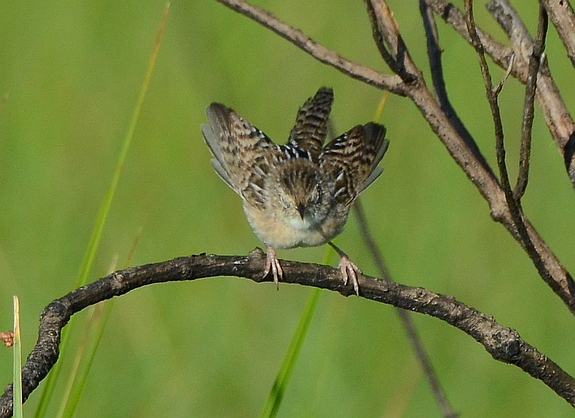
Novel Sedge Wren pose. It's hard to believe that a number of species shaped like they shouldn't be flying more than ten feet at a time are actually accomplished migrants, i.e. Sedge Wrens, Yellow Rails. Impressive...most impressive.


My worst misidentification of the trip (I think) was of this fat black water snake...it was big and girthy and sunning itself at the edge of a pond. I thought it was a cottonmouth at first.


But look at that face. That blank, vapid, round-pupiled face. That is not a cottonmouth face.


The first thing some visitors will see at the refuge is a Cliff Swallow impaled on a spike (left bird) under the veranda where folks like to get lunch. Come on refuge, dick move.

This post is running long...more from Anahuac in the next post! And Bolivar Flats!

Thursday, August 18, 2016

Rocky Mountain National Park: Medicine Bow Curve, Endovalley, The Rabbit and The Rock


Our second morning in Colorado, we awoke early...destiny does not come for the late riser. This would be a fateful day, one way or another. By the end of the day I might be a birding hero, or it could all come crashing down on me. If failure was in the cards, this would be a memorable dip indeed. Following in the footsteps of probably thousands of birders before me, we would aim for arriving at Medicine Bow Curve as early as possible for the best chance of bagging a White-tailed Ptarmigan, the undisputed target bird of the trip. White-tailed Ptarmigan was one of those birds I saw in a field guide as a kid that seemed especially fascinating...though it was a bird found in the Lower 48, who knew when I would actually get to look for one? Never? Over 20 years later, I finally had my chance.

We got out of our Airbnb at Horsetooth Reservoir acceptably early, passed some Swainson's Hawks at their night roost, avoided a predawn collision with a herd of bighorn sheep crossing the road and quickly got up to Medicine Bow Curve. The park was beautiful early in the morning, and practically devoid of human life. We were the first people to arrive at the curve, the weather was sunny and calm, so I thought our chances of crossing paths with this bird was very good.

As the morning dragged on, my opinion of our chances started to fade. Back and forth I trodded along the short trail, scanning the rocky ground for a rock that would move. This went on for some time. Finally, I knew it was time to admit defeat...Billy and I were almost back to the car when I made my ceremonial last scan (As the GBRS ranked #7 birder in the U.S., I highly recommend taking a thorough last scan for interesting birds whenever you are about to leave a site. I can't tell you how many times this has resulted in lifers and rarities, whereas I would have had nothing to show for it otherwise). Wayyyyy upslope above me, I noted a rock with a protrustion that resembled a head and neck of a ptarmigan. This was not exciting, and not even really interesting...I knew, in my heart of hearts, that it was just a rock that happened to resemble a ptarmigan. What it certainly was not was an actual ptarmigan.

Then, I thought I saw the head of the rock move. Could it be? Finally, the entire rock started strolling away, with 5 golfball-sized rocks following it.


Suddenly, the air was filled with imaginary fireworks. Ticker tape rained down on us, and squadrons of F-18s flew low overhead in a show of birding patriotism. The shimmering ghost of Roger Tory Peterson stood with the spirits of Yoda and Obi-Wan Kenobi, proudly regarding the winning birders. We had done it!

The ptarmigan and her escort of tiny chicks seemed to have a particular destination in mind, which looked like it happened to be right next to the end of the trail, so we scurried back down the trail toward where I thought the birds were heading. Sure enough she reappeared above, with a vanguard of ridiculous ptarmiganlets leading the way.


While ptarmigans are reported with comforting regularity from this location, they are not by any means a sure thing. Among birds in the Lower 48, perhaps no other species has camouflage equal to that of the White-tailed Ptarmigan, made possible from the drastic molts they undergo each spring and fall, transforming from a peerless sheer white even Snowy Owls are envious of to an indescribably intricate pattern of gold, tan and black. This is a product of living in an environment of extremes, of course, the sort of place that for many years involved a major undertaking for humans to get to. There is a reason that so many cultures believe that The Creator dwells on the highest mountain top. And who does The Creator keep for company for much of the year, when all other creatures go to sleep or flee for warmer climes? The pika, and the ptarmigan.


Unlike the chicks, the hen was wearing  a lot of accessories...leg bands, a radio collar, and a big antenna that sprouted from her back. The ptarmigans here are part of a long-term study to detect changes in population density and monitor reproductive success; this species is vulnerable to climate change and may also be impacted by elk browse on alpine willows.


The fam fam (pfam pfam) strolled right by us, just as I had hoped. Though extremely hard to spot (as advertised), they also were very confiding (as advertised). I couldn't believe that it had all come together like this...was it all luck? Was Frank Mayer down in the valley below, emanating beams of his notoriously excellent luck?


A baby ptarmigan is not something I thought I would ever see. I get all choked up just thinking about it. Look at those stout little legs.


After our time in the company of the ptarmigan was over, it was back down Trail Ridge Road. The Mountain Bluebird nest at the visitor's center restroom was about to explode with fledglings.

The Brown-capped Rosy-Finches again abided at Lava Cliffs. A stop at Rainbow Curve for Pine Grosbeak (which a birder had just seen there earlier that morning) and Gray Jay was met with failure, but in the light of the come-from-behind win with the ptarmigan family, that didn't matter very much. Finally we decided to visit Endovalley, which is popular with birders and surely held some more yankee bravos. It really is a pleasant place to bird and hang out; we happened to park next to a calling Hammond's Flycatcher, which would be the only one of the trip. We walked along the gurgling stream, which Billy enjoyed like a normal person but which simply frustrated me because I kept seeing dipper shit on the rocks but with no accompanying dipper. Finally we came up on an area with no dipper shit, but an actual dipper.


Eastern birders absolutely fiend for dippers, and rightly so. There is nothing like a dipper in the east...waterthrushes are cool, but they are no dipper. Western birders are very grateful for their ouzels, we do not take them lightly. We hung out a long time with this confiding juvenile, who serenaded us with some whisper singing that served as the perfect accompaniment to the babbling brook.


The dipper seemed content to do absolutely nothing for quite a while, which I can really respect. Eventually it took interest in a nub on the log, which I also respect. It's all about the little things in life you know?


This ended up being the mellowest dipper I had ever met, probably even the best dipper I had ever seen. For those of you who have not met one of these stream spirits, don't worry...your dipper is out there, waiting for you. Just don't look for one in a dried up stream, or you will find your spirit equally dried up.


After loitering with the dipper, we walked back out along the road to bird the aspen groves. It did not take long before another yankee bravo reared its sappy head...several Red-naped Sapsuckers lurked within the aspens. Though I'd seen many in California over the years, I'd never actually seen one where they breed. Aspens are an ideal place for sapsuckery.


This male is showing the classic red throat washing over the black border of the throat, and of course the reddish nape. Sharp bird.


After we finished up at RMNP, we had a "day off" in the lowlands, hanging out around Fort Collins and visiting a few spots around town. The two Airbnbs we got for this trip had really worked out well, especially the one by Horsetooth Reservoir, where one could do some decent yard birding. In fact, one of the most bizarre experiences of the trip happened there while we were talking to the owners about birds...their cat wandered outside, and came back to us a few minutes later with a live baby cottontail in its mouth, which was squealing in agony. The cat, of course, simply dropped the rabbit (which was bleeding from its neck) and walked away. For the next several minutes, the rabbit would appear to finally be dead, then kick pathetically in the air, then repeat. It was quite awkward, because the owners certainly didn't know what to do about it. Finally Billy decided enough was enough, and volunteered me to put it out of its misery...great. So I held it against a large rock, got another rock, and beat its brain in until there was nothing left of its head anymore (don't worry, I dispatched it on the first blow, I'm good at stuff). It was extremely messy. So in case you needed to be told for the millionth time...keep your shitty cats indoors people!

Since this was late July, I was fiending to find some migrant shorebirds...surprisingly, there are seemingly countless ponds and lakes in the area, but they pretty much all had too much water to support any shorebirds at all. Fossil Creek Reservoir had a couple hella distant sandpipers but these Lark Sparrows (adult and fledgling) in the parking lot were more fun to hang out with.


I don't remember my lifer Mountain Bluebird, American Dipper or Red-naped Sapsucker (was it at Galileo Hill?), but I do remember seeing Lark Sparrows for the very first time. This bird really left a mark on me...never underestimate the power of the Lark Sparrow, or suffer your father's fate you will. Whatever that is.


Both Eastern (above) and Western Kingbirds are very common in the area and happily (or bitterly?) use the same habitats, which is odd since they behave so similarly and are both famously hyperaggressive species...I guess there must be enough food to go around.

The next day we would make the drive out to the legendary Pawnee National Grasslands, where lunch would be served with a large side of longspurs. See you at the next post.

Thursday, July 17, 2014

Sic Semper Tyrannus


Yellow-bellied Flycatcher is an Empid I hold, for some reason, in high regard. I first met the species in Pennsylvania back in 2009, and we have since crossed paths in Florida, Mexico, Costa Rica, and now Texas. Photographed at South Padre Island, TX.

Texas is a state rich in flycatchers...with only one exception (Gray Kingbird), every flycatcher that breeds east of Texas is found regularly in the state. And then there are Scissor-tails, and the valley species, and all the vagrants they have been blessed to receive over the years. I'm not ambitious enough to post pics of every flycatcher species I saw out there last spring...but I can do most of them.

Are flycatchers a major headache migraine? Does looking at them make you feel stupid? Do high-ranking birders with mysterious motives make false statements about how often they vocalize? Yes! But that is part of what makes them so great. You don't have to worry about them hybridizing (much) and they are a group of birds that your new birding app won't be able to identify for you for a very, very long time. And they do stuff. Good stuff.

When you get to the end of the post and are drenched in sweat, feel free to cruise over to The Powdermill Reserve (the only place I've seen Yellow-bellied Flycatcher in hand) for a nice post on more eastern flycatchers.


I'm itching to find one out here in California...most (not all) of the individuals I've seen have been pretty easy to ID, and they tend to stand out...they are yellow (er...olive and faintly yellowish) and have a call that isn't a damn "whit" note. South Padre Island, TX.


Least Flycatcher...the gray flycatcher of the east. It is the most basic Empid of the east, in terms of color and abundance. South Padre Island, TX.


Least Flycatcher, probably the same individual as above. Note the amount of darkness on the mandible (or lower mandible, as most of us say), which is atypical. I've always found the amount of paleness here to be dependably variable in many Empid species, and a field guide could potentially lead the birder astray with this character. South Padre Island, TX.


Acadian Flycatcher has a big head and big bill, a true loggerhead of the Empidonax. South Padre Island, TX.


Traill's Flycatcher (the pre-split name of Alder and Willow Flycatchers) is one of the most troubling species-pairs that eastern birders have to face. Even California birders are pained by this problem, as a handful of legit Alders have been documented in the state over the years...and guess what? We want more. South Padre Island, TX.


This is the same bird as above. Note the overall gray-brown on the upperparts that does not contrast with the throat, rendering it quite dull even by Empidonax standards. There is an eyering present, but it is extremely narrow, which is to be expected in eastern Willow Flycatchers. There doesn't appear to be any greenish coloration from this angle, aside from the inside of the folded wing; it is remarkably drab. By all accounts, this is a Willow Flycatcher.


Here is a different Traill's from South Padre Island. This bird is a bit greener and more contrasty in the throat than the above individual, has a more pronounced eyering and seemingly has a shorter bill. It actually looks considerably different than the above bird. I'm going with Alder Flycatcher on this one. Of course, empids can look quite a bit different in fall, so there's only so far one can go with some of these field marks without hearing a vocalization...but it never hurts to try. South Padre Island, TX.


Eastern Wood-Pewee has the distinction of being one of the most misidentified flycatchers in the U.S., despite being one of the most abundant. Learn the pewees, and then you will love them. Until then, you will not have a healthy relationship. South Padre Island, TX.


Couch's Kingbird. This is a typical brightly-colored bird with a smallish bill. Atypical is how the tail appears completely unnotched. Willacy County, TX.


Couch's Kingbird. There is variation in bill structure in this species, and you can see that this bird has a heavier bill than the above individual, being especially deep toward the base. I reckon Tropical Kingbirds have a more consistent bill length, and still appear longer-billed (and not so big at the base) than this individual. Sabal Palm Sanctuary, Brownsville, TX.


Eastern Kingbird, a true feel-good flycatcher. Everyone can love an Eastern Kingbird. South Padre Island, TX.


Brown-crested Flycatcher. This is cooperi, the subspecies found in Texas, and is less beefy than the magister that reside in Arizona. Note the unimpressive size of the bill. Hidalgo County, TX.


Great Crested Flycatcher. God, look at the tapering of the white border of the first tertial feather! That's what I'm fucking talking about. What I'm not talking about is why Great Crested Flycatcher and Brown-crested Flycatcher have more structural differences in the grammar of their names than the birds do in reality. South Padre Island, TX.