Showing posts with label Monterey Bay. Show all posts

Saturday, August 25, 2018

Masked/Nazca Booby in Monterey Bay!

Yesterday, August 24, was my first time leading on a Shearwater Journeys trip for the year, and it turned out to be a great day to be on the water. We had the calmest seas I've experienced in years and a very nice marine layer that lingered late into the morning. On the way back into the harbor at Monterey, about a mile or less off Pt. Pinos, I picked out a distant, but clearly very large Sulid flying over a feeding flock; the size and dark and light patterning quickly narrowed the options down to a couple species...Masked or Nazca Booby! Luckily Captain Tinker was willing to go check it out even though it was getting late, and we managed to stay on the bird and get to it quickly. The boob made several close passes, flying directly over the boat, and even did some plunge diving off the bow! On at least one occasion, it did successfully grab a fish.


This was one of those rare and special occasions where we had talked about our chances of finding a specific high quality rarity and had those hopes come to fruition. We were on the lookout for rare boobies all day, as it has been an excellent year for finding several species from San Diego north to Monterey, specifically Red-footed, Masked and Nazca. Incredibly, 6 species of Sulids have already been reported in California this year! It just seemed like there was bound to be one of these birds around.

However, the jury is still out on what species this is, or if it can safely be identified to species...immature Masked and Nazca (both Bird Police species in California) are notoriously hard to tell apart, and I have no experience with Masked in this plumage, or with Nazca whatsoever. If you have some familiarity separating these two species, I'm very interested to hear what you have to say. All photos in today's post can be viewed at full size, so please feel free to double click on images and comment away.


Below is a crop from the above shot, the best I was able to manage of the uppertail. Lots of molt going on.

And here is a garbage photo that at least does show the overall uppertail pattern again.


Whether Masked Booby, Nazca Booby, or the dreaded Slash Booby, I'm stoked.

Tuesday, September 17, 2013

Offshore Monterey: Mixed Water, A Mixed Bag


Back on September 7, I kicked off three days in a row leading pelagic trips for Shearwater Journeys. This was a boat out of Monterey (probably the only one I'll be on this year). There was some swell to contend with, and we had some difficulty figuring out where the birds were. A lot of the water we found out on the Albacore Grounds looked a bit cold and disgusting (i.e. no "hard edge"), and as expected the birds were not out in force.


We did have acceptable numbers of jaegers (including close to 27 Pomarine) and Sabine's Gulls. This crisp Parasitic Jaeger was going all in on getting this Sabine's Gull to regurge something tasty.


It was one of the few more dramatic moments of the trip. Sabine's Gulls must despise the fact that multiple species of jaegers are following them around all year, all the way from the Arctic to the waters off South America. Talk about a real nemesis bid.

The rest of the flock retreats unscathed.

The highlight of the day for me were a couple of Blue Whales. This is the closest I've seen them. Pictures, of course, do not do them justice.


I previously referred to Blue Whales as behemoths, so today I will call them leviathans. Late summer and fall is a good time to see them off California, as the migrate south for the winter.


I get a lot of questions about how to tell phalaropes apart. This plump, short-billed creature is none other than a Red Phalarope. Red-necked is smaller, slimmer, with a longer, thinner bill...they're not too difficult to tell apart in flight if you get a good enough look. A lot of Red-neckeds moving through are juveniles, which are distinctly darker-backed than Red.


Sooty Shearwater was the most abundant bird of the day, which is to be expected this time of year. Short-taileds will be arriving in a few weeks, which we should all be ready for. You may have noticed that I set myself up for a good little Short-tailed discussion, but what could I mention that isn't already in your field guide? Down with redundancy.

Oh, some Sooty Shearwaters have white chins...you won't find that in the field guides. Now you know.


Pink-footed Shearwaters are very common as well. I like the lighting on this bird.


Here is a bird in harsh afternoon light...I prefer overcast. Aside from Red vs. Red-necked Phalaropes, I notice a lot of Pink-footed Shearwaters mistakenly get called Buller's Shearwaters...other than the standard differences in size, flight style and underpart color, it's worth mentioning that Pink-foots are freshly molted right now, and can look hella contrasty on the upperwing, reminiscent of Buller's at first glance.


It's impossible to resist the urge to photograph Black-footed Albatross, no matter how many I've utterly destroyed with my camera over the years. That's a juvenile Western Gull next to it, for size comparison.


Dark-rumped birds like this one are younger and not as world-weary. It's nice to see these optimistic, exuberant individuals before they are mentally crushed by too many seasons of failed breeding and watching their friends choke on plastic action figures plucked from the North Pacific Gyre.

Right. Who said that?


Here is a homely-looking Pomarine Jaeger. Gross.

Overall, not a bad day on the water; a pair of Baird's Beaked Whales, a big pod of Common Dolphins, Arctic Tern and a handful of Buller's Shearwaters were nice. We only found a paltry 7 Ashy Storm-Petrels, but we found the motherload the next day off of Half Moon Bay. Noteable misses were Long-tailed Jaeger and South Polar Skua...can't win 'em all!

Wednesday, October 17, 2012

"Jaeger! SKUAAAA!!!"


Here is the second installment from my first pelagic trip this fall, out in Monterey Bay, CA. Pomarine Jaegers stole the show for much of the trip.


They came by for many close passes.


Really close, in fact. I was pretty stoked to finally properly slay this species with a camera.


Pomarine Jaeger. I think the blob in the foreground is a California Gull, which are common relatively far offshore.


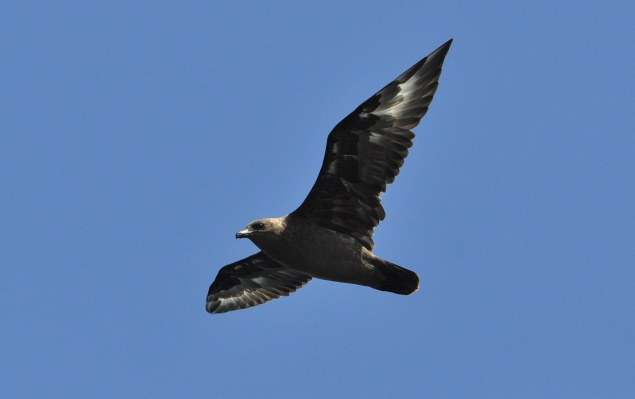
Of course, a South Polar Skua will always upstage a jaeger. Jaegers eat lemmings, skuas eat penguins.


South Polar Skua. Thanks to all the penguin chicks who sacrificed themselves to bring this skua to us today.


They still remind me of juvenile Western Gulls though.


Parasitic Jaegers made a few appearances too, but were greatly outnumbered by their bigger relatives.


Parasitic Jaeger. I did my best to try to get my 2012 Long-tailed Jaeger on the boat, to no avail.

Thursday, October 11, 2012

Fall Seabirds

Pink-footed Shearwater, or most likely Pink-footed Air-Dolphin. The bump on its forehead is a clear and obvious sign of its dolphin ancestry.

Within the last month I've made it onto a couple pelagic trips, trying to reconnect with my ocean-loving winged brethren. Here are a few shots from a trip with Alvaro's Adventures out of Monterey, CA. Shearwater numbers were low that day and storm-petrels practically nonexistent, but jaegers and skuas kept things entertaining, as well as a smattering of albatross. A much better trip than the previous boat out of San Diego...which I can blame the birds for, not the birders. Today's pictures feature some of the tubenoses that we crossed paths with out in open water.

Also on the boat were Jake and Christian of Camera Trapping Campus, a great blog based on (you guessed it) camera trapping in California, as well as giving nods to reptiles, amphibians and birds. Check it out! 

Pink-footed Shearwater.

Pink-footed Shearwater.


Buller's Shearwater, a very popular seabird around these parts.


Sooty Shearwater.


Sooty Shearwater.


Black-footed Albatross.


Black-footed Albatross. It's checking out Alvaro's revolutionary new seabird-attractant, the "chumcicle".


Black-footed Albatross. Adult birds can look pretty dingy this time of year, although you can see lots of fresh feathers molting in.


For comparison, here is a Black-footed Albatross photographed in spring at Midway Atoll. It's a different-looking beast. Yes, that is the normal water color there.


A terrible picture, but these 4 species sum up the boat trip pretty well. Pink-footed Shearwater, South Polar Skua, Western Gull and Pomarine Jaeger. If only the whole trip was this birdy.