Showing posts with label herring gull. Show all posts

Monday, February 3, 2020

South Bay Winter Slumber


While Santa Clara is not known as one of the premiere gulling counties in the state, that is not because there are a lack of gulls. There are many thousands of Herring Gulls (like the one above) in the county right now, and where there are Herring Gulls there are rare gulls...sometimes anyway. I have at least managed a Santa Clara Glaucous Gull already this year and a 5MR Western Gull, which I didn't see in the radius until November last year. Photographed at Don Edwards NWR.

Uhhhhhhhhhhhhhhhhhhh it's February. I don't know how I feel about that. It sure got here quickly, and as I say in BB&B pretty much every year I'm leery of March birding around these parts. Things have been pretty slow this winter here in Santa Clara, especially if you opt to not attempt feverish county year birding and rechase all the rarities you already chased a month or two ago, or the previous winter. But! But. BUT...the middle of winter is generally a great time to be birding around these parts. If you really need to see a rarity or a year bird or whatever every time you go birding, then just give up birding and be honest with yourself and everyone else...you are not a birder. You are a chaser. You don't enjoy the activity of birdwatching, you like birdchasing.

I think the quasi-elitist and increasingly obsolete notion that listing is something to scoff at now borders on being something to scoff at itself. Let's face it, most of us have bird lists that we care about. Listing is not the problem here, heck chasing isn't even the problem. I happily chase stuff on the reg and recommend it highly. The problem is when you get so locked into certain lists that they dictate that you run after other people's birds every time you go out. Going out with the hopes of finding something interesting yourself, once standard practice when one went out birding, is becoming increasingly uncommon and comparatively bold.

Is it time for a great schism in birding? Is it time for the strict chasers to separate themselves from the rest of us? There is already a large and still growing subset of photogs who seem to chase every rarity but never find anything rare themselves. Something to ponder on a cool February day.

But now that I've begun to peel back the lid on that can of worms, I'm going to put it back on the proverbial shelf for another post. That was not a road I intended to go down! Shifting gears (but probably still instilling some butthurt anyway), I've really been enjoying my new CANON gear after kicking Nikon to the curb. With the assistance of CANON, here is a sampling of our winter birds from along the edge of the South Bay.


Iceland Gulls can be be quite common at certain sites right now. Here is a particularly eye-catching bird with a big dark hood. Photographed at Don Edwards NWR.


Here is a more typical looking Iceland (darker eye, whiter face) photographed from the same spot. Photographed at Don Edwards NWR.


While Herring x Glaucous-winged are often the most common hybrid in Santa Clara gull flocks, along the bay Western x Glaucous-winged like this one can be more abundant. The Olympic Gull is a particularly unpleasant creature and I have nothing more to say about them. Photographed at Don Edwards NWR.


Mew Gulls, with their small size and delicate build, are absolutely delightful in comparison. They should have named Daymaker Gulls. Photographed at Don Edwards NWR.


I thought this COMBO was worthy of posting, a ring-billed Mew Gull and a ring-billed Ring-billed Gull. Photographed at Don Edwards NWR.


The occasional close pass by a Northern Harrier is always appreciated. Photographed at Don Edwards NWR.


Familiarity breeds contempt, but as common as they are Turkey Vultures are still cool to see close up. Photographed at Don Edwards NWR.


Santa Clara is not a very goosey county, but we get a light smattering of non-Canadas every fall and winter. Here is part of a family group of Snow Geese that have been wintering next to Shoreline Lake near Mountain View. Photographed at the Shoreline Park kite flying area.


A group of Greater White-fronted Geese is also wintering in the same area and are similarly acclimated to people, no doubt due in large part to the large flocks of JUDAS GEESE (nonnative/tame Canada Geese) here. I like the lawn-mowing lineup.


Sometimes, I think about grebes. Luminous beings are grebes. I am a fan of Horned Grebes, but it is one of those species that makes me wonder why, know what I mean? Like if someone could do a brain scan while I looked at a Horned Grebe vs a Western, there would probably be more HOGR-related brain activity even though WEGRs sound way cooler and have a legendary courtship display. Maybe it all goes back to when I first started birding, where HOGRs are harder to come by. I'm sure a great many of my feelings and opinions about certain birds, and birding in general, are heavily colored by those early years more than I realize. Photographed at Shoreline Lake.


EARED GREBE/HORNED GREBE COMBO!!!!!!! The HOGR is showing off its flatter crown, thicker bill, and more contrasting face/neck/flank pattern.


While I think of it, I wanted to mention another aspect of my new Canon gear that I forgot to bring up in my previous post about it. For all previous combos and iterations of Nikon bodies and lenses I've used (which are numerous), one flaw that all of them had was that when the subject was on a flat surface (i.e. sitting on or flying low over water, on mudflats, in short grass) and not close up, the camera invariably have a very difficult time focusing on the intended subject. I could shoot 50 similar frames and sometimes less than 10 would have the subject acceptably sharp with good light and good settings and a near-stationary bird, which is a really shitty ratio. I have no such problem now with the Canon 90D/100-400mm II and couldn't be happier. Photographed at Shoreline Lake.


These Western Sandpipers just had to probe the same exact spot. Must be awkward to bump bills under the mud. Photographed at Charleston Slough.


Let's wrap things up with some avocets, photographed at Charleston Slough. Avocets simultaneously look gangly and awkward in flight, but somehow also striking and graceful. There are a shitload of avocets in the South Bay and I'm pretty happy about it. 

Thursday, June 15, 2017

Imperial Bellow, Old World Bellow, Imitation Rail Mellow


Of course, it wasn't always all about yardbirding for Seagull Steve. Believe it or not, he used to venture forth to look at birds outside of the friendly confines of his yard all the time. On this occasion, he walked by a flock of Snowy Plovers, a local and beloved species. Pilarcitos Creek Mouth, Half Moon Bay, CA.


Some color band combinations are easier to read than others. Spending time with the soothing plover flock here is always a nice consolation when walking back to your car after dipping on rare gulls, at least for Seagull Steve.


When Seagull Steve is birding here, it is typically a lowly, disgusting, gull-oriented endeavor. Here is a Herring Gull with Pillar Point in the background, which makes this image slightly less lowly and disgusting. Steve excels at not seeing rare gulls here; usually Slaty-backed, though Kelp also comes to mind.


Seagull Steve has to keep posting Thayer's Gulls while he still can! This might become an Iceland Gull next month.


After mild success at Pilarcitos, Seagull Steve ventured north to once again see the Emperor Goose wintering on the golf course at Sharp Park in Pacifica. The Emperor was still crippling and still seemed to be doing typical goose things, but not for long. "Rise, my friend," he bellowed to his dark and powerful protege, a nearby Common Raven.


Answering The Emperor's bellow, a Common Raven flew in to attack a nearby Canada Goose, much to The Emperor's delight. "Everything is proceeding as I have foreseen," said The Emperor, cackling with glee. "Your work here is finished, my friend. Go out to the municipal pier and await my orders."


However, not everything was going according to The Emperor's plan...the solemn leader of the Canada Goose Alliance told the other geese, "The Emperor has made a critical error and the time for our attack has come." With the raven distracted, the geese turned on The Emperor, sending him reeling.


And much like when Vader betrayed The Emperor in Return of the Jedi, the imposing Common Raven then joined the fray, taking wing to put an end to The Emperor once and for all.


The Emperor was unwise to lower his defenses.


But this is not Return of The Jedi, and The Emperor escaped unscathed. "Young fool...only now, at the end, do you understand." Fuck you Common Raven, and fuck you Canada Goose.


While it is appropriate to nurse grudges against the giant resident CANGs, there is no place for such feelings when CACGs are involved. Seagull Steve crushed this enthusiastically loafing Cackling Goose at Miller-Knox Regional Shoreline, in Richmond, CA.


This is also a dependable location for Eurasian Wigeons in winter. Female Eurasian Wigeons (right, with the head that does not contrast with the upperparts) are one of those birds those birds that can hide right in plain sight, if there are enough American Wigeon around. And if you are scanning through wigeon in bad light, you can forget about finding one of these (though it is a great time to string one!). It's just something you have to accept. Seagull Steve has accepted it, and he is the Global Birder Ranking System's #7 birder in the country. You would be wise to do the same.


Seagull Steve would not want to be on the receiving end of this mighty Old World bellow!


Bald Eagles are pretty sick. Seagull Steve had a pair of adults fly over at Benicia State Recreation Area, in Benicia, CA. Why was he there? For Black Rails, obvi. He heard three of them, and there are few things more comforting than the sounds of Black Rails...but one even more comforting sound does come to mind: a Northern Mockingbird imitating a Black Rail! Incredible! Yes, he heard a mockingbird imitating a Black Rail that morning. Unbelievable.

And no, I don't write in the third person now, I'm just filling in for Seagull today. He may or may have not overdosed on something last, shhhhhhhhh. - Felonious Jive

Thursday, May 18, 2017

Squid, Scum, Styrofoam, Scavengers


It's May. Not much birding lately...except from my exceptional yard. So far this month, I have the best yard list in the entire state, in eBird anyway. What else do you expect from #7? I'm not fucking around over here. Yardbirding has suddenly become very serious. But more on that to come...

Though I haven't been slaying lately, I did bird a great deal this winter and earlier this spring, so let's dip into that, starting with a Squid Crow. I've seen American Crows eat a great many different things, but this is the first one I've seen with a squid. The novelty is compelling; the ramifications are still being fully ascertained. San Leando Marina, San Leando, CA.


This first cycle Herring Gull was pleasantly typical. Novelty may be something worth seeing with Corvids, but not with large gulls. Revel in the simple gulls such as this that do not leave you wanting to reach for the bottle. San Leandro Marina, San Leandro, CA.


Soon, Thayer's (above) and Iceland Gulls may become much less of an identification headache. We are now in the calm before the shitstorm of butthurt that will come ashore when these birds are lumped. Get you shitjackets ready. San Leandro Marina, San Leandro, CA.


Anyone know who is putting field-readable bands on Western Gulls in the last few years? The banded birds from the Farallones typically just have an unnumbered color band as far as I know. San Leandro Marina, San Leandro, CA.


I'm sure something ended up scavenging this hapless scaup. Life is pain. Lake Merritt, Oakland, CA.


Is this what the future of birding looks like? Scum, styrofoam, and a mopey Mew Gull? Perhaps. Lake Merritt, Oakland, CA.


This Glaucous-winged Gull* has beady black eyes. Trippy. It looks possessed. Look away, nothing novel to see here. Lake Merritt, Oakland, CA.

*Not sure if Olympic Gull can be ruled out, but at the very least it presents as a GWGU.


Here is a more typical-looking Glaucous-wing. Not novel. That is fine. Lake Merritt, Oakland, CA.


We get a lot of birds that look like this in the bay in the winter. They aren't very big, and at first glance they look like a good candidate for a Herring or a pale-eyed Thayer's. In fact, with a second or third glance, they still like one of those two. Lake Merritt, Oakland, CA.


Take a look at the orbital ring...it's almost colorless. A grayish pink? It's not what you would expect on either a Herring or Thayer's. I reckon this is a Herring X Glaucous-winged that looks mostly like a Herring. Oh, and it did not show a Thayer's pattern on the underside of the primaries, if you are wondering.


Since we may be saying goodbye to Thayer's Gull, here is another one. So long, old friend. Pacifica Pier, Pacifica, CA.


Few species in the world have had poorer reproductive success than Heermann's Gulls in the last few years. HEEGs drew the short straw as far as fledging chicks goes...we in California can tell because juveniles have suddenly become rarities. Not mellow. Pacifica Pier, Pacifica, CA.


There are a few places around the bay area where Common Ravens are extremely tame. Though abundant and generally bad for nesting birds, they are pretty impressive up close. Look at that profile! Those cankles! Pacifica Pier, Pacifica, CA.

Monday, October 3, 2016

ID Challenges: The Worst of The West


Birding...it's not easy. Sure, there are times when you get out of the car, walk over to a group of birders, and they wave their hand at the staggering mega that is sitting there in front of you. Some birders will chase rarities, see the bird, then ask to have the field marks explained to them by others...how easy! How great! What else is great? Harlequin Ducks, Roseate Spoonbills, Elegant Trogons, Scissor-tailed Flycatchers, Scarlet Tanagers...those are beautiful, unmistakable birds.

Most birds? Not that easy. Not that easy to find, not that easy to see well, not that easy to identify. I thought I would take the time today to run down some of the hardest families of birds in the western Lower 48...people like lists, after all, particularly birders. There is some overlap here with other parts of the country, but there are distinct differences...for example, the east coast has more terns and thrushes, but less storm-petrels and hummingbirds.

Before we get to the list, I should name some Honorable Mentions that didn't quite make the Top Ten:

- Swans. Tundra vs. Trumpeter can be extremely challenging. Luckily, we only have two swan species to really worry about (until Bewick's Swan is split). That's a Tundra Swan up top there.

- Petrels. Petrels are arguably the most difficult of our birds, period. A large suite of them can potentially show up off our coast, very few birders know them well, and they rarely cooperate with boats or come close to seawatching sites. They fly incredibly fast and all come in white, gray, black and brown. However, they are rarely encountered relative to all the other birds we are discussing today; while often seen on repositioning cruises, there are few other instances when you can realistically expect to see them.

- Hawks. Hawk ID is not exceptionally complicated west of Texas, in my opinion, though obviously there are problematic plumages out there. Of course, Accipiters will always be misidentified by everybody, so hawks are deserving of a mention (an honorable one).

- Oystercatchers. This problem is unique to Southern California...Black Oystercatchers are as distinctive as any bird we have, but Black X American Oystercatcher hybrids and our local American Oystercatcher subspecies look confoundingly similar. American Oystercatcher is one of the most overreported birds in the area.

- Plovers. Telling apart American and Pacific Golden-Plovers can be absolutely excruciating. Beginning and intermediate birders will often misidentify Black-bellied Plovers for either Golden-Plover species. The smaller plovers aren't bad though.

- Crows and Ravens. Some birders can't tell crows and ravens apart from one another...well what about Common Raven vs. Chihuahuan Raven? American Crow vs. Northwestern Crow? In some places, these ID challenges can seem almost impossible to overcome, particularly with the crow situation in Washington.

- Gnatcatchers. If you are birding someplace where Black-capped Gnatcatcher can reasonably be found, the other two southwestern species can give you a world of trouble, especially if you don't find yourself birding down there very often and don't know the calls well. They are hyper little bastards, which makes seeing already subtle field marks an extremely taxing ordeal.

And now...the list!


#10 - Sparrows. The western U.S. is blessed/cursed with an impressive diversity of sparrows. The majority of them are migratory and/or have a tendency toward vagrancy, and they are all brown, brown, brown, brown, brown, brown brown...gray, and brown. However, though they are terrifying for beginners, sparrows aren't so bad once you've put some birding years in the rearview, and some of them are downright difficult to misidentify. That said, Spizella sparrows (like the Clay-colored above) can be especially vexing. Savannah Sparrows, one of the most abundant sparrows in the country, are arguably also the most misidentified of them all, as they can pass for Song, Lincoln's, Vesper and Baird's.


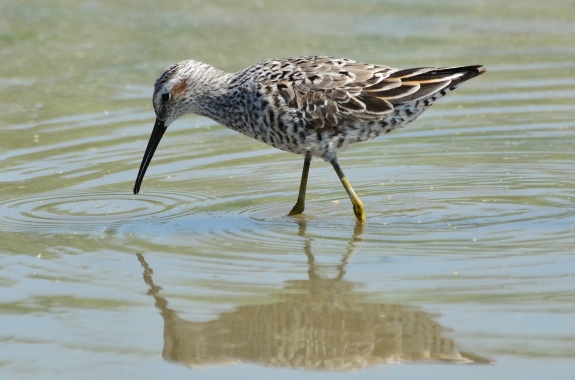
#9 - Sandpipers. Show me a rookie birder and I will show you someone who is going to be greatly troubled...by shorebirds, sandpipers in particular. The dowitcher duo is legendary, peep problems are relentless...to put it bluntly, almost every sandpiper species is at a high risk of being misidentified for something else. Those of us on the coast always have Siberian species on the brain, which complicates the picture even further...yikes. However, the "expected" species do become pretty familiar in time.


#8 - Warblers. Spring warblers are decidedly unproblematic, with the exception of waterthrushes (that's a whitish Northern above). However, you may not be aware that there are three other seasons. Most warblers do not have the same snappy facemelt in October that they do in April. They are referred to as "confusing fall warblers" for a reason, though I despise that tired and overused phrase. There are so many identification pitfalls here that there is no point in even starting in to them. Californians have it especially bad, since we have multiple records of almost every breeding warbler species in the country.


#7 - Vireos. Vireos make people very uncomfortable. Seen poorly enough, every single vireo species (with the exception of a vagrant White-eyed) stands a good chance of being misidentified. Just a few days ago on Facebook, I watched (seemingly in slow motion, like a car crash) in horror as a birder sought out the expertise of an expert, to identify a bird she had photographed very well. He called it an Orange-crowned Warbler...it was a Warbling Vireo. At least with a sandpiper you know it's a sandpiper...with vireos, people call them warblers (and vice versa) on the regular. The hardest vireos? Warbling vs. Philadelphia, and Blue-headed vs. Cassin's vs. Plumbeous. That's a Philadelphia above.


#6 - Longspurs. Away from the prairies of eastern Colorado, Wyoming and Montana, we don't even get to see longspurs in spring. When we get them, they always look like rubbish. Lapland (above) can look like Smith's, Smith's can look like Chesnut-collared, Chestnut-collared can look like McCown's. And 90% of the time, you are getting total garbage looks at them. They all look similar, their calls are not drastically different, and they hate being cooperative for birders. That is a recipe for pain.


#5 - Hummingbirds. Unlike sneaky longspurs and skulky warblers, you can typically get really solid looks at hummingbirds. That said, this may not be of much use to you if you are not prepared...male hummingbirds are facemelting birds, but young males (like the Costa's above) and females can be brutal. With the exceptions of Violet-crowned and maybe Berylline, I think every one of our young/female hummingbird species is at an extremely high risk of being misidentified. Don't believe me? Go geri-birding in Arizona and watch the carnage unfold.


#4 - Storm-petrels. I lead a lot of pelagic trips, and I will tell you that no group of birds strikes more fear into the heart of an inexperienced birder than these. When it comes to these birds, people seeing them for the first time completely surrender any attempt at an ID to the leaders on the boat. We could tell them whatever we wanted and get away with it (fortunately, we want to tell them the truth). Other than the lovely Fork-tailed Storm-Petrels (most of the birds above), they are either all small black birds or small black birds with white rumps. Generally, they want nothing to do with the boat you are on and you are going to be really unsatisfied looking a them if there is a big swell that day. New developments in the Leach's complex have everyone reeling. These are the birds your nightmares are made of.


#3 - Jaegers. You probably didn't see this being #3....but the difficulties of jaeger ID are legendary. Even dark Pomarines and South Polar Skuas get mixed up. Trying to ID certain individuals can lead to such circular logic and mental numbness that I am getting tired just thinking about it. Just be happy when you get to see "easy" individuals, like this Pomarine above.


#2 - Flycatchers. You know what? I haven't done a quiz in a while. What do you think this bird is? The answer is at the bottom of the post. Hint: It's a flycatcher.

Flycatchers are just heinous. Think about each gnarly genus we have all lumped into one jaw-clenching, teeth-grinding family...Contopus, Empidonax, Myiarchus, Tyrannus, etc. That's some heavy shit. The first three genera are especially bad. I don't even know what to tell you here, except to advise you that you can at least get close to the right species. Hammond's and Grays are not similar. Willows and Pacific-slopes are not a confusing couple. Buff-breasted do not look like pewees.

Pewees....yeah. Just identify pewees correctly (don't misidentify them for Empids) and you will command at least a small modicum of respect. Don't report an Eastern unless it's calling though, or you will be run out of your state.


#1 - Gulls. Obvi. I have nothing to say about gulls that you haven't heard before. This is a perfectly typical Herring Gull...I bet not many of you knew that.

There you have it, the list, for your edification and mine. Do you agree, or do I have it all wrong? Are ducks and geese deserving of being on the list? Are alcids alarming? Do Wrentits cause your brain to boggle? I hope not. At any rate, feel free to let us know.


p.s. The quiz bird is a Least Flycatcher. Props if you got it right. And before you descend into a nerdy rage, yes it is a flycatcher that breeds in western states. #notjustavaguerunt