Showing posts with label white-eyed vireo. Show all posts

Wednesday, April 2, 2014

Migration At Last


Back on March 24 I saw that first fateful email of the spring...the one that confirms what you have suspected all along...spring had arrived. But it wasn't the usual "FOS" I'm used to, about the first Western Kingbird or Warbling Vireo...no. This is not California. When you read about Blue-winged and Worm-eating Warblers, Wood Thrush, 25+ Hooded Warblers...those are not-fucking-around spring birds.

You see, despite my standing in the birding community (#7), I rarely get much exposure to the epic movements of spring migrants that happens from Texas to Maine. If you want to see a bunch of migrating songbirds in California, you have to go to some bizarre desert shitholes, which is incredibly fun but also incredibly out of the way. You are stoked to see 10 species of warbler, not 20+. And so last weekend I found myself grateful to be living less than an hour from South Padre Island, which is known for it's great migrant traps and legitimate fallout potential. I have never experienced a fallout, and I would be more than willing to do a variety of awful things (most of them felonies and capital crimes) in order to bear witness to such a spectacle.

It turned out I was there on a "slow" day, but I was more than happy.


A few Yellow-throated Warblers were hard to ignore...they have melted my face over and over again for many years now, and this time was no different. I appreciate the epic stance this bird adopted for the photo.


By the end of the day I could no longer deny how crippled I felt by looking at these birds for too long, at dangerously close proximity. But there was another Yellow-throated beast that inflicted much damage...


The first bird I looked at when I got the South Padre Island Convention Center was this Yellow-throated Vireo. It gave me the shakes. 


It's good to see you again, my big-headed friend.


This vireo is superior in appearance to any native Californian vireo. Someone was really phoning it in when those west coast vireos all came into existence. Sure Yellow-throated Vireo seems to have borrowed the exact palate of a bright male Pine Warbler, but it's a winner.


Speaking of vireos that are better-looking than west coast vireos, there was a single White-eyed Vireo at the Convention Center, the only one I saw that day. White-eyed Vireo is by far the most confiding member of it's family that I have ever met, and come in to pishing rapidly and recklessly.

Of course White-eyed Vireo is one of the most common birds one finds in shrubland and forest in this part of the state, but that has not yet diminished my enthusiasm for them. Especially when they choose to sit motionless, on an unobstructed perch, about eight (8) feet away. 


I know what you are thinking. "Seagull Steve...I didn't know that bird photography was so easy." And to that I say, you are correct! Naw just kidding, it's hard as fuck. Here is a failed photo of a Black-and-white Warbler that I actually kind of like.


Luckily not all my Black-and-white Warbler shots from last Saturday were so blurry. This bird is a striking bird. There were a handful of Black-and-whites at the Convention Center and at Sheepshead, but they were so busy foraging nuthatch-style that they would rarely bother looking at you...which is great to see, but not to photograph.


I couldn't believe how many awesome birds were getting in my face...the geri-birding scene there is raging, and this is why.


How could someone not feel moved by such a rear end? Hella intricate and thought-provoking. 


"Every breath you take, every move you make...I'll be watching you." - Scissor-tailed Flycatcher to American Golden-Plover. 

Thankfully, there was much more to see and attempt to crush that day, so expect another South Padre Island post in the near future. Until then, drink whisky and read bird migration forecasts.

Tuesday, December 11, 2012

Running Amok Around Garden Key


Running amok around Garden Key may or may not yield many birds...but there will always be Sandwich Terns. Well, in fall, at least.

I have crossed the Rubicon (or was it the Eel River?), and finally have returned to Humboldt County, where birds and birders and plentiful and everyone is high (especially the birders). I won't be here much longer, but its been good times. This place has been riddled with birders for years, and its been good to see a bunch of familiar faces again. My 2012 year list has grown to be even more corpulent in the last week, but with Bostick taking a trip to Hawaii, he is back in the lead again. Fuck. Maybe I will end up winning the year in the NIB category (that's Non-Introduced Birds, for you less nerdy people), but he may take the overall cake. Time will tell.

Here's some more scenes from the Dry Tortugas. Its easier to take pictures there than in Humboldt County.


Meet the first Swainson's Thrush to grace the pages of BB&B. This indelible Catharus of catharsis spent a day tamely hopping through our campsite, deftly avoiding the enormous hermit crabs that littered the ground.


Look at this White-eyed Vireo. It looks like it's teleporting into another dimension. That's where they really go in winter.


More teleporting. This one looks more like a Blue-eyed Vireo (***MEGA***).


The outer wall and moat at Fort Jefferson. Not a bad perch up there.


American Kestrels are another one of those birds that can be hard to talk about, because everyone knows what a kestrel is and how great they are. The roof of Fort Jefferson turned out to be a good place to get flight shots of them as they zoomed around having territorial battles.


Northern Parula sez: NOMNOMNOMNOMNOMNOMNOMNOMNOMNOM
NOMNOMNOMNOMNOMNOMNOMNOMNOMNOMNOMNOMNOMNOMNOMNOMNOMNOMNOMNOM


A barracuda making faces.


What a sweetheart.


This was the lone Northern Harrier that made it to Garden Key during my trip. I found her in a frigatebird flock.


Magnificent Frigatebird. The first one you see will trigger an agonizing reappraisal of all the birds you have previously seen that you hold so dear...they can really put the kibosh down on any motivation to watch non-charismatic avefauna.

Friday, November 30, 2012

Mas Tortugas


White-eyed Vireos were one of the commoner migrants, with at least one anchoring almost every mixed flock I came across...which was frequent, considering I was *ahem* not on a birding trip.

Since I didn't go snorkeling while I was at the Dry Tortugas (land team), I mostly did loops around Garden Key for four days straight, although I did eventually end up swimming for a while on the last day. It was legit, and I didn't even get any jellyfish stings.

As you can expect, I took a lot of pictures, the best of which you will be seeing on here on and off for the next several weeks. Maybe they will compel you to make a trip out there, spring or fall. The birds on this trip left me a bit weak in the knees, which is a feeling any birder lives for. Come to think of it, they will die for it too.


Bay-breasted Warbler (year bird). I only saw 2-3, which is not enough but will have to do for now. I typically go years at a time without seeing these buffy-flanked beasts, they are not easy to come by in California. 


Another shot of the Hooded Warbler that appeared in the first Tortugan blog post. A snazzy bird, which has been documented to cause birders to stutter and foam disgustingly from the mouth.


Normal people on Garden Key would not be happy about this, but ominous skies are a good sign for birders....rain is likely to bring migrating birds down to the islands. 


The seas surrounding Garden Key have the classic hue that any island paradise should.


Mmmmmm, Palm Warbler. There was no shortage of them on Garden Key, but strangely I only saw a couple on my first day, when there were the most birds around.


Brown Boobies aren't very abundant in the Tortugas, but they are really easy to see, since they favor perching on the channel markers that are scattered around Garden Key. As is the case with their bigger, more exotic Masked relatives, the Tortugas is the best place in the continental U.S. to see this species. This is as close as I got to one on this trip.


A number of Great Blue Herons were on Garden Key and Bush Key. This one was relishing having some fresh water after a storm...getting all your water from just eating salty fish probably gets old after a while.


If herons could slurp, this one would be slurping.


See? Here is a fish. If I was birding all the time, I would not have seen this fish. This is some kind of awesome parrotfish. We saw a lot of these around Garden Key and in Key West. They get much bigger than this one. Aside from their brilliant colors that can melt a human face in the blink of an eye, they are known for eating coral and having sandy poop. Can you imagine eating a bunch of coral and then having to pass it? Ouch though.


Warblers aren't the only weary birds that need to take a mid-migration rest, raptors do too. Lots of Accipiters stopped in Garden Key, although I didn't see any Buteos. I'm not sure, but this Sharp-shinned Hawk may be the first one to make it on BB&B.

I lost count of the number of catbirds I saw meet their fate in the talons of Accipiters and Merlins while I was there. The death-squeal of a catbird is not a pleasant sound. The grassy roof of Fort Jefferson is in the background; it's a good place to watch raptors, frigatebirds, and other migrants come in off the ocean.

Sunday, November 11, 2012

A Lack of Pronounced Eye Ridges, The Umbrella Move, A Calming Calm


American Crocodile. In the United States, crocs are only found in extreme southern Florida...probably the easiest place to see them is in the marina area and Buttonwood Canal at Flamingo in Everglades National Park. Crocs can be told from gators by their pointed snout, lack of pronounced eye ridges, obvious teeth sticking out, and their preference for salt (and sometimes brackish) water.

How do you like that? Starting off a post with a nonavian organism? Yeah, we get pretty crazy around here, no question.

Now that we know exactly what a birder is, here's another slough of photos from the Everglades for your enjoyment.


I somehow managed to not photograph an alligator while in the Everglades this time, although we saw (and heard!) a few. Crocodiles are listed as "Threatened" in the U.S.


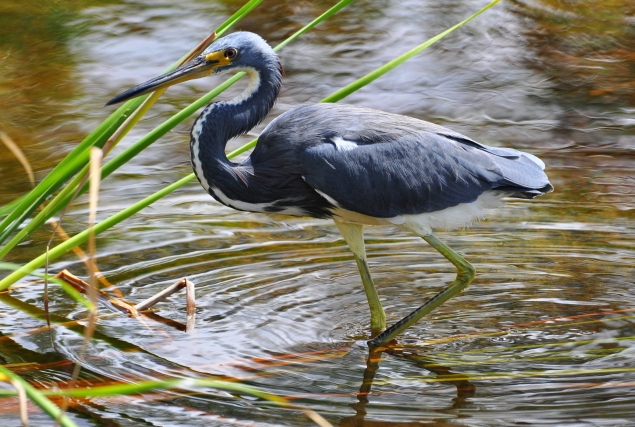
I did not expect Mrazek Pond to be particularly birdy, but there was a lot going on. This Tricolored Heron was feeding hyperactively right next to the road.


Yup, it even busted out the classic umbrella move. Reddish Egrets aren't the only waders that can dance. Nice primaries eh?


Showing off it's tricoloredness while Blue-winged Teal lurk in the shadows.


I really like how the water appears in this picture, even though the heron is a bit backlit. They really are striking birds.


Red-shouldered Hawk is another South Florida classic...it even has it's own subspecies (extimus). They are common and unwary in a lot of places. 


The hawk scans its sawgrassy domain.


The top end of the Buttonwood Canal, nicely framed by mangroves. You need a craft of water to get here...the calm water is indeed calming. Also worth mentioning are the hundreds of White-crowned Pigeons that flew over on the way to this spot.


I think this is some kind of Needlefish (Belonidae). They seem to be everywhere in South Florida and the keys, often right on the water's surface.


White-eyed Vireos are hard to miss in Florida, as with much of the southeast. Their songs are fun to hear, they seem to be gifted with a larger repertoire than other vireos. Whoever named them should get an award for common sense.

Friday, August 17, 2012

A Haggard Vireo of Happiness


Went to Fort Rosecrans National Cemetery (San Diego, CA) quickly before work this morning and got to see the unseasonal and homely White-eyed Vireo. I tracked it down after I saw a bird bomb out of the Eucalyptus grove and fly north into the Myoporum next to "The Wall", where it briefly made itself visible. If you are reading this, other birder who was present, thanks for pointing me in the right direction.

State bird. Stoked.

Saturday, November 6, 2010

They Gave Me Some Beans For My Last Meal


My, what pretty slippers you have Wood Stork.  Your head looks like it could use some moisturizer though.

Hey kids.  It's kind of late at night to be posting blogs (on a Saturday night, no less), but I just got home from seeing Billy Bragg, Im drinking Famous Grouse scotch, and it just seems right.  Tomorrow I am finally breaking my official self-imposed birding hiatus to go look for an Ivory Gull that showed up at Pismo Beach last week.  This is only the second one ever seen in California, and they're really hard to find even where they're supposed to be (the highest of the high arctic).  

I am bringing extra underwear with me, because if I do see it, I will crap my pants.  I'm not joking.  Only a few pants-crapping birds show up in the vast state of California in a given year, and this may be the most pants-crappiest of them all.

Unrelatedly, here's some pictures from Florida that I took in October of last year. Absolutely crippling birding down there. Hope ya'll had a positive weekend.


White-eyed Vireo.  Gaze into its pale eye and you will know your destiny.


Loch Ness Monster?  Anhinga!


Tricolored Herons are one of the many colorful and beloved denizens of southern marshes.


Black Vultures (shown here) and Turkey Vultures are both abundant in Florida...probably because of all the old people. Zing!