Showing posts with label great blue heron. Show all posts

Friday, January 4, 2019

2019: The Year of The 5MR


In 2018, White-throated Sparrow was a county bird, a Five Mile Radius bird, and eventually a yard bird! This was the #1 bird I was hoping to see at Rancho de Bastardos that I kind of expected to show up eventually, and this looker spent a few days here right before Christmas. Sadly, it abandoned us before 2019. Another fun fact: every White-throated Sparrow I've seen in my home county has been in my radius! I would grade my radius as being middling for sparrows, maybe even above average. Fingers crossed for a Harris's this year, though it would not have to show up in my yard to make me happy. 

By this point, every regular BB&B reader has heard about the Five Mile Radius (5MR) and has one of three opinions on it.

Opinion A: 5MR is a fantastic idea and I'm already doing one!

Opinion B: 5MR does sound interesting but not interesting enough for me to start one...yet.

Opinion C: 5MR is stupid. It is stupid because listing is stupid/I am too invested in rabid county listing all over the state/I am busy because I am always doing a big year and need to spend hella time driving or flying/not everyone is doing it so therefore I will not do it/I suck.

If you are of Opinions A or B, or even the highly unlikely Opinion D ("What is 5MR?"), then this post is for you. If you are of Opinion C, well, god help you.


My 5MR is very good for sapsuckers; I saw Red-breasted (above, fairly common here), Red-naped and Yellow-bellied all in 2018. 2019 started with Red-naped (a different one) and Yellow-bellied...nope, no Red-breasted yet! If a Williamson's ever shows up it will probably be in a little park or cemetery no one birds, and 5MR is all about birding places like that. Photographed at Almaden Lake County Park.

I am not going to punish regular readers with describing what 5MR is all over again, but in case you are wondering what all the fuss is about, you can read this BB&B post and check out Flycatcher Jen's new handy little 5MR FAQ page.

BB&B is world-renowned for being a leading trendsetter, influencer, and tastemaker for birding in the 21st century, but Flycatcher Jen, PNW's blogging darling, gets full credit for launching this concept...we are just here to preach the radial gospel. I am a 5MR missionary, if you will, and in the end many of you will be converted, or in other words, saved. The birding paradigm is beginning to shift. So what is new with 5MR birding?


Last fall was excellent for Willow Flycatchers in Santa Clara County; this one was in my yard for a few days in September. There are a number of decent places in my 5MR to check for migrant Empids, but kingbirds are much tougher.

The 2019 5MR challenge is what is new. Jen has invited birders everywhere to come join in; she is tracking everyone's 5MR for 2019, and is at almost 150 (!!!) participants in many states and multiple countries! It's really all about birding your 5MR (or 8.05KR if you are metrically inclined) a lot this year, and we will be tracking many more metrics than just the usual who-will-get-the-most-species stat. She is even doing monthly challenges! You can read all about it right here, and if that grabs ya check out some more of the nerdy, jaw-clenching metrics right here. She also set up a Facebook group devoted to 5MR, which is (somewhat unexpectedly) really flourishing - go here to check it out and join up. No need to sign up for the 2019 challenge to be in the group!

Birders of all levels and all stripes have embraced the 5MR, and you should too! Bird Police, civilian bird wizards, "young birders", geri birders, intermediate birders, and probably some stringy ones...we are all here! Come revel in the places less birded and the luxury of never having to drive more than 20 minutes from your home! Become the master of your local eBird hotspots, or if there aren't many, you can bring them into existence yourself! Of course, there is no need to sign up for the 2019 challenge to enjoy the fruits of 5MR, but I think it will be fun.


Easily one of the best birds in my 5MR last year was this Blackburnian Warbler, which I dipped on twice before connecting. I'm still figuring out how readily findable fall vague runts are in my 5MR, but clearly searching for them is not a fruitless endeavor. Incredibly, in December I got to see another one only 0.3 mile outside my radius. Photographed at Vasona Lake County Park.


Those of us living in urban areas tend to be very heavily biased towards months with wintering birds and lots of migrants passing through, but obviously no matter where you are, you can't forget about the birds that breed in your 5MR! Much of my radius is urban/suburban hell, but a lot of it is protected open space as well, mostly in the form of oak woodland, modest riparian corridors, and some chaparral. Good summer birds in my 5MR include Black-chinned Hummingbird, Vaux's Swift, Common Poorwill, Rufous-crowned Sparrow and Band-tailed Pigeons. I'm sure the pigeons are here year round but I don't see them around where I live for most of fall and winter. Look at this ridiculous thing mantling my tiny feeder! Need to track down Western Screech-Owl in my radius this year, among other residents/breeders.


I've said this a number of times now but there are a huge number of gulls in my radius in the winter months. I really, really want to find something rare in my 5MR (probably Glaucous, Lesser Black-backed or Slaty-backed) and in fact I'm sure they are around, it's just a matter of being in the right place at the right time. This Iceland was casually soaring over my yard last month.


If gulls and waterbirds are strengths, and perhaps even upland birds, the Achilles Heel of my 5MR is shorebirds. Why do they have to be so hard? Every species of shorebird I have recorded in my 5MR has been from my yard. That would be one species of plover (Killdeer, claro) and 4 sandpipers, of which Wilson's Snipe is the only interesting one, though it is the only expected one besides Spotted. It's pretty bad but I will take my snipes. Solitary is possible but I can't even fathom seeing something like a flock of peeps.


Not only do I have all three mergansers in my radius, I've seen them all from my yard! Red-breasted was a fluke though and I'm not sure if I will get another one in the radius this year. The ponds at Los Gatos Creek County Park are very reliable for Hooded Mergansers (where these cripplers were hanging out), which is probably the most heavily birded hotspot (for good reason) within my 5MR.

In 2018, I fared somewhat better than I thought I would in my 5MR. Birding at the very edge of my 5MR at Santa Teresa County Park in spring gave me some great birds like Calliope Hummingbird, Horned Lark, Grasshopper Sparrow and Rock Wren. The radius is real tricky there, with some sections of trail inside and some outside, but I finally got a good handle on it. Fall migration bestowed upon me a nice array of new 5MR birds like Cinnamon and Blue-winged Teal, Greater Scaup, Palm Warbler and Brewer's Sparrow. A Summer Tanager showed up right before Christmas, and the nearby Phainopepla is wintering at the same site again. I finished the year with 159 species in my 5MR without being really committed to inflating that total, which I'm pretty happy about - a few other 5MRs in Santa Clara County finished slightly below that number, though I have no doubt someone living closer to the salt ponds could do better than me, probably substantially so.


My 5MR has most of the expected Northern California wading species, though White-faced Ibis is not something that will be easy to find. Perhaps a Yellow-crowned Night Heron will turn up behind my house with all the Black-crowneds at some point? Yellow-crowned is long overdue in this part of the state and they have been increasing in Southern California. Until then, I will be content with the expected locals, like Great Blue Herons, when they choose to be confiding. Photographed at Los Gatos Creek County Park.

Of course, just because you don't want to sign up for the 2019 challenge doesn't mean you shouldn't do a 5MR at all! Absolutely none of my 5MR birding last year, or the year before, was done with me thinking about getting freaking year birds for my 5MR list...how embarrassing is that? It's pretty embarrassing...but oh wait I am ALL IN on the 2019 challenge so this year will be different!

Well, maybe not all in...I am about to leave for Belize. So long White-crowned Sparrows, hello Tody Motmots! See you on the other side Bushtit, pleasant good morning to you American Pygmy Kingfisher! Godspeed Hutton's Vireo, oh so good to finally meet you Yucatan Vireo!

Right, but otherwise I am heavily invested. Looking forward to checking out some new spots (a couple cemeteries immediately come to mind), tracking down a few self-found rarities, and really pinning down species that I have yet to see in my 5MR that I could reasonably expect to find here...Eared Grebe, Allen's Hummingbird, Red-breasted Nuthatch, and Tricolored Blackbird all come to mind quickly, though that does not mean they will come easily. I am hoping to see some more 5MRs pop up in Santa Clara County in 2019 as well!

Challenge or no challenge, hope you all have a very radial 2019!


My last Santa Clara County bird of 2018 was also my last new 5MR bird. American Bittern was the closest thing I had to a nemesis bird in Santa Clara. Ugh I love bitterns so much, happy that they are possible in my radius. Photographed at Los Gatos Creek County Park.

Monday, January 16, 2017

Fulfilling Destiny: The Five Mile Challenge


Last week I decided to take an impromptu day off...it had been raining day after day on end, we were finally going to get a break, and I wasn't very busy at work. It turns out when you are about to have a kid, you unexpectedly get a bunch of free time on your hands right before your fetus levels its warrior and becomes a baby. Anyways, I was twitching to go birding, and not just any kind of birding...I had a Five Mile Challenge (5MC) to do.

Flycatcher Jen had already carried out her challenge, getting 60 species despite below freezing conditions. She had threatened to attempt another challenge with a more intimidating species total, but the better weather she was hoping for never came. Portland currently resembles the North Pole more than the North Pole does. While 60 species was commendable considering the conditions she was stuck with, I thought that it would take a very bizarre turn of events for me to not exceed that number. I don't know my Five Mile Radius (5MR) like the back of my hand, but let's acknowledge the elephant in the room...I am the #7 birder in the United States. So, banking on my sevenness, I did what I thought was best and decided to plunge into the challenge, even though a storm had not quite finished passing through.

Unfortunately, when I arrived at my first site that fateful morning, I was essentially birding in a rain cloud. It sucked. 25 minutes spent at Lake Anza in Tilden Regional Park ended up being a total waste, with only 17 species, all of which I would see again during 5MC. I also missed target birds like Belted Kingfisher and Ring-necked Duck. Ugh...if I had to do it over again, Lake Anza would be out. So much for sevenness.

The next stop was another part of Tilden Regional Park, Jewel Lake and the area around the nature center. The weather was still pretty wet and dismal. This stop was supposed to provide the bread and butter for my passerines for the day, an area my 5MR is not particularly strong in. Fortunately, the birding here didn't end up being as regretful as it was at Lake Anza...Band-tailed Pigeon, Red-breasted Sapsucker and Purple Finch were all quality pickups, and by the time I abandoned Tilden I was up to a modest 35 species. I had missed some easy birds, but I figured that I could just wallop the bayshore sites and make my 5MC list swollen with waterbirds.


The Emeryville Marina was my next stop, which I had timed to be at high tide to pick up roosting shorebirds. Day birds came at a rapid clip...everything was proceeding as I had foreseen.


This was my only place to get Surfbird, a plump west coast specialty which did not disappoint. This roost site is one of the few reliable spots for Surfbird in Alameda County.


The godwits and Willets also sheltered Whimbrels, dowitchers and Black Turnstones. Redhead was definitely the best bird at this stop, and a completely unexpected bonus for the 5MC. The total lack of scoters was worrying, but I figured I would pick them up elsewhere.


An impromptu stop at Aquatic Park in Berkeley was next. I've never birded here before...is that weird? A lot of people bird here. Anyways, I'm glad I stopped because I just piled on more and more day birds, a number of which I didn't get anywhere else that day. I finally got my 5MC Great Blue Heron, which was my first of 2017...what a relief. However, as I had been anticipating for months, one of the locking arms in my tripod finally gave out, meaning that my tripod could only function if I was sitting down or on my knees. This was an ominous turn of events...would this end up crippling my effort?


Berkeley Meadows was the next stop. A distant woodpecker frustratingly had to go down as Downy/Hairy, but White-tailed Kite, Say's Phoebe and Lincoln's Sparrow were all new for the day. A flock of Yellow-rumped Warblers held another new 5MC species...


Mmmmmm...Western Bluebirds. This was one of the few sources of facemelt I got to experience during 5MC. With a decent haul from the meadow, Berkeley Marina would make for another quick stop as it was right next door. The Berkeley Fishing Pier is still closed (railer), but I finally got my Surf Scoters, and Downy Woodpecker, Golden-crowned Kinglet and Red-winged Blackbird all made for quality bonus birds.

By this time, I knew I had surpassed Flycatcher Jen's total...it was just a matter of if I had done well enough to be out of reach of This Machine Nate yet. Since I don't have an iphone, the eBird app doesnt keep a day list for me, so I didn't quite know how I was doing. At any rate, it was time for a sandwich.


Getting a sandwich from Sea Breeze Deli (next to the marina) was very fortunate, in part because they make damn fine sandwiches, but also because I got another day bird behind the parking lot...Greater White-fronted Goose. Fuck yes...I was on a roll. Talk about the stars aligning! Ok GWFG isn't a monumental rarity or anything but it's locally rare and was one of the best birds of the challenge.

By now it was mid-afternoon, so after getting goosed I thought I should stop by the Albany Mudflats real quick to finish my sandwich and take advantage of the falling tide...Northern Pintail, American Avocet, Long-billed Curlew, and Mourning Dove were all new birds. At this point I felt invincible...I still did not know what my 5MC list was at, but it had to be over 70 and I still had to bird Meeker Slough, Richmond Marina, and the Albany Bulb...I was going to kill it. Who knows how many more birds awaited? But before I could go on to the next stop, I got a text message. This text message turned out to be life-changing. I knew, then and there, that the 5MC was over for me...there was something very important to do, something that could not wait, something that might not ever happen again in my entire life.

I know what you are thinking...no, Billy did not go into labor during the 5MC...that would make for a great story, but something even more unexpected had happened...a Ross's Gull had been found in Half Moon Bay, and that is where I had to be.

But that is for another post. My 5MC was completed with over two and a half hours of daylight remaining. I had missed a lot of birds, even taking into account my abbreviated day...Bushtit, Pacific Wren, American Pipit, Savannah Sparrow, American Goldfinch come to mind first...as I said, passerines are not the strong suit of my 5MR. But none of that matters now...I am the winner of the 5MC.

I just figured out my 5MC list while writing this post. I saw a lot of birds...I did not think I would get as many as I did, and now I know that it is possible to do a Big Day in my 5MR and get over 100 species...that's pretty fucking sick, don't you think? The final stats are: six hours, no help, no chased birds, no naps, no poops, some farts, one Contra Costa County bird (Red-breasted Sapsucker), one new 5MR bird (Redhead), one thermos of coffee, one ginger ale, one hella good sandwich, one awkward couple getting into a fight because their dog got loose, 40 year birds...and 86 species, most of which were in Alameda County, though 20 species were recorded in Contra Costa only.

I am the king of the 5MC. It is an honor and a privilege. I love getting 86'd, who knew it would be so good? Though I am a birding champion, props to Jen for making the 5MR a thing that seems to be catching on fast. You can read about Flycatcher Jen's effort here, and This Machine Nate's attempt with near-identical total over here - it is good to see him blogging again.

Well I would like to stick around and gloat, but I need to pick out my prizes...

Monday, May 2, 2016

An Ancient Harlan's Hawk, Newt Problems, Shades of Merlin


As any California birder knows, Humboldt offers a lot more than just the (very) occasional Great Gray Owl. There is no shortage of good birding spots to scour during the winter, so of course I had to check some other shit out while I was up there. I birded Arcata Marsh, since it is conveniently located right in town and just about anything can show up there...the dependable Swamp Sparrows I was looking for were not very dependable on this day, but the much more range-restricted Golden-crowned Sparrows were there in predictable abundance.


Unlike most birding spots, the marsh continues to grow in size and simply gets better and better when it comes to shorebirds and waterfowl, possibly to the detriment of the local Short-eared Owl population. This Greater Yellowlegs was feeding right in the face of this Green-winged Teal, foraging on little inverts the teal was stirring up with its bill. When you have a height of only a few inches it must be strange to have a yellowlegs looming over you, but the teal did not seem to mind.


This was apparently a successful foraging technique, as the yellowlegs did grab something while I was watching.


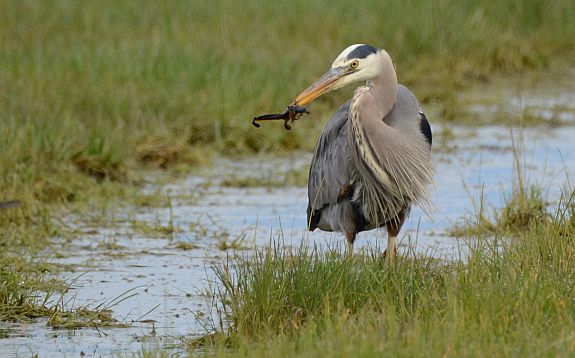
Over on the V Street Loop, this Great Blue Heron had gotten a hold of a much more interesting prey item...a large newt.


The heron did not appear to have a good idea of how to go about eating the newt, repeatedly dipping it in water, bashing it against the grass and not giving attempting to swallow it at all while I was there. This is an awkward thing to prey on at best, extremely toxic and deadly at worst. Native Americans in the Pacific Northwest used newt juice as a poison...


On the far side of the loop a cooperative Merlin was posted up on...a post. This bird struck me as being fairly pale, with no mustachial stripe...in the field I thought it was a female, but looking at the photos now I don't feel so sure about that. Interesting bird, I'm not quite sure what to make of it as far as age/gender/subpecies.


Elsewhere in the bottoms, I came across another, especially confiding Merlin. This bird was noticeably darker with heavier markings on the breast and belly than the first Merlin of the morning, but I'm not enthusiast about pulling the trigger and calling it a "Pacific" Merlin (I would expect a darker face and even more streaking/barring on the breast and belly). The vast majority of Merlins I've seen over the years usually zip by, giving shitty looks...I'd like to have more time to watch these birds and get to know each subspecies more.


For all you robin-strokers out there, here is an American Robin. There are thousands in the Arcata Bottoms in the winter. It is known.


Much, much more interesting than the area robins was this Harlan's Hawk. This bird has been wintering along the Highway 101 corridor between Eureka and Arcata for over a decade (!), usually near the Jacoby Creek Cutoff. In the past, I had only seen it while on the freeway, getting a quick naked-eye glimpse of it perched on a billboard or something and thinking "Oh, that was probably the Harlan's", but I finally managed to get great looks at the bird on this trip.


The bird is extremely dark, lacking any "warm" tones whatsoever. Fitting for an Alaskan bird. The uppertail (not visible in any of my photos) appeared dark gray without a hint of red, with a prominent dark subterminal band.


Although I never saw it fly, this bird definitely provided the best looks I've had of any Harlan's. Hopefully it will make it back to Humboldt this fall once again.

It was a relatively quiet winter in Humboldt as far as rarities go, but with a Snowy Owl (that I gleefully did not chase) showing up shortly after I was up there, the winter Vague Runt season ended for local birders on an extremely high note. What will show up next winter? Steller's Eider? Gray Wagtail? Black-tailed Gull? Siberian Accentor? The possibilities boggle the mind.

Monday, April 18, 2016

Pointless Perching, A Nemesis No More, Sage Baron


There's still much to catch up on post-Mexico, so that is what we will do. Let's start things off with a Black Oystercatcher, a bird that is universally celebrated. California is a state rich in rockpipers...we have Black and American Oystercatchers, Wandering Tattler, Rock Sandpiper (and currently a possible Purple Sandpiper at the Salton Sea), Surfbird, Black and Ruddy Turnstones. The possibility of Gray-tailed Tattler looms large. I appreciate this rockpiper diversity, as it can't be matched anywhere else in the Lower 48. Sometimes I think about what it would be like to live on the east coast, and though warblers bring the stoke I always cringe when I think about the paltry rockpiper scene over there.


How long will my range overlap with that of the Black Oystercatcher? Ten years? Two years? Twenty years? Impossible to say, pointless to wonder about. Miller-Knox Regional Shoreline, Richmond, CA.


Great Blue Herons are looking good this time of year. I can barely look at young Great Blues, they look like total rubbish compared to alternate adults like this one. Photographed at Miller-Knox Regional Shoreline.


Moorhens and gallinules are accomplished at perching on stuff, although it usually doesn't seem necessary. Look at this...does this seem necessary to you? Fortunately, it is quite novel for the rest of us. Las Gallinas Ponds, Gallinas, CA.


Common Mergansers don't make it onto BB&B with much frequency, though they are deserving of it. "Familiarity breeds contempt" does apply to some birds, but not this one, I just don't get to photograph them very often. Photographed at the Las Gallinas Ponds.


A male Long-billed Curlew (note the short bill length) prowls goose-grazed grassland for invertebrates. Middle Harbor Shoreline Park, Oakland, CA.


Aren't grasspipers great? So bucolic, not to mention pastoral. Long-billed Curlews are early, short-distance migrants, and we are only without them on the coast for a couple months of the year; they will be back in numbers in July. A nice bird to have at my patch on the regular.


Well...its time for full disclosure. Until this year, until this bird above, I have never seen a Northern Saw-whet Owl. This was my Nemesis Bird. Sure I've heard lots of them, but the stars never would align for me. It was agonizing hearing them all the time on Santa Cruz Island (where they lived outside the ranch where I was staying)...there were many nights walking in circles under calling birds in the trees with nothing to show for it. When I told people my horrible truth about NSWOs, they would always ask "Really?", with a look of bemused scorn on their faces. And let me tell you...there is nothing more fucking tiresome than being looked upon with bemused scorn.


This bird had more brown in the facial disc than I expected, and relatively little streaking on the crown...this is not an adult bird, I reckon.


It's really nice to not have a Nemesis anymore. Really, I can't think of one for the Lower 48. Most of the birds I still need are not species I've invested a lot of time in seeking out...Eastern Whip? Swainson's Warbler? Great Cormorant? None of those species invoke feelings of anger or shame within me (just typical birdlust) so I think I'm good for now...I am pretty pissed at all the Hawaiian Petrels I haven't seen though, so if I go through another pelagic season again without seeing one (which, for me, would be typical) I will know who I have beef with. Anyways, this LIFE BIRD was a one-day-wonder at Golden Gate Park, San Francisco, CA.


As the Great Ornithologist Felonious Jive has said, birding is hard. We all know that. If it wasn't hard, there wouldn't be stupid phrases like "Nemesis Bird", and I certainly would not feel compelled to capitalize that. Authors at the ABA Blog have really run with Felonious Jive's phrase, devoting no less than three different blog posts to this idea. Look, obviously birding is easy if you go are really happy to look at Mallards and Ring-billed Gulls all the time (which is terrible), or if you are geri birding (which is fantastic), or if you go to a new country and you are surrounded by life birds (which will never get old). I get that. That said, birding is hard. That's what makes the easy moments so glorious. That's part of what makes seeing great birds so great. So when I went to look for this Sage Thrasher near a particular bench, I was quite chuffed to walk up to the bench, see the thrasher naked-eyeballed next to the bench where I was supposed to look, then watch it perch on the bench itself. Success! A much-needed reprieve from hardship!


I then unleashed a torrential crush-rain onto the bird. This was easily the most cooperative Sage Thrasher I have ever seen. To describe the bird's behavior in scientific terms, I would describe it as giving none fucks. It made a House Sparrow seem about as confiding as a Black Rail...and this Sage Thrasher is no more of a House Sparrow than I am.


Sage Thrashers are very early migrants, but seeing this Vague Runt in a coastal county in January was not on anybody's radar. As expected, it only hung around a few disappears before disappearing, hopefully reorienting in a direction where more sagebrush was to be found.


Life is good when you have a Sage Thrasher hopping around at your feet. Schoellenberger Park, Petaluma, CA.


If you've never been to Northern California before, there is a good chance you've never seen a Bicolored Blackbird. This is the locally-breeding subspecies of Red-winged Blackbird, readily identified by the lack of a yellow border on epaulet and (to my ears) a somewhat shittier-sounding song than other Red-winged Blackbird subspecies. Females are markedly different as well, looking annoyingly similar to female Tricolored Blackbirds. Photographed at Schoellenberger Park.

Wednesday, February 3, 2016

Winter Mexican Tour Y2K16, Day 6: Chacalilla and Chenchoing Part I


On the morning of Day 6, we returned to Chacalilla, parking at a random spot near the north end of town and birding our way out along the main road that leads directly north (out of town) until we ran out of decent habitat. We did pretty well, and I got a life bird (Elegant Quail), though that is definitely going on the "better views desired" list. We had also seen them them on the east side of town a couple days earlier, but I got shit looks. I suspect there might be better roads to bird in the area than the northern one but we did end up with a pretty impressive species list that morning. Along with some big mixed flocks in town, there were also a number of grackle-esque Sinaloa Crows, which never failed to hold my interest despite being crows.


Great-tailed Grackle on the left, grackleesque Sinaloa Crow on the right.


Along with Sinaloa Crows, one of the most abundant local specialties in the area is Golden-cheeked Woodpecker. They are loud, conspicuous, and seemingly everywhere.


Our first Bare-throated Tiger-Heron of the trip was perched on a snag in a dry field, scanning/lording over its domain.


Weird birds. Such thick necks. We got to hear them doing their low grunting sounds at Lower Singayta, which was a nice lifer vocalization.


Cinnamon Hummingbirds are very common in the lowlands of Nayarit, Jalisco and Colima. Go there and you will see many, and inevitably begin cursing their abundance when you begin struggling with finding other hummingbird species.


Cursed abundance aside, it is a very attractive bird with an attractive tongue.


I find Groove-billed Anis to be fascinating. Anyone else feel this way? I can always stop and look at anis, even when there is more facemelting stuff available.


There were a good number of raptors in the area...here is an immature Zone-tailed Hawk, which were a fairly common bird to find during the trip. You can view our heavy eBird checklist from the morning here. Definitely consider birding around Chacalilla if you ever bird San Blas, it has hella species and is a quick drive from San Blas.


Here is Flycatcher Jen, gently caressing the love of her life, Campana. Campana lives, more or less, at the Bucanero (our motel in San Blas). Campana is one of the perks.

As we finished up our morning of birding at Chacalilla, we weren't sure how the rest of the day would play out. What we wanted to do was go on a boat trip with Chencho, the now world-famous guide who is notoriously good at showing birders waterbirds, which he knows the names of in English. Chencho could get us Northern Potoo. Chencho could get us Rufous-necked Wood-Rail. Chencho was a birding god as far as we were concerned. We did not want to go with anyone but Chencho...however, we made no prior arrangements with him. I was told he could be reached through Hotel Canela Garza, so we went there, but the lady working the desk did not acknowledge knowing of his existence. Then we went to the spot next to the bridge where a lot of tours leave from...but we were told that Chencho launches from the other side of the bridge. So we went over there, and of course Chencho wasn't there. Then we got Chencho's cell number from Mark Stackhouse, but our motel didn't have a phone we could use. This all happened over several days. Chencho was becoming a mythical figure. Finally, on the way back to town from Chacalilla, we went back to Chencho's launch. Dipper Dan talked to a guide there who knew Chencho, who then drove away on a bike to get Chencho, who then returned with Chencho's son (also named Chencho, I believe), who then told us that Chencho Sr. would meet us later in the afternoon for a bird trip. It was a Mexican Miracle.

If any of you want to try a similarly unplanned, haphazard way of finding Chencho, he launches from a spot on the west side of the river next to San Blas, just south of the bridge into town, at the end of the only paved street that gets anywhere near the base of the bridge. Its easy to find. Chencho said he works in a cooperativo, and that there are only two other bird guides who do river trips, I think they were Oscar and "Huevos"? Why "Huevos", I don't know. Anyways, if Chencho can't take you I guess look for them.

Chencho did show up that afternoon, giant spotlight in hand, and it was all smooth sailing from there.


Great Blue Herons hunted in the shadows of the mangroves.


Ospreys soared with the frigatebirds above the river.


Anhingas offered some more exotic flavor.


Anhinga feet. I don't think I've really looked closely at Anhinga feet before...they're yellow, weird and muscular. What cankles.


Very early on in the boat tour, we were dealt one of the highlights of the trip, in the form of Rufous-necked Wood-Rail. Astonishingly, we saw two different Rufous-necked Wood-Rails on opposite sides of the river. It was astounding. I couldn't fucking believe we got to see two of these things, let alone one, and no playback was required. I really didn't think we would see one, and this was one of the top target birds of the entire trip. Dipper Dan spotted both of them, and he all got extra sloppy HJs from us that night. I'm no wood-rail expert, but I'm pretty sure the only reason we saw them is because we were looking for them at a lowish tide; if the tide was too high the birds would be back in the dense mangroves and thus not visible.

Although this photo is absolutely not worth bragging about (though seeing this species is), I'm amazed I even have an image that is recognizable; I managed one frame, focused on nothing but pitch black shadows, and somehow got something. They look much, much better than this in real life, I assure you.

More birds provided by Chencho coming soon.