Showing posts with label Black-throated Blue Warbler. Show all posts

Thursday, March 8, 2018

The Five Mile Radius

The Five Mile Radius. Is there anything more chic in the birding world right now? Let me answer that for you...no. No there is not. But if you are still in the dark about this transformative approach to birding, I am happy to enlighten you.

The lists birders keep are mostly based on temporal (big day, year, big sit) and geopolitical (ABA, country, Lower 48, state, county) boundaries that were generally decided on by people who are long dead. The big exception is, of course, patches. A patch can be anything...a tiny park, a huge national wildlife refuge, a whole cluster of sites...there are no rules or borders to conform to. A list for your Five Mile Radius (5MR) is basically a cumulative list of all the birds you can find within five miles of your house - a patchwork of local patches, if you will. Simple, right?


Unlike my last 5MR, which had close to no fresh water birding spots at all, the new 5MR has numerous ponds and a couple of lakes. Stoked - this certainly helps compensate for the lack of saltwater in my new radius. I've already had all three merganser species within the 5MR, including this snazzy leucistic Common Merganser. Photographed at Almaden Lake.


Here is the pasty wonder with a typical female for comparison.


The idea (my interpretation) is that you should bird a lot within your 5MR, because almost everyone should be birding more locally than they already are. Less fuel burned, less time in the car, less going to the same old places where everyone else goes. If you think it is fun to get to know the birds of your county (let's face it, that is definitely your idea of a good time), then just think of the joy and ecstasy of mastering the status and distribution of birds within 5 miles of where you live! Plus it gets you exploring more, and what can be more rewarding than finding a gem of a hotspot or a gem of a rarity in your own backyard, so to speak? If you are wondering what your own 5MR may encompass for you, it can easily be displayed in Google Earth, which you can download for free (use the ruler tool, then select the circle tab). The simple but radical concept of a 5MR was created by Flycatcher Jen of I Used To Hate Birds, and after simmering a couple years in the hearts and minds of other birders, its popularity is beginning to boil over. The birding Zeitgeist is moving on from big years, and right into the 5MR!


Red-naped Sapsucker is a nice, low-level rarity in much of the state, but a great bird for a 5MR! This is also the only one I've seen in the county so far. Photographed at Almaden Lake, where it also wintered 2017-2018.

As a major arbiter and birding trendsetter, BB&B is more than happy to be a proud sponsor of the 5MR, and as a sponsor I have been very active within my own 5MR lately. I moved to San Jose less than a year ago, leaving behind a rather short-lived 5MR that included the Berkeley Hills and extensive bayshore areas in Alameda and Contra Costa counties - this is where the now-classic Five Mile Challenge went down, where I trounced Flycatcher Jen in Portland, OR, and This Machine Nate in Austin, TX. It wasn't a fantastic 5MR, but it was pretty good. So what is up with this new Santa Clara County 5MR? Well, that's it right there at the top of this post, you can see what it looks like. Basically, more than half of my radius is terrible, soul-crushing urban/suburban sprawl with a handful of greenbelts and one potentially interesting county park that I haven't been to yet. Pretty shitty from a birding/ecology perspective, there is no way around it, though I'm sure there there are some other parks up there that could yield some surprises. But the southern half of the 5MR looks very different....much of it is comprised of county parks and publicly accessible open space.


Western Bluebirds are abundant in the southern half of my new 5MR, seemingly present everywhere I bird. Can't complain! Photographed at Vasona Lake County Park.


Visiting birders often want to know where to find California Thrasher - for years I didn't have any great recommendations, but now I have spots for them within my very own 5MR! There is lots of readily accessible chaparral and scrub in my radius, and so there are readily accessible thrashers. Photographed on the Alamitos Creek Trail.


Human-tolerant Green Herons can easily be found at many sites. Photographed at Vasona Lake County Park.


Black-crowned Night-Herons abound as well. My hopes and dreams of discovering a wandering Yellow-crowned have so far not been met, but I am going to keep looking and looking and looking and looking. And looking. This half of the state is overdue for another one. Photographed at the Los Capitancillos Ponds.


Shorebirds are extremely hard to come by in my 5MR, but I am happy to say there is no shortage of gulls. There are several sites where one can comb through 1000+ gulls (with Herring being the most abundant), and to be honest, the rarity potential is scary high...I would be surprised if there wasn't a Slaty-backed or Lesser Black-backed somewhere around here. Iceland Gulls are pleasantly common as well. Photographed at Los Gatos Creek County Park. 


There are hordes of Canada Geese about, which act as bait for other species of geese to settle in. This young Greater White-fronted Goose was at Los Gatos Creek County Park. This is another species I've seen only in my 5MR in the county.

A handful of statistics; out of the very modest (sub-modest?) 225 species I've seen in this county so far, I've recorded 143 of those in my 5MR, which is 64% of my entire county total. Not so bad eh? My previous Albany 5MR was left at 149, and god willing, the Rancho de Bastardos 5MR will top that in a few months. I no longer have saltwater habitats available, which are powerful weapons to deploy in 5MRs, but the sheer number of ponds and semi-intact upland habitats I have at my disposal should get me there soon...spring migration is already underway, after all. Of course, my incredible yard list has a part to play in all of this too, but that is for another post.


I couldn't find any when I went to the east coast in October, but luckily a Black-throated Blue Warbler was waiting for me when I got back home! Brilliant. Without a doubt, this is the best bird I've seen in my new 5MR so far and it seems unlikely that I will be seeing another one in the county any time soon. Photographed next to the Santa Clara Valley Water District pond.

So what do you have to lose? Dare to be different. Draw up your own 5MR and start tearing it up. Bird it relentlessly. Become one of those "local experts" you've always heard so much about. Reap the rewards (and savings!) of being a patch-pummeler. If you want to be weird and do a 3MR or a 9MR instead, no one will stop you (not even the bird police!)...or you could be part of the 5MR movement, and join me in shaking up the birding world with a new kind of list. It's a lot more fun to compare your 5MR with someone else's, after all. To that effect, birders in Los Angeles County are even doing a year long competition of sorts with a bunch of new 5MRs sprouting up, which is fantastic!

Come join us and draw up your 5MR today. Depending on where you live, birding your 5MR may not be the most glorious kind of birding, but you will quickly find it scratching an itch that you may never have known you had.

Tuesday, November 11, 2014

I Still Fiend For Vague Runts, But I Can Actually Look At A Common Bird (And Enjoy It)


Hey buddies. Felonious Jive (The Great Ornithologist) and I have just not been good bloggers lately. We've hardly been birding, to be honest. Between work and raging super fucking hard various social obligations, life has been pretty eventful, but not in any avian sense. In fact, I've been birding so rarely of late that I can now actually look at a common bird and enjoy it. Like today I looked at avocets and was able to appreciate them, instead of wishing they were a different shorebird species that were more apt to have rarities associating with them. Of course I still fiend for Vague Runts, but in time, my urges will be sated, once again. Thank Christ that goddamned pipit is gone so I don't have to think about it anymore; the Brambling doesn't hurt nearly as much.


That said, let's start this post with a Vague Runt Tropical Kingbird. Tropical Kingbirds are not unusual in late fall up and down California, generally a low-level rarity along the coast, but we don't get tired of looking at them...especially when they are vomiting. Lake Merced, San Francisco, CA.


Did you think I was being cute or something? That UFO on the left side of the photo came out of the kingbird's mouth. Look how far away the kingbird was able to fling it! Talk about hurling.


This female Black-throated Blue Warbler spent some time at Mendoza Ranch on Point Reyes last month. I know this isn't really a crush, but bear with me...it was really dark under the canopy and my ISO was set at something like 50,000, so it's amazing that anything is visible at all.


Also amazing is how confiding members of this species can be. It always astounds me...for whatever reason, they just don't seem to give a fuck. A bird on the Dry Tortugas brushed me with it's wing. This bird was feeding at eye level, less than 3 feet from my face. If you want to suck someone into birding, arrange for them to have a meeting with a Black-throated Blue Warbler. They will be hopeless bird junkies after that.


I said I would give you common, so I'm going to give you common...here is a Common Raven having an aerial tangle with a Red-shouldered Hawk. Photographed at Lake Merced.


The same two birds. I would imagine that if you are any sort of bird of prey larger than a Sharp-shinned Hawk, you would hate ravens. They are relentless in their harassment of raptors, and apparently impossible to kill. Anyone ever see a bird of prey get a good whack at a raven?


Not common, but Tricolored Blackbirds are to be expected on outer Point Reyes. This male is showing off that long bill that can often be of great use in distinguishing them from Red-winged Blackbirds.


Here are a pair of female Tricoloreds, wallowing in shit. Don't feel bad for them, they love it!


Golden-crowned Sparrows are horrendously abundant this time of year, but they are still fun to encounter by eye and ear. Even though the bird is sitting on an "artificial perch", I'm kind of into how intensely brown this photo is. #Shadesofbrown is the new #Shadesofgray. Arrowhead Marsh, Oakland, CA.


Although I've met a number of Common Loons that seemed pretty fearless, I don't meet Red-throateds very often that lack their species' usual disdain for humanity. Photographed at Arrowhead Marsh.


Brown Pelicans are truly charismatic birds, being capable of both inspirational majesty and baffling clumsiness. I honestly think this is a species that nonbirders (with the exception of some fishermen) appreciate more than birders do, since they are huge, abundant, highly visible, and prefer to fly awesome routes in tasteful formations. Photographed at Arrowhead Marsh.


Raptors aside, I can't think of another bird in the bay area that is more fun to watch while they are feeding. Photographed at Arrowhead Marsh.

Tuesday, February 19, 2013

Taking a Gull Siesta With Bay Area Warblers


Ah, the crispy Black-throated Blue Warbler. Rare but regular during fall migration, this is the first bird I've seen that is actually wintering in the state. Pescadero, CA.

Birding for the last few weeks in the bay area has largely been dominated by gulls and waterfowl. That's fine and everything, but there are other birds worthy of our attention as well, particularly ones that aren't gull-like in any way, shape or form. Today I've posted a few of the warblers currently wintering in the area, rare and otherwise...they provide a more than welcome reprieve from the birds that wield nothing but whites, browns, grays and blacks.

BB&B is excited to be making several other announcements today as well...the much-maligned BB&B interns have been hard at work churning out high-quality content since the return from Costa Rica, and we are bringing you, the nerd, some good stuff in the near future.

- The Human Birdwatcher Project is finally bringing you the next installment in its scandalous birder interview series soon, featuring Johnny "in the middle of some twisted Real World Field Biologists nonsense" Nutcase, whose blog is here. Check the Human Birdwatcher Project tab above for previous coverage.

- It's gull season. You are painfully aware of this, despite the emotions you may or may not have for them. If you are wondering why people even bother looking at gulls, you will soon find it all explained in grisly and dorky detail.

- Have you noticed that vagrants who cross international lines are frequently being considered escaped pets by unwitting birders? Its been nagging at me, and I think there is something we can do to clear this up. Expect TOTAL COVERAGE on this subject in the next week or two.

- If you haven't found it yet, BB&B has a Facebook page that ridicules birders even more than we do here. Some exclusive bird porn is provided as well...come join us!

The bird is largely dependent on a particular tree that is owned and operated by a Red-breasted Sapsucker. The sapsucker drills wells in the bark, the warbler steals the sap. The sapsucker knows what the warbler is up to and will chase it off if it sees that the warbler is up to its tricks. Thanks go out to the property owner who has not tried to stop all the visiting birders from staring into his front yard.


As Black-throated Blue Warblers are prone to be, this bird has been pretty cooperative and confiding.


It's not a warbler, but BB&B would like to finally welcome Red-breasted Sapsucker to its hallowed halls. This is the bird that is making the Black-throated Blue's winter visit possible. Thank you Red-breasted Sapsucker, thank you.


Easterners who yawn at the sight of a Black-throated Blue Warbler may better appreciate this Towsend's Warbler instead. Despite their abundance here this time of year, they never wear out their welcome. Cascade Ranch, Santa Cruz County, CA.


Cape May Warbler is a very good bird in California (I believe it's still a state review species), especially in winter...please excuse the photo quality and instead wallow in the warbler's greatness. This bird's winter territory ostensibly consists of a single eucalyptus tree in Palo Alto, CA.


It's nice to see an adult male, rather than one of those staggeringly drab hatch year birds. If you are wondering what the black shit on this bird's face is, its gunk from Eucalyptus flowers. Just to see what was so amazing about this tree that could attract (and keep) a vagrant warbler that belongs thousands of miles away, I drank some nectar from one of the flowers...it was delicious! If I could live in that tree and drink its succulent nectar all day, I would do it in a heartbeat.


Common Yellowthroat. They don't make it onto this blog often, so here is a reminder that they are out there and you should love them. Cascade Ranch, Santa Cruz County, CA.


Palm Warblers occur regularly on the West Coast in fall and winter. I found this bird amongst rocks lining a sidewalk...they are not too picky about habitat. Sausalito, CA.

Monday, November 26, 2012

Fall Birding in Dry Tortugas National Park


Dry Tortugas National Park is doubtlessly one of the most famous and crushingly good birding hotspots in North America. It is mentioned in the same breath as any incredible place birders swarm to for migration...Cape May, Magee Marsh, High Island...you get the picture. Ever since I was a teenager, I drooled about someday going (yes, I also drooled about girls too). Being out in the open ocean, the Tortugas are a migrant vacuum for landbirds...this is one of the few places you can reasonably hope for real fallout. Equally as stoke-inducing is the great collection of nesting and visiting seabirds as well.

Of course, almost all birders go in spring. That's just how it's always been done. That's when warblers are the brightest, that's when fallouts happen, and that's when you have the best chance at seeing the high-quality terns....Sooty, Bridled, Roseate, and Brown and Black Noddies. Fall in the Dry Tortugas is not something birders seem to know much about...so being the Number 7 Birder in the nation, I decided to do something about it.

In the predawn hours of October 17, Booby Brittany and I managed to make it on to the Yankee Freedom III (after I was almost stranded on a sailboat that was NOT going to the Tortugas, but that's another story). Despite my enthusiastic (bordering on desperate) efforts to find any shearwaters or pelagic terns, the boat ride there (and back) was uneventfu beyond a few boobies and frigatebirds. The only surprising thing was the tens of thousands (hundreds of thousands are more likely) of lobster traps that carpet the ocean between Key West and the Dry Tortugas...I can't imagine that's a very sustainable fishery.

As we arrived at the Tortugas, so did a rainstorm. As we passed Brown Boobies on channel markers and the mini Masked Booby (year bird) colony on Hospital Key, a sizeable flock of birds appeared out of the rain. As they crossed the bow, I got a good enough look to see they were thrushes...a good sign.


The skies can get quite congested above Fort Jefferson, with frigatebirds and raptors being the most obvious. The Tortugas are probably the best and most reliable place for Magnificent Frigatebirds in the U.S., as they are persent in numbers throughout the year. The white-headed bird is an immature, the black-headed bird a female.


Garden Key has a good roosting spot for gulls, terns and shorebirds. A Piping Plover (year bird) roosts with Black-bellied Plovers.

A flock of Magnificent Frigatebirds met us as we docked at Garden Key, and Booby Brittany and I quickly made our way to the campground to stake out a good spot...we were to stay 3 nights, and wanted to pick a place with shelter from the rain. We wound our way through the tame flock of Ruddy Turnstones and Eurasian Collared-Doves (what a weird mixed flock) and finally settled on a spot, where a Gray Catbird eyed us with anxiety. It was a precursor of things to come.

After getting camp set up, we took a walk into Fort Jefferson in the pouring rain. The first bird we ran into was a Hooded Warbler (year bird), followed by a redstart, then a Clay-colored Sparrow...then Peregrine Falcons, Merlins, Cooper's and Sharp-shinned Hawks, a flock of Tricolored Herons, and hundreds of Gray Catbirds. Catbirds seemed to be ravaging the place...practically every tree had its own catbird flock. Finally the storm let up, and I was free to bird unrestrained...to put it lightly, it was intense. I knew things were going to be good when we walked right up to a Philadelphia Vireo (year bird), which paid us no attention at all. There were a lot of birds around, which I finally realized was a result of the storm.

The next day was almost just as birdy (another storm rolled in overnight), but with clear skies things really mellowed on days 3 and 4, although it was not hard to figure out that birds were arriving and leaving throughout the day regardless of the weather. I watched birds like Cave Swallow (year bird), Chimney Swift (year bird), and White-winged Dove fly in off the ocean, only to never be seen again. As always, its great to watch migration in action.


A Black-throated Blue Warbler was one of many birds that caused carnage to my adrenal gland. This was our campsite buddy for a day.


This was the one and only Veery I saw while out there. I like it's facial expression. Despite the sizeable thrush flock that flew over as I arrived, the only thrushes present were this Veery and a few Swainson's.

The campground turned out to be one of the best spots on the island. At one point I watched a Swainson's Thrush hop past my feet and into our tent. A male Black-throated Blue Warbler spent a whole day in and around our campsite, brushing me with its wing as it flew past at one point. Ovenbirds strutted under the picnic table while we sat playing cards. Hooded, Canada (year bird), Worm-eating, Blackburnian, Orange-crowned, Magnolia, Palm, American Redstart, etc. all popped in to our campsite as well...not the campground as a whole, mind you, just at our little campsite. A couple of Piping Plovers roosted with the small shorebird flock at the coaling dock, a stone's throw away.

A couple of Blackburnian Warblers came in with one of the rainstorms and foraged point blank. Some birds out there went beyond "confiding" and far into the realm of "not giving a fuck". Awesome.


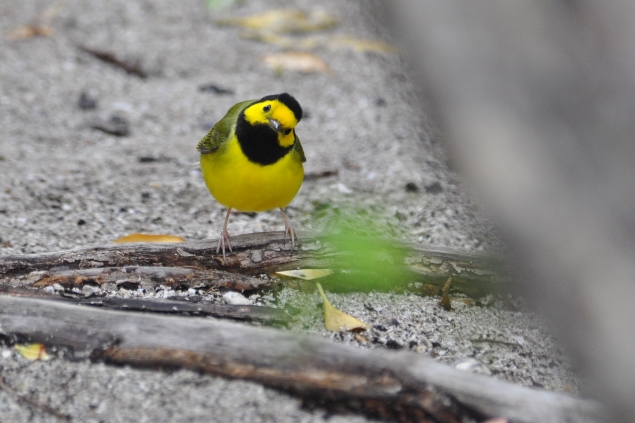
This crippling adult male Hooded Warbler was one of the brightest birds at Garden Key during my visit.

All in all it was a completely successful trip. My face was left badly disfigured, almost completely melted off by the avian brilliance, and I have had to spend thousands of dollars on plastic surgery since then. Vireo Vita and Booby Brittany had an amazing time snorkeling, and from shore I was happy to see enormous groupers (bigger than people!), parrotfish and angelfish, barracudas, and even the fabled Tortuga Crocodile, which I understand has Loch Ness Monster status among Key West locals (undoctored photos to come soon). In 4 days I tallied 77 species of birds, including 21 species of warblers...pretty good for a 400 X 500 meter island! It would be awesome to get to explore Bush Key or Loggerhead Key, but that's not something many birders get to do.


Sandwich and Royal Terns roost on one of the the old coaling docks. Both coaling docks are quality snorkel sites as well. Bush Island is in the background; that's where the Sooty Terns and Brown Noddies nest in season.


A Northern Parula takes a break from moth-catching to collect itself.

I would definitely recommend camping on Garden Key, although you have to bring all of your supplies (they do have bathrooms though)...but that's just part of the fun if you ask me. Also, the Yankee Freedom III is docked at Garden Key most of the day, and you are welcome to buy lunch, beer, etc. on board, so you are not really 100% roughing it. It's really nice before and after the boat is around though, because there are fewer people around. Biting insects were few and far between.

Birders should check the campground, the trees inside the fort, and the patch of vegetation that lies north of the campground, outside the fort. Both coaling docks should be checked, and don't forget to frequently look up for incoming wayward migrants. Birds come and go throughout the day so it's a good idea to do the rounds regularly (what else do you have to do?). Hope and prepare for rain. As of my visit the famous water fountain in the fort courtyard was not being used in the fall...Booby Brittany overheard a park employee saying something ridiculous about leaving it off so migrant birds don't try to winter there and die.

The conclusion: the Dry Tortugas have huge potential during fall migration. Of course, now I want to go back in spring...

Thursday, October 1, 2009

From A Lacerated Sky


Yeah, I took the title from a Slayer song, pretty sweet huh? I usually title entries after whatever I am listening to at the the moment (which happens to be The Gaslight Anthem's excellent Sink or Swim), but BB&B has been missing some death and carnage lately, so I thought I would put the focus back on wind energy. So the Slayer works, right? Yes, words like "death", "carnage" and "gore" do not exactly fit the language of the industry, but it happens. This past month we have started finding bird kills relatively regularly......so far they have all been warblers and vireos, plus a Mourning Dove and Ruby-throated Hummingbird. No raptors. Bats are still getting it as well, but we haven't had any really big daily kill totals in a few weeks. The weather has been treacherous lately, which might have something to do with it. But when the fog rolls in and visibility is piss poor(above), and wind is blowing out of the north (so a lot of birds are moving through), we may get a few birds on the ground the next day.

Speaking of which, I heard some sort of heron fly over my mountain last night, couldn't i.d. it by call......gotta work on my wader nocturnal flight calls I suppose. Bizarre.


Here's a good mystery bird. I guessed what it was before I found it's head, and was waaaaaay off. Feel free to take a shot. At any rate, the turbine didn't cause most of this damage, something had already scavenged it by the time I stumbled onto it.


A particularly bright-legged Blackpoll Warbler (they are usually dark-legged in fall) in eternal slumber.


A female Black-throated Blue Warbler met her maker the night before.


This Big Brown is the last bat I came across. It had already been there a few days when I found it.