Showing posts with label red-necked stint. Show all posts

Monday, December 11, 2017

Rarities Return, Featuring: Parakeet Auklet, Little and Red-necked Stints!


Every now and then a birding community will be struck by a rarity so bizarre and unlikely that we are left running around slamming into walls, foaming at the mouth, bleeding from headwonds, uttering incoherently about needing to be somewhere, at any cost. A Parakeet Auklet in July (July!) in San Francisco did exactly that, smashing the 2017 summer doldrums into oblivion and sending birders scurrying to SF. The story of how this vague runt was found was truly unlikely; a birder found it in the water off Sutro Baths in the summer of 2016, but it was never seen again...a year later, the same birder relocated the bird while kayaking less than a half mile further up the coast. This time, the bird was seen sitting on seastacks and cliffs, which as far as I know is the first time a healthy individual has been seen on solid ground in the state. There is a good chance the bird was doing the same thing the previous year, but no one saw it!

I appreciate a good Parakeet Auklet, and this being a good Parakeet Auklet (and a state bird) I dragged the family up to the city kicking and screaming for a chance at this bird...but despite staking it out for hours, it never showed. It was a tough dip to swallow, and most everyone who actually dips will tell you that all dip is tough to swallow to begin with...I'm talking about chewing tobacco of course, but hey it applies to birds as well.

While doing the drive of shame back to San Jose, I analyzed my chances of getting the bird the next morning if I made another chase attempt and decided against it...which I immediately regretted the next day when the bird was relocated quickly. My heart was filled with hate. By mid afternoon I was twitching uncontrollably from the constant updates of resightings, said "fuck it" and rocketed back north. This time I found the bird in about 30 seconds, circling behind Mile Rock. It eventually landed on a distant rock just a stone's throw from the shoreline, which I pointed out to several birders who were clearly there for the same reason as me.


Incredibly, one of the birders I updated totally ignored what I had just said, and instead told me that he believed the bird was currently sitting on a seastack right below us. Keep in mind I had a spotting scope and he did not, so I must have seemed absolutely incompetent to him. Friends, do I give off an air of complete ineffectiveness? For those of you who haven't met me, next time you encounter a birder in the field that you believe has utterly no idea what they are doing, just go ahead and assume it is Seagull Steve.

I had to look at this man's auklet, of course. It turned out to be not a guillemot, or an oystercatcher, or a black bird of any sort...it was a shadow. A shadow.

I booked it to where the actual bird had been sitting and eventually ended up below it, as it had flwon from its rock and was roosting high up on a cliff. Talk about something I never expected to see outside of Alaska. July in San Francisco? Get out of here. State bird! Though California has accrued quite a few records now, this is a very unreliable bird to see anywhere in the state....as Flycatcher Jen would tell you, good times.


July isn't all state birds and Parakeet Auklets though. Least Sandpiper is much more typical birding fare around these parts, and much more confiding as well. Photographed at Don Edwards NWR.


My god...could it be? SHARP-TAILED GROUSE???

No, it can't be, but this Least Sandpiper is striking a pose remarkably similar to what displaying Sharp-tailed Grouse are known for. This bird was having a territorial dispute with another Least.


Remember the barren dowitcherless times? It sure is nice to have dowitchers again, especially pink and orange ones. I think these are all Long-billed.


On another July day, I was out birding and saw a report of an alternate plumage Little Stint that was within easy driving distance. It wasn't a lifer/state/county bird, but seeing as I had gotten to look at all of one (1) before, I picked up the scope and hustled back to the car. The instincts that made me the Global Birder Ranking System's #7 US birder made me stop and scan a blackbird flock just long enough to find my county Yellow-headed Blackbird on the way back, and I was still able to make it back to the car quickly. Things were going splendidly. Unfortunately, at that point my instincts ceased to serve me well...in my haste to get on the road, I broke off TWO door handles to my car. What the fuck?! Who does that? This wasn't even for a life bird. That's what those two gray things are in my palm, freakin door handles.

And to top it off, later that day I was playing bass and I ripped off the plug to the amp from the power cord. Nerd strength was just pumping through my veins that day.


But hey, I saw the Little Stint! Talk about a completely rubbish photo (digiscoped). The light wasn't great and the bird wasn't very close, but I did get really nice, prolonged views. Lifer plumage! Year bird! It was nice to continue my long running streak of taking terrible stint photos.


A few days later I went back to see if the stint was still around (it was not), but I did find a very interesting peep that had me confused for a bit. Not that you can tell, but the bird's back was very bright and boldly marked, with lots of orange and red tones. With the short, straight, tapered bill, it was an intriguing combination, but at the end of the day it was just a Semipalmated Sandpiper.

Just a Semipalmated Sandpiper? That's a bit of an understatement...despite a great deal of looking at peeps all around the bay for many years now, until this bird I have never been able to find one in any bay area county. Anyone who has birded much around here would find that baffling, and they would be right. This was a hard-won bird, thus you are forced to look at a photo (digiscoped) so awful that it is, in fact, art. It was also the most colorful individual I have ever seen, but again you cannot make that out whatsoever. Because art.


Sorry about the run of appalling photos. Here is an alternate Western Sandpiper pondering life in its reflection. This looks to be a male, judging by the relatively short and straight bill.


This adult has already acquired a lot of basic plumage, but retains some old summer chevrons on the breast. More of a femaley bill on this bird.


Oh why hello RED-NECKED STINT. It sure is nice to see Red-necked and Little Stint in the same week! That's California birding for you. This one was at Elsie Roemer Bird Sanctuary in Alameda. As I mentioned back in 2015, this place had been due for a great bird! As with my other Red-necked Stint experiences in California, nice prolonged looks at a spiffy alternate bird that was either distant or in crap light. Not sure how that keeps happening, but when one is looking at a stint one cannot complain. But now I really, really need to get a good photo of some kind of stint eventually...

Although they don't inspire the panic of a stint, Baird's Sandpiper is a refreshing fall migrant that only has a short window here. They are refreshing birds in and of themselves, but their presence is always a tasty precursor of things to come...if you are looking at a Baird's Sandpiper in California, chances are you are only a few weeks away from experiencing that holiest of months, SEPTEMBER.

I know, I know, you can roll your eyes, we are far removed from September, but I'm getting there! I won't say that blogging is hard (it isn't, despite everyone who starts one and then gives up), but I will tell you that blogging with a baby is hard. As Corey Finger rightly pointed out to me last year, it's not that you won't have time to bird anymore once you have a baby, it's that you won't have time to blog. This is true.


Refreshing birds are often found in disgusting places. That's not a gross mudflat the birds are on, it is a much filthier floating mat of algae. Juvenile Least Sandpiper on the left for comparison.


Has any bird mastered the filthy floating mat dance like the Baird's Sandpiper? Unlikely.


Ok, I'll throw in a token resident bird, and one that BB&B doesn't cover much. This juvenile California Gull was also holding down the algae mat along with the peeps. I know birders in most states don't get to see this short-lived plumage very often, and we are balls-deep in gull season right now, so enjoy! The Baird'seses and the gull were at Coyote Hills Regional Park in Fremont, CA.

Wednesday, August 3, 2016

A July Shorebird Cake With Stint Frosting


July. Birders have four options in July...if they are fortunate enough to have the right habitats nearby, they go to the mountains, or go to the mudflats. If these habitats are unavailable, they either don't bird at all, or optimistically (some do so abysmally) bird through it, noting newly fledged young and what species the local cowbird population has successfully parasitized. In much of California, after a quick two week break in late June, we don't have to suffer through a hot, boring, and brutal July...we can get back to the business of searching for interesting my grunts...that's right, the fall vague runt window is suddenly thrown open after a brief reprieve, and all of a sudden a birder may sort through peeps like a kid in a candy store. Southbound shorebirds begin returning in late June, and by the second week of July a birder can go out to a favored shorebird spot and see thousands of birds.


After managing to avoid the site (not purposefully) for years, I finally visited Frank's Dump, a great shorebird site along the bay in Alameda County. The impoundment was absolutely packed with shorebirds, including over 100 Red Knots, which you can see above mixed in with similarly-colored dowitchers. This is the most knots I've ever seen in California, quite an impressive showing for this normally uncommon species.


Western Sandpipers were back in force, there were thousands. My attempts at picking out a Semipalmated proved futile again; I have yet to see one anywhere in the bay area, for some reason. In typical fashion, someone saw one shortly before I arrived. I still have many weeks left of prime Semipalmated Sandpiper time, so maybe this will finally be the year. Semipalmateds have always been of unusual interest to me, probably because that was one of the first "rare" birds I got adept at finding and identifying when I was a sniveling little bastard teenager.


This crisply marked Least Sandpiper endured only minimal wear and tear on its way south from Alaska or wherever the fuck its from. Who knows? It could be bound for Peru, the Galapagos...the world is your oyster when you are a Least Sandpiper.


As much fun as it is to muse about where Least Sandpipers may or may not be going, that is not why I found myself at Frank's Dump. No one goes to Frank's Dump just to look at Least Sandpipers, as far as I know, and if anyone does please tell me all about it.

Right. July is not just to be celebrated for the return of shorebirds, it is to be celebrated because it is the best month of the year to find stints in California. This Red-necked Stint was kind enough to follow the flightpath of misoriented stints of the past, and gave some good looks although it never came close enough for a reasonable photo. But unlike the photogs lying in the mud (literally), I was able to enjoy the bird through a scope.


This was just the third Red-necked Stint I've ever seen, the first being a juvenile on Buldir Island (AK) and my deucer being another adult on the Los Angeles River. This was a brilliant, glowing bird, a true gasper if that is possible for a peep. It was very easy to pick out from the nearby Western Sandpipers; aside the reddish-orange face, the contrasting bright white belly made it easy to locate as well. At one point a bright alternate Sanderling landed next to it, looking surprisingly similar in plumage, but not in size and structure.


What a year its been in northern California for shorebirds...Marsh Sandpiper, Purple Sandpiper, Little (the one in Santa Clara and one just reported in Del Norte) and Red-necked Stints! As August has just arrived, I am hoping out incredible run of vague runt shorebirds will continue. What's next? Lesser Sand-Plover? Common Ringed Plover? Spotted Redhank? Gray-tailed Tattler? The potential for Sibe shorebirds to show up in California has almost no ceiling. Maybe that Black-tailed Godwit I've been waiting for will finally come our way.


Of course, most of the birds here are not Sibes, and have no idea that Siberia even exists. This worn American Avocet is one of those birds.


Unlike other shorebirds, young avocets like this one molt into something that closely resembles an adult in alternate plumage when they lose their down. Why that is, I could not tell you, but then again stilts and avocets are not in the same family as sandpipers, which all attain a unique (if sometimes indistinct) juvenile plumage that they retain through the fall.


The Elsie Roemer sanctuary is one of a handful of Alameda (city) sites that gets much attention from birders, who go for the shorebirds. Terns use the site as well. This time of year there are lots of Forster's (above) and Caspian Terns flying around with fish, trailed by not only their offspring but sometimes the offspring of other terns as well.


Young terns may beg for fish for an extended period after fledging; we often hear the plaintive begging of young Elegant Terns (which also just returned, not pictured here) well into fall.


Black-bellied Plovers are back in large numbers. Most are already shedding their slick black underparts in favor of doomy gray duds. It was fun while it lasted.


This bird was missing a foot, which look like it came off a while ago. I wonder how many north to south migrations this bird has completed while handicapped. If you think that is impressive, I once saw a Snowy Plover with NO FEET, true story. I think these birds can often overcome major injuries, as long as their wings stay intact.


Back at the beginning of the month, Felonious Jive went up to Humboldt County to attend the wedding of ASOC and Nice Lady, both very important figures in his life. Felonious reported getting quite drunk and having a good time. He also took a few shitty photos at the Arcata Marsh, which I will include here because why not?


This Great Egret caught a nice scuplin, and did the typical wader thing of shaking and bludgeoning it and flipping it around in its bill until it worked up the courage to swallow it.


The egret eventually gulped the sculpin down once it was good and slathered in mud, and continued on its merry way.


A male Norther Harrier hunting over the marsh flew by with some hapless young bird. I may be #7, but not even I can ID the prey item. Felonious told me he knows what it is, but won't tell me. Asshole.


Vaux's Swifts were abundant that day, and as usual were almost impossible to photograph due to being fast. This tattered bird is the first Vaux's Swift to make it onto BB&B, where we welcome it with open arms.


A Northern Red-legged Frog made an appearance in its usual spot at the side of the log pond. It is a handsome frog.

Well, hopefully that was enough of a shorebird onslaught to hold you over for a while. Next up, I started a new state list a couple weeks ago, and there was a lot of good birding put into that list. For the first time, I took BB&B and several of our interns to...Colorado!

Thursday, July 18, 2013

California #500: A Red-necked Stint in the Rubicon


This is where the magic is happening; the Los Angeles River just north of Willow Street in Long Beach, CA.

After dropping off Booby Brittany at LAX Tuesday morning, I was driving back to Ventura when Dipper Dan alerted me to the presence of a Red-necked Stint on the LA River. He implored me to turn around and get the bird, although I had no optics of any sort. Alas, I chose not to, as it was not a life bird and I was loathe to brave the snarled LA traffic without any sort of birding weaponry to deploy once I got there.

But by late that afternoon I found myself again in LA gridlock with Officer Searcy, a belligerent and oft-maligned member of the State Bird Police. The traffic was so bad we were beginning to worry the sun would set before we would even get there, but the congestion finally loosened and Officer Searcy's filthy patrol car was coughed up from the 710 onto Willow Street, where the bird was located.

Finding the bird took a mere 60 seconds of scanning. The peep that was colored more like a Red Knot than a Western Sandpiper stood out like a sore thumb, in the very patch of mud that it had been frequenting all day. Aside from this being only my second Red-necked Stint, it was a life plumage...and my 500th California bird.

500 has been a long-time coming...over 18 years, in fact. My ability to add to this precious list has been at times very limited over the years for various reasons...being too young to drive, too busy with college life, living out of state, bourbon and bastards, etc. But none of that matters now...the blood, sweat, tears and other substances wrenched from my body over these 18 years by 500 species of birds has all led up to this moment, this bird.

The stint was extremely cooperative, always out in the open, never flying, and usually just a few yards from Western and Least Sandpipers for comparison. Although the bird wasn't very close, it might as well have been staked to the same patch of mud, as it was very territorial, terrorizing any unsuspecting Least Sandpipers that tried to encroach.

After soaking the bird in, we walked back across the river to Officer Searcy's patrol car. With the colorful stint seared into my brain and the exalted figure of 500 achieved, it was not the Los Angeles River below me...I was crossing the Rubicon.

Things will never be the same.


A Least Sandpiper yearns for quality mud as the Red-necked Stint glows behind it. Bad photo, exceptional bird.

Tuesday, August 9, 2011

August in the Aleutians

Birders drool at the thought of seeing a Horned Puffin. Birders in the Aleutians drool because they are so common and boring. Ok thats not true...the puffins never get old, even after seeing them every day for months. They finish nesting really late in the summer so right now they are probably very busy bringing fish back to their fat fluffy chicks.


This picture is totally not from August, sorry. By now almost all the Least Auklets will be out at sea, as they finish up nesting and fledging pretty early. It's sad when you are out clambering around on Buldir Island's Main Talus and have no auklets for company...you are accompanied by a hole in your heart instead. Note the Crested Auklet and Least Auklet doing weird things in the background.

Aleutian Cackling Geese spend weeks higher up on the island while they molt their flight feathers...by August they have mysteriously reappeared near the coast. I think the front birds are juveniles.


The view from the front door of the cabin. Or, more obnoxiously, "my office".


July and August are stressful because you are just fiending for rare shorebirds (like this Red-necked stint) to appear. Rare birds, especially of the Aleutian caliber, have an addictive quality.


Some Tufted Puffins mingle above a Thick-billed Murre colony. No big deal.


Red-legged Kittiwake battle. So intense. I think those are Black-legged Kittiwake wings sticking out in back.


Black-legged Kittiwakes. Some juveniles (foreground) should be fledging by now.


Aleutian Song Sparrow. I don't know what else to say about them, except that I'm glad they were there. It's weird to not be around Song Sparrows. These are big and dark.


Scumbag.


Wednesday, December 1, 2010

I'm Getting Used To Getting Old, But Where's My Ambition?


A broad-chested, short-winged Thick-billed Murre takes evasive maneuvers. 

Goodbye fall. You were a good one this year. Not one for birding necessarily (although spending August in the western Aleutians was fantastic), but for quality of life in general. So thanks to everyone who made that possible. It's been an explosive jubilee of reveling and raising glasses with old friends. And yes, much bourbon was had.

With the passing of Birder's Fall (August-November) and the onset of Birder's Winter (December-February), Californian birders are now beginning to switch gears to adjust their birding habits to better suit the winter months. So many crippling vagrants have arrived in the state in the last month (The Fab Four: Bean Goose, Ivory Gull, Brown Shrike, Black-tailed Gull) that people really have their hopes up. Many a birder has tasted the sweet taste of victory (most people who have looked for the Bean Goose) or bashed their heads into a wall of defeat (most people who looked for the Brown Shrike) after looking for said birds, and there will be more to follow. The rivers may yet run red with angry birder blood this winter. The possibilities of what may arrive here this winter are almost endless.


Here's a couple of new ones for you. They're not great shots, but for most Americans, they're great birds. Wood Sandpipers turned out to be one of the most abundant (well, relatively speaking) shorebirds on Buldir Island this year, much to my....um....delight.


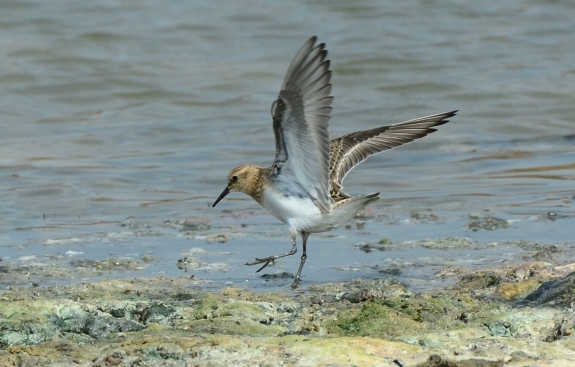
This juvenile Red-necked Stint was the one and only to visit us.

Besides that, what winter means for me personally is I switch out of "WOOOHOOO NO MORE FIELD WORK!!!" phase into "Hrmm, I should probably start lining up my spring field work" phase, which isn't nearly as fun....but does add a light taste of drama to everything. Its quite strange, really. Few other people (outside my line of work) comfortably vacillate from slaving away for months to having absolutely nothing to do to lackadaisically looking for jobs knowing that somehow you'll get one if you apply to enough...I am nothing if not a consumate professional, after all. But its pretty weird. I recognize and appreciate how shitty it is for people to lose their jobs and their homes (the house I'm living in is being foreclosed on, thanks Bank of America), but since I consensually lose my job a couple of times a year....well, it just doesnt have much of an impact for me. Besides, I really enjoy my freedom...if you don't have that...what do you have?

Oh yeah, summers are usually a mix of "LIFE IS PAIN" and "I have the best job in the world!". Haven't found a way to combine those two concepts yet.

All pictures today are from July-August at Buldir Island, Alaska. As usual they have very little to do with what I'm talking about...maybe I'll work on that.


Another shot of one of the scarce Aleutian sunsets we got to see.