Showing posts with label Barrow's Goldeneye. Show all posts

Wednesday, March 21, 2018

The Rancho, Rarities, Radii and Rebo

Christ on a cross! Should I just quit while I'm ahead? Put BB&B to sleep forever? The 5MR post has quickly shot up to the third most popular post we've ever had...and in case you've forgotten, that is ten years of blogging, close to 1,000 posts! What have I been doing with my life?! The only more popular posts are LIFE IS PAIN (thanks to Reddit) and RISE OF THE STORM WIGEON (thanks to birders and hunters).

Well, I'm not sure how to follow that up, so I suppose I can just cover some recent birding, which I've practically stopped doing somehow...blogging about it, that is.

March vagues. Well, somehow suddenly spring is here. It's been a real slow winter for yours truly as far as vague runts go, but the previous winter featured a Ross's Gull, so I can live with that. While great for wildflowers and so-so for spring migrants, this month is a mediocre (and I'm being generous with that adjective) time in the state for seeing chronic rarities. There have been a handful of notable exceptions in the state recently though...but I'm sure as shit not going to chase the goddamn Gyrfalcon again, which was well photographed this month and is quite possibly still here. As usual, Humboldt/Del Norte sucked in another winter MEGA in the form of a Black-tailed Gull, which (this year) is too far for me to see. A more-or-less-confirmed Steller's Eider has been seen by several observers in Humboldt County, which would fulfill a prophecy made by a certain visionary birder back in November. I would be exceptionally gripped off if other birders were having much luck refinding it, but high surf, bad weather and a lack of an elevated viewpoint is preventing that from happening...but I could really use seeing a megaeider right about now.

Closer to home instead of Nome, I dipped on a Slaty-backed Gull over the weekend here in Santa Clara County, which is very typical for me and that species - in general, February and March seems like a great time to find them in the state though. It's only the second in the county, but with all the gulls that winter here and the relatively few observers around who could identify one, I suspect they are here with some regularity. The bizarre, long-staying Garganey may have finally left its duck pond (mostly a Mallard pond) down south, as it has not been seen for a week.


Inexplicably, this year has been heavy on Bald Eagles for me so far, despite putting in no effort to see them (very nice, I like) - I've seen three from my yard alone! This one was next to my house at the Los Capitancillos Ponds.


This Anna's Hummingbird had the brilliant idea of building a nest right next to my hummingbird feeders...talk about convenience! She was able to incubate eggs while protecting her feeders at the same time. I suspect the chicks got eaten though :/

Rancho de Bastardos. The yard birding is pleasant as usual, but it has been a long time since a new bird has been added to the yard list. The most recent highlight was a California Towhee with a white head that bounded through the yard. The yard list sits at 120 species (newest addition was Red-breasted Merganser in January), with 87 recorded so far this year...that is tied for #1 in all of California, by the way. With spring migration in effect, I'm hoping it won't be long before we get something new...Orange-crowned Warbler, Bullock's Oriole, Allen's or Rufous Hummingbird would be nice.


March is a good time for scouring your 5MR. This White-tailed Kite was along the Los Alamitos Creek Trail, a part of my radius that I plan on giving more attention to this year.

The 5MR. What's funny (in a sad way) is that I've seen and heard about a ton of other 5MRs in the last week or so as this thing has blown up, and it turns out mine is one of the worst of them all in terms of potential for species diversity and rarities. No matter, I will keep on toiling! Incredibly, my last new 5MR bird (Rufous Hummingbird) was also a county bird....fuck yeah.

Winter rarities. As I said earlier, I've given up on catching the blog up on all the birding I've done...but it's not like it's been a completely dull winter, despite the lack of lifers and state birds. Here's some of the rarities I've met up with from the past few months.


I was hoping that this Barrow's Goldeneye (surrounded by Commons) would return to Shoreline Lake this winter, and the dude obliged. Nice county bird, and typically a species I only see a handful of times each year anyways.


After seeing the goldeneye, I bumped into this "Common" Teal in Charleston Slough, which I had totally forgotten was present. Sweet. We Nearcticans think of them as just another subspecies (or two, can't forget nimia), but the IOC treats them as a separate species. Will the AOS ever be persuaded to embrace this vision of distinct tealness?


Vesper Sparrows are really hard to come by in the bay area; they just don't venture to the coast very often. This obliging and confiding stub-tailed bastard at La Honda Creek Open Space Preserve (San Mateo County) was the first I've seen locally.


I went to San Luis National Wildlife Refuge for the first time this winter; it was mellow, not as birdy as Merced, but this Swamp Sparrow at a random part of the auto tour route was a nice find. It is only the 8th eBirded record for Merced County, though I'm sure with the amount of good habitat out there they occur on the reg.


This Vermilion Flycatcher wintering in Coyote Valley is the first Santa Clara County record, and was a great way to kick off local birding in 2017. This species has become considerably more regular in much of the state since when I started birding in the mid-90's, even factoring in the increase in observers.

And just like that, winter is singing its swan song and spring will be in full effect before you can say "five mile radius". I look forward to the year birds....and county birds! I didn't get out a ton in Santa Clara last spring, for reasons too boring to state here, but this year is different.

Of course, spring birding is really going to be kicked up a notch when I get out to Texas to lead a trip for MAX REBO BIRDING TOURS (no one finds Ortolans like Ortolans!), where every day will cough up all manner of avian rewards. I will be gagging on neotropical migrants. It will be truly gluttonous birding, even with slow days at the migrant traps. And while I mention it, a space just opened up on the trip...don't miss this opportunity!

Contact MAX REBO BIRDING TOURS for details.

Sunday, March 6, 2016

Dumpy Goodness, Majestic Murderer, Wearing Hoodies On The Regular


Western Sandpipers roost at high tide in the Arcata Bottoms, Arcata, CA. The habitat in the background is Lesser Frigatebird habitat, believe it or not. The Vague Runts that put down in Humboldt County never cease to amaze.

March is upon us, and in California that means two things: spring migrants, and no rare birds. It is bloody hard to find unusual birds this month, though lingering winter birds usually mean something good is around, somewhere. Perhaps it is a good month to go track down some scrub-jays...for that Island Scrub-Jay you still have not looked for, or for Woodhouse's Scrub-Jay, which some believe will be an imminent split. Tracking down a Bendire's Thrasher would not be a bad idea either...I've still only seen one ever, about 20 years ago...it's probably time to rethrash.

But I will not be doing any of those things...weird scrub jays and novel thrashers are far from me, and my wage slavery will keep me in the bay area for the time being. So without further delay, here is a classic/cliche I-went-birding-locally-and-this-is-what-I-saw post from a few spots over the winter.


Here it is, the most overrated bird. Note that I did not post this sighting on a listserv, unlike most people. I did not need to say "I saw a Pine Siskin too!" It is simply not necessary. It is a common bird that can be found in many different habitats, from sea level to the mountain tops. The appropriate way to report this species is something like "The redpoll was associating with a flock of Pine Siskins", right? Photographed in the Arcata Bottoms.


On a trip up to Humboldt County earlier in the winter, I was rained out when it came to birding. I accomplished much drinking, but birding was unproductive, with one exception. On the way home, I pulled into Fields Landing (which sometimes is ablaze with waterbirds), and was shocked to find a flock of Red Knots foraging in a puddle next to the parking lot. Knots are rarely seen in southern Humboldt Bay in winter, and getting within 20 feet of them anywhere in California is an impreesive feat. I just parked next to the knot puddle and crushed away as the rain came down.


Look at this dumpy goodness. What a lovable bird.


These birds belong to the roselaari subspecies, the only subspecies expected on the Pacific coast of North America.  I'm glad they are not getting completely hammered (on a population scale) like rufa, but on that note there are less than 14,000 of them (and maybe less than 10,000). Be grateful for the knots you see in California and Mexico, because there are not many of them.


The knots were not expected at Fields Landing, but there is often a flock of turnstones checking out the wrack line next to the boat ramp.


Black Turnstones are the most abundant rockpiper in California, and generally the most confiding as well. They seem a bit more opportunistic in their foraging than other rockpipers, and were feeding side-by-side with the knots in this rain puddle.


I've hardly been to Lake Merritt at all this winter...lame. Canvasbacks like this one have not been getting much attention from me, though they are absolutely deserving of it.


This Great Egret looks like it had just killed the shit out of something. Berkeley Meadows, Berkeley, CA.


Majestic murderer.


Barrow's Goldeneyes can often be found in the tidal channel south of Lake Merritt, where they are easy to see but often stay just outside true crushing distance.  This is an absurdly difficult bird to get further south in the state, with the Colorado River being the only exception.


Lloyd Lake in Golden Gate Park (San Francisco) is one of the best places to get up close to Hooded Mergansers. These birds were so unapproachable where I grew up birding that I still feel compelled to stop and look at them whenever I'm birding in the park.


This thick-necked bastard looks like he is doing some courtship display.


With spring in the process of springing, I may have seen my last Hoodie until the fall. In the meantime, I will honor them by wearing lots of hoodies.

Thursday, August 13, 2015

The Human Birdwatcher Project Presents: The Democratization of Birding


This is a Broad-tailed Hummingbird. This fact is not disputable, though there are many who would put their disputing caps on and try anyway. Photographed in Miller Canyon, AZ.

Today's post is brought to you by The Human Birdwatcher Project, where "Birders are people too!" and birding-by-vote can lead down a dark path indeed.

In a true democracy, decisions are made by the majority, plain and simple. Most decisions decided by voters are based on personal values.  In these situations, wrong and right is entirely subjective.  You know this, and I don't think it needs any more explaining.

It was not long ago when the words "democracy" and "birding" could never be uttered in the same sentence...but that was Then, and this is Now.  Birders knew the other local birders, gossiped about birds and birders, and went about their business (birding).  The ABA and various Bird Record Committees made decisions, big decisions, in relative isolation and with relative impunity.  For example, I can still remember the uproar that was caused when the ABA (allegedly) forcibly removed Papa Echo Lima from his throne (Editor of Birding), and there was a huge backlash from the birding community.  Many high-ranking birders were furious, and quit the ABA altogether. Think about that for a second, and put it in your pocket...we will take it out for another look later.

The very fabric of birding rapidly began changing in the 90's with the wide availability of the internet.  First, there was email, which led to listservs, and easy communication with birders around the world.  Next came digital cameras; people could digiscope with point and shoots, and then SLRs became more affordable to the general public, and now people can get good images with their phones. Bird photography was suddenly affordable, and not very difficult either. Birding blogs were springing up left and right.  Then there was social media...most birders were too old to jump on the Myspace train, but they latched on to Facebook and never let go. EBird was the frosting on the cake.

With everyone so connected now, there is a lot of communication going on between birders. It's intense. Birders who aren't even trying to sell you something have legions of Facebook friends/fans, and get huge responses to their photographs or ramblings on whatever it is they feel like expounding upon (be it birds or not)...birders just seem to eat it right up, whether it be pure gold or utter bullshit. The ABA's main FB group has over 6,700 members, and it manages multiple groups, a staggering fact.

One of the best and worst things about all of this, be it in a listserv or in a FB group, is that everyone has a voice.  Now some of you might be thinking, "What do you mean worst? Are you some kind of fascist?  Do you hate birders?", and it is those of you who need to hear this the most.  Birding has suddenly become a democracy.  And when it comes to birding, democracy is often not our friend.


Since we are all connected so closely these days, news of something like a stray Barrow's Goldeneye travels very fast. Everyone is connected, and is capable of getting the word out quickly. This is a good thing. Could there be a downside to this new, interconnected Democracy of Birding?  This is a non-stray Barrow's Goldeneye, photographed near Lake Merritt, Oakland, CA.

Look, it is all well and good when, for example, the ABA asks its members to vote on if they want to add Hawaii to the ABA area or not.  That's great, but it's not really what I'm aiming for here.  I'm talking about far more basic things here...bird identification, for example.

Bird Records Committees, or Bird Police, if you prefer, often function to identify birds. They often are quite good at carrying out these tasks because their members are either very knowledgeable, very experienced, or willing to listen to those who know more than they do...preferably all three.  With the occasional exception, they correctly identify birds that are often very difficult to identify.

Now consider attempting bird identification with this model in the public birding arena.  This should not be difficult to imagine, since it happens constantly...but I digress.  There are a lot of birders out there, a lot of new birders...and as there always has been, a lot of birders who are not good at identifying birds.  So what happens when a bunch of random birders get together to identify birds?

Chaos.

This is the fundamental distinction between democracy as a political system and democracy when it comes to birding...there is only one right answer.  The backyard birder's opinion on fall warbler identification is not as worthy as the person who bands hundreds of warblers during fall migration every year.  I'm not trying to be harsh, just stating a simple, logical truth...no reason to get all sore about it.

The Democratization of Birding and the internet go hand in hand. If you are a birder and have spent any time on the internet, you know what I am talking about. Someone will post a picture of a bird somewhere, and disturbingly often a bunch of people will collectively decide what the bird is.  They will vote on it! Even if someone, even if multiple people correctly identify the bird using sound and unassailable logic, they may get drowned out.  The birders getting the bird wrong often inexplicably get their feelings hurt when they are corrected, and claim they are being attacked! It is insane. The level of butthurt that emerges from these minor disagreements boggles the mind.

Democratic birding raises its many-faced head in other debates as well...escapees vs. natural vagrants, the effects of climate change on birds, and all manner of theories on why some birds show up in particular places (do you remember Hurricane Sandy?)...you know, birders can disagree on just about everything. The fact that the vast majority of birders do not have a background in science compounds the amount of confusion in discussions that veer from the topic of bird ID.  The potential for misinformation to spread unchecked is very high and has been sustained for some time now. I'm going through a blatant example this right now in another browser window, looking at SFBirds...are there three Indigo Buntings in Golden Gate Park?  Is the female a Lazuli?  Is the HY bird a Indigo X Lazuli?  Is this the first breeding record for the county?  Did they even breed in the park?  Bunting Chaos.  Luckily, the birder known as The Rustic Bunting Hero has stepped in, in an attempt to quell the masses...but a flareup of Bunting Unrest is just around the corner.


When you are a birder and pay a lot of attention to listservs, the Birdosphere, and Facebook groups, it's all too easy to want to make like a dowitcher and dunk your head under water for an unhealthy period of time in order to keep the thousands of voices at bay. Fortunately for these Short-billed Dowitchers, they will never know the pain of getting in to an internet fight with a bitter birder thousands of miles away. Middle Harbor Shoreline Park, Oakland, CA.

So what is the mechanism for all this confusion?  All this hate?  It is twofold. First, some birders mistakenly believe that everyone's opinion is equally important when it comes to bird identification, where a bird comes from, etc. Well...a bird can only be one thing, and some of us are better equipped to know that bird's story than others.  There is only one right answer, and that is usually in our collective grasp.  Most birds are not first cycle, heavily worn hybrid gulls, nor are they distant murrelets with confusing facial features seen from a mile away, nor are they Yellow Grosbeaks of questionable provenance (providence???). Most birds are knowable.  Clearly, we should always tend to defer to the most experienced, most trustworthy birders, because they are the ones who will mostly like get the identification right, which is the primary goal here for most birders. A dozen beginning and sketchy birders are usually not as qualified as one good birder to tell a Lesser Yellowlegs from a Greater, a Semipalmated Sandpiper from a Western. Second, being unfamiliar with the reputation of other birders can make one assume that they aren't highly skilled.  That is totally excusable for beginners of course, not being around for very long and whatnot, but that doesn't mean we can't give people the benefit of the doubt when debating ID with unknown birders. I even know someone, a very capable birder actually, who stated that he doesn't trust field guides (I mean books, not people) if he doesn't personally know the authors...gross. Lets not go that far. If everyone who doesn't personally know Steve Howell opens up Rare Birds of North America and thinks "this guy is a complete wanker", then the wonderful world of birding as we know it would simply not exist.

So what is the solution to all of this?  Unfortunately, I don't have one for you.  This is why we so badly need the Global Birder Ranking System to release its data on the world's birders.  The fact that they have all the world's birders skillsets catalogued (from social skills to subspecific storm-petrel ID), with ranks updated daily, is truly a tremendous feat...but the day they go public may never come.


If I posted this photo to whatbird.com or any number of Facebook birding groups asking for ID help, there would be wild conjecture.  Good guesses with good evidence would just get lost in the shuffle of folks crying out for TENNESSEE WARBLER! or ANOTHER VOTE FOR LEAST FLYCATCHER!...and I don't think that is constructive for anyone.  Since I know you are wondering, this is actually a Bell's Vireo. Funny to see that single new feather coming in, since this shot was taken in spring. Photographed at South Padre Island, TX.

On the flipside, why don't you take that fateful decision regarding Papa Echo Lima out of your pocket. If that decision with that editor happened today, in 2015, the ABA would face a catastrophic backlash as soon as the news broke. Hundreds of people would be taking up arms on Facebook, denouncing them for what they had done, shaming and trolling to no end.  The birdosphere would be aflame with hate. For good or ill, it probably never would have happened if the birding community has the collective voice that it does now. The new Democracy of Birding is not inherently evil, but it's getting a little too close to The Dark Side of Birding for comfort...but perhaps we will have to live with that if we continue to take advantage of this open and free exchange of ideas.

Actually, no...there is room for improvement. Don't be a dick. Don't get butthurt. Think before you type. Don't throw your bullshit hat into the ring if you know your hat is covered in bullshit, unless you admit it up front (people actually do this a lot, it does not go unappreciated). If you are going to challenge experts, by all means do (it's quite fun, actually), but back your claims with evidence. When someone posts a picture of a real Gray Hawk, do not reply with a hilariously dismissive "not convinced" and then quit the Facebook group after you are corrected (this really happened). Simply, be excellent to each other. With so much we can all learn, I hope birders carry on with this haphazard democracy in the right way, but only time will tell.

Sunday, March 8, 2015

Winter Hangs On In The East Bay


Mmmmmm....Nelson's Sparrow.  Show me your orange face.  Show it to me at high tide.  Does anyone else think of Nelson Muntz whenever they hear the name of this bird?

Much of the Birdosphere is already talking about spring, and the eastern half of the U.S. is dying for spring, but here at BB&B we are desperately clinging to winter, if only because that is the season we associate with desperately needed rain and snow.  Listservs are being flooded with grave news of birds pairing up and flirting with each other, but that is not a dialogue that BB&B will be joining...not yet.  Foxtrot Oscar Sierra and Foxtrot Oscar Yankee are not phrases that abound, at least not for another couple weeks.  Winter birds are still here, after all, and aside from a swallow here and an Allen's Hummingbird there, the local avifanua remains distinctly winter-flavored.  Well, let's start things off with a rare bird and take it from there.


Nelson's Sparrows winter in California in low numbers (very low numbers), and after trying many times over the last few years to see our local bird or two at Arrowhead Marsh, I finally succeeded.  Although secretive (as expected), the bird was pretty confiding, giving some of the best looks I've ever had.


I had to manually focus for this shot, and bump up the ISO a bit.  Not bad, eh?  If I had a county nemesis bird, this would be the one, so getting such good looks was supremely satisfying. Good luck to you Nelson, on your way back to Saskatchewan or wherever it is you are about to be going.


Like Nelson's Sparrows, Marsh Wrens hate when you look at them, especially if you are nearby with the sun to your back, so it's always nice when they pop out in the open and even better when they sit for a portrait.  Unlike Nelson's Sparrows, Marsh Wrens have yet to be split, although some feel that that would be appropriate.  Photographed at Arrowhead Marsh.


For years I have known that Lake Merritt's outlet, the channel that connects it with the bay, was a good place to see Barrow's Goldeneyes up close, but I had always settled with seeing them occasionally on the lake itself, often at great and uninspiring distances.  I finally decided to check out the channel and was rewarded with this female Barrow's, my Foxtrot Oscar Sierra and Lima Oscar Sierra, which provided some of the best looks I've had of the species.


Interesting pattern on the bill...I'm not sure how much of that darkness is actual pigment and how much is accumulated gunk.  It's possible she is a young bird, retaining some of the mandibular darkness of a juvenile, but I don't think there is a way to conclusively know.


Perhaps you, the discerning birder, were concerned about the first two photos of the Barrow's Goldeneye.  Perhaps you liked the yellow bill, but not the head shape.  This is where your concerns can be laid to rest.  This is where you can tuck them into bed and say goodnight, and sing them the last lullaby they will ever hear.  Birds can change their head shape....it is known. Diving ducks often flatten their crowns when actively feeding...now you know.


It would have been preferable to have the hen Barrow's next to a hen Common, but drakes are better looking so I'm not complaining.


A female Common Goldeneye shows off the classic head shape and bill pattern one would expect of the species, although I wasn't expecting to see her on such a towering perch. Interesting approach.


Greater Scaup are the bane of molluscs, and they take their mollusc-bane very seriously. Photographed at Lake Merritt's outflow.


I wish my digestive system would allow me to just choke down entire shellfish...but if I could do that I might be a type of scaup, which is an odd thing to consider.


Big plumes are sprouting from the backs of egrets everywhere.  Great Egrets are ubiquitous in wetlands around the bay, and despite their abundance they will not be ignored.   I think it's fascinating that birds with such large ranges can be incredibly variable or, to our eye, very homogeneous...for example, there are 13 recognized subspecies of Marsh Wrens in North America, but just 1 subspecies of Great Egret that we know of.  Perhaps if they had more variety in their color palate there would be noticeable geographic variation, but then again maybe not.  Photographed at the Lake Merritt outflow.


Is Willet the new phalarope?  A Peregrine Falcon in the area was keeping the shorebirds from their preferred roosting destination, and out of frustration this Willet flock simply landed on the open water. Photographed at Arrowhead Marsh.


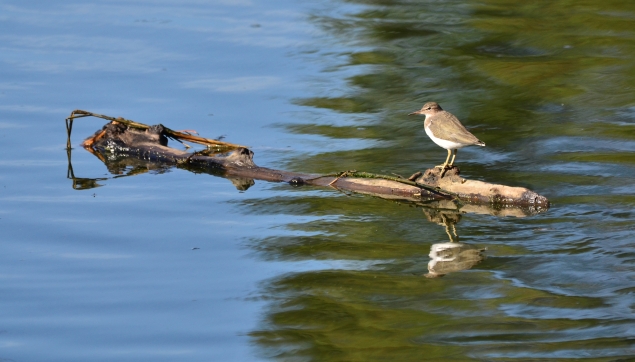
Did that unconvential Willet flock get you worked up?  Relax with this bucolic Spotted Sandpiper. Photographed at Lake Merritt's outflow.


You all know Hank, the world's most famous American White Pelican that lives at Lake Merritt.  I prefer to photograph Hank's wild, free-flying buddies when they are around (Hank is a cripple and was brought here from Oregon, where she collided with powerlines), but Hank just looks so damn sexy this time of year I had to crush her face.  And yes, as far as anyone can tell Hank is a girl, she was presumably named before anyone saw her next to any other pelicans (males are noticeably larger, though there is overlap).


This is my favorite photo I have of her, without a doubt.


In case you were thinking about being in a good mood today, here is a lynched cormorant for you to look at. What a shitty way to die...life is pain. Photographed at Lake Merritt.