Showing posts with label Philadelphia Vireo. Show all posts

Thursday, July 5, 2018

Bolivar Flats and Anahuac: Friends, Fevers and Feelings


Back to Texas! Let's start with the legendary Bolivar Flats. Our wonderful group went on a couple different days; it was quite good one day and more on the meh side on another day, but it was easy to see why it's such a heavily-birded spot. The first time out we had good looks at this Glaucous Gull, which was lingering late into the spring. This is the southernmost Glaucous that I have ever seen, which also gave better looks than what I'm used to.


I expected a lot of great birds on this trip, but hulking arctic gulls were not among them. You just never know what will turn up when MAX REBO BIRDING TOURS is in the field! Speaking of unexpected hulking arctic birds, we just missed a Pomarine Jaeger by a few days that had been hanging out at Rollover Pass. I've never even seen a Pomarine Jaeger sitting on solid ground before, and I've seen a lot of them. The Vague Runt potential of the Bolivar Peninsula is not to be taken lightly.


Glaucous Gull bills look almost tubular to me sometimes, due to the depth and relative lack of a gonydeal angle on many individuals like this one. We also had Great and Lesser Black-backed Gulls here on this day...three quality gulls, especially for late spring, all of which were Sierra Bravos for me. Over 300 in Texas now, mmmm.


This Machine Nate and Officer Shaw courageously plow through distant flocks.


California has a lot of great birds, but Wilson's Plover is not among them. Birders who dwell within the range of Wilson's Plovers should consider themselves lucky. Be sure to stop and smell the Wilson's Plovers next time you are around them, I bet they smell good.


It's hard not to think of Wilson's as a heavily enhanced Snowy Plover. What invertebrate could withstand the bludgeoning bill and furious charge of a Wilson's Plover? Snowies, while similar, appear to woo their prey into submission by being cute.

We never could find any actual Snowies. Our trip list suffered for it, but we soldiered on.


Black-bellied Plovers were in abundance, as expected, and were looking mighty fine and crispy. At another site, we saw some get strung as American Golden-Plovers...which isn't a digression of the Summer Tanager-Blackburnian Warbler class, but very typical all the same. One past trip report I read from the area (probably at the same site where this misidentification went down) showed photos of an obvious American Golden-Plover, with the author discussing how it was an Upland Sandpiper and how he convinced his whole dubious group of the identification.

Geri, how do you do it? The blunders never cease.


Continuing with the plover theme, Piping Plovers are very lovable and easy to find at Bolivar. I wish I could have spent some more time with them, as they are worth all the time in the world. Speaking of time being a Piping Plover (as opposed to a flat circle), this species has grown into a major blocker in California...I think we are due for another.


One of the great perks of birding the UTC (and the thing that mostly makes the birding so great in the first place) is seeing migrants drop straight in from who-knows-where, like these Wilson's Phalaropes did. Yankee bravos! Oh by the way, you can potentially get ticketed for parking here without a beach pass, which you can apparently get from many local businesses. We just missed getting busted by a couple minutes one day.


Dan found a sand friend (sand-friend), and leaned in to hear what he had to say. His sandy compatriot whispered, "Your work here is finished, my friend. Go out to the command ship and await my orders."


Not as famous as Bolivar Flats but birded just as hard (since it is conveniently halfway between High Island and Bolivar) is Rollover Pass. We didn't see anything too juicy here but there was an enormous tern flock (mostly Commons) here one day.


Back to Anahuac! Yes, I will stoop to taking Cattle Egret photos. Disgusting, I know. What won't I do? Well, you don't get to be #7 by being classy. I will say that I won't chase unambiguous escaped birds though...some things are just wrong. Mandarin Ducks come to mind...seems like quite a few have turned into chase targets in recent years, which defies logic. The only Mandarin Duck I've seen was by accident, and I feel shame in even mentioning it.


Least Bittern in a classic pose. This is much better than a Mandarin Duck. I'm amazed this photo came out, I was pretty much shooting into the sun. Bless you Least Bittern, mysterious wraith of the reeds. Bless you Nikon, god of cameras.


Piles of Purple Gallinules await you on the Shoveler Pond Loop, where they are acclimated to cars and aren't shy. Check out the length of that gallinule talon!


Common Nighthawks were indeed common on multiple days. We didn't have the luck to blunder in to any Eastern Whip-poor-wills anywhere, but incredibly had a day-flying Chuck-will's-widow cruise high over Officer Shaw's Sugar Land yard right before yours truly had to drag himself to the airport. Classic April Magic in Texas.


Dipper Dan and I specifically went down into the bowels of the refuge in search of Seaside Sparrow, which I've only seen a few of and Dan had not seen at all. Finding them was an easy task...there were dozens of them out in Yellow Rail Prairie, singing and displaying everywhere. Seaside Sparrows galore! We were chuffed. Despite our Great Success with seeing copious amounts of Seaside Sparrows, we never did connect with any Nelson's here or anywhere else.


On the way back in from Trinity Bay and the Seaside Sparrows, we stopped at the one and only little woodlot next to the road before the Shoveler Pond turnoff. It was hella birdy! And there was a drip! In eBird this is called the Jackson Prairie Woodlot - I had never heard of it before but it was quite birdy, and I recommend it highly. We saw very few Blackpoll Warblers that week, this is the only one I got deec photos of.


While we had to put some work in daily to find Blackpolls, the other monochrome warbler migrating through the area was abundant day in and day out. Yes, you are in for a treat...I am talking about the Black-and-white Warbler.


On one emotional, tear-filled night, a choked up Dipper Dan confessed to me how much Black-and-white Warblers mean to him. Luckily for Dan, we saw them pretty much constantly. He had Black-and-white Fever, flogging the migrant patches for maximum Black-and-white yield.

Who am I to argue with these warblers, these feelings, these interesting approaches? Not even #7 has jurisdiction over such things.


Speaking of fevers and waking dreams...at one point my head became light...my tongue swelled up, and a salty liquid discharged from my eyes. What had gone wrong? Was this the end of Seagull Steve? It almost was. You see, Bay-breasted Warblers also occupied the woodlot, and this bird was suddenly gleaning about unnervingly close to me, closer than I've ever been before. The crippling effects of this species are not well-publicized compared to other warbler species, but I assure you they are very real and very serious. I thought this was a close call, but it was nothing compared to what I was about to experience at Sabine Woods...more on Sabine in the next installment.


Yet another Philadelphia Vireo that loves to forage in close proximity to people. This is the people's vireo, the vireo of the commons. Philadelphia Vireos are for all to enjoy. For a bird that is misidentified so much, they sure are considerate about trying to make sure everyone gets to see them well.

Monday, June 11, 2018

Anauhac National Wildlife Refuge


If you haven't been, one of the great things about doing a trip to the High Island area is all the other superb birding opportunities (that can be as good or better) that are there for the taking within an hour's drive. Anahuac National Wildlife Refuge is a large refuge northwest of High Island that demands attention, and I went a couple different times with This Machine Nate and Dipper Dan. Chances are you've been there or have heard about it, so I won't blast you with too many accolades about it other than saying that I think it might actually be underrated for viewing springtime Neotropical migrants - marsh birds typically get most of the attention there.

This tyrant isn't exactly newsworthy - Eastern Kingbirds are abundant at Anahuac - but I will give EAKIs the attention they deserve, especially when they are down to be crushed.


Migrants can and do appear frequently and randomly along the roadsides, like this Blue Grosbeak. This is a big refuge so a lot of migrants are dropping in throughout the area in spring, but there aren't many conspicuous wooded areas to concentrate warblers, vireos and other tree-hugging species.


Where there are trees, there can be quite a few birds. The area at the main entrance of the refuge (across from the restroom) had a smattering of migrants, although the scattered planted trees there didn't exactly scream "migrant trap"...but in this area, practically any clump of trees can hoover in spring migrants. This obliging Philadelphia Vireo gave great looks.


I've seen a lot of vireos over the years, and have come to the following conclusion: the most obliging vireo species north of Mexico are Philadelphia and Hutton's. Perhaps this behavior, what biologists describe as "not giving a fuck", lends these species species certain advantages, much as it can with Homo sapiens.

Tell your friends.


Some Scarlet Tanagers were also being obliging, giving only one or two fucks.


You know it's happening when stuff is on the ground that shouldn't be on the ground.


I may be #7, but I am not a King Rail expert. That said, I will claim that Anahuac is one of the best places to see them, and there are great numbers of them there (and Clapper Rails, and presumably intergrades too). This little King Rail chick got separated from its fam and was running around on the road and Shoveler Pond boardwalk, calling pitifully for its parents before finally leaping off the boardwalk back into the marsh. I was afraid some rednecks were going to push it all the way to the end of the boardwalk (where it most certainly would be fucked), but they were surprisingly patient with it and waited for it to go on its way. I say this because a few minutes earlier one of them tried to move a big turtle off the road, but then dropped it onto the pavement upside down, kicked it back over, then left it there.

That's not how I would have done it.


Here is an adult King Rail Officer Shaw rustled up for us in a ditch just outside the refuge. Heckof colorful, even when partially obscured. This is a bird I haven't seen in over a decade...not quite a "relifer", but close to it.


This Machine picked out this American Bittern hunting near the Shoveler Pond boardwalk. It's been some years since I had the chance to see one this well. Mellowing.

Other events that transpired on this boardwalk:

*We saw a Glossy Ibis. Twice. That's a good bird. Double good.

*One birder was totally bored and unimpressed by the above bittern because it wasn't a Least Bittern. I've never seen a birder so utterly unenthused by an American Bittern before, didn't know that was a thing.

*Another birder thought this was a Least Bittern!

*Barn Swallows were nesting under the boardwalk, offering point-blank views as they are prone to do. A pair of birders identified them as Purple Martins...unbelievable. They were from Oregon.

*At the parking area, some out of shape Geris asked us if they should even bother walking on the boardwalk. They were not joking, they really wanted to know.

The boardwalk seems to be an excellent place to document birder blunders and to take in all the beauty and grace that mankind has to offer.


The UTC is thick with Least Bitterns. This one was teed up on a shrub next to the road, which I suppose is not a weird thing there (it is in California).


To this west coast birder, Sedge Wren is a really good bird. I've never seen one in California and maybe never will...haven't seen one in years anywhere, in fact. I was surprised to find that not only are they abundant in the UTC, they remain so all the way through April, even though they don't breed in the region.


Once I locked down their song in my head, it didn't take long to realize I was surrounded by Sedge Wrens almost everywhere I went. Bizarre...I did not know they were so abundant there.


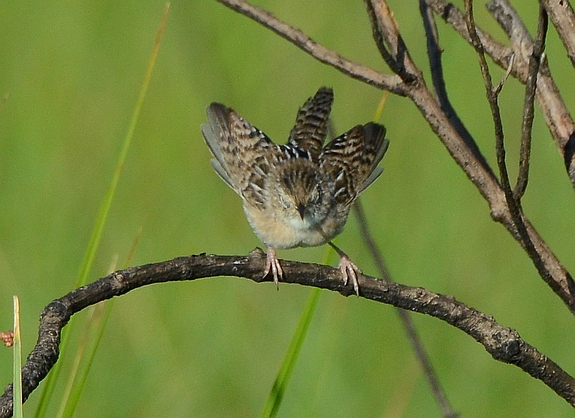
Novel Sedge Wren pose. It's hard to believe that a number of species shaped like they shouldn't be flying more than ten feet at a time are actually accomplished migrants, i.e. Sedge Wrens, Yellow Rails. Impressive...most impressive.


My worst misidentification of the trip (I think) was of this fat black water snake...it was big and girthy and sunning itself at the edge of a pond. I thought it was a cottonmouth at first.


But look at that face. That blank, vapid, round-pupiled face. That is not a cottonmouth face.


The first thing some visitors will see at the refuge is a Cliff Swallow impaled on a spike (left bird) under the veranda where folks like to get lunch. Come on refuge, dick move.

This post is running long...more from Anahuac in the next post! And Bolivar Flats!

Friday, May 4, 2018

Withering Waves of Migrants Pummel The Gulf Coast: A Brief Dispatch From Max Rebo and Friends


Most of the Philadelphia Vireos I've come across in Texas are very confiding for some reason. This one is showing me the spider it just caught, because that is what they do there. Photographed at Anahuac National Wildlife Refuge.

The Upper Texas Coast. The place where birding legends are made. Where a birder's skills are constantly tested. Where a birder's tolerance for being around other birders is also constantly tested. Where the quality of birding can exceed the highest of expectations, or equally likely, be so disappointing that a birder may just have to take the next year off from birding and work on cultivating their Facebook personality while completely relying on Arby's for sustenance.

No point in trying to build any more suspense...the trip is done, and the birding was fantastic. At times, the number of migrants present were just flabbergasting. I'm not talking about mixed flocks, I mean swaths of woods just saturated with migrants...the never-ending flock that we all have been searching for. Most days I found myself being absolutely drunk on birds at one point or another. We arrived at pretty much the perfect time, and left at pretty much the perfect time; for those unfamiliar with birding out that way, the number and diversity of migrants is highly dependent on which direction the wind is blowing, the presence/absence of cold fronts and stormy weather, etc. We began birding High Island as soon as a cold front from the north had blown through (April 22), and the woods were jammed with birds. One day of moderate south winds mid-week meant a lot of turnover and new birds dropping in, as the winds reversed a day later and deposited the heap of new birds right on the coast, instead of allowing them to cruise inland on a comfy tailwind.

I'll do some more thorough posts highlighting specific areas, but wanted to get something out into the Birdosphere post haste while the sweet taste of birding victory is still fresh in the mind. 


This exhausted Prothonotary Warbler passing out on the ground in a small garden was absurdly tired and had just successfully fought through the storm that passed us earlier that morning. If there is such a thing as a poignant bird, this is one of them. I have never seen anything quite like it...it was plain old pooped. Crossing the Gulf of Mexico is hard. Photographed near Boy Scout Woods on High Island.


I knew there would be an opportunity to see spoonbills up close, but getting to hang out next to a huge rookery was, as Geri would say, just lovely. Photographed at the Smith Oaks rookery on High Island.


Bay-breasted Warbler was one of the most common warbler species in the second half of the trip...didn't exactly expect that. Their bretheren, the Blackpoll, was comparatively uncommon while we were there. Photographed at Smith Oaks.


You may have thought little of me before, but now I will stoop even lower and post a picture of a grackle. Three species of grackle are common in this area, which I don't think is something I've experienced before. This Boat-tailed Grackle dropped into a pond to a grab a little shrimpy. Very enterprising. Photographed at Sea Rim State Park.


Lots and lots and lots of tanagers were moving through while we were there, especially in the first half of the trip. Scarlet Tanagers outnumbered Summer (above), but not by much. I made the mistake of parking the car under a mulberry tree on the first morning, and later found it coated in droppings and berry residue from numerous tanagers, thrushes, grosbeaks, catbirds, Tennessee Warblers, etc. How embarrassing. Later I got mulberry butt (locally known as "butt period" apparently) from sitting on the "grandstand" seats at Boy Scout...thwarted again by tanagers and trees!

Oh! And if you were hoping to hear about a nice Geri moment, Officer Shaw assisted a Geri with a Summer Tanager he was struggling with. No, Geri didn't think it was a Scarlet Tanager...he thought it was a Blackburnian Warbler. Just another day birding the Texas coast. Photographed near Boy Scout Woods on High Island.

Friends of the blog, Dipper Dan, This Machine Nate, and Officer Shaw all got in on the sweet sweet migrant action multiple days, and MAX REBO was more than pleased about how the tour went...MAX might decide to run it again next year, especially if folks inquire about it now! That's right, you may get another chance to get completely humbled by migrants! Stay tuned for more highlights from the trip, I assure you these posts won't be of the "make lemons into lemonade" variety, more like "make opium into heroin". And who doesn't like metaphorical avian heroin?

Monday, October 3, 2016

ID Challenges: The Worst of The West


Birding...it's not easy. Sure, there are times when you get out of the car, walk over to a group of birders, and they wave their hand at the staggering mega that is sitting there in front of you. Some birders will chase rarities, see the bird, then ask to have the field marks explained to them by others...how easy! How great! What else is great? Harlequin Ducks, Roseate Spoonbills, Elegant Trogons, Scissor-tailed Flycatchers, Scarlet Tanagers...those are beautiful, unmistakable birds.

Most birds? Not that easy. Not that easy to find, not that easy to see well, not that easy to identify. I thought I would take the time today to run down some of the hardest families of birds in the western Lower 48...people like lists, after all, particularly birders. There is some overlap here with other parts of the country, but there are distinct differences...for example, the east coast has more terns and thrushes, but less storm-petrels and hummingbirds.

Before we get to the list, I should name some Honorable Mentions that didn't quite make the Top Ten:

- Swans. Tundra vs. Trumpeter can be extremely challenging. Luckily, we only have two swan species to really worry about (until Bewick's Swan is split). That's a Tundra Swan up top there.

- Petrels. Petrels are arguably the most difficult of our birds, period. A large suite of them can potentially show up off our coast, very few birders know them well, and they rarely cooperate with boats or come close to seawatching sites. They fly incredibly fast and all come in white, gray, black and brown. However, they are rarely encountered relative to all the other birds we are discussing today; while often seen on repositioning cruises, there are few other instances when you can realistically expect to see them.

- Hawks. Hawk ID is not exceptionally complicated west of Texas, in my opinion, though obviously there are problematic plumages out there. Of course, Accipiters will always be misidentified by everybody, so hawks are deserving of a mention (an honorable one).

- Oystercatchers. This problem is unique to Southern California...Black Oystercatchers are as distinctive as any bird we have, but Black X American Oystercatcher hybrids and our local American Oystercatcher subspecies look confoundingly similar. American Oystercatcher is one of the most overreported birds in the area.

- Plovers. Telling apart American and Pacific Golden-Plovers can be absolutely excruciating. Beginning and intermediate birders will often misidentify Black-bellied Plovers for either Golden-Plover species. The smaller plovers aren't bad though.

- Crows and Ravens. Some birders can't tell crows and ravens apart from one another...well what about Common Raven vs. Chihuahuan Raven? American Crow vs. Northwestern Crow? In some places, these ID challenges can seem almost impossible to overcome, particularly with the crow situation in Washington.

- Gnatcatchers. If you are birding someplace where Black-capped Gnatcatcher can reasonably be found, the other two southwestern species can give you a world of trouble, especially if you don't find yourself birding down there very often and don't know the calls well. They are hyper little bastards, which makes seeing already subtle field marks an extremely taxing ordeal.

And now...the list!


#10 - Sparrows. The western U.S. is blessed/cursed with an impressive diversity of sparrows. The majority of them are migratory and/or have a tendency toward vagrancy, and they are all brown, brown, brown, brown, brown, brown brown...gray, and brown. However, though they are terrifying for beginners, sparrows aren't so bad once you've put some birding years in the rearview, and some of them are downright difficult to misidentify. That said, Spizella sparrows (like the Clay-colored above) can be especially vexing. Savannah Sparrows, one of the most abundant sparrows in the country, are arguably also the most misidentified of them all, as they can pass for Song, Lincoln's, Vesper and Baird's.


#9 - Sandpipers. Show me a rookie birder and I will show you someone who is going to be greatly troubled...by shorebirds, sandpipers in particular. The dowitcher duo is legendary, peep problems are relentless...to put it bluntly, almost every sandpiper species is at a high risk of being misidentified for something else. Those of us on the coast always have Siberian species on the brain, which complicates the picture even further...yikes. However, the "expected" species do become pretty familiar in time.


#8 - Warblers. Spring warblers are decidedly unproblematic, with the exception of waterthrushes (that's a whitish Northern above). However, you may not be aware that there are three other seasons. Most warblers do not have the same snappy facemelt in October that they do in April. They are referred to as "confusing fall warblers" for a reason, though I despise that tired and overused phrase. There are so many identification pitfalls here that there is no point in even starting in to them. Californians have it especially bad, since we have multiple records of almost every breeding warbler species in the country.


#7 - Vireos. Vireos make people very uncomfortable. Seen poorly enough, every single vireo species (with the exception of a vagrant White-eyed) stands a good chance of being misidentified. Just a few days ago on Facebook, I watched (seemingly in slow motion, like a car crash) in horror as a birder sought out the expertise of an expert, to identify a bird she had photographed very well. He called it an Orange-crowned Warbler...it was a Warbling Vireo. At least with a sandpiper you know it's a sandpiper...with vireos, people call them warblers (and vice versa) on the regular. The hardest vireos? Warbling vs. Philadelphia, and Blue-headed vs. Cassin's vs. Plumbeous. That's a Philadelphia above.


#6 - Longspurs. Away from the prairies of eastern Colorado, Wyoming and Montana, we don't even get to see longspurs in spring. When we get them, they always look like rubbish. Lapland (above) can look like Smith's, Smith's can look like Chesnut-collared, Chestnut-collared can look like McCown's. And 90% of the time, you are getting total garbage looks at them. They all look similar, their calls are not drastically different, and they hate being cooperative for birders. That is a recipe for pain.


#5 - Hummingbirds. Unlike sneaky longspurs and skulky warblers, you can typically get really solid looks at hummingbirds. That said, this may not be of much use to you if you are not prepared...male hummingbirds are facemelting birds, but young males (like the Costa's above) and females can be brutal. With the exceptions of Violet-crowned and maybe Berylline, I think every one of our young/female hummingbird species is at an extremely high risk of being misidentified. Don't believe me? Go geri-birding in Arizona and watch the carnage unfold.


#4 - Storm-petrels. I lead a lot of pelagic trips, and I will tell you that no group of birds strikes more fear into the heart of an inexperienced birder than these. When it comes to these birds, people seeing them for the first time completely surrender any attempt at an ID to the leaders on the boat. We could tell them whatever we wanted and get away with it (fortunately, we want to tell them the truth). Other than the lovely Fork-tailed Storm-Petrels (most of the birds above), they are either all small black birds or small black birds with white rumps. Generally, they want nothing to do with the boat you are on and you are going to be really unsatisfied looking a them if there is a big swell that day. New developments in the Leach's complex have everyone reeling. These are the birds your nightmares are made of.


#3 - Jaegers. You probably didn't see this being #3....but the difficulties of jaeger ID are legendary. Even dark Pomarines and South Polar Skuas get mixed up. Trying to ID certain individuals can lead to such circular logic and mental numbness that I am getting tired just thinking about it. Just be happy when you get to see "easy" individuals, like this Pomarine above.


#2 - Flycatchers. You know what? I haven't done a quiz in a while. What do you think this bird is? The answer is at the bottom of the post. Hint: It's a flycatcher.

Flycatchers are just heinous. Think about each gnarly genus we have all lumped into one jaw-clenching, teeth-grinding family...Contopus, Empidonax, Myiarchus, Tyrannus, etc. That's some heavy shit. The first three genera are especially bad. I don't even know what to tell you here, except to advise you that you can at least get close to the right species. Hammond's and Grays are not similar. Willows and Pacific-slopes are not a confusing couple. Buff-breasted do not look like pewees.

Pewees....yeah. Just identify pewees correctly (don't misidentify them for Empids) and you will command at least a small modicum of respect. Don't report an Eastern unless it's calling though, or you will be run out of your state.


#1 - Gulls. Obvi. I have nothing to say about gulls that you haven't heard before. This is a perfectly typical Herring Gull...I bet not many of you knew that.

There you have it, the list, for your edification and mine. Do you agree, or do I have it all wrong? Are ducks and geese deserving of being on the list? Are alcids alarming? Do Wrentits cause your brain to boggle? I hope not. At any rate, feel free to let us know.


p.s. The quiz bird is a Least Flycatcher. Props if you got it right. And before you descend into a nerdy rage, yes it is a flycatcher that breeds in western states. #notjustavaguerunt