Showing posts with label Yellow-shouldered Blackbird. Show all posts

Wednesday, February 22, 2017

Puerto Rico Winter Tour Y2K16: Refugio de Vida Silvestre de Boquerón, Cabo Rojo


It's been a weird winter here in the bay area. It seems to rain constantly, and I am in a persistant daze due to the newborn baby that strangely requires frequent attention. However, I can't bitch about not getting to the tropics this winter, because it was only back in December that our group from MAX REBO BIRDING TOURS were slaying Caribbean birds in Puerto Rico. The trip report must go on...

It is about time I posted a picture of one of my first lifers of the trip...Greater Antillean Grackle. I somehow did not get to crush them as well as I could, so I had to settle with photographing them while sitting around eating lunch after we birded Laguna Cartagena. An old lady with bad Parkinson's was feeding them rice, so I stole a few grackle souls.


These are one of the most abundant native birds of Puerto Rico. They are quite small, more like a Common than a Great-tailed, and haven't totally abandoned native habitats in favor of streets and parking lots. They are also much less cacophonous and obtrusive than Great-tailed...I ended up liking them a lot, considering they are literally a trash bird.

After lunch we decided to check out Silvestre de Boqueron, a coastal site that is not mentioned in a single trip report that I could find, but boasts a very robust (for Puerto Rico) site list in eBird. We found the entrance road easily enough and parked at the admin buildings. Here, there is a boardwalk trail through the mangroves, and longer trails that go to the south and to the west. We chose to walk the southern trail, which ended up being very rewarding...almost immediately we got our first White-crowned Pigeon of the trip, which was a lifer both Officer Searcy and Dipper Dan. They turned out to be fairly common there, and one of the dudes who works at the refuge says they nest next to the other trail that we did not take.


White-crowned Pigeon did not turn out to be the highlight though...a few minutes later, we were blessed with an increasingly rare group lifer (#grouplifer)...at long last, we had found a Lesser Antillean Pewee!  YESSSSSSSSSS!!!!!! This was a major target bird of the trip (again, all Caribbean species were targets for us), and I was getting worried that we might end up dipping on it. The Puerto Rican birds population may be treated as their own species someday, so it was a very bankable bird as well.


We saw multiple pewees on this trail, in a habitat where none of us were expecting them...they are not exactly considered a mangrove species from what I could tell. Though the birds would rarely sit in crushable light, they were bizarrely cooperative, which I appreciated very much. Their buffy underparts and trusting ways were most mellowing. We would not go on to see them anywhere else, though I did hear one at Bosque Susua.


Puerto Rican Woodpeckers were common and widespread. This eye-catching endemic is built to last, occupying many different habitats...unfortunately I never got the crush that this bird deserves. It is much, much more interesting than your average Melanerpes.


The most surprising thing about our time at Silvestre de Boquerón was how fucking birdy the place was. Almost everywhere we birded on the island was somewhere between not birdy and kinda birdy, but there was a lot of activity here. Northern Parulas were very common, showing up in almost every mixed flock we crossed paths with.


As with most sites, Puerto Rican Flycatchers were holding it down.
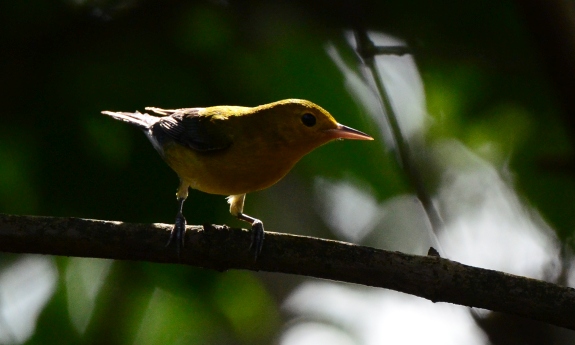

Unlike the pewee, Prothonotary Warblers are known to be lovers of swamps and mangroves. This dimly-lit (but still facemelting) rarity was another excellent trip bird; a Black-and-white Warbler near the parking area was another new North American migrant for the trip list. Good times at this place...if you are interested in checking out this site, our eBird checklist can be viewed right here. Note that during the hunting season the refuge is not accessible seven days a week. We were also told that it was ok to park outside the entrance gate and walk in to bird outside of normal hours.

We had some daylight left, so it was back to Cabo Rojo to continue the never-ending search for trip birds (other than the mythical Masked Duck, we had run out of lifers to get in immediate area). Our spot that previously produced a huge peep flock and Franklin's Gull earlier was almost devoid of birds, which did not surprise any of us. Still a bummer though.


This friendly Merlin provided some consolation. I don't know about ya'll, but friendly Merlins are few and far between out here. Oh, and while I think of it, how come Merlins seem to be so unpopular with falconers? Seems like the next logical bird to graduate to after a kestrel, and they are fun as hell to watch hunt. Oh well, leave them in the wild, suits me.

Our search for waterbirds took us all the way to the end of the road, at the parking area for the hella popular beach. Despite a great deal of good habitat, there was little to see...maybe the tide was too high?


We did see some cool terrestrial snails at least. Who doesn't appreciate a good snail?

On the way back we pulled over where some shorebirds and a group of icterids were roosting; Dipper Dan noticed some Yellow-shouldered Blackbirds in the flock, so we hung out and looked around.


The trees along this stretch of road were clearly the site of a significant night roost for Icterids. It was fantastic to see Yellow-shouldered Blackbirds in a more natural setting than the La Parguera hardware store.


A little while later, we refound the Franklin's Gull picking at shit out in the lagoon...a nice bird, but there was a lot more to look at...the closer to sunset it got, the more and more birds we noticed began to arrive...and that is when we realized it was happening.


Thousands of icterids flew south down the peninsula to roost next to where we had parked. Shiny Cowbirds (above) comprised a large portion of these birds, which I had mixed feelings about; they are a major factor in the decline of the blackbird...but they were also a bird I had just lifered only days before. We also started seeing Prairie Warblers fly in to roost (!), which was a most fetching thing to watch.


Luckily for us, Yellow-shouldered Blackbirds came streaming in over our heads with the grackles and cowbirds. Ace.


Amazing looks at these hell of rare birds. While it is easy to think of them as just a Red-winged Blackbird with a different wing patch, there is another major difference between the two species, phenologically speaking...the sexes have identical plumage. Yup, these might be females. Astounding, no? I wonder how this unisex plumage evolved.


Flocks of Stilt Sandpipers and Lesser Yellowlegs wheeled around over the laguna while we watched the blackbirds fly in, adding to the birding ambiance.


The laguna and distant Guanica Dry Forest glowed beneath afternoon storm clouds in the fading light. Our time here at the blackbird roost was one of the definite highlights of the trip, and I would highly recommend attempting to see the blackbirds here (17.954779°, -67.198514°) in the late afternoon instead of the mutant bread-lovers at the hardware store.

Thursday, January 19, 2017

Puerto Rico Winter Tour Y2K16: La Parguera, Maricao, Puerto Rican Nightjar, Laguna Cartagena


In the afternoon, we called it quits at Cabo Rojo and headed east to La Parguera for some good old-fashioned geri birding. The "hardware store" in La Parguera was easy enough to find, though not so easy to identify correctly. For anyone heading that way, this is what it looks like. You see, BB&B is here to help.

Why were we here? This was the easiest and most reliable place for Yellow-shouldered Blackbird. On the right side of the store, they toss out bread every day to feed the doves/icterids, and Yellow-shouldered Blackbirds are expected among the visitors. Well it turned out we got there way too early, but eventually the bread went out and the blackbirds came in.


Success! Another endemic down. We didn't see very many, and unfortunately 2-3 of the birds we did see (in other words, about half) had growths on their faces that looked a lot like avian pox. It was a bummer...I'm not sure what exactly it was or how they contracted their afflictions, but I suspect feeding them there may not be the best idea...they are endangered and not exactly thriving. We had a much better experience with them a couple days later someplace else, which I will get to in the next Puerto Rico post.


The next morning was just a total clusterfuck. There is no other way to describe it, although we did lifer Puerto Rican Vireo in the process. Not only did we get lost, we also definitely would have gotten ourselves stuck if not for being able to use 4X4. Google Maps was our enemy that day. We were trying to get to the Maricao forest, sanctuary of the Elfin-woods Warbler and supposedly one of the best places to bird...well it turns out getting there from the south is easy (go to Sabana Grande, take 120 all the way there), but that is the only way you can go! Don't even think about trying any other horseshit, unless it is from the town of Maricao itself (north of the forest).

We did finally make it, first stopping at a little unused track that goes north of 120 at the 13 km marker. We got great looks at Puerto Rican Vireos, which are not dissimilar from Eastern Bell's Vireo.


We couldn't ask for better looks really, so this was very satisfying. After getting vireo'd, the next bird we saw was a female Elfin-woods Warbler...holy shit! I thought those birds were supposed to be hard! A Green Mango was flitting around, and a little while later Dipper Dan and Officer Searcy found the male Elfin right on the main road.


If I was British, I would tell you that the views we had of this bird was superb. I'm not though, so the views we had were fucking sick. The bird was very cooperative, not being in any rush to get anyplace, and wasn't acting that much different than a typical warbler. Before I knew what was happening, it was already too late...I had birdgasmed.


I like this photo because it is confusing. Behold the No-headed Warbler ("No-faced" subspecies).


Though it lacks the power to melt face or cripple body and mind, seeing this bird well was one of the highlights of the trip for me. It is only found in higher altitudes on the island, and Maricao is the one really reliable place for it...had we missed it, we would have come right back up the next morning. It was first discovered in 1969, which is astoundingly recent. These idols of inconspicuousness managed to remain safely unidentified for an incredibly long time.

The rest of Maricao was...disappointing. It turns out middle of day is not always best time to make for greatest of bird. We had some mediocre road birding elsewhere, but the area around the ranger station was quite dead (though Officer Searcy did get another Elfin here), and we got kicked out of one of the recommended birding trails. There was some sort of bizarre operation going on that involved some biologists doing something bird-related who did not want to talk about what was happening, I don't know exactly what they were doing but it looked interesting. Which is not what needs to be talked about...the point is that I'm sure the birding is better earlier in the morning. We were bummed to not pick up anything else new for the trip (at this point, not seeing Lesser Antillean Pewee was getting stressful), but we got the bird that mattered most and headed down to roll the dice on Masked Duck.

Dipper Dan and I knew the fix was in even before we got out of the Jeep. We knew how the Masked Duck game works...the Masked Duck wins every time and anyone else playing eats shit. Simple. And so we made a long, hot walk through the mud (the roads were way too wet to drive) to the known Masked Duck pond in Lajas Valley. There were some crappy exotics, Least and Pied-billed Grebes, a Purple Gallinule (trip bird!), a rail that scurried over the aquatic plants that went unidentified (this is a good spot for Yellow-breasted Crake as well...dammit). No duck, as expected.


At least the incoming storm was nice to look at. I got stuck in the mud at one point on the way back (how embarrassing!), but at least we made it back to the Jeep before the rain really hit and no one had broken into it. Success? No.

Life is pain.

Maybe I will have another chance at Masked Duck in 2017. Or 2018. Does it really matter? I'm not going to see one.  Anyways, after our unsurprising failure we made the brilliant decision of quitting birding for the rest of the afternoon instead of hiking to another pond through the mud where we would not see Masked Duck again, and retreated to our place in Guanica. We got dinner fixins at a grocery store, chilled for an hour, then set the next nerdplan into action.

The good thing about staying where we were is that we were right next to the Guanica Dry Forest. El Seco is good for daylight birding and all, but what that really means is that we were staying right next to Puerto Rican Nightjars, which are pretty much endemic to this rare and restricted habitat type. Instead of looking for them where most people do, we turned east on 333 and slowly drove with the windows down, listening...we had them within 5 minutes! We heard multiple individuals and had great looks at one, though we lack photos to prove it...


The stretch of road around 17.957622, -66.869134 was quite good for them. I couldn't believe our luck, they were remarkably easy to find considering this species was thought to be extinct for a considerable span of time. How often do you get to see a species that has come back from the dead. Nocturnal [e]mission complete!

The next morning it was off to Laguna Cartagena, one of the best wetland sites on the island. White-winged Parakeet was a reluctant lifer en route. We approached from the only recommended entrance point, turning south off 101 at 18.028426, -67.109147. This is a straight shot down to the western access points of the refuge, but the road was covered in vast, deep puddles...it would not have been possible to barge this in a sedan, but we had no problem with the jeep. We made it to the trail to the tower without any problems.


There were a great many butterflies here...here is a buckeye thingy.


I think this here is a cracker thingy.


This American Kestrel (not a thingy) was following the trogon methodology of domain surveying.


When we first got to the tower, I was kind of disappointed...the laguna is highly filled in with sediment and vegetation, but with persistent scoping we found some ducks and gallinules in the smaller, more open pockets that hadn't been choked out by reeds and shrubs.


The tower really did provide a good view, as Officer Searcy demonstrates. Most importantly, it allowed us to find West Indian Whistling-Ducks (many!), which are very uncommon on Puerto Rico and not at all something that was guaranteed...this lifer helped make up for the lack of Masked Duck, which presumably can also be found in this large wetland. Dipper Dan even found a pair of whistling-ducks with ducklings, for bonus bird points. Other trip birds we got here included Ring-necked Duck, Ruddy Duck, Black-crowned Night-Heron, and Sora.


[Insert caption here]


After the tower, we walked another trail from the entrance road out into the marsh (18.012569, -67.108868). The "trailhead" is well-marked, and a short distance north of the parking area for the tower. It is very overgrown but there was still some decent visibility toward the end. Fortunately, some West Indian Whistling-Ducks were holding things down, and although not hell of close I did my best to soak them in with my eyes.


West Indian Whistling-Duck and Glossy Ibis (trip bird!) combo. I really like that combo.


The marshes here are absolutely saturated with Purple Gallinules, I don't think I've ever seen so many in one place.


I've still never dealt one the crushing this species deserves, but I think you get the idea that these crippling blue bastards are just begging to be looked at. Why do they exist? How lucky are we to live in a world with Purple Gallinules?


Horrendously large numbers of butters here. Just terrible. Plagues of them. It was great.

Our eBird checklist for the morning is here. The birding had been very rewarding, and we were whistling-duck heroes...but there would be more heroics and more lifers before the day was done.