Showing posts with label Gray Kingbird. Show all posts

Monday, May 8, 2017

Puerto Rico Winter Tour Y2K16: Bosque Cambalache, Camuy, Trip Wrap Up


This is it...the last Puerto Rico post! I'll go over the last day of our trip (very good birding), mistakes that were made, and general comments and recommendations for those of you thinking about birding there in the future.

The main destination for our final morning was a spot I knew almost nothing about. While doing research before the trip, I was trolling through eBird, looking for good sites for quail-doves...clearly one of the most dependable spots for both species found on "mainland" Puerto Rico was Bosque Estatal de Cambalache, in the Arecibo area. This site was not mentioned in any trip report I could find, but clearly this was a Geotrygon stronghold, so why not bird it? A Mangrove Cuckoo greeted us in the predawn light.


After a spell of no quail-doves at all, we began hearing Key West Quail-Doves and flushing unidentified quail-doves from the road...without being able to identify them of course. This would happen over and over again, even though we were moving painstakingly slowly to avoid it. Mercifully, a Key West Quail-Dove cooperated for good looks, relieving Dan and Adam of their itchy and sore grip-off episode I dealt them the previous day at Bosque Susua. A tiny anole cooperated for even better looks.


A few minutes later, our bitternish pace on the trail rewarded us with distant looks at a Ruddy Quail-Dove, which was a sweet sweet lifer for yours truly. And under the watchful gaze of terrestrial snails, we got great looks at a second individual shortly afterward. Fuck yes.

Our eBird checklist from the site is here. Note that we did not include several unidentified quail-doves that flushed from the road before we could get bins on them. Though not a super birdy site, we did have a good mix of native birds and great success with KWQD and RUQD, so I would definitely recommend birding here if you get to this part of the island.


Hacienda Esperanza was another site in eBird that boasted a healthy site list, and many potential trip birds were on the menu. However, when we arrived a guard at the gate told us we needed reservations, which was railer. We tried another access point to the east though, and a guard waved us through. Some nice beaches here and a few much-appreciated trip birds, though we didn't see anything very exciting.

If you care about seeing exotics, I would definitely recommend birding the open areas of the access road to Hacienda Esperanza....there are flocks and flocks of exotics here, the most interesting of which were these Monk Parakeets.


Don't worry, you will see plenty of Gray Kingbirds along the road as well.


At this point we had only one last target bird of the trip to go for, so we headed west toward Camuy. A roadside pond halted our progress and yielded a flock of Glossy Ibis.


Pile of turtles, pile of ibis.


The most exciting bird here was, believe it or not, a Ring-billed Gull. I have never been so happy to see a Ring-billed Gull before. This was only the second individual gull we saw on the trip.


Alas, we left the Ring-billed Gull behind and finally arrived at our last birding destination of the entire trip, a medium-sized farm pond with a great number of birds. White-cheeked Pintails were one of the most abundant species.


RUDU-WCPI takeoff combo? I'll take it.


Ducks are cool and all, but we had come to this random pond for one reason...AMERICAN FLAMINGO. This Vague Runt has been on the island for years and only occasionally moves around; it is usually found at this pond. What a ridiculous, impressive, and unbelievable bird. I've never really taken one in before, if we are being honest here (but not literal), they really walk the line between being completely crippling and profoundly absurd.


This is not a bird to be taken lightly. It is too outlandish. Too good. Too pink. It's bill is incomprehensible. What a marvel.

This was the last group lifer of the trip. Note that our eBird checklist features Mallard! This is a good spot for waterfowl, in addition to the famous resident flamingo.


At this point we decided to do the unthinkable...go somewhere for reasons other than birds/food/beer. The Arecibo Observatory is a scientific behmoth that borders on being a monstrosity. Definitely a tourist trap, but it is too grand a thing to not see in person. If you are a space nerd, you would love this shit. If you are not a space nerd, it's still hard to not be impressed. It does, for good or ill, give you a moderate Death Star vibe. Yes, that is a lip of the giant dish carved into the earth that you can see at the bottom of the photo, but so far it has yet to be used against rebellious planets or Mon Calamari cruisers.


The trip was a great success. Not a shitload of birds, but many lifers. The lifer-to-bird ratio was very solid, in fact. Good people. Good vacay. Some pocket. Great pinchos. Not quite enough rum. Annabelle does not have microcephaly. Winning.

Comments:

We took a leisurely 8 days to bird the island; most birders are usually only hunting endemics, and take less time to bird Puerto Rico...though I'm not sure where else they are planning on seeing something like Antillean Crested Hummingbird anytime soon. Anyways, we were going for all the Caribbean specialties in addition to all the endemics, and we did really well with our target birds, so I think ours was a quality timeline. I got 46 lifers...phenomenal. Around 40 were native birds, not a bad ratio considering the number of bizarre introduced species in Puerto Rico. We got to see a lot of the island this way as well, instead of just being relegated to the southwest corner where most endemics are easiest.

We planned our route and chose our hotspots using trip reports (very helpful), tips from a couple of former Bird Police (very helpful, thanks Tom and John), eBird (quite helpful), and A Birdwatchers' Guide to Cuba, Jamaica, Hispaniola, Puerto Rico and the Caymans (somewhat helpful). We found the book to be, well, not very well-written, especially when it comes to giving directions. That said, it was still useful, but you don't need to have this book when birding Puerto Rico.

We had a 4x4 Jeep. We did actually use four wheel drive several times, it came in handy! If you go during the rainy season and want to access places like Laguna Cartagena and other spots in the Lajas Valley, I would recommend you do the same. If you are prone to getting lost, it can help you out.

As I mentioned before, Google Maps led us astray repeatedly. It can help you get places here, and it can help you get lost. Don't put all your birding eggs in the Google Maps basket.

We stayed at Ceiba Country Inn and two different Airbnbs, one just outside of Guanica and one near Arecibo. Ceiba had decent rooms, decent birding on site (we got visuals of Puerto Rican Screech-Owl nowhere else), but poor breakfast for the price. Not a bad place for a birder to stay though, if you get to the east side of the island. Nice dogs.

Misses:

White-tailed Tropicbird is an easy bird in spring along the northwestern coast, but considerably more difficult to find in early winter. However, I think we could have gotten one if we devoted some time to seawatching, which we did not attempt.

Masked Duck is not only my Nemesis Bird, I think it is fair to say that it is also Dipper Dan's Nemesis Bird, so of course we weren't going to see one despite lots of effort in lots of good places. However, we can completely blame Officer Searcy for our failure to find this bird, as he claimed we would see one...this is a grave mistake, do not do this if you are hoping to see a Masked Duck. Looking at eBird, it looks like they started showing up at Laguna Cartagena after our trip. Typical.

We were bummed to miss the local Sharp-shinned and Broad-winged Hawk subspecies. The local Sharpie is critically endangered and not at all easy to see though.

Few visiting birders make the effort, but if you take the ferry to Vieques, you stand a strong chance of getting Bridled Quail-Dove if you can make it to the right part of the island. We did not undertake this journey.

It turns out Black-whiskered Vireo is quite rare in December; we missed this species entirely despite looking for them constantly. They are much easier later in the winter (February) when migrants arrive.

We were aware that Antillean Nighthawk and Caribbean Martin are spring birds, not to be expected in early winter. We saw neither.


We left Puerto Rico with 137 species in the bag, a good avian haul I reckon. Thanks again to MAX REBO BIRDING TOURS for making this all possible!

Wednesday, December 28, 2016

Puerto Rico Winter Tour Y2K16: Comerio to Guanica


Our time in Ceiba was done, so the nerds got up early for making the Kessel Run trip to get the final east side target bird, none other than the rare, legendary and highly-localized endemic subspecies of Plain Pigeon. This is not a bird you will blunder into while birding in Puerto Rico; you definitely need to make a targeted effort to see them. Google Maps was highly ineffective in getting us to the right spot (again, beware the app's suggestions for shortcuts in Puerto Rico), but eventually we made it. It was a weird place...basically, you look for the birds from a baseball field. Lifer situation.

Adam and I immediately had a Plain Pigeon fly directly overhead when we arrived, basically looking down the first base line, though better views were definitely desired. Looking at the trees beyond the outfield was unproductive after the initial flyover, so I turned the scope around and started scanning the hillside beyond home plate....BINGO. We had distant but prolonged looks at two Plain Pigeons feeding in the blooming African tulip trees (local photogs call them tulipans)...fuck yes. A scope was essential here, so if you plan on seeing Plain Pigeon in any satisfactory way, do bring a scope or you run the risk of stringing a Scaly-naped Pigeon. We ran into some local bird photogs who were about to head up a road to the general area where we had seen the birds, so if you want to try and get closer to the birds you can walk up the small road at 18.222429°, -66.201390°.


Ground Zero in the valley of the Plain Pigeon.


Gray Kingbirds seem to run things in any remotely open habitat on the island.


The most conspicuous reptiles of Puerto Rico are the introduced green igaunas. They are everywhere. Any loud, crazy thrashing sounds you hear coming from shrubbery, plopping into ponds or falling out of trees are iguanas.

After the pigeon victory we headed down to the south coast, hoping to check out some random spots between Jobos and Guanica, where we sould be spending the night. This stretch of the island is seemingly unbirded by anyone who doesn't live in Puerto Rico, as this large area is completely absent from any trip reports I've found. Dipper Dan worked on trying to find some places to bird switching between eBird and Google Maps with mixed success...we managed to get to 2/4 spots we attempted to bird. Again, Google Maps on the island is not your best friend, but it's not worthless either.

Playita-Vertedero Salinas was a totally random spot Dan found on eBird that was not hard to access (17.955920, -66.286848). Just drive down the dirt road and park in the obvious dirt parking area next to the lagoon; scope the lagoon and bird further on down the road. The lagoon and salt flats were not overly birdy but did net us a number of trip birds (most notably the one and only Gull-billed Tern of the trip), and the mangroves along the road held Black-faced Grassquits (common and widespread on the island) and a smattering of warblers.


By far the best bird here (for me anyways) was this cooperative Green-throated Carib, which we got much better looks at than back at Humacao. Caribs appear to have their eyes set further back in their heads than other hummingbirds, which gives them a unique facial expression.


The deep blue belly contrasting with the emerald throat is a nice touch. This would be the last carib we would see on our trip, and we never saw Antillean Crested away from Humacao and the Fajardo Inn.


Palm Warbler was a new trip bird; we finally got our first Yellow Warblers of the trip here as well. The local Yellow Warbler subspecies turned out to be much more uncommon than we thought they would be.

Dipper Dan worked furiously on eBird, trying to figure out how to access other hotspots...attempts to access a couple bird areas east of here were met with abject failure (thanks Google Maps), but we did successfully reach Laguna Salinas (yes, another Salinas) after an awesome lunch at the Oasis Cafe and Bakery in Santa Isabel. Their coffee was unlike anything I've ever had...hot damn!

Accessing this site is interesting...you have to get on an eastbound onramp to Hwy 2 and then make a sharp right turn onto a dirt road directly off the highway. The dropoff between the highway and the road is pretty big, so I'm not sure how well this would work with a sedan (we had a jeep, so it was mellow). At any rate, the turnoff to the laguna is at 17.974407, -66.673697. The birding here was decent (in other words, more trip birds), with close looks at a Clapper Rail being one of the highlights. Lifer subspecies!


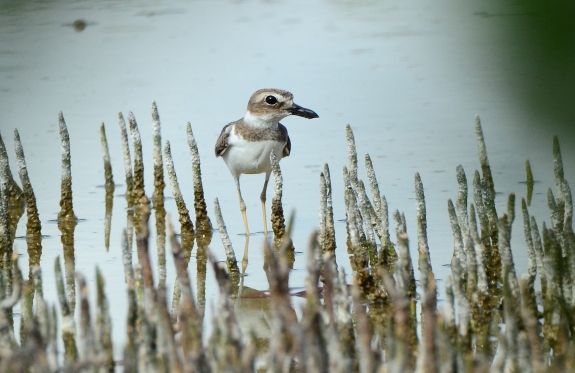
I hadn't seen Wilson's Plover since I was working in Texas a couple years ago...this bird was standing in the middle of the road, a niche typically occupied by Killdeer. Lifer situation. I had forgotten what a massive bill is attached to that cute little plover face.

At the end of the day we finally pulled in to our Airbnb, a few minutes southeast of Guanica. As we had hoped, the area had some decent birding to offer...a big semi-birdy (genuinely birdy places are apparently rare in Puerto Rico) lagoon was right next to our place. Venezuelan Troupial was a facemelting but reluctant lifer (they are an introduced species), and were very common here. This would be home base for the next four nights. One of the beds smelled like piss and the tap water was burly (not the owner's fault obvi, but tap water in other parts of the island was excellent), but otherwise it worked out really well. Lots of great birding within an hour's drive!


The view from the balcony, a mellow mangrove-lined lagoon with the famous Guanica Dry Forest cloaking the hills in the background. Tranquilo, though the mosquitoes got annoying. This was one of the best views of any Airbnb I've ever stayed at, though I still think "The Edge" in Lubec, Maine, still has...an edge.


These amazing/terrifying lobster-tailed things were crawling all over the place. You never know what is waiting in the bushes of love.


The lagoon was filled with Lesser Yellowlegs and Stilt Sandpipers; more than 400 Stilt Sandpipers could be seen roosting from our balcony every day, which is hella to a California birder. The only place we can see that (well, maybe not anymore 😓) is down at the Salton Sea.


White-cheeked Pintails were the commonest ducks here, which were always visible in some numbers. Fantastic. I no longer need to feel the pain of a stinging gripoff whenever one is seen in Florida.

The next day we would bird a lifer habitat in the Guanica Dry Forest, which was very kind to us. Spoiler alert: lifers.

Wednesday, November 14, 2012

Ospreys, Flycatchers With Forked Tails, and The Manatee Inhales


Good day to you birders. How have you been handling November? Hopefully you are getting sparrowed enough to properly cope with SWAD (Seasonal Warbler Affective Disorder, which seems to only strike birders). Of course, some places are stiill blessed with some warbler diversity, but most of us are drowning in the brown/gray/white sea of Yellow-rumped Warblers that has flooded much of the United States. 

Attempting to escape SWAD, I have been birding a bit locally...my last year bird was a Harris' Sparrow, which I finally nailed on my third attempt...an inspiring Zonotrichia to be sure...photos to follow.

I rewatched The Big Year with Booby Brittany last night, so she could potentially understand my addiction better. Well, as Bostick puts it...its more of a "calling". If you are a birder (or just have the shame of personally knowing one), it's worth watching, although its leaves a lot to be desired. Still waiting, as always, for the Christopher Guest movie.

Right. Here is the last of the Everglades shots.

Florida is blessed with a plethora of Osprey. Flamingo, in Everglades National Park, is a great place to watch them close up.

Ospreys rank in the top 10 species that nonbirders ask me about. This is one of the few relatively noticeable birds someone will notice on a drunken river trip.

Ospreys lack the humungo feet of eagles, but look at the length of those talons! Who knows how many fish have met their fate in the grips of this bird.


Less than a mile outside Everglades National Park, I looked up and saw a couple Scissor-tailed Flycatchers (year bird) perched on the power lines. This is a young bird, lacking the insanely long tail feathers of an adult, but an adrenaline-producing site nonetheless.


Scissor-tailed Flycatcher is a rare but regular visitor (even uncommon?) to south Florida. I also saw one in the Everglades on my previous trip, so it seems to be a good place to find them.


Perched with the Scissor-tails was a Gray Kingbird, which seemed quite late to be remaining in Florida (this was on October 16). Note the deeply-forked tail and excessive drabness. They do have a red crown, but they keep it well-hidden most of the time.


Just the slightest tinge of yellow on the underwing.


I was pretty pleased to run into this bird. I can now claim that I have seen three (3) Gray Kingbirds...this is a great number, because I expected to come back with none at all.


Although the water is murky, manatees are easy to spot at the Flamingo marina. These amazing, incredibly fat creatures are unwary of people here...you can stand right above them on the docks. A tiny calf was among the adults while I was there.


A young Green Heron borrows a pose from the bitterns.


The Everglades are not a "must" for birders (unless you are crazy enough to look for flamingos), but they have many area specialties and are definitely worth checking out.  Hopefully, I will have the sense to go during the dry season next time.

Thursday, October 25, 2012

Birding The Conch Republic


While walking through the streets of Key West on our first day, I heard a loud unfamiliar flycatcher call above me. Shock and awe overcame me as I looked up to see my lifer Gray Kingbird. Key West, FL.

I have to say, if you are looking to go birding on your nonbirding vacation, Key West is a good place to be. Even frequent consumption of excessive drink and living on a sailboat anchored offshore (that's how we roll) were not able to get in the way of birding. The fact that the island is so small and that there are only a handful of places to bird (all easily accessed) make for very convenient birding.

Of course, in the first couple days I was completely slammed with year birds, and the bonus life bird was just extra frosting on the proverbial birding cake. My first afternoon birding there happened to fall on a very good day for migrants, and Zachary Taylor State Park was littered with birds. Another positive aspect of being there in the fall (and waking up late because you are raging all the time) is that there are tons of raptors flying around throughout the day; this is a major migration corridor and the numbers of falcons, accipiters, and Broad-winged Hawks streamed, kettled and puddled (?) overhead were impressive to say the least.

Here's some shots from my first couple days there.


Look at the size of that bill! This bird was right on Duvall Street, known more for its puddles of tourist vomit than its lingering South Florida specialties.


This Blackburnian Warbler (year bird) was one of the first birds I laid eyes on at Zachary Taylor State Park. The ABA birding guide recommends birding the native veg that grows near the Fort, but I had equal numbers of migrants (if not more) in the Australian Pines that grow near the beach.


Look at that stubby tail. For whatever reason, our west coast warblers are all relatively long-tailed in comparison.


A female Blue-winged Teal in the moat by the fort. Predictably, I didn't see much else in the way of waterfowl on this trip. Zachary Taylor State Park, Key West, FL.

You can still photograph Laughing Gulls while you are busy Not Birding. Key West Bight Marina, Key West, FL.


I love birding cemeteries, I'm not sure why. Key West Cemetery is worth checking out, although it doesn't offer the same level of birding that Zach Taylor or the botanical gardens do. It does have some pretty cool headstones though. Here is a Palm Warbler, the most abundant passerine I saw over the last two weeks. Key West Cemetery, Key West, FL.


Blue-gray Gnatcatchers are always suckers for a good pish (or even a "spish"). Key West Cemetery.


The long, thin bill of gnatcatchers are perfect for the emotionless crushing of hapless, stupid insects.


While hanging out in the bush with the gnatcatchers, my first Northern Parula of the trip popped in as well.

If Tennessee Warblers (year bird) always sat like this, people would not have such a hard time identifying them. Zachary Taylor State Park.


This sunset shot proves I was not on a birding trip. I was enjoying the sunset, like a normal person. Zachary Taylor State Park.