Showing posts with label Texas. Show all posts

Thursday, November 29, 2018

The Best Birding of The Year: April in Sabine Woods


I'm not sure if anyone has noticed, but I am pretty awful at finishing trip reports in a timely manner. However, I love trip reports (though they seem to be dying) and I love fantastic birding, so I would be crazy to not make one last installment from this year's trip to Texas. Our second trip to Sabine Woods not only warranted a blog post, it was the best birding I experienced the entire year. So hop on in to the BB&B time machine one last time, as we make the quick leap back to April of 2018...

The day started out innocently enough. After Great Success earlier in the week at Sabine Woods, Dipper Dan and I headed back, hoping for a repeat. The southerly winds that prevailed over much of the previous day had switched to winds out of the north, so conditions were right for a good morning, if not a facemelting one.

At dawn we started the birding the trees at Texas Point National Wildlife Refuge, which is right on the way to Sabine Woods. It's not an impressive looking patch (some pieces of private property in the area appeared better suited as migrant traps), but since this is the UTC it should be checked! It was really slow at first, but after a while we began to see sweet sweet migrants coming in off the coast. Not many were stopping, but it was encouraging. The Northern Parula above was very accommodating, and ended up being the only one we would see that day.


After exhausting the relatively small Texas Point patch, we returned to Sabine Woods. Birding was on the slow side at first...acceptable, but not anything crazy. The forest floor was not crawling with Ovenbirds and thrushes, like it was when we visited earlier in the week though. This Canada Warbler that Dipper Dan found was an early highlight.


After talking to BB&B reader Steve from Kansas City for a while and learning about how terrible fans of the Kansas City Royals are...and looking at the Cerulean Warbler he pointed out to us...I found this Blue Jay getting high on sunbeams in the forest floor. Things were getting interesting.

Incrementally, the birding got better and better as the morning progressed. What began as dull birding became mediocre birding, which turned into decent birding which turned into good birding. A few hours after we arrived, the number of birds in the patch had seemed to double, then triple. By about 2PM there were simply birds all over the place. Woods totally empty of Ovenbirds earlier now were filled with them. The birding had gone from good to great; migrants just seemed to be piling in to the patch.

Eventually, we came to that rare and special realization that it was happening, much like it was at High Island the first day of the trip. This was the birding I had come here for, the birding I had hoped to experience but dared not expect. There were simply too many birds, too many birds to look at, mainly thrushes, vireos and warblers. Migrants galore. At one point, Dan and I split up for a while, and he encountered this Swainson's Warbler (left). It was only a few feet from him, falling asleep inside a bush, so the only photo he could get of it was with his phone. Obviously, the bird had just dropped in from who-knows-where and needed a nice nap before turning up the skulk meter to normal Swainson's Warbler parameters.

Well, when it's happening, it's happening. This is the sort of thing that happens when it's happening.


I missed Dan's sleepy Swainson's by a few minutes but managed to find my own in a different part of the patch. It was slightly more cooperative than I expected, which I was happy about. The brown wonder was a lifer only a few days before.

We birded vigorously through the afternoon. It was great. Not a fallout...lots of very approachable but otherwise normal-acting birds...but I had difficulty thinking that the birding could be much better than it was.


Eventually, we were fully saturated by migrants and the day was drawing to an end. We made our way back to the entrance, where a confiding Worm-eating Warbler greeted me...


...and promptly flopped down to the pavement. I love seeing warblers flopping around on the ground...it is a sign of excellent birding. Sure, some warblers are inherent ground floppers, and some may flop at any height...but it can be a sign. Worm-eating Warblers aren't exactly ground-phobic though, so I merely appreciated the bird's gesture and went on my way.

But I didn't get far. The day's final act was about to unfold, and the few tattered remains of what was once my face were about to melt off completely.

Right next to the entrance, some birders were looking at some Blackburnian Warblers...certainly not an unusual event but I felt these Blackburnians needed some special attention.


It turns out these Blackburnians were especially tired. They were in full just-crossed-the-Gulf mode and treated us with the same amount of caution they would give to an oak tree...in other words, we might as well have been invisible. I've met some confiding Blackburnians before, but these really took it to another level. When one of them started passing out on an open branch about 15 feet away, I knew that not only was it happening, it was happening really hard.

In short order they flopped to the ground and did their best Brewer's Blackbird-in-a-parking-lot impressions. I've been lucky enough to be really close to Blackburnians before, but this was a different level of close.


Incredible.


Here is an uncropped photo - the dark blob on the right is my shadow.


I looked up into the trees and saw a Bay-breasted Warbler, then two. They had been fairly common the past few days, but it was strange to see them perched just a few inches from one another; I got the clear impression that they had just fallen out of the sky together, their long Gulf crossing just completed. The Worm-eating Warbler on the ground had foreshadowed what was unfolding before my very eyes...


Warblers were now flopping around on the ground in front of us. This adult Tennessee Warbler, a known ground hater, flopped about without apologies.


Another Tennessee jumped into the ground frenzy. The growing terrestrial congregation of fearless warblers wasn't completely surrounding us, but were very focused or concentrating on an area in front of us about the size of a small lawn.


A Hooded Warbler, known to groundabout, was especially floppy.


The pair of Bay-breasted Warblers descended from the trees to join the growing flock of warblers in the grass for soul-satisfying looks.


Considering all the warblers on the ground, gravity must have been especially strong. This Blue-winged Warbler felt the pull but mostly managed to stay a few feet above it.


Gravity's pull was so forceful here that it was holding on to a leaf with one foot for dear life. Clearly, this was some sort of Bermuda Triangle for warblers.


This crippling Chestnut-sided Warbler materialized a few feet above the ground-fray.


The Bay-breasted Warblers in particular had little interest in going back up into the trees.


We should probably make sure a combo gets in here...Blackburnian/Bay-breasted ground combo is a sweet one. There were other warblers here in groundtown as well, but this post has to end eventually!

I'm still not sure how to describe this event. This was not normal. Kansas City Steve, who had logged a great many years of springtime birding at Sabine Woods, admitted he had never seen anything like it. It was like what I expect a full-blown fallout to be like, except happening on a weirdly small scale. I have always maintained that there is no such thing as a small fallout, but it appears time to reexamine that position. Keep in mind, of course, that there were huge numbers of birds in the patch that were not acting like this, but I'm thinking a small wave of extremely exhausted migrants had arrived at the edge of the patch just as we were leaving, giving us....well...a micro fallout? It makes me wince to read that but I can't think of a better label for the event. No matter what it was, it was unlike anything I've experienced before, things will never be the same, and I really hope a springtime return to the Gulf Coast happens sooner than later. We ended up getting new high counts in eBird for Acadian Flycatcher, Swainson's Thrush and Ovenbird at this heavily birded site.

I did have one more day to bird in Texas with Dipper Dan and Officer Shaw at High Island, which was ok but nothing like what happened at Sabine Woods the previous day. We then went to Shaw's, where we drank incredibly good beer, I had an incredibly bad allergy attack (how embarrassing), and a freaking Chuck-will's-widow flew over his suburban yard in broad daylight!

This will conclude BB&B's coverage of 2018's fantastic foray to Texas. Thanks to This Machine Nate for coming all the way out to the coast, shortly before being banished to the depths of an uncharted corner of Ohio. Thanks to Dipper Dan for being my ride or die and coming out from SoCal. Thanks to Officer Shaw for meeting up with us (twice!) and letting us crash in the Land of Sugar. You all battled Geri, you all won, and you are all birding heroes.

Monday, June 11, 2018

Anauhac National Wildlife Refuge


If you haven't been, one of the great things about doing a trip to the High Island area is all the other superb birding opportunities (that can be as good or better) that are there for the taking within an hour's drive. Anahuac National Wildlife Refuge is a large refuge northwest of High Island that demands attention, and I went a couple different times with This Machine Nate and Dipper Dan. Chances are you've been there or have heard about it, so I won't blast you with too many accolades about it other than saying that I think it might actually be underrated for viewing springtime Neotropical migrants - marsh birds typically get most of the attention there.

This tyrant isn't exactly newsworthy - Eastern Kingbirds are abundant at Anahuac - but I will give EAKIs the attention they deserve, especially when they are down to be crushed.


Migrants can and do appear frequently and randomly along the roadsides, like this Blue Grosbeak. This is a big refuge so a lot of migrants are dropping in throughout the area in spring, but there aren't many conspicuous wooded areas to concentrate warblers, vireos and other tree-hugging species.


Where there are trees, there can be quite a few birds. The area at the main entrance of the refuge (across from the restroom) had a smattering of migrants, although the scattered planted trees there didn't exactly scream "migrant trap"...but in this area, practically any clump of trees can hoover in spring migrants. This obliging Philadelphia Vireo gave great looks.


I've seen a lot of vireos over the years, and have come to the following conclusion: the most obliging vireo species north of Mexico are Philadelphia and Hutton's. Perhaps this behavior, what biologists describe as "not giving a fuck", lends these species species certain advantages, much as it can with Homo sapiens.

Tell your friends.


Some Scarlet Tanagers were also being obliging, giving only one or two fucks.


You know it's happening when stuff is on the ground that shouldn't be on the ground.


I may be #7, but I am not a King Rail expert. That said, I will claim that Anahuac is one of the best places to see them, and there are great numbers of them there (and Clapper Rails, and presumably intergrades too). This little King Rail chick got separated from its fam and was running around on the road and Shoveler Pond boardwalk, calling pitifully for its parents before finally leaping off the boardwalk back into the marsh. I was afraid some rednecks were going to push it all the way to the end of the boardwalk (where it most certainly would be fucked), but they were surprisingly patient with it and waited for it to go on its way. I say this because a few minutes earlier one of them tried to move a big turtle off the road, but then dropped it onto the pavement upside down, kicked it back over, then left it there.

That's not how I would have done it.


Here is an adult King Rail Officer Shaw rustled up for us in a ditch just outside the refuge. Heckof colorful, even when partially obscured. This is a bird I haven't seen in over a decade...not quite a "relifer", but close to it.


This Machine picked out this American Bittern hunting near the Shoveler Pond boardwalk. It's been some years since I had the chance to see one this well. Mellowing.

Other events that transpired on this boardwalk:

*We saw a Glossy Ibis. Twice. That's a good bird. Double good.

*One birder was totally bored and unimpressed by the above bittern because it wasn't a Least Bittern. I've never seen a birder so utterly unenthused by an American Bittern before, didn't know that was a thing.

*Another birder thought this was a Least Bittern!

*Barn Swallows were nesting under the boardwalk, offering point-blank views as they are prone to do. A pair of birders identified them as Purple Martins...unbelievable. They were from Oregon.

*At the parking area, some out of shape Geris asked us if they should even bother walking on the boardwalk. They were not joking, they really wanted to know.

The boardwalk seems to be an excellent place to document birder blunders and to take in all the beauty and grace that mankind has to offer.


The UTC is thick with Least Bitterns. This one was teed up on a shrub next to the road, which I suppose is not a weird thing there (it is in California).


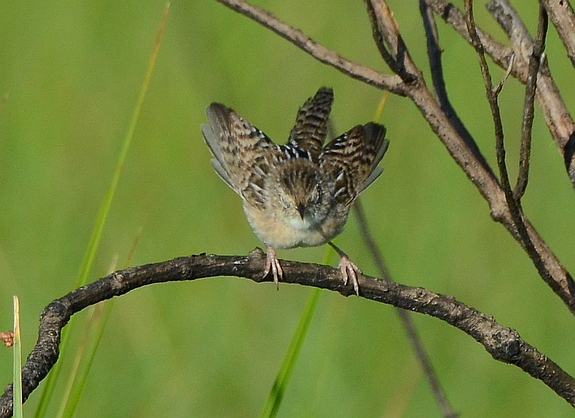
To this west coast birder, Sedge Wren is a really good bird. I've never seen one in California and maybe never will...haven't seen one in years anywhere, in fact. I was surprised to find that not only are they abundant in the UTC, they remain so all the way through April, even though they don't breed in the region.


Once I locked down their song in my head, it didn't take long to realize I was surrounded by Sedge Wrens almost everywhere I went. Bizarre...I did not know they were so abundant there.


Novel Sedge Wren pose. It's hard to believe that a number of species shaped like they shouldn't be flying more than ten feet at a time are actually accomplished migrants, i.e. Sedge Wrens, Yellow Rails. Impressive...most impressive.


My worst misidentification of the trip (I think) was of this fat black water snake...it was big and girthy and sunning itself at the edge of a pond. I thought it was a cottonmouth at first.


But look at that face. That blank, vapid, round-pupiled face. That is not a cottonmouth face.


The first thing some visitors will see at the refuge is a Cliff Swallow impaled on a spike (left bird) under the veranda where folks like to get lunch. Come on refuge, dick move.

This post is running long...more from Anahuac in the next post! And Bolivar Flats!

Tuesday, May 15, 2018

The Smith Oaks Rookery: Spectacle of Life, Specter of Death


Moving on to the other side of High Island...the other big sanctuary here is Smith Oaks. As a migrant trap, it is better than Boy Scout Woods for many species, but this post is about the awesome, enormous rookery on the east side of the sanctuary. Before visiting the rookery, I lacked a decent photo of a Roseate Spoonbill (how embarrassing)...I no longer have that problem.


The Smith Oaks rookery is sprawling, loud and stinky; a spectacle. I was really impressed with it. The spoonbill show is something else...just look at these things. Why are they the way that they are? We are fortunate to have the world's best spoonbill species here, all of the others are vanilla in comparison.

I think we were too early to see spoonbill chicks, which is too bad. Surely they must look absurd.


It could be sharper, but this crop pleases me to no end for some reason. Makes me think of dinosaurs.


Roseate Spoonbill-Common Gallinule combo. The UTC is a region rich in combos.


Spoonbills are the main attraction, but Great Egrets seemed to be the most abundant species and they are difficult to ignore.


I don't think I've had the chance to sit and watch Great Egret nests close up before....it all felt very National Geographic. Speaking of which...


There are hella alligators at the rookery. This fairly large one slipped into the water and started hunting as we watched.


After some time it reemerged, taking a very direct path towards something...


...which turned out to be a Great Egret chick that had fallen from its nest.


I believe this was the chick's final moment before it went to that great big nest in the sky.


The last crunch.


The gator dispatched the egret chick very quickly and was back in the water in short order. Damn! Was not expecting to watch something like that unfold, let alone capture it all on the crusher. For the egret chick, you might be thinking "life is pain", but if not the for merciful reptile it would have died the slow and brutal death of exposure and starvation. Next time you run across an alligator, thank it for its service.


A couple days later we saw probably the same gator come striding out of the colony with another egret chick, though this time we did not bear witness to the chick's demise. I bet the local alligators hardly eat for much of the year compared to when the rookery is active.


Neotropic Cormorants also breed in large numbers here. In trip bird news, we managed to see all of one Double-crested Cormorant for the whole trip, an immature at this rookery.


These Almost-Geri demanded that Dan stop taking spoonbill photos and take their picture instead. In time, they will expect even more from us Non-Geri. That is the way of things...the way of The Geri.


Though the rookery is incredibly distracting (rightly so), don't forget to keep looking for migrants next to the viewing platforms (tired migrants aren't necessarily put off by throngs of loud Geri and photogs) and along the main rookery path. This glowing Blackburnian Warbler was right next to the observation deck pictured above.

More migrants in the next post!