Showing posts with label red-necked phalarope. Show all posts

Sunday, January 5, 2020

Radius Roundup: Lessons and Results From a 5MR "Big Year", and The Shortest Big Day


A Ruby-crowned Kinglet unleashes a terrifying bellow into the chilly radius air. Photographed on the Guadalupe River Trail.

There has been an awakening.

Have you felt it?

eBird Top 100 listing rises, and Radius birding to meet it.

If you've checked in on BB&B a few times this year, you already know that I've put my full weight as one of birding's marquee influencers into propping up the FIVE MILE RADIUS. 5MR is now flourishing throughout the land, particularly in my state of California. But this year has been so much more than simply harvesting Flycatcher Jen's vision and going Johnny Appleseed with it all over the nerdscape...I've not only been talking the radial talk, I have spent this entire year walking the radial walk. Like several of you, I've taken part in Jen's 5MR Challenge, doing my own big year of sorts in my 5MR. More and more I find "big year" to be a cringeworthy phrase, but I guess it is what it is. I admittedly didn't go all out and missed my share of birds (more on that below), but I spent a shocking amount of time within five miles of my home this year while actually doing quite a bit of birding. To say it was nice would be a gross understatement...it was time well spent birding instead of sitting in the car, driving somewhere, burning gas, chasing things that some list may have "needed" but I did not actually need to see. Rather than feeling tied down by my radius, shifting my focus to what was really local felt almost luxurious at times.

How did I do? I finished 2019 with 187 species in eBird, with the only species not sanctioned by the Bird Police being European Goldfinch, which have been present in very low numbers in a part of my radius for a number of years but rightly are not considered established in the state by the CBRC. The goal I set for myself earlier in the year was 185 species, so I was surprisingly on point there. Many U.S. birders exceeded that total in their respective radii this year but I am still really happy with how I did. Lifetime (aka from spring of 2017 until present) my 5MR now stands at 196 species. I started the year with 169 species, and eagerly look forward to the 200 species milestone, which should be possible with spring migration coming this way sooner than I will be ready for.


While some spots I've recently started birding did not yield anything unexpected, I think it is only a matter of time before some of them bear radial fruit. Martial Cottle Park is one such place, and until that time its Poop Fairies Western Bluebirds will continue to remind dog walkers to pick up their shit.

Long story short, after a lot of work, strategy, staring at Google Earth and exploring, The Year of The 5MR has been Great Success. I'm very happy with how it went, and thought I'd share some final thoughts before easing off the radius gas pedal for a bit.

My radius is probably best described as moderately birded by other people. There is a small but dedicated and active group of birders who already do much of their birding within the confines of my radius, and there are a number of places that are productive enough to draw in birders from further afield. In terms of radius rarities I managed to see this year, I certainly benefited from the efforts of others (i.e. Horned Grebe, American Bittern, Swainson's Hawk, Red-naped and Yellow-bellied Sapsuckers, Summer Tanager), but I am very pleased with what I found myself (Long-billed Dowitcher, Glaucous Gull, Pileated Woodpecker, Eastern Kingbird, Red-eyed Vireo, Tennessee Warbler, Clay-colored Sparrows, Red Crossbill). I certainly did chase some birds but am happy to report that this was no run-of-the-mill year listing effort where I spent tons of time chasing species found by others, which was part of the idea baked into this thing in the first place.


While I did very, very little chasing outside my radius this year, I had no problem tracking down radius-rare stuff found by others. This Red-necked Phalarope found at the Los Capitancillos Ponds by Ann Verdi was without a doubt one of the Top 10 birds to be found within my radius this year, and possibly the most unexpected, even though they are fairly common migrants about 15 miles away.

I can't speak for Flycatcher Jen, but I always assumed 5 was chosen for the radius distance because it is a nice, round, modest number. For where I live, I am totally fine with it, 5 miles really does seem perfect. However, for other people I know that it isn't so appealing...obviously, people don't all live with the same diversity of habitats within 5 miles and, equally importantly, have comparable access to potential birding sites as everyone else. There's a lot of private property out there, a lot of public land that doesn't have real access, a lot of vast expanses of homogeneous habitat (i.e. sage, creosote flats, intensive ag, etc). In some places, a larger radius could be more appropriate than 5 miles, or *gasp* the whole radius thing isn't necessary. I would say that places not suited for 5MR are certainly the exception and not the rule though.

I touched on this already, but I found a great many locally uncommon and rare birds myself, including a number of species that are downright rare for the county. This is what I had hoped for but did not dare to actually expect, and is consistent with the experience of a lot of other 5MR birders this year. Rarities are out there waiting to be found, often in places where relatively few birders are searching. Tired of chasing stuff? Want to break from the pack and find your own birds more often? Your radius awaits.


I knew going in to 2019 that my radius is very, very tough for shorebirds, and results bore that out. However, I am now convinced that we actually could get numbers of shorebirds in the rare event that water levels at wetland sites actually become suitable. This flock of Western Sandpipers photographed from my backyard was, as far as I know, the one and only flock of peeps seen by anyone in my 5MR in 2019.

Another of the primary tenets of 5MR birding is to go check out sites you have never been before, places that are underbirded, or not birded at all. I'm happy to say I was able to do all that very frequently...in fact, on my last morning of birding of the year, 2 of the 3 sites I visited were places I'd never been to before 2019. eBird helped with this of course, not to mention just scrolling around satellite imagery in my radius and some local help too. It really is satisfying going to new places nearby and finding some that are worth repeat visits. Last month I walked up the "back side" of Santa Teresa County Park and snagged my first radius Prairie Falcon - I never would have tried this trail if it wasn't for 5MR....and I would not have seen the falcon if I was not doing the monthly challenge, which happened to be a stationary count!

Also, I have said this from the beginning, but 5MR is really perfect for birders with time constraints, such as when you have small children and can't afford to be gone all day without seeming like a Kenny Bostick. I knew radius birding was a match made in heaven with parenthood even before Annie was born, but this year really drove that point home. A number of other parents have echoed the same sentiment.


Birding a lot in my 5MR has really driven home the point that Cooper's Hawks have adapted quite well to suburban life. They are common here year round. Sharp-shinned Hawks, on the other hand, are very uncommon and nowhere reliable. This Cooper's was strutting around my back yard one day last summer.


For those of us who are interested in nonavian life, exploring your 5MR can be very beneficial as well. My non-bird highlight of the year (which was uncomfortably close to being a lowlight) was inadvertently walking up to a hunting mountain lion at Almaden Quicksilver County Park. I am still convinced it was waiting to ambush one of the many radius black-tailed deer in the area and would have ignored me had I not noticed it, but I still feel a bit lucky that I noticed it when I did and not when I was 7 or 8 feet away. Anyways, a sketchy but cool experience, happy to be able to see a lion up close and not have it be in a threatening mood.

What else? I bought less gas than I would have, burned less gas than I would have, potentially saved on some car maintenance, and only rarely found myself birding where more than a couple other birders were present at the same time. These are all very good things. And since I reached the 185 species plateau, I completed the bourbon challenge I issued to myself earlier this year. As a Champion Radius Birder, I bought myself a bottle of Black Skimmer Bourbon and WOW...if you are a whiskey fan do yourself a favor and pick some up if you are ever in a treat yoself mood. The Black Skimmer Rye is also very good, and is a few bucks cheaper.

Were there negatives to doing so much radius birding? Sure, birding in July and August (with one notable exception) was even slower than usual, and I didn't see a ton of Vague Runts this year...in fact, I did not even get a state bird...which stings, honestly. I love getting state birds. I would have chased the Yellow-browed Warbler but luckily a prior engagement prevented me from trying for it when I otherwise would have...which would have resulted in joining in a big fat group dip with 100+ other miserable birders from around the country. The shortage of Vague did make the rareish birds I saw in the radius that much better though. My backyard Eastern Kingbird will forever be one of my favorite self found Vague Runts, and I still reel over discovering a July Red-eyed Vireo, which is a bird I discovered without even driving.

And this should be obvious to everyone, but I would advise that you make sure to still bird out of your radius sometimes! Focusing solely on your 5MR is likely to make you crazy and make birding sound like a lackluster idea, which is really unnecessary. Don't foresake the places that you love! Birding your 5MR does not mean you are breaking some holy vow if you go bird outside of it.


Want to become the master of your domain? 5MR birding will get you extremely attuned to birdlife in your radius...not just status and distribution, but arrival and departure dates and breeding behavior or lack thereof. My radius Pied-billed Grebes had chicks very late this year at multiple locations - this fish exchange between an adult and a chick took place on November 9, which seemed strangely late in the year. Photographed at Los Gatos Creek County Park.


In November I listed my top 10 target birds for the remainder of the year; I managed to see 4 of them. My last new species of 2019 - this Golden-crowned Kinglet - was on the list. This fall/winter has been very good for many irruptive birds like this in the region, though the Varied Thrush invasion I was hoping for did not pan out. Photographed at Greystone Park.

And with that, here is everything that I know of that I missed that was seen in my radius this year. Most of these were just one or two records.

Tundra Swan (also a county bird)
Greater Scaup
Bonaparte's Gull
Solitary Sandpiper
Cassin's Kingbird
Purple Martin
Varied Thrush (damn you Justyn)
Pacific Wren
Hermit Warbler
Nashville Warbler
Blackpoll Warbler
Yellow-breasted Chat (also a county bird)
Swamp Sparrow
Evening Grosbeak

I'm sure there were some other species that could have been found on the fringes or passed through undetected, such as Northern Pygmy-Owl, Northern Saw-whet Owl, Ferruginous Hawk, Greater Roadrunner, Hammond's Flycatcher and Tricolored Blackbird. I'm very surprised that Snow Goose wasn't seen by anybody in the area this year. A Calliope Hummingbird was seen a stone's throw from my radius and was probably actually visible from inside at some point. But missing birds is a fundamental part of any kind of birding experience, no need to do a thorough autopsy on birds not seen.

In other radial news, on December 21 I met the monthly 5MR Challenge issued by her lordship Flycatcher Jen and did a BIG DAY in my radius. What better day to do a big day than the shortest one of the entire year?! It was not a max effort day as I did not go owling and I had done no scouting specifically for this, but I went pretty hard...no lunch break or anything like that. I started off by walking out my back gate and doing some of the ponds behind my house in the predawn light, which quickly netted me 46 species. After that, I was off like a shot.


You can't make out much in this photo but I think a lot of you recognize that silhouette. A Phainopepla has been wintering at Guadalupe Oak Grove Park for many years now and was readily findable on The Shortest Big Day. This is still the only one I've seen in the entire county; I assume the freakish flyover Phainopepla I had at my house once was this very bird.

I decided on 90 species as a goal...seemed reasonable, and was above the 86 species that was my previous day high back in 2017 for the 5MR challenge, which was done in the northwestern corner of Alameda County back when I lived in Albany. I could have gotten more on that fateful day, but I abruptly had to quit in the afternoon to go chase the Ross's Gull...one of the best decisions I've made in my whole life.

Instead of giving an agonizing blow by blow, I'll just skip to the end. Steller's Jay and Eurasian Collared-Doves were the biggest misses, and I easily could have picked up Wild Turkey and Band-tailed Pigeon had I gone up into the hills at all. I also probably could have found a Red-winged Blackbird if I stood in my backyard long enough at sunset. But otherwise I did very well, having less-than-ideal weather at only one spot and having much fortune with waterbirds and upland species in general.


I missed this bittern multiple times at the beginning of the year, but luckily it returned for another winter and I was able to connect with it a couple times late in 2019. One of those times was during my Solstice Big Day, which was heck of lucky considering it often isn't hanging out someplace visible.

I finished the day with a stunning (to me) 101 species! I couldn't be happier with that...considering the short day and lack of preparation, I think it is a sign of fruitful radius. It does make me wonder what time of year I could actually squeeze the biggest day out of my 5MR...is December/January as good as it gets? April? November? Maybe I'll attempt another one in 2020 and find out.

And so it goes. I'm going to give 5MR coverage a well-deserved rest for a while, as I've said my piece and don't plan on getting cray with year listing on any scale in 2020. That said, with the beginning of the new year I hope more birders give perpetual county year listing a break and give the radius a try! 

Tuesday, June 21, 2016

Train Wreck: The Siberian Express Derails in California


Spring is a loathsome time in California when it comes to rare shorebirds...compared to fall migration, they are very, very hard to come by. It is worthwhile to search for the very occasional Hudsonian Godwit or White-rumped Sandpiper, sure, but what about Sibes? It is a sad state of affairs.

Several years ago, while I was out in Texas, a freak Marsh Sandpiper was seen for a couple days in Solano County. A Marsh Sandpiper is a meguh. It's a species birders wistfully look at in their books and think "maybe I'll see one in Alaska some day", or, more commonly, "yeah, right". Being out of state saved me from some of the pain and stress I would have experienced if I was back at home and not seen it, and I just wrote the bird off as one of those things that I will just have to live with. Something to live with, and something to die with, in a nagging, unresolved way.

Earlier this year, the impossible happened...a Marsh Sandpiper was reported less than two hours from my house. In April! An hour later it had been confirmed, and I was on my way. After a short wait, the bird reappeared and provided great looks for the next hour and a half. This was not a life bird I was anticipating to get on this continent, but that is California birding for you.


The bird showed off its distinct white back wedge on a number of occasions. Though it never wandered very close to the birders, it was very cooperative. I couldn't believe my luck. I always thought I would see something like a Spotted Redshank (which is absurdly, painfully rare) in the state before a Marsh Sandpiper, yet here the bird was.


It had something like a Wilson's Phalarope X Lesser Yellowlegs structure. Luckily, I did not have to listen to any birders make the ludicrous suggestion that this is what the bird really was. Yeah, it's gotten to the point where I'd rather hear about blatant misidentifications rather than hybrid conspiracy theories.

This is one of the best birds, in terms of rarity, that I've seen in California over all these years. Considering I really like Sibes and I really like shorebirds, it's a tough one to top (though Common Scoter and Salvin's Albatross come to mind). It's not a flashy species, but damn it was a satisfying bird to see.


What is the deal with Red-necked Phalaropes? They are very pleasant birds. They are shorebirds, but they swim. You can see them way out at sea or far from the sea. They look fantastic in spring and not so bad in fall. Impressive credentials. Photographed at Don Edwards National Wildlife Refuge.


Red-necked Phalaropes are masters at picking edible crud off the surface of the water, and they make it look good.


Eared Grebes were also in abundance, all in slick black and gold alternate plumage. But Red-necked Phalarope and Eared Grebe were not the bird we were seeking. In a dramatic development, a Little Stint had been found here two days previous. That's right...another April vague runt shorebird...another April Sibe...another bird I had never seen in California, or any other place in my life. What were the chances? We trolled the side of a salty impoundment, back and forth, until finally another birder got all stinty.


Little Stint! Little Stint! Unlike the Marsh Sandpiper, which is unfathomably rare, this is a bird that I had been waiting a long time...a long time. They are pretty much annual in California, but I had never come across one, and my time on Buldir Island back in the day had yielded only (!) Red-necked and Long-toed. The bird foraged earnestly out in the impoundment with a group of Dunlin and Western Sandpipers...this may sound dumb, but I didn't expect it to be so...little. The bill was indeed slight with a fine tip, not at all what I would expect from a Semipalmated...but that seems like something that could be easily overlooked by just about anybody who didn't have spring stints on the brain.

The internet played a big role in developing the story of this rarity as well...Will Brooks, who found it, originally thought (as almost anyone would) that this was a Semipalmated Sandpiper, but the eBird reviewer (I believe it was Marshall Iliff) who looked at his photos thought Little Stint was a better fit. Word got out, and the following day photos were obtained showing that the bird lacked any webbing between its toes. The rest is birding history.


That's it on the left, being dwarfed by a Western Sandpiper. Even in the harsh light at a less than ideal distance, you could make out the rufous edging to the alternate tertials that had recently molted in. I couldn't believe my luck...three consecutive weeks in early spring had bore fruit in the form of Glossy Ibis, Marsh Sandpiper and Little Stint, a state bird and two lifers. This put a temporary end to whisky-fueled nights of screaming unintelligible obscenities and shaking my fist at the night sky.


I went back a couple times afterward to get better looks at the bird, to no avail. Instead, I got to see these avocets fuck. They sure make it look elegant. Pretty sure people look like trolls in comparison when they do the deed...actually, I am absolutely sure about this.


Even the dismount looked graceful.


Post-coital avocets are just the cutest thing. This is their version of spooning.


Even in the eye of a spring storm of Siberian meguhs, I can still stop and appreciate the rufous and chevrons of a Western Sandpiper. Ignoring Western Sandpipers isn't going to solve anything.


Of course, April birding in the bay area is not all hot-shit vague runts, hell, this might be the first and last time...but there are locally rare my grunts to look for. I live just a couple minutes from Emeryville, so one day after work I lurked over to the Emeryville Marina to check out a Gray Flycatcher that Aaron Maizlish had found.


Aaron was actually leaving when I pulled up, but was kind enough to go back and point the bird out to me. He's a BB&B reader, so naturally he is a good person. The Gray Flycatcher was a nice year bird and addition to my home county list, which I generally am not very excited about. Why that is, I couldn't tell you. Gray Flycatchers are always worth garnering some excitement for, though maybe its just because I don't see them on the regular.


Compared to Dusky vs. Hammond's Flycatchers, identifying Gray Flycatchers is a walk in the park. The bill alone is usually enough to clinch it for me. Grays are rare but regular along much of the California coast; they are much easier to find as my grunts in the desert or breeders (brie duhrs?) in or near patches of sage. If there was a Sage Flycatcher, I think this would be it, but since Gray Flycatcher is a spot-on description (albeit boring), I can live with that.

Wednesday, September 26, 2012

The Old Shorebirding Grounds


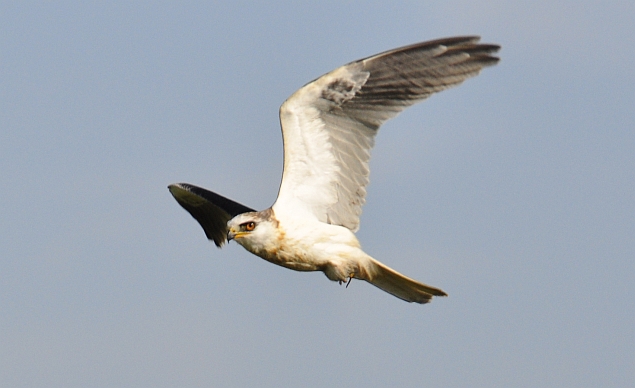
White-tailed Kite. This young bird had just plummeted to earth and crushed a small rodent. Todays shots are all from my old shorebirding grounds at Point Mugu, CA, where I was lucky to bird earlier this month. It had been a long time...the birds that saturate this area helped put me on the shining path to Number 7 when I was just an awkward teenager.


Here's a closer look. You can see a couple little feet and a tail sticking out. This is a young bird, easily told by the rusty "necklace" and nape, and limited black patch under the wing. I think the eyes are a bit duller too...most birds with red eyes don't get them until they are adults.


The Point Mugu area is one of the best places in southern California for shorebirds. Pectoral Sandpipers occur in good numbers here in fall. Good numbers is an understatement actually...there is a veritable shitload of Pectoral Sandpipers. It is amazing.


This is probably one of those species that I would not be so enamored with if I lived someplace where they were common...but since I don't, I am enamored.


Juvenile Western Sandpipers bring fall with them as they migrate south. You see, they carry autumn on their rusty shoulders. Falling leaves are for suckers.


Red-necked Phalarope with a high scumline. High scumlines are in this fall.


Being a seabird at heart, phalaropes always adhere to the Economy of Style in the fall.


This Red-necked Phalarope was too close for comfort. I was terrified that I would get sucked into the circular vortex it was spinning.


Lesser Yellowlegs are another locally common shorebird here. They are drawn to the grassy impoundments like The Great Ornithologist Felonious Jive is drawn to a bottle of bourbon.


This fork-tailed kingbird gave me pause, but I was able to make sure it was a juvenile Cassin's Kingbird before we parted ways (you can just make out the gape at the base of the bill in this photo). Seeing a kingbird with a tail like this on the west coast in fall will lead you to a Tropical Kingbird more often than not, but there are lots of other field marks to look out for.


Cooper's Hawk. With so many birds packed into the area, it is no wonder that a lot of raptors call the fields and marshes home as well. It is an area that birders fantasize about to no end...the potential for MEGAS is endless.


Here is the above White-tailed Kite as it stoops toward the vole it had been eyeing. I wish getting lunch could be this fun.

Sunday, September 16, 2012

The Wrong End of the Rarity Spectrum


Red-necked Phalarope. Hopefully I'll be drowning in their Red (yes, Communist) cousins on Saturday in Monterey Bay. Point Mugu, CA.

I write this after a long and mixed-bag kinda day out on Point Reyes. I did manage to get 2 year birds (Blackpoll Warbler and American Redstart), but was hoping for something more on the MEGA-CRIPPLER end of the spectrum. The fog was not conducive to that. Nine (9) warbler species was nice though, and I couldn't even find an Orange-crown.

You will be reading this the day after what will probably be my last pelagic trip of the year. Photos and stories of Epic Glory (or Tragic Woe) to come soon. See you next week!

My first (and last?!) Semipalmated Sandpiper of the year. Obviously, I haven't been as mobile in 2012 as previous years...that will all be changing soon. South end of the Salton Sea, CA. 


Here is an Osprey doing its best phalarope impression. I don't blame it, it was hot out. South end of the Salton Sea, CA.


Sunday, September 9, 2012

Modest Accolades and Low-Level Glory


Shorebirds have been barreling south through the continent for over 2 months now, but they won't be stopping anytime soon. This flock, mostly Western Sandpipers, was in Imperial Beach, CA.

Wow. A lot has been happening lately here. I just moved out of San Diego, sold my car and bought another one. This is important, because I am much more enthusiastic about taking birding trips when I am not afraid of my car seizing and dying on me. So some boring shit that definitely is not blogworthy went down, but rest assured Ive made sure to keep birding. Once I get to my migratory staging area in Oakland, CA, things will settle down and I can go back to my routine of seeing incredibly rare, good-looking birds.


Wilson's Phalaropes. They have switched gender roles. They swim in circles. They have a lot of different plumages. What's not to love? Imperial Beach, CA.


Here's a juvenile Red-necked Phalarope. This time of year, I think they are a lot more eye-catching than the adults, who are very gray and blotchy. Imperial Beach, CA.


Adult Reddish Egret. It got too close and I clipped its wing, sorry...it won't happen again. Imperial Beach, CA.


Cooper's Hawks are particularly common throughout the country this time of year...not only are they migrating en masse, but their populations are very high due to the all the young birds (like this one) present. Young raptors have very high mortality rates, most won't make it through the winter. Tijuana River Valley, CA.


This is not a bird you are likely to see in fall migration, at least not in California. If you do find one, expect skepticism...but if you pass the test of the Bird Police, there will be modest accolades and low-level glory. This Least Bell's Vireo was at the Dairy Mart Ponds in the Tijuana River Valley, CA.


Hutton's Vireo. Considering their repetitive 2-note song, and the fact that they look like a Ruby-crowned Kinglet on steroids, I think this is the most boring vireo. This may be a BB&B first though, so I've got to put it up...these birds are generally considered resident but they do show up at migrant traps. Dairy Mart Ponds.


House Wrens are common fall migrants in California lowlands. They don't sing much but they are still loud...it's a good time of year to learn their calls. Fort Rosecrans National Cemetery, San Diego, CA.


Common Yellowthroat. You know them, you probably don't love them, but you like them. You have definitely misidentified them for other things, if just for a few seconds. Strangely, a BB&B first. Tijuana River Valley, CA.

Friday, June 1, 2012

So Long And Thanks For All The Fish


A common dolphin gets the big air the kids love.

Happy June, and welcome to another astounding Friday edition of BB&B. Of course, this is the only place on the internet that heaps praise upon the American birdwatching community, yet dishes out the cold and merciless ridicule it rightfully deserves.

Here is the last installment from a pelagic off San Diego I went on a couple weeks ago. As you may have guessed, if I start out a blog post with frakking dolphins, it wasn't exactly a very good day for seabirds out there...the power-birders were bummed, and even the beginners got bored. Maybe I just need to go to Monterey Bay next time.


Several pods of dolphins attempted to cheer up the gloomy birders on the boat, with some success. Common dolphins lived up to their name; I think this is a Long-beaked.


Common dolphins can do it all...swim, fly (apparently), star in Douglas Adams novels, save people's lives or even kill them. Why there are not more dolphin-worshipping religions out there is strange to me. I think this one is a Short-beaked Common Dolphin, but I'm no expert.

Remember friends, whenever you buy tuna, you are supporting the only industry that still kills lots of dolphins. "Dolphin-safe" my ass. If you are a fish-eater, stick to Albacore...they do not suffer from greatly depleted stocks and are line-caught, which greatly reduces the potential for cetacean bycatch.

If you care, at all, how your diet may be affecting life at sea (most birders sadly don't), there are a lot of good educational resources out there...Monterey Bay Aquarium's Seafood Watch is a great place to start.


Pink-footed Shearwaters are one of the 3 seasonally-common shearwaters in California waters, the others being Sooty and Black-vented (SoCal only). A lot of the shearwaters offshore now are in heavy molt and aren't exactly sharp-looking.


Pink-footed Shearwaters are aptly named.


Black Storm-Petrels are easy to find off San Diego. The word "languid" was invented when someone first observed a Black Storm-Petrel in flight. "Languid" is currently used more to describe the flight style of Black Storm-Petrels than anywhere else in the English language.


Least Terns were not something we expected to see 30 miles offshore, but there were more than just these two out there. I had no idea they foraged this far offshore, but am not completely surprised...their wintering grounds are still a mystery, and are thought to be somewhere far from sight of land.


This bird is interesting. This was one of a handful of Common Terns that flew by at one point...curiously, this bird seems to have an entirely gray upperwing, which is not the norm for the species...I attribute that to the season and the atrocious lighting. If anyone really knows their Common Tern wing patterns, feel free to drop some knowledge...I don't think the bird is a Forster's, and blowing up and lightening the photo shows it is clearly not an Arctic just by looking at the bill alone.


Xantus' Murrelet with its Xantus' Murreletlet.


Hella good parenting right here.


Red-necked Phalaropes are some of the smallest birds that make a living on the ocean; like storm-petrels, their (pelagic) diet is restricted to the crud that is at the very surface. Mmmmm, delicious surface crud...


A sad picture of the one Sabine's Gull of the day. Still working on getting a passable photo of one of these sharp birds...this is a species I definitely wish I could see more of.


Risso's Dolphins! I haven't seen one in many years. They are easily identified at a distance by all their scars. Stoked.