Showing posts with label Marsh Wren. Show all posts

Monday, August 28, 2017

The Serpentine Sparrow, The Frog of The Falls


At the end of March, Billy and I were growing bolder about where we would take Annabelle, as she was a couple of months old and seemed like a fairly robust little creature, at least compared to her ultra-larval state that she was in back in January. We decided to go for a hike out on the Pine Mountain Fire Road in Marin, where I could potentially get a precious Marin county bird and there was a good chance we would see some decent wildflowers. A few Band-tailed Pigeons crossed over the ridge and into another drainage when we arrived.


Look at this sick habitat shot...BB&B is "not just a bird blog", eh? EH? Sound familiar to anyone? Anyhow, it didn't take long to figure out we were in a serpentine zone, as evidenced by the soil color and interesting plant community that made up this large, impressive swath of chaparral. A Black-chinned Sparrow was found out here after I moved south to San Jose, can't say I was surprised.


I reckon this is Bolinas ceanothus (Ceanothus masonii), which is a serpentine-loving Marin endemic. It was blooming all over the place that morning.


Less endemic but more familiar, a handful of red larkspur (Delphinium nudicaule) was in bloom down near Carson Falls.


Rufous-crowned Sparrow was the main draw for me that morning. We managed to find one pair, but oddly they weren't in any of the huge chaparral patches. They were frolicking in a grassland just downslope from a modestly sized patch of chaparral.
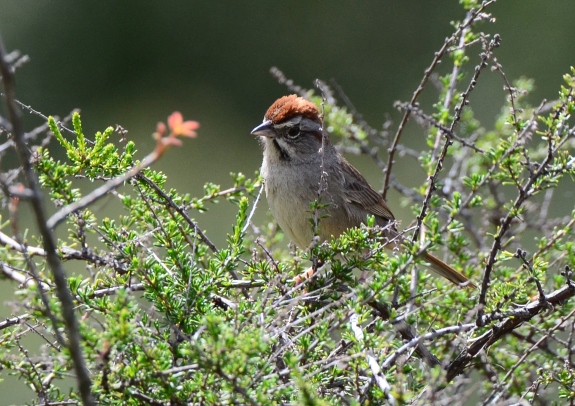

Rufous-crowned Sparrow is very uncommon in Marin, so it was great to check out a new zone and snag a desirable county bird at the same time.


We unwittingly found another highly local being, this one even rarer (but perhaps more dependable) than the sparrow. Carson Falls still hosts foothill yellow-legged frogs, which have been extirpated almost everywhere else in the county.


These stream-loving/pond-hating frogs love a good current and some good basking sites nearby. COUNTY FROG!!!!!!
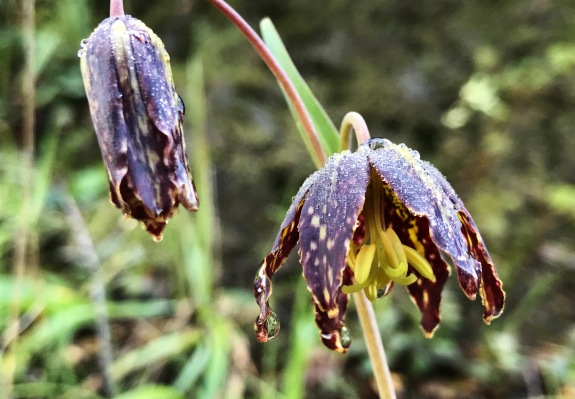

This was the best flower of the day, checker lily (Fritillaria affinis), looking all dewy and soothing.


Little crippler!


My bastard girls with some nice yellow-legged frog habitat. There's so much good stuff in Marin, it was great to be so close for a few months. Now I am in the process of discovering the good things Santa Clara has to offer. There's no Point Reyes...or ocean...but the shorebirding is great. If only there were some sod farms...


On another day in March I was back at the Las Gallinas Ponds. Cinnamon Teal were still looking as Cinnamon Teal should back then. All the ducks are currently recovering from eclipse plumage now, and don't look like a whole lot.


What a strange body type you have Common Merganser.


This is a long bird. Beware.


A Bewick's Wren offered itself up for a solid crush, which I was obliged to partake in. I'm sure I've mentioned it before, but I can't help but mention it again...Bewick's Wrens are so abundant and adaptable in California, it's strange to think that their eastern populations have fared so poorly in comparison. Is competition with other species (other wrens?) to blame?


Bewick's Wrens have little to fear from Marsh Wrens. By this time Marsh Wrens were belting it out in full force, beckoning the Least Bitterns (local legends) to return. It only works when you do the splits though, which this bird knows. I did snag one of the bitterns for my YOHOMBSLBFTINFOLF eventually, though it was heard only.


Pied-billed Grebe is one of those birds I see constantly but photograph rarely. This extra-fluffy one was too good to pass up.


No wings. Only fluff.


Adults in alternate have a solid black throat, which I admittedly forget about sometimes since I don't spend a lot of time looking at Pied-billed Grebes, despite all the opportunities I have to do so. How would you describe the voice of a PBGR? Jon Dunn (via the Natty Geo field guide) says they deliver "a loud series of gulping noises". Pretty good, they are certainly loud, though American Bittern is considerably gulpier. I would go with loud and hollow "coos" and "cowps", and a series of nasal, rapidly uttered "hey-hey-hey-hey-hey-hey-hey-hey" delivered in the same pitch. Ugh, I can't imagine having to describe a field guide's worth of bird vocalizations.

Monday, April 17, 2017

Las Gallinas - Zono Zone, Let The Kinglet In, The One You Least Suspect (LISP)


Sorry for the lack of output lately buddies. Unsurprisingly, it becomes harder to blog when you are hanging out with a baby all the time. I've gotten plenty of good birding in this winter/spring though, so I have no shortage of material to work with...shit, I even have flowers.  But before I could even blog it, the Quasi-Perpetual Weekend (QPW) has come grinding to a halt...it's back to work for me. I've been off since my daughter was born in January, so this is going to be weird.

One of the things I've been able to take advantage of during the QPW was my proximity to Marin. Among northern California birders, few counties hold the appeal that Marin does. While I've lived in a number of places in the bay over the last ten years, I've never managed to live in Marin, which is widely considered the best birding county. That said, my current home in Albany is just a quick 15 minute drive over the Richmond Bridge to the Promised Land. I've spent a great deal of time birding in Marin since last fall, which has paid no end of dividends in terms of rarities and quality outings.

The Las Gallinas Ponds is a default birding location on the Marin bayside...you can rack up over 60 species pretty easily for much of the year, it has rarity potential, and a lot of the birds are highly crushable. Indeed, if you enjoy running into photogs who can't identify the birds they are shooting (who doesn't?!), then spend some time here!

Marsh Wrens are extremely common here (not unusual), but there are so many of them that you are bound to get good looks at a couple (unusual).


Common Gallinules are a highly local species in the bay area, and there is no better place to see them than at Las Gallinas. They are totally fearless here, even more so than the coots. Close observations of gallinules will lead you to conclude they are more interesting than coots in almost every possible way, except their feet are not as cool. Coot feet are hard to top. I'm not sure why gallinule feet are so simple in comparison, considering their niches and behavior overlap so much.


Did someone say "common"? Oh good, now I have a reason to post a White-crowned Sparrow. We have them year-round here, but they still are very much a scourge of winter.


Your friend and mine, the Great Egret.

This photo begs a question...without googling, does anyone know what bird species has the longest neck? Either in proportion to its body, or actual length? This seems like important trivia to know.


Don't worry locals, I managed to slip in one rarity in this post. After a substantial time spent dipping on this bird, eventually I connected with the Harris's Sparrow at Las Gallinas. Though not a MEGUH by any means, this is a solid rarity in California, and since I didn't see any last year it made for a fine yankee bravo, as well as a Marin County bird. Unfortunately it disappeared after about 30 seconds, and I was left wallowing around in more common birds...


Golden-crowned Sparrows are abundant and often very confiding...too bad most of them don't look very impressive until April or so. But what they lack in aesthetic appeal, they make up for in humble plumpness.

Wow, did I just throw up pics of three Zonotrichia? Perhaps it is time to brush up on these horsemen of the apocalypse.


Unlike Zono sparrows, Cooper's Hawk is not a bird I encounter up close very often. Practically everything at Las Gallinas is begging for merciless crushing.


I am not above posting the occasional House Finch photo...and by occasional, I mean this is the third one BB&B has ever posted since 2008. It was time. Come on, I know you are programmed to not even look at it, but it's a pretty bird, admit it. It looks good with that lichen...this is something you and I have to accept. Hey, if you are ever going to find that vagrant rosefinch, you're going to have to look closely at some House Finches.


Now that we got that out of the way, we can let this Ruby-crowned Kinglet into the empty cavities of our hearts. Don't be afraid...just let it in.


This is, without doubt, the best Ruby-crowned Kinglet photo I have ever taken. This is not a boast (that would be embarrassing), just simple fact. I dig how yellow the tail looks on this individual, that's not something I notice in the field very often.


Lincoln's Sparrows often fit the descriptions of murderers that you hear about on local news stations...they are quiet, nice, keep to themselves. Wouldn't harm a fly...or so you would think. No one would ever suspect them of breaking the law at all, let alone capable of killing nine people.


This is definitely a species pulling stakes right now; I've probably seen my last of the spring already. I've mentioned here before how they never sing at wintering/stopover sites in California. Do they just fail horribly the first few times they sing each year? They are probably spot-on, but I like the idea of them having to sing out the rust.


A few minutes away from Las Gallinas is the Marin Civic Center. There's a big, weird artificial pond there which attracts some gulls and ducks and has pulled in a couple interesting birds in the past. I recently discovered that it has tame Common Mergansers, which is heck of novel to me.


I've never seen them so close before. That is probably an odd notion to some of you, but now you know you can become #7 without ever getting close to Common Mergansers. As you definitely can tell, they were looking for delicious bread handouts (that's why they evolved serrated bills, obvi), but they are pretty striking birds regardless of the lowly intentions of these individuals.

Ok, I think I used up all my blog stamina. I've got to save energy for the next post, as that will deal with something I've been needing to tell you about for a long time....a long time.


Sunday, March 8, 2015

Winter Hangs On In The East Bay


Mmmmmm....Nelson's Sparrow.  Show me your orange face.  Show it to me at high tide.  Does anyone else think of Nelson Muntz whenever they hear the name of this bird?

Much of the Birdosphere is already talking about spring, and the eastern half of the U.S. is dying for spring, but here at BB&B we are desperately clinging to winter, if only because that is the season we associate with desperately needed rain and snow.  Listservs are being flooded with grave news of birds pairing up and flirting with each other, but that is not a dialogue that BB&B will be joining...not yet.  Foxtrot Oscar Sierra and Foxtrot Oscar Yankee are not phrases that abound, at least not for another couple weeks.  Winter birds are still here, after all, and aside from a swallow here and an Allen's Hummingbird there, the local avifanua remains distinctly winter-flavored.  Well, let's start things off with a rare bird and take it from there.


Nelson's Sparrows winter in California in low numbers (very low numbers), and after trying many times over the last few years to see our local bird or two at Arrowhead Marsh, I finally succeeded.  Although secretive (as expected), the bird was pretty confiding, giving some of the best looks I've ever had.


I had to manually focus for this shot, and bump up the ISO a bit.  Not bad, eh?  If I had a county nemesis bird, this would be the one, so getting such good looks was supremely satisfying. Good luck to you Nelson, on your way back to Saskatchewan or wherever it is you are about to be going.


Like Nelson's Sparrows, Marsh Wrens hate when you look at them, especially if you are nearby with the sun to your back, so it's always nice when they pop out in the open and even better when they sit for a portrait.  Unlike Nelson's Sparrows, Marsh Wrens have yet to be split, although some feel that that would be appropriate.  Photographed at Arrowhead Marsh.


For years I have known that Lake Merritt's outlet, the channel that connects it with the bay, was a good place to see Barrow's Goldeneyes up close, but I had always settled with seeing them occasionally on the lake itself, often at great and uninspiring distances.  I finally decided to check out the channel and was rewarded with this female Barrow's, my Foxtrot Oscar Sierra and Lima Oscar Sierra, which provided some of the best looks I've had of the species.


Interesting pattern on the bill...I'm not sure how much of that darkness is actual pigment and how much is accumulated gunk.  It's possible she is a young bird, retaining some of the mandibular darkness of a juvenile, but I don't think there is a way to conclusively know.


Perhaps you, the discerning birder, were concerned about the first two photos of the Barrow's Goldeneye.  Perhaps you liked the yellow bill, but not the head shape.  This is where your concerns can be laid to rest.  This is where you can tuck them into bed and say goodnight, and sing them the last lullaby they will ever hear.  Birds can change their head shape....it is known. Diving ducks often flatten their crowns when actively feeding...now you know.


It would have been preferable to have the hen Barrow's next to a hen Common, but drakes are better looking so I'm not complaining.


A female Common Goldeneye shows off the classic head shape and bill pattern one would expect of the species, although I wasn't expecting to see her on such a towering perch. Interesting approach.


Greater Scaup are the bane of molluscs, and they take their mollusc-bane very seriously. Photographed at Lake Merritt's outflow.


I wish my digestive system would allow me to just choke down entire shellfish...but if I could do that I might be a type of scaup, which is an odd thing to consider.


Big plumes are sprouting from the backs of egrets everywhere.  Great Egrets are ubiquitous in wetlands around the bay, and despite their abundance they will not be ignored.   I think it's fascinating that birds with such large ranges can be incredibly variable or, to our eye, very homogeneous...for example, there are 13 recognized subspecies of Marsh Wrens in North America, but just 1 subspecies of Great Egret that we know of.  Perhaps if they had more variety in their color palate there would be noticeable geographic variation, but then again maybe not.  Photographed at the Lake Merritt outflow.


Is Willet the new phalarope?  A Peregrine Falcon in the area was keeping the shorebirds from their preferred roosting destination, and out of frustration this Willet flock simply landed on the open water. Photographed at Arrowhead Marsh.


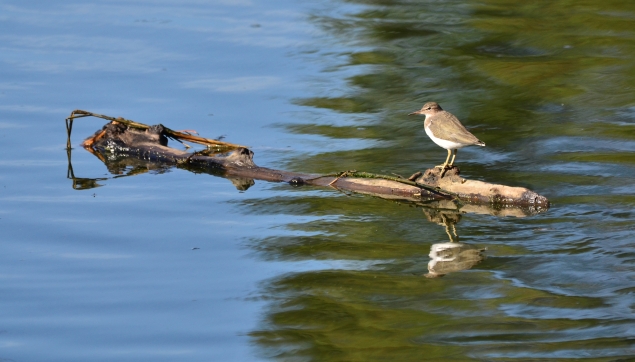
Did that unconvential Willet flock get you worked up?  Relax with this bucolic Spotted Sandpiper. Photographed at Lake Merritt's outflow.


You all know Hank, the world's most famous American White Pelican that lives at Lake Merritt.  I prefer to photograph Hank's wild, free-flying buddies when they are around (Hank is a cripple and was brought here from Oregon, where she collided with powerlines), but Hank just looks so damn sexy this time of year I had to crush her face.  And yes, as far as anyone can tell Hank is a girl, she was presumably named before anyone saw her next to any other pelicans (males are noticeably larger, though there is overlap).


This is my favorite photo I have of her, without a doubt.


In case you were thinking about being in a good mood today, here is a lynched cormorant for you to look at. What a shitty way to die...life is pain. Photographed at Lake Merritt.