Showing posts with label Vermilion Flycatcher. Show all posts

Thursday, January 24, 2019

Belize! Part I: Arriving at Crooked Tree


Belize is in the books and BB&B is back! I was rewarded with a very pleasing number of lifers, a lot of species I've only seen once or twice before (or heard only), and soaked in the much needed return to the Neotropics. Aside from the potholed condition of a number of the roads, getting around Belize, and birding it, was "relaxed and easy", as some of the tour companies like to name certain tours...which makes me wonder if MAX REBO BIRDING TOURS is still going to pursue the "relentless and stressful" or "bossy and tense" branding schemes they were cooking up? Anyways, I was often birding too hard to be relaxed, and the tension of being surrounded by potential lifers was constantly in the air.

If there was anything to bitch about, it was my new camera body having a major malfunction and being reduced to a paperweight for most of the trip (and no, it did not occur to me bring a spare)...but I'll try to keep my whinging on that topic to a minimum...for now anyways, it arrives at the Nikon shop today...and fortunately had no problems with it while in Crooked Tree, which offers photo ops galore.

The first destination, back on January 5, was Crooked Tree Village, where we stayed at Bird's Eye View Lodge (BEV) for three nights. BEV is right on the edge of Crooked Tree Lagoon and runs guided boat tours (geared heavily toward birders) from directly behind the hotel, as well as a number of other birding tours, and is situated with very good birding within walking distance. When the lagoon begins drying out and getting low, it is possible to walk out of your room and see thousands of waterbirds feeding in the lagoon, but we were too early for that spectacle. BEV is very popular with birders; the Crooked Tree Lodge on the other side of the village also gets a lot of visiting nerds. In addition to all the birding ops, BEV offers three meals a day, has a fridge full of beer you can help yourself to (honor system), and can also whip up cocktails if needed. The air conditioning is nice, and considering that many of the good birding lodges in Belize are either not on the cheap side or are the polar opposite of cheap, the price is right!


Crooked Tree Village is comprised of a mosaic of habitats, with a lot of wetlands (obvi), open areas and edge. Vermilion Flycatchers are absurdly abundant and pretty tame around BEV; this male was having a protracted faceoff with another one a few feet away.

Since you can do a lot of birding without a car at Crooked Tree, we actually had someone from BEV pick us up from the airport instead of getting a rental right away...HOW LUXURIOUS. Made me feel all geri! Rudy, our driver, is also a birding guide, and he pulled over for a random Jabiru (!!!) he spotted foraging near the highway, the first lifer of the trip. This was one of my top target birds and I was obviously stoked to finally see this enormous, stunning monument to charismatic avian megafauna. Jabiru is actually pretty difficult to find in early January (Crooked Tree is famously reliable for them later in winter/spring)...it would have been an incredibly stinging thing to dip on, so seeing one on the drive from the airport was a hell of a way to start the trip.

The next morning at dawn, I followed a strange call north to the Limpkin Trail, which turned out to be another lifer...why hello RUFOUS-BREASTED SPINETAIL it is nice to meet you!!! This ended up being the only one I would see, though their quick and concise three note call is unmistakable (sounds like "i LOVE you" or "i HATE you"...or perhaps "i'll KILL you") and I heard many more during the trip.


Social Flycatcher is, of course, very common in Belize, but were not quite as abundant as I have seen them in parts of Mexico and Costa Rica.

Other lifers I picked up early on were Tropical Pewee (somewhat overdue...or maybe hella overdue?) and Black-collared Hawk, which I found while scoping the opposite shore of the lagoon during a rainy lunch at the lodge. This is a definitely good place to bust out a scope!

Right, I'll have a couple more Crooked Tree posts coming up, so will use this post to throw up some more of the landbirds found while walking around.


How about more flycatchers? Yucatan Flycatcher was on the target list, but I ended up with a resounding dip on that one - Crooked Tree was the only place we visited where they were somewhat expected. We did have lots of Dusky-capped Flycatchers though (which presumably are constantly misidentifed as Yucatan Flycatchers), including this very confiding bird.


Mangrove Swallows were abundant at Crooked Tree and were extremely approachable. Their white rumps are obvious in flight but perched they look very much like Tree Swallows with little white supraloral stripes.


The Tropical Mockingbirds were abundant and approachable too...I'm beginning to sense a pattern here.


Several warbler species that we often strive to see well in the U.S. take on very different personas in Belize...I guess everyone relaxes when they get to Belize. The American Redstarts at BEV were helping to fill the niche typically reserved for House Sparrows, which seem to be absent from most of the country. 
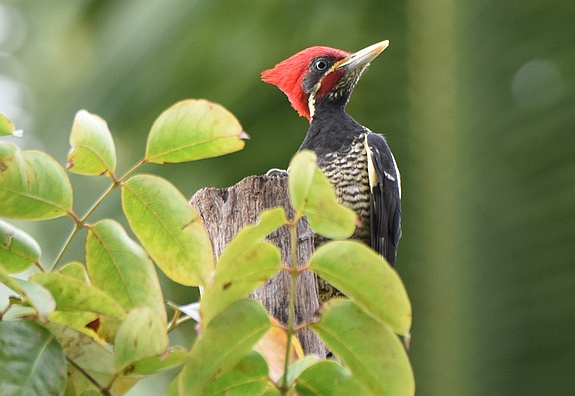

To change things up, Lineated Woodpeckers were neither abundant or extremely confiding, though I fortunately saw them on the reg. Lineated is in the same genus as Pileated, as you could probably guess.


You are probably wondering about the GERI BIRDING...well, the lodge did offer geri birding, but apparently were not yet putting out the fruit feeders they have done in the past (it wasn't high season for birders yet). They did have a cluster of hummingbird feeders which attracted a number of Baltimore and Black-cowled Orioles, the inevitable Rufous-tailed Hummingbirds, and this Green-breasted Mango. I also saw mangos (mangoes???) on the entrance road.
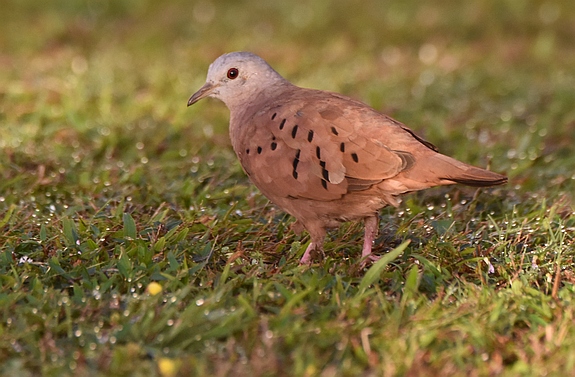

Ruddy Ground-Doves seem to be one of the commonest and most widespread birds in Belize...I have no problem with that.


Late one afternoon I took a walk on the Woodcreeper Trail, just south of BEV. Not much in the woods besides mosquitoes and a handful of frustrating calls I didn't know, but when I got back to the trailhead I ran into an excellent mixed flock. In the fading light a couple of Rufous-browed Peppershrikes came out for great looks, the only ones I would end up laying eyes on for the trip.

For the Woodcreeper Trail, I should say that it is very intriguing habitat (taller, more intact forest than what is nearby) but I was never able to get in there in the mornings, which is probably a good idea. I felt that Gray-throated Chat could be a possibility on the trail and that patch of forest had a lot of potential. The big trees near the entrance of the trail and in the campground also were pretty birdy and worth looking over. Other nearby walks a birder would be into from BEV include the entrance road and the previously mentioned Limpkin Trail, which will take you all the way back to the lagoon causeway if it isn't flooded. If you want to go for a longer walk, you can go west to the pine savanna for a whole other suite of species, but more on that later.

I'm sure that when the lagoon is lower you can walk the shorelines for quite a ways as well (thus getting to bird the wooded edge as well as the lagoon), though that seems like a chiggery prospect if much grass has grown in.


The cloudwatching on the lagoon was often excellent in the afternoons.


One of the hallmarks of Neotropical birding are the combos. This is the first Solitary Sandpiper-pig combo I have ever experienced.


And I will leave you with this...balls. Straight up pig balls. How does that grab ya?

Much more Belize coverage to come! And no more huge pig balls, I promise.

Wednesday, March 21, 2018

The Rancho, Rarities, Radii and Rebo

Christ on a cross! Should I just quit while I'm ahead? Put BB&B to sleep forever? The 5MR post has quickly shot up to the third most popular post we've ever had...and in case you've forgotten, that is ten years of blogging, close to 1,000 posts! What have I been doing with my life?! The only more popular posts are LIFE IS PAIN (thanks to Reddit) and RISE OF THE STORM WIGEON (thanks to birders and hunters).

Well, I'm not sure how to follow that up, so I suppose I can just cover some recent birding, which I've practically stopped doing somehow...blogging about it, that is.

March vagues. Well, somehow suddenly spring is here. It's been a real slow winter for yours truly as far as vague runts go, but the previous winter featured a Ross's Gull, so I can live with that. While great for wildflowers and so-so for spring migrants, this month is a mediocre (and I'm being generous with that adjective) time in the state for seeing chronic rarities. There have been a handful of notable exceptions in the state recently though...but I'm sure as shit not going to chase the goddamn Gyrfalcon again, which was well photographed this month and is quite possibly still here. As usual, Humboldt/Del Norte sucked in another winter MEGA in the form of a Black-tailed Gull, which (this year) is too far for me to see. A more-or-less-confirmed Steller's Eider has been seen by several observers in Humboldt County, which would fulfill a prophecy made by a certain visionary birder back in November. I would be exceptionally gripped off if other birders were having much luck refinding it, but high surf, bad weather and a lack of an elevated viewpoint is preventing that from happening...but I could really use seeing a megaeider right about now.

Closer to home instead of Nome, I dipped on a Slaty-backed Gull over the weekend here in Santa Clara County, which is very typical for me and that species - in general, February and March seems like a great time to find them in the state though. It's only the second in the county, but with all the gulls that winter here and the relatively few observers around who could identify one, I suspect they are here with some regularity. The bizarre, long-staying Garganey may have finally left its duck pond (mostly a Mallard pond) down south, as it has not been seen for a week.


Inexplicably, this year has been heavy on Bald Eagles for me so far, despite putting in no effort to see them (very nice, I like) - I've seen three from my yard alone! This one was next to my house at the Los Capitancillos Ponds.


This Anna's Hummingbird had the brilliant idea of building a nest right next to my hummingbird feeders...talk about convenience! She was able to incubate eggs while protecting her feeders at the same time. I suspect the chicks got eaten though :/

Rancho de Bastardos. The yard birding is pleasant as usual, but it has been a long time since a new bird has been added to the yard list. The most recent highlight was a California Towhee with a white head that bounded through the yard. The yard list sits at 120 species (newest addition was Red-breasted Merganser in January), with 87 recorded so far this year...that is tied for #1 in all of California, by the way. With spring migration in effect, I'm hoping it won't be long before we get something new...Orange-crowned Warbler, Bullock's Oriole, Allen's or Rufous Hummingbird would be nice.


March is a good time for scouring your 5MR. This White-tailed Kite was along the Los Alamitos Creek Trail, a part of my radius that I plan on giving more attention to this year.

The 5MR. What's funny (in a sad way) is that I've seen and heard about a ton of other 5MRs in the last week or so as this thing has blown up, and it turns out mine is one of the worst of them all in terms of potential for species diversity and rarities. No matter, I will keep on toiling! Incredibly, my last new 5MR bird (Rufous Hummingbird) was also a county bird....fuck yeah.

Winter rarities. As I said earlier, I've given up on catching the blog up on all the birding I've done...but it's not like it's been a completely dull winter, despite the lack of lifers and state birds. Here's some of the rarities I've met up with from the past few months.


I was hoping that this Barrow's Goldeneye (surrounded by Commons) would return to Shoreline Lake this winter, and the dude obliged. Nice county bird, and typically a species I only see a handful of times each year anyways.


After seeing the goldeneye, I bumped into this "Common" Teal in Charleston Slough, which I had totally forgotten was present. Sweet. We Nearcticans think of them as just another subspecies (or two, can't forget nimia), but the IOC treats them as a separate species. Will the AOS ever be persuaded to embrace this vision of distinct tealness?


Vesper Sparrows are really hard to come by in the bay area; they just don't venture to the coast very often. This obliging and confiding stub-tailed bastard at La Honda Creek Open Space Preserve (San Mateo County) was the first I've seen locally.


I went to San Luis National Wildlife Refuge for the first time this winter; it was mellow, not as birdy as Merced, but this Swamp Sparrow at a random part of the auto tour route was a nice find. It is only the 8th eBirded record for Merced County, though I'm sure with the amount of good habitat out there they occur on the reg.


This Vermilion Flycatcher wintering in Coyote Valley is the first Santa Clara County record, and was a great way to kick off local birding in 2017. This species has become considerably more regular in much of the state since when I started birding in the mid-90's, even factoring in the increase in observers.

And just like that, winter is singing its swan song and spring will be in full effect before you can say "five mile radius". I look forward to the year birds....and county birds! I didn't get out a ton in Santa Clara last spring, for reasons too boring to state here, but this year is different.

Of course, spring birding is really going to be kicked up a notch when I get out to Texas to lead a trip for MAX REBO BIRDING TOURS (no one finds Ortolans like Ortolans!), where every day will cough up all manner of avian rewards. I will be gagging on neotropical migrants. It will be truly gluttonous birding, even with slow days at the migrant traps. And while I mention it, a space just opened up on the trip...don't miss this opportunity!

Contact MAX REBO BIRDING TOURS for details.

Thursday, May 25, 2017

The Emperor Does Not Share Your Optimistic Appraisal Of The Situation


Fuck, Vader sure had some good lines didn't he? That was from one of my favorites scenes in Return of the Jedi. I guess he can credit The Dark Side for imbuing him with a dry sense of humor, which he clearly lacked as Anakin Skywalker. Anakin was a tool.

Over the winter I read a listserv message about an Aleutian Cackling Goose being seen at a coastal golf course. This news, neither unusual nor unexpected, was not exactly on par with learning that Emperor Palpatine was going to come for a visit to potentially force-murder you for your underwhelming project management skills. In other words, I thought "cool story, bro" and moved on.

The next day a very apologetic birder wrote back to the list, saying what he had meant to say was that it was an EMPEROR GOOSE, and that he had a massive brain-shart due to sleep deprivation and wrote the wrong species in his email. Emperor Goose is an Aleutian goose, after all. As expected, the chase wagons were subsequently fired up and the bird was relocated immediately, and following this success the original observer was celebrated instead of crucified.


The Emperor's arrival coincided with the birth of my daughter, but eventually I was able to make it out to the coast to pay my respects. The bird was a lovely adult, no sign of any dark smudging on the immaculate white head. It wasn't in great light, but birders are not allowed to have any complaints when they see an Emperor Goose.


The Emperor kept the local nonnative Canadas for company, which were not impressed by their new, totally superior member of their flock. You can't really blame them...almost any bird looks like shit when it has to stand next to an Emperor Goose.

This was the southernmost Emperor I have ever seen, and the southernmost to show up in California in a long time...a long time. Talk about a quality year bird. Sharp Park, Pacifica, CA.


On the way back I made a detour to a place with nice lawns and a shitload of dead bodies...it had been far too long since I had birded a cemetery. Who doesn't like birding cemeteries??? Anyways, a Vermilion Flycatcher was wintering there and it did not take long to find. While Vermilions are becoming increasingly common in southern California (a very good thing), they are still powerful rarities this far north. "Only Sleeping" indeed...Cypress Lawn Cemetery, Colma, CA.


Roosting American Avocet flocks have a mellowing effect on the soul when viewed at close range. Serenity now. Albany Mudflats, Albany, CA.


Regular Northern Pintail crushings are healthy, especially when you can catch the purple iridescence on their heads. We are balls deep in molting Mallard season now, but soon they'll be back, and in greater numbers. Albany Mudflats, Albany, CA.


California is blessed with huge numbers of Bushtits. They are practically everywhere. If you look at an ebird abundance/distribution map, the state is almost black with Bushtit. They make chickadees look like unadaptive niche-specialists in comparison. Luckily for birders, Bushtits are great. We may complain about Yellow-rumped Warblers, but no one talks shit on Bushtits. Albany Bulb, Albany, CA.


An interesting thing about Bushtits is their lack of repertoire that the human ear can pick out. It sounds as if they have a contact call and an alarm call, nothing more. They don't really have a typical song per se, but they are quite noisey birds.


Look at this diminutive little bastard. I have crushed Least Sandpipers a great many times, and I will continue to do so indefinitely. Maybe one day it will lead me to a Long-toed Stint, which I nominate for "most overlooked Sibe in the U.S.". The Lower 48 is long overdue for another LTST...will this be the year? Richmond Marina, Richmond, CA.


Greater Scaup coming in for a landing, with a bonus Red-throated Loon lurking in the background. Richmond Marina, Richmond, CA.


Such majesty, such scootsmanship, as some would say. Anthropomorphizing is a bitch, but it's hard to accept that waterfowl may not enjoy landing on water. They get to brake, skate and scoot to a stop. Then they shake their tails, and let out some kind of quack/honk/whistle, looking all cute and shit. Come on waterfowl, tone it down.


Perhaps this is where I should have said, "They'll soon be back, and in greater numbers." Eh? EH? GET IT????


Don't worry, I wasn't going to start this post with a crippling rarity then drive it into the ground with abundant brown birds, we can talk about this Peregrine Falcon instead. This very smart-looking bird was at the mouth of Pilarcitos Creek, in Half Moon Bay, CA.


I've seen a lot of Peregrines over the years. The only ones I've seen really closely were either really sick or were trying to behead me because I was too close to a nest. This one was neither. It was mellow. However, due to the location, I had to wonder if this was one of the Ross's Gull murderers. The scene of the crime was about 4 miles away, but this could have been a different bird.


The bird, quite unexpectedly, did not give a fuck about me. Decent photo ops suddenly turned into prolonged bursts of shutter fire when I realized it might be a great many years before a falcon was this nonchalant again. Eventually it began to crumble under the relentless torrent of crushes I unleashed upon it. It surrendered, signaled by flashing the underside of its foot and lowering its head weirdly. How often does one observe the underside of a Peregrine foot?


I'm not sure why the bird was so unwary that morning. It was bloody cold, but falcons are not reptiles. I did appreciate the killer looks though.


Awesome bird! I've never even had a kestrel be this confiding. Random aside: one of my first birding memories was walking out to the mouth of the Santa Clara River Estuary with my dad when I was a kid. It was winter, we didn't see shit except for a Sanderling, which was flushed by a Peregrine and chased with great persistence and glee. This was a very exciting event for adolescent Steve. Back and forth they went; it seemed like the falcon was just terrorizing the Sanderling for fun, as it was such a tiny prey item. Anyways, it was a facemelting experience for me, thought you should know.

Wednesday, November 30, 2016

Decemberance


2010. After ditching a camera for a great many years, by December of 2010 I was back into photography again and always birded with a camera on hand. At the time, that put me in the minority of birders...the boom in bird photography since then wasn't something I expected. This male Allen's Hummingbird had taken up residence in the backyard of where I grew up, in Ventura, CA, and is still the best place I know of see Allen's at point-blank crushing range.

December...we're almost there. The year is almost over, and it's been a doozy. It all started being sick to death in Oakland and doing no partying whatsoever on New Year's Eve for the second year in a row (SHAME), dragging my sick ass to Lake Merritt on January 1 to get some year birds, then heading down to Mexico for a fucking ace birding trip that will go down in the history books. Now, on the other end of the year, I live in a different city, preparing myself to become a father next month...holy shit! Is this really happening? This was not another boring year, by any stretch of the imagination.

Before I grab fatherhood by the balls though, I have one last trip to get out of my system...tonight I will be on my way to a DADCHELOR PARTY birding trip to the one part of the country where I could get the most lifers, which just happens to be in...Puerto Rico! I've never been to any of the Caribbean islands before, so this is a whole new part of the world for me.

So nerds, unfortunately I will be busy birding so won't be posting for a couple weeks. To tide you over, I thought I would revisit some birds from previous Decembers that may have not gotten the attention they deserve recently. I will be back soon with many reviews of all the Puerto Rican strip clubs and quality of cocai...oops hahahaha by that I mean a crop of crushed lifers. Thanks Billy for letting me loose to look at a shitload of birds one more time before (human) nesting season arrives!


2011. By this time I had finally settled on a lens I was happy with (the underperforming Sigma I had purchased recently was stolen by a Mexican cartel, which turned out to be kind of a favor because I went out and got a better lens). Shooting birds like American Pipits was hella more fun than it used to be. Sacramento NWR, CA. 


2012. By now I had quite a few ABA Area and Mexican birds under my belt so it was time to go to that special place where all birders must visit eventually, Costa Rica. This Gray-capped Flycatcher was one of many ridiculous lifers we got at Hotel Gavilan (near La Selva), where we stayed a few nights. I definitely recommend staying there...there is geri birding, after all.


Sarapiqui Eco-Observatory (not sure if the name has changed since then) has an awesome setup for geri birding and overall good birding on the property...I'm sure we would have seen more if it hadn't been raining almost the entire time. The $20 birding/crushing fee did seem ultimately worth it. This Bronze-tailed Plumeleteer was a clutch bird to see up close.


La Selva and birding with Haynor was fucking great. This low-flying King Vulture, a bird I'd always drooled over, was an immense lifer. I definitely want to go back and rebird the shit out of that place.


La Cinchona has some of the best geri birding I've ever experienced. Prong-billed Barbets await.


2013. I went back up to Humboldt County to see the Little Bunting (great success, very nice). Will Humboldt or Del Norte be home to another MEGUH this winter? Highly likely. But if that doesn't happen, just remember Bonaparte's Gulls are fucking cool. Photographed at Arcata Marsh.


2014. California is blessed with a pleasant number of Eurasian Wigeon during the winter months, and every now and then they turn up someplace where they are practically fearless. This drake was getting all pastoral at a small park in Thousand Oaks.


That winter Don Mastwell and I had a sector for the Salton Sea (south end) CBC. We totally failed in taking care of our main responsibility (getting Least Bittern), but at least there were hella Yuma Ridgway's Rails. Fortunately we bagged a Horned Grebe, the only one of the count.


Considering the ridiculous number of rarities that had been seen in the area over past winters, the Salton Sea vague runt situation at the time of the CBC was pretty dull. A Varied Thrush was a great county bird though, and as usual there were Vermilion Flycatchers around. Vermilion Flycatchers are synonymous with good birding if you ask me, and I am the Global Birder Ranking System's #7 U.S. birder, in case you didn't know...so take that to heart.


LeConte's Sparrow is a deeply underappreciated bird. This skulker is intricately patterned and make my eyes bulge painfully and my tongue engorge whenever I see one. Talk about an eye-feast. This easygoing bird wintered at Abbott's Lagoon in Marin County and didn't put much effort into staying hidden, thankfully.


California is arguably the best place in the world for sapsuckery; I haven't done it myself, but there are birders who have achieved the vaunted SAPSUCKER SLAM, getting all four species in the same day....the mind reels. This is the weirdest sapsucker I have ever seen, a reported Red-naped near Inverness Park in Marin County that ostensibly doesn't have any blatant hybrid traits (Red-breasted X Red-naped are regular in the state) but it bizarrely lacks any white behind the eye and has an unusually dark breast. Hypermelanistic?


2015. I pulled into Fields Landing, Humboldt County, during a rainstorm to find a flock of Red Knots feeding in a puddle next to the parking lot. The knots must have been starving because I parked next to them and crushed them with reckless abandon and total disregard to all the knot souls I was stealing. It was brilliant. 

Thanks for jumping into the BB&B time machine today! If all goes well, soon there will be posts littered with Antillean Crested Hummingbirds and Red-legged Thrushes.