Showing posts with label Scarlet Tanager. Show all posts

Monday, June 11, 2018

Anauhac National Wildlife Refuge


If you haven't been, one of the great things about doing a trip to the High Island area is all the other superb birding opportunities (that can be as good or better) that are there for the taking within an hour's drive. Anahuac National Wildlife Refuge is a large refuge northwest of High Island that demands attention, and I went a couple different times with This Machine Nate and Dipper Dan. Chances are you've been there or have heard about it, so I won't blast you with too many accolades about it other than saying that I think it might actually be underrated for viewing springtime Neotropical migrants - marsh birds typically get most of the attention there.

This tyrant isn't exactly newsworthy - Eastern Kingbirds are abundant at Anahuac - but I will give EAKIs the attention they deserve, especially when they are down to be crushed.


Migrants can and do appear frequently and randomly along the roadsides, like this Blue Grosbeak. This is a big refuge so a lot of migrants are dropping in throughout the area in spring, but there aren't many conspicuous wooded areas to concentrate warblers, vireos and other tree-hugging species.


Where there are trees, there can be quite a few birds. The area at the main entrance of the refuge (across from the restroom) had a smattering of migrants, although the scattered planted trees there didn't exactly scream "migrant trap"...but in this area, practically any clump of trees can hoover in spring migrants. This obliging Philadelphia Vireo gave great looks.


I've seen a lot of vireos over the years, and have come to the following conclusion: the most obliging vireo species north of Mexico are Philadelphia and Hutton's. Perhaps this behavior, what biologists describe as "not giving a fuck", lends these species species certain advantages, much as it can with Homo sapiens.

Tell your friends.


Some Scarlet Tanagers were also being obliging, giving only one or two fucks.


You know it's happening when stuff is on the ground that shouldn't be on the ground.


I may be #7, but I am not a King Rail expert. That said, I will claim that Anahuac is one of the best places to see them, and there are great numbers of them there (and Clapper Rails, and presumably intergrades too). This little King Rail chick got separated from its fam and was running around on the road and Shoveler Pond boardwalk, calling pitifully for its parents before finally leaping off the boardwalk back into the marsh. I was afraid some rednecks were going to push it all the way to the end of the boardwalk (where it most certainly would be fucked), but they were surprisingly patient with it and waited for it to go on its way. I say this because a few minutes earlier one of them tried to move a big turtle off the road, but then dropped it onto the pavement upside down, kicked it back over, then left it there.

That's not how I would have done it.


Here is an adult King Rail Officer Shaw rustled up for us in a ditch just outside the refuge. Heckof colorful, even when partially obscured. This is a bird I haven't seen in over a decade...not quite a "relifer", but close to it.


This Machine picked out this American Bittern hunting near the Shoveler Pond boardwalk. It's been some years since I had the chance to see one this well. Mellowing.

Other events that transpired on this boardwalk:

*We saw a Glossy Ibis. Twice. That's a good bird. Double good.

*One birder was totally bored and unimpressed by the above bittern because it wasn't a Least Bittern. I've never seen a birder so utterly unenthused by an American Bittern before, didn't know that was a thing.

*Another birder thought this was a Least Bittern!

*Barn Swallows were nesting under the boardwalk, offering point-blank views as they are prone to do. A pair of birders identified them as Purple Martins...unbelievable. They were from Oregon.

*At the parking area, some out of shape Geris asked us if they should even bother walking on the boardwalk. They were not joking, they really wanted to know.

The boardwalk seems to be an excellent place to document birder blunders and to take in all the beauty and grace that mankind has to offer.


The UTC is thick with Least Bitterns. This one was teed up on a shrub next to the road, which I suppose is not a weird thing there (it is in California).


To this west coast birder, Sedge Wren is a really good bird. I've never seen one in California and maybe never will...haven't seen one in years anywhere, in fact. I was surprised to find that not only are they abundant in the UTC, they remain so all the way through April, even though they don't breed in the region.


Once I locked down their song in my head, it didn't take long to realize I was surrounded by Sedge Wrens almost everywhere I went. Bizarre...I did not know they were so abundant there.
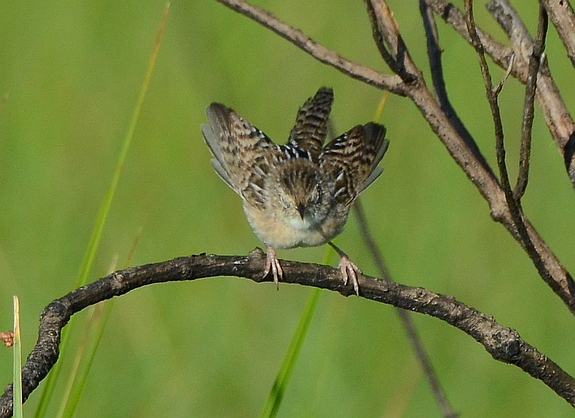

Novel Sedge Wren pose. It's hard to believe that a number of species shaped like they shouldn't be flying more than ten feet at a time are actually accomplished migrants, i.e. Sedge Wrens, Yellow Rails. Impressive...most impressive.


My worst misidentification of the trip (I think) was of this fat black water snake...it was big and girthy and sunning itself at the edge of a pond. I thought it was a cottonmouth at first.


But look at that face. That blank, vapid, round-pupiled face. That is not a cottonmouth face.


The first thing some visitors will see at the refuge is a Cliff Swallow impaled on a spike (left bird) under the veranda where folks like to get lunch. Come on refuge, dick move.

This post is running long...more from Anahuac in the next post! And Bolivar Flats!

Wednesday, May 9, 2018

Boy Scout Woods: Facemelt, A Lifer, The Faint Scent of The F-Word


On the first morning of sweet sweet UTC birding, This Machine Nate, Officer Shaw and I headed straight to Boy Scout Woods on High Island. Upon getting out of the car, it was obvious there were a lot of birds around; it was happening. The first (and last) Yellow-throated Warbler of the trip was out along the road as soon as we left the parking lot.

The crowds of birders that I expected did not disappoint...there were so many birders....or, in festival parlance, so. many. birders. It was ghastly. But the birding....ohhhhhhhh the birding was off the chain. The cold front that just blew through left hordes of migrants in its wake...there were birds everywhere. It was everything I had hoped for and more. I even managed to find my lifer Swainson's Warbler there that first morning (no photos), which was a huge relief...in part because I didn't want to owe someone an hj. Meeting the big brown ground warbler with the long bill and rusty cap was a very pleasant experience, and like the multiple others we would see later in the week, it was within a few feet of a Wood Thrush. You show me a Wood Thrush and I will show you a Swainson's Warbler. I'm already working on the paper, don't steal my idea. We also found our first Cerulean Warblers of the trip, which we would go on to see somewhere almost every day we were there.

Boy Scout is probably the best known Audubon sanctuary/birding site on High Island, though arguably not the best to bird - the habitat there undoubtedly has huge value as a stopover site, but much of it is fairly homogeneous and doesn't have a whole lot of openings/edge habitat, which can make viewing canopy species difficult. The ponds/drips are nice though, for sure, if you can cut through the Geri to see them (we never bothered trying to get into the photography blind). So much of the sanctuary is great for Catharus and ground-loving warblers, but due to the closed canopy one has to work a bit harder for many of the other warblers that prefer to be above eye level. I went three times, so that makes me an expert, right? I also highly recommend birding the road/across the street from the entrance.


Another afternoon Dipper Dan and I spent some time at the "grandstands" near the entrance, a target of much scorn from some birders but placed in a good spot to see birds. A Scarlet Tanager was coming down ridiculously low to feed on precious mulberries, repeatedly within 10 feet of me...what a crippler. It dropped a mulberry on my head so I crushed it.


We saw lots of Indigo Buntings every day, including some pretty big flocks. Stunners.


I know, I know, this isn't a good picture, but bear with me. On the first morning, this Painted Bunting dropped into the trees across from the sanctuary entrance (I believe this is known as "the barnyard", and demands to be birded) and immediately started passing out - it clearly had just finished its Gulf crossing and needed to recuperate - too tired to feed. I don't think I've seen anything quite like that before. We then went around the corner to go after a Cerulean Warbler that This Machine had seen, and was greeted by this bird instead...


A Prothonotary Warbler falling asleep on the ground! Keep in mind this is all happening at about 8:00 AM in the morning, these aren't birds taking mid-day naps in unusually visible places. I would not dare say the F-word here, but with the numbers of birds present we would see at High Island that day and birds doing crazy stuff like this, the smell of F-word was certainly in the air.


Prothonotary eventually woke up to do some preening and light foraging, glad we didn't watch it expire on the ground. We would find no more Prothonotaries after the first day.


This is no ordinary Little Blue Heron, this is a Little Blue Heron (present in this same pond for days) that Geri proclaimed to be a Reddish Egret, the first ever seen in Boy Scout Woods! Hooray!


Kentucky Warblers were common all week long at many sites. I haven't seen hella before this trip, but now I can say I have seen hella and I had a great time doing it.


I just know you were waiting to see some Geri...here they are! I think they were looking at a Blackburnian Warbler.


As This Machine pointed out, how about getting Swainson's Warbler, Swainson's Thrush and Swainson's Hawk all at the same spot? We enjoyed triple Swainson's at Boy Scout our first morning there. Overall we did not fare well with raptors on the trip, but that is not something I am about to whinge about.


The number of birds on the ground at times was staggering. Thrushes, catbirds, Brown Thrashers, Ovenbirds, Hooded and Kentucky Warblers, etc., were ceaselessly thrashing and sifting through the leaf litter or parading around on lawns and paths. On several occasions over the week, at Boy Scout and other spots, there were simply too many birds to look at, which is a phenomenon I generally reserve only for birding in the Neotropics. Wood Thrushes were abundant throughout the week, rivaling Swainson's Thrushes in numbers.


The crowds here are no joke.


Another Scarlet Tanager shot, just because.

All photos were taken at Boy Scout Woods, or across the street from it. Much more Texas material coming up!

Wednesday, January 31, 2018

Episode VI: RETURN OF THE GERI


Seagull Steve has returned to the state of Texas in an attempt to rescue his friend This Machine Nate from the clutches of the vile Geri Birders.

Little does Steve know that the GERIATRIC EMPIRE has secretly begun amassing an unstoppable army even more powerful than the dreaded hordes that swarm South Padre Island.


When assembled, this ultimate army of Geris will spell certain doom for the small band of birders struggling to restore good identification skills to the birding galaxy...


How does that grab you? I don't really have the capacity to do an opening crawl in blog format, so this will have to do. Though the Jedi were obviously the protagonists in Return of The Jedi, the Geri are decidedly not the heroes of Return of The Geri. They are the rising darkness, and we are the light to meet it. 

Always in motion is the future, but I can see it now. The mosquitoes will be thick, and Geri will be thicker. Photographers (Geri and otherwise) high on bird lust and low on almost everything else will inspire anger, fear, aggression. When brightly colored birds in plain view within spitting distance are pointed out, Geri will struggle mightily to locate them and demand more instruction so I cannot enjoy watching the birds myself. Birds will be misidentified constantly. Black-and-white Warblers will become Blackpoll Warblers. Tennessee Warblers will become Philadelphia Vireos. Eastern Wood-Pewees will become Acadian Flycatchers. Ovenbirds will become Wood Thrushes. All Catharus thrushes will become each other. Red will become blue and one will become two. There will be squadrons of Geri to wade through at many of the sites, indeed, an army I feel I may not be able to defeat. But does it spell certain doom? Perhaps, but much like Lando Calrissian, Nien Nunb and Wedge Antilles defied the odds and destroyed the second Death Star, we may be able to find a way around the legion of Geri and get into some fantastic birding. That depends on the birds, the weather, our birding strategy, and a lot of luck.


Geri may be a force to be reckoned with, but a confiding Hooded Warbler can become more powerful than you could possibly imagine. 

Cheesy/stupid intro aside, we are excited to announce that BB&B will be returning to Texas this spring. Ostensibly, I will be leading a custom trip organized by the up and coming MAX REBO BIRDING TOURS ("No one can find Ortolans like Ortolans!"), and meeting up with famed Bicknell's Thrush expert and Jawbreaker scholar, This Machine Nate. But the real reason I am going is to bend the knee and worship at the altar of Spring Migration. Like most of you, I have never seen a proper fallout...I've been around for some good waves of migrants (what some would call "modest" fallouts perhaps, which seems oxymoronic to me), but not the genuine article...warblers littering the ground, ungodly hordes of exhausted migrants, too much for one birder to possibly take in...one of the great climaxes of North American birding. I've been close enough to the real deal to develop a strong appetite for it though, and so I must head east.


I like to see Indigo Buntings. I like to see lots of them, at extremely close range. For the birder looking to get high on Indigo, spring in coastal Texas is the time and the place to do just that. 

Now, as you may have heard, I am the #7 birder in the country...it's not like I am going into this situation blind. Even if I was going to spend weeks out there (I'm not), I'm not expecting to be so lucky, or for the birds to be so unlucky. I will be completely happy just to reconnect with a bunch of different species and be there when a decent number of newly-arrived migrants drop in to the woods.  I am expecting some slow, perhaps excruciatingly slow, days on the passerine front...but this is what one must endure to have the best chance at being around for an iconic migration event. Or just plain old good birding! It's not like I require 25 species of warblers in a day to be satisfied.


I found this Scarlet Tanager in the middle of the day ("best time to make for great birdwatch", according to one notorious birder), smashing a large moth in the middle of a suburban street with nothing resembling respectable stopover habitat in sight. I shot this crippling lens-cracker out my car window. No doubt this is a bird that meets all standard fallout criteria (tired/voraciously hungry/in weird coastal habitat/totally oblivious to people/facemelting), but unfortunately one bird does not make a fallout.

Aside from seeing a lot of birds and getting some crushing in, I do have one particular target bird in mind - Swainson's Warbler. I have never seen a Swainson's Warbler, and I hope to rectify that unfortunate situation by the time I return to California. While pretty much everyone else is looking up for yellow, green, blue, orange and red, I will be looking down for brown...at least some of the time. I am merely mortal, unable to resist the canopy-loving species, and one in particular has a special draw. If you are new to BB&B, you may not know that I dream about Cerulean Warblers more than any other bird, and I dream about birds with embarrassing frequency. I think it's a fantastic bird to dream about! Just last week, in a dream, I had male Cerulean and Blackburnian Warblers in the same binocular view...what a combo! You could even call it a dream combo. Will these birds make the jump from my subconscious to my binoculars in a few months? And if they do...what are the implications? Can anyone be ready for something like that? If you missed it from back in 2014, From South Padre Island to The Astral Plane: A Cerulean Warbler Vision Quest is a pretty good read. It is completely accurate account, with no fiction or exaggerations of any sort. Big lenses may be raised against me in anger once again, but I am not afraid...

Right. The mind begins to wander. Possibilities of glory on the scale of an exploding Death Star or failure the size of Alderaan seem equally plausible. Is my fate intertwined with that of the Cerulean Warbler? Is my entire life just a Franzenesque cliche? A lot of questions may be answered on this trip.


When the Geri-to-warbler ratio is askew in the woods, there will be no shortage of other great birds to look for instead. Upland Sandpiper is one of a great many shorebird species that use the area in spring, and I haven't seen them since the last time I was in the Lone Star [Beer] State.

Well, now you know the main plotlines we will be working with. Top priorities are freeing This Machine from the carbonite, lifer Swainson's Warbler, ask Cerulean Warbler about interdimensional travel and astro-projection. Eastern Whip and Black-whiskered Vireo are both needed birds as well, but I reckon a lot of luck would be required for either and my expectations for those are not high. Most of the time, it will be all about year birds! And our clients, of course...MAX REBO BIRDING TOURS is famous for going above and beyond to coddle (not cuddle) clientele, and this trip will be no exception.

I guess I should wrap this, considering nothing has even happened yet and it is still winter. The passerines in this post were photographed on South Padre Island, and the UPSA was in some ag fields north of Harlingen. All in Texas, obvi.

Tuesday, May 13, 2014

Red-headed Woodpecker...Blackpolls and Butthurt...One for the Herpers


This is the celebrity Red-headed Woodpecker that spent some time on South Padre Island this spring. I've only seen a few ever before, so you can bet I was deep into the stoke when I saw this. What made it even better was that when I first heard about it, I specifically did not chase this bird, even though it was only a block away. A big crew of geri were sprinting/scuttling/hobbling/limping over to the woodpecker and I thought it would give me a better chance to find the Cerulean Warbler that was in the area. This tactic failed miserably, but at least the woodpecker was still present several days later.


Unlike everyone else who were practicing their wildlife harassment skills on this bird, I just stood next to a tree it liked and was within a few minutes rewarded with a crush. What a crippler!


One thing that this bird made painfully obvious was how annoying and indifferent photographers can be with birds. Although you can easily witness this yourself on any spring day on South Padre Island, this bird seemed to constantly have some tool mercilessly chasing it around the convention center, for days on end. It's not like flushing a bird is a big deal (well...sometimes it is), but this woodpecker had a whole harassment crew to keep it as bummed out as possible. Wankers.


People don't seem to realize that birds will often just beg you to crush them if you don't try to chase them out of the state. Pictured is a Scarlet Tanager, not giving a fuck.


To all the colorblind birders out there...I am truly sorry. You have my sympathies.


This female Scarlet Tanager that spent a weekend at the convention center was one of tamer birds I've met this spring. Once she became addicted to oranges, she would do anything for a wedge.


Blackpoll! How poignant.


My, what crisp plumage you have. Such orange legs you possess.


A Blackpoll Warbler utters an otherworldly bellow from the convention center's water feature. It's pretty funny hearing all the seething photogs whine and pine for how the water feature used to be set up, when the birds were more exposed and had to come closer to people to take a drink or bathe. There is some serious butthurt going on out there.


Speaking of butthurt, that's how I was planning on feeling if I didn't get a good look at a Gray-cheeked Thrush this spring. I had only seen one ever before, and that was for a whopping 10 seconds, about 10 years ago, at Marblehead Neck in Massachusetts. Well, my butt does not hurt and my ass does not ache. Gray-cheeked Thrush has become pretty predictable on SPI, for the time being.


More than one birder has told me, discreetly, of his/her fixation with vireos. Well, this one is for you. I thought I would be seeing a lot of Red-eyed Vireos this year...that has not been the case. I reckon this is my best photo of one for the year (it's been weeks since I've seen one), and I'm pretty happy with it.


Have I seen my last Hooded Warbler of the spring? Yeah. It's a sad state of affairs.


The Hooded Warbler is enthusiastic about being near the ground. Not so much as an Ovenbird, but if you get warbler neck from looking at a Hooded Warbler, you are either suffering from an extreme case of stunted growth already or you are misidentifying the bird entirely. While many birders suffer from various renditions of stunted emotional growth, I find the latter scenario more likely.


Finally...one for the herpers. I was told this is a Laredo Striped Whiptail, which one can find many of at the Sheepshead lot on South Padre. Most I have seen have not been this large, or so cerulean. Whiptails are parthenogenic, aka have Virgin Mary powers. The mind reels.

Thursday, April 24, 2014

Migrant Chugging


The birds are just chugging through South Texas now...anything and everything seems to be showing up. My sense of birding FOMO is growing quite acute, although my obsessive monitoring of the weather makes me not worried that I'll be missing a fallout anytime soon. Right. I was lucky enough to come across some cooperative Yellow-billed Cuckoos last weekend. Usually shy and reclusive, the cuckoo does not always stick to it's reputation in the company of one #7 birder.


I could get used to hanging out with stationary cuckoos. I feel like they do this a lot. I wonder what these birds mull over when not migrating or casually decimating tent caterpillar colonies.

Scarlet Tanagers are also moving through now, with reckless abandon. Birders are getting blinded left and right...many will never be able to see color again. I swear there is nothing redder than a male Scarlet Tanager. A cardinal appears dull and lifeless in comparison.


The notorious threat posture of the male Scarlet Tanager is enough to make anyone weak in the knees.


Drab birds want to be crushed too. Here is a female Scarlet Tanager. Note the short, grayish bill and contrasting dark wings, which help set them apart from female Summer Tanagers. They actually remind me of female Painted Buntings a little bit.


This is the one and only Veery I've seen this year. On the day I saw it, it was constantly foraging way out in the open. Very few people seemed to notice it though, although it seemed to be begging for the attention of all birders and photographers in the area. Pro tip from #7: if you want to avoid the hordes of birders and photographers at South Padre Island, watch brown birds.


See? Begging for attention. The descending, ethereal song of the Veery is one of my favorites by the way...if you've never heard one, be assured that you are poorer for it.


Although gifted with a Veeryish voice, the song of the Swainson's Thrush doesn't compare. No offense Swainson's Thrush.


I do enjoy Swainson's Thrushes...they are a fun bird to study, and relatively variable. The birds here are much drabber than those of the west coast, but still have a lot of color in the face. And yes, I have seen a couple Gray-cheeked already this spring.


There are piles of Indigo Buntings out on South Padre right now. Talk about facemelting. I'm not really accustomed to crushing helpless birds like this but I'm not complaining. If Scarlet Tanager owns the color red, Indigo Bunting has mastered the color blue.


There are often a pleasant number of birds around. Sometimes there are hella. This is hella. Here are Indigo Buntings, Orchard and Baltimore Orioles.


Dickcissel has arrived!!!! Before this year I've only seen them as vagrants in California. Now I feel like a non-vagrant Dickcissel veteran...I've seen some big flocks on SPI. I'm still trying to make sense of their face and breast pattern...its complicated. Their distinctive, fart-like calls easily give them away as flyovers.


Franklin's Gulls are still coming north in big numbers. Note the limited black visible in the underwing, and obvious white primary tips, which help differentiate it from Laughing Gull. Of course, Laughing Gulls do not have pink bellies.


The other day I went out after some north winds had been blowing, hoping for more migrants putting down than usual. While there was no fallout, there were thousands of Franklin's Gulls around the convention center. Here is a chunk of the big roosting flock.


The Global Birder Ranking System has subsequently informed me that being in the presence of so many Franklin's Gulls has awarded me +8 points. Not a bad way to level up. All photos in today's post were taken on South Padre Island, TX.