Showing posts with label Greater Scaup. Show all posts

Thursday, May 25, 2017

The Emperor Does Not Share Your Optimistic Appraisal Of The Situation


Fuck, Vader sure had some good lines didn't he? That was from one of my favorites scenes in Return of the Jedi. I guess he can credit The Dark Side for imbuing him with a dry sense of humor, which he clearly lacked as Anakin Skywalker. Anakin was a tool.

Over the winter I read a listserv message about an Aleutian Cackling Goose being seen at a coastal golf course. This news, neither unusual nor unexpected, was not exactly on par with learning that Emperor Palpatine was going to come for a visit to potentially force-murder you for your underwhelming project management skills. In other words, I thought "cool story, bro" and moved on.

The next day a very apologetic birder wrote back to the list, saying what he had meant to say was that it was an EMPEROR GOOSE, and that he had a massive brain-shart due to sleep deprivation and wrote the wrong species in his email. Emperor Goose is an Aleutian goose, after all. As expected, the chase wagons were subsequently fired up and the bird was relocated immediately, and following this success the original observer was celebrated instead of crucified.


The Emperor's arrival coincided with the birth of my daughter, but eventually I was able to make it out to the coast to pay my respects. The bird was a lovely adult, no sign of any dark smudging on the immaculate white head. It wasn't in great light, but birders are not allowed to have any complaints when they see an Emperor Goose.


The Emperor kept the local nonnative Canadas for company, which were not impressed by their new, totally superior member of their flock. You can't really blame them...almost any bird looks like shit when it has to stand next to an Emperor Goose.

This was the southernmost Emperor I have ever seen, and the southernmost to show up in California in a long time...a long time. Talk about a quality year bird. Sharp Park, Pacifica, CA.


On the way back I made a detour to a place with nice lawns and a shitload of dead bodies...it had been far too long since I had birded a cemetery. Who doesn't like birding cemeteries??? Anyways, a Vermilion Flycatcher was wintering there and it did not take long to find. While Vermilions are becoming increasingly common in southern California (a very good thing), they are still powerful rarities this far north. "Only Sleeping" indeed...Cypress Lawn Cemetery, Colma, CA.


Roosting American Avocet flocks have a mellowing effect on the soul when viewed at close range. Serenity now. Albany Mudflats, Albany, CA.


Regular Northern Pintail crushings are healthy, especially when you can catch the purple iridescence on their heads. We are balls deep in molting Mallard season now, but soon they'll be back, and in greater numbers. Albany Mudflats, Albany, CA.


California is blessed with huge numbers of Bushtits. They are practically everywhere. If you look at an ebird abundance/distribution map, the state is almost black with Bushtit. They make chickadees look like unadaptive niche-specialists in comparison. Luckily for birders, Bushtits are great. We may complain about Yellow-rumped Warblers, but no one talks shit on Bushtits. Albany Bulb, Albany, CA.


An interesting thing about Bushtits is their lack of repertoire that the human ear can pick out. It sounds as if they have a contact call and an alarm call, nothing more. They don't really have a typical song per se, but they are quite noisey birds.


Look at this diminutive little bastard. I have crushed Least Sandpipers a great many times, and I will continue to do so indefinitely. Maybe one day it will lead me to a Long-toed Stint, which I nominate for "most overlooked Sibe in the U.S.". The Lower 48 is long overdue for another LTST...will this be the year? Richmond Marina, Richmond, CA.


Greater Scaup coming in for a landing, with a bonus Red-throated Loon lurking in the background. Richmond Marina, Richmond, CA.


Such majesty, such scootsmanship, as some would say. Anthropomorphizing is a bitch, but it's hard to accept that waterfowl may not enjoy landing on water. They get to brake, skate and scoot to a stop. Then they shake their tails, and let out some kind of quack/honk/whistle, looking all cute and shit. Come on waterfowl, tone it down.


Perhaps this is where I should have said, "They'll soon be back, and in greater numbers." Eh? EH? GET IT????


Don't worry, I wasn't going to start this post with a crippling rarity then drive it into the ground with abundant brown birds, we can talk about this Peregrine Falcon instead. This very smart-looking bird was at the mouth of Pilarcitos Creek, in Half Moon Bay, CA.


I've seen a lot of Peregrines over the years. The only ones I've seen really closely were either really sick or were trying to behead me because I was too close to a nest. This one was neither. It was mellow. However, due to the location, I had to wonder if this was one of the Ross's Gull murderers. The scene of the crime was about 4 miles away, but this could have been a different bird.


The bird, quite unexpectedly, did not give a fuck about me. Decent photo ops suddenly turned into prolonged bursts of shutter fire when I realized it might be a great many years before a falcon was this nonchalant again. Eventually it began to crumble under the relentless torrent of crushes I unleashed upon it. It surrendered, signaled by flashing the underside of its foot and lowering its head weirdly. How often does one observe the underside of a Peregrine foot?


I'm not sure why the bird was so unwary that morning. It was bloody cold, but falcons are not reptiles. I did appreciate the killer looks though.


Awesome bird! I've never even had a kestrel be this confiding. Random aside: one of my first birding memories was walking out to the mouth of the Santa Clara River Estuary with my dad when I was a kid. It was winter, we didn't see shit except for a Sanderling, which was flushed by a Peregrine and chased with great persistence and glee. This was a very exciting event for adolescent Steve. Back and forth they went; it seemed like the falcon was just terrorizing the Sanderling for fun, as it was such a tiny prey item. Anyways, it was a facemelting experience for me, thought you should know.

Sunday, March 8, 2015

Winter Hangs On In The East Bay


Mmmmmm....Nelson's Sparrow.  Show me your orange face.  Show it to me at high tide.  Does anyone else think of Nelson Muntz whenever they hear the name of this bird?

Much of the Birdosphere is already talking about spring, and the eastern half of the U.S. is dying for spring, but here at BB&B we are desperately clinging to winter, if only because that is the season we associate with desperately needed rain and snow.  Listservs are being flooded with grave news of birds pairing up and flirting with each other, but that is not a dialogue that BB&B will be joining...not yet.  Foxtrot Oscar Sierra and Foxtrot Oscar Yankee are not phrases that abound, at least not for another couple weeks.  Winter birds are still here, after all, and aside from a swallow here and an Allen's Hummingbird there, the local avifanua remains distinctly winter-flavored.  Well, let's start things off with a rare bird and take it from there.


Nelson's Sparrows winter in California in low numbers (very low numbers), and after trying many times over the last few years to see our local bird or two at Arrowhead Marsh, I finally succeeded.  Although secretive (as expected), the bird was pretty confiding, giving some of the best looks I've ever had.


I had to manually focus for this shot, and bump up the ISO a bit.  Not bad, eh?  If I had a county nemesis bird, this would be the one, so getting such good looks was supremely satisfying. Good luck to you Nelson, on your way back to Saskatchewan or wherever it is you are about to be going.


Like Nelson's Sparrows, Marsh Wrens hate when you look at them, especially if you are nearby with the sun to your back, so it's always nice when they pop out in the open and even better when they sit for a portrait.  Unlike Nelson's Sparrows, Marsh Wrens have yet to be split, although some feel that that would be appropriate.  Photographed at Arrowhead Marsh.


For years I have known that Lake Merritt's outlet, the channel that connects it with the bay, was a good place to see Barrow's Goldeneyes up close, but I had always settled with seeing them occasionally on the lake itself, often at great and uninspiring distances.  I finally decided to check out the channel and was rewarded with this female Barrow's, my Foxtrot Oscar Sierra and Lima Oscar Sierra, which provided some of the best looks I've had of the species.


Interesting pattern on the bill...I'm not sure how much of that darkness is actual pigment and how much is accumulated gunk.  It's possible she is a young bird, retaining some of the mandibular darkness of a juvenile, but I don't think there is a way to conclusively know.


Perhaps you, the discerning birder, were concerned about the first two photos of the Barrow's Goldeneye.  Perhaps you liked the yellow bill, but not the head shape.  This is where your concerns can be laid to rest.  This is where you can tuck them into bed and say goodnight, and sing them the last lullaby they will ever hear.  Birds can change their head shape....it is known. Diving ducks often flatten their crowns when actively feeding...now you know.

It would have been preferable to have the hen Barrow's next to a hen Common, but drakes are better looking so I'm not complaining.


A female Common Goldeneye shows off the classic head shape and bill pattern one would expect of the species, although I wasn't expecting to see her on such a towering perch. Interesting approach.


Greater Scaup are the bane of molluscs, and they take their mollusc-bane very seriously. Photographed at Lake Merritt's outflow.


I wish my digestive system would allow me to just choke down entire shellfish...but if I could do that I might be a type of scaup, which is an odd thing to consider.


Big plumes are sprouting from the backs of egrets everywhere.  Great Egrets are ubiquitous in wetlands around the bay, and despite their abundance they will not be ignored.   I think it's fascinating that birds with such large ranges can be incredibly variable or, to our eye, very homogeneous...for example, there are 13 recognized subspecies of Marsh Wrens in North America, but just 1 subspecies of Great Egret that we know of.  Perhaps if they had more variety in their color palate there would be noticeable geographic variation, but then again maybe not.  Photographed at the Lake Merritt outflow.


Is Willet the new phalarope?  A Peregrine Falcon in the area was keeping the shorebirds from their preferred roosting destination, and out of frustration this Willet flock simply landed on the open water. Photographed at Arrowhead Marsh.


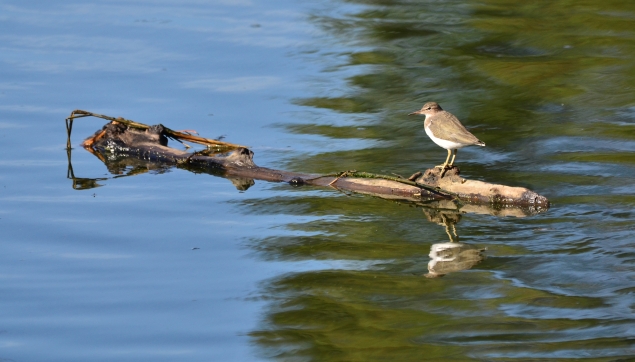
Did that unconvential Willet flock get you worked up?  Relax with this bucolic Spotted Sandpiper. Photographed at Lake Merritt's outflow.


You all know Hank, the world's most famous American White Pelican that lives at Lake Merritt.  I prefer to photograph Hank's wild, free-flying buddies when they are around (Hank is a cripple and was brought here from Oregon, where she collided with powerlines), but Hank just looks so damn sexy this time of year I had to crush her face.  And yes, as far as anyone can tell Hank is a girl, she was presumably named before anyone saw her next to any other pelicans (males are noticeably larger, though there is overlap).


This is my favorite photo I have of her, without a doubt.


In case you were thinking about being in a good mood today, here is a lynched cormorant for you to look at. What a shitty way to die...life is pain. Photographed at Lake Merritt.

Wednesday, March 13, 2013

Diver Cavalcade


The bay area is blessed (cursed??!?!!!?!?!) with an enormous diving duck population in the winter months...some of the state's biggest concentrations of divers are here, if the not the biggest. Mount Tamalpais watches over them, no doubt a knowing and powerful duck god. Miller-Knox Regional Shoreline, Richmond, CA.


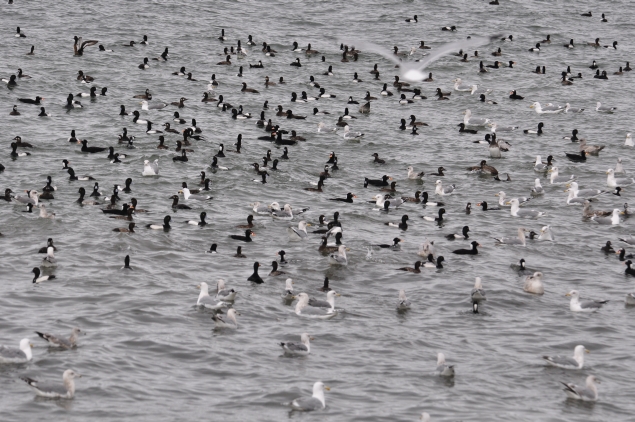
Surf Scoters and Greater Scaup. Thousands of ducks convened at Miller-Knox last month to feed on the herring roe that had also brought in enormous numbers of gulls.


Herring runs are fun for ducks and gulls alike. Here they mingle in harmony...the mind reels.


Among the throngs of Surf Scoters was this lone male Black Scoter. Their preference of wintering sites in the state are generally not conducive to photography, so it was nice to finally get some photos of the yellow-knobbed enigma.


Black Scoters are rare, or at most locally uncommon in coastal California...they are probably not overly enigmatic either, although they have been less studied than other sea ducks. Population estimates and trends are imprecise at best.


Black Scoters of western North America breed entirely in tundra lakes of Alaska; the closest population of breeding eastern birds is in Hudson Bay. I wonder how genetically divergent these birds might be.


It was truly a vulgar display of fowl. The seas seethed and frothed with egg-laden ducks.


A high-density scaup flock scrambles for handouts. Nothing will churn the placid waters of the lake like a bunch of carb-loading ducks. Lake Merritt, Oakland, CA.


Aside from the coots and Canvasbacks, these are almost all Greater Scaup, with one obvious Lesser mixed in. Can you find it? If you can't, the Global Birder Ranking System will note your failure.


Is there a better place than Lake Merritt for Canvasback watching? I have yet to find it.


Red-breasted Mergansers around here are mostly females and young males...older males mostly winter to the north of us. Not sure if this is a young bird or if it's still molting out of eclipse (this was photographed a few months ago).


This Common Goldeneye is going into classic stealth mode, where they swim with their neck extended and head held just above the water. Doesn't seem particularly stealthy to me but they think it works.


Locals will recognize this female Redhead that has been wintering on Lake Merritt for the past several years. The white flecking on her head (a result of leucism, not old age) makes her easy to identify as the same returning bird.

Thursday, February 14, 2013

Some Recent Birds: Majestic, Mighty, Nemesis, Oiled, Typical, Snazzy, Grotesque, Crippling.


Not much new to report here at BB&B. Post-Costa Rica birding has been good, but has gotten a bit slow lately...even year birds are getting difficult. I do have my first job interview of the year next week, and so The Perpetual Weekend is now in jeopardy.

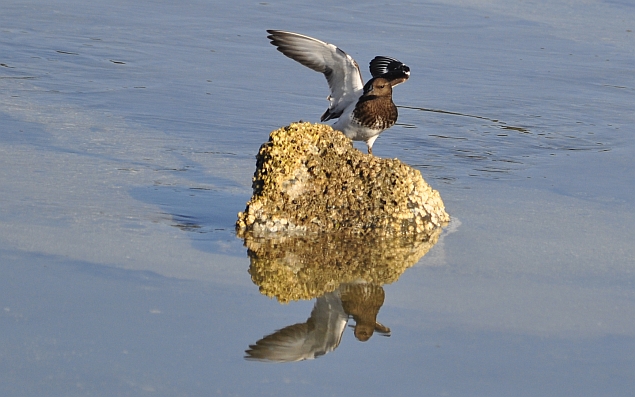
Here is a Black Turnstone that happened to land in front of me. They are common along the west coast, but this would be a definite MEGA in any of the other states...just a matter of time, I reckon. Photographed at Pillar Point Harbor, CA.


Behold its breathtaking wingspan.


Majestic, as always.


The Mighty Dunlin: Often seen, but rarely photographed....by me anyways. Coyote Point County Park, San Mateo, CA.


It's still gull season here on the California coast. Despite my efforts I have seen absolutely nothing interesting beyond a handful of freaks and unusual hybrids since locking on to my state nemesis Slaty-backed Gull (above, middlish) in Sausalito several weeks ago, where this was photographed. Other birds in this photo are Glaucous-winged X Western Gulls (aka "Olympic" Gulls), and a pure Western Gull (bottom left). Oh, if you disagree with any of my gull ID's, please provide cruel negative feedback.

The oiled bird is an adult Herring Gull; the bird in front is a pale-eyed Thayer's Gull. Herring and pale-eyed Thayer's can certainly be confused for one another...I think this photo shows the contrast in bill and head shape between the two pretty well. Pilarcitos Creek, Half Moon Bay, CA.


A pretty typical first cycle Glaucous-winged Gull with a bit more pink in the bill than normal, but that is not unusual in late winter. Sausalito, CA.


I don't think Eurasian Wigeon has graced BB&B many times, although I am lucky enough to see them pretty regularly. The drakes (left) are really snazzy looking ducks, and the hens (not pictured) provide a good ID challenge. Pier 94, San Francisco, CA.


Here is a grotesque Greater Scaup. I don't know how a duck goes about having a huge chunk of it's bill removed...that's gotta hurt. Lake Merritt, Oakland, CA.


Here is a non-grotesque Greater Scaup for comparison. Lake Merritt.


Harlequin Duck is in that small realm of birds that defy explanation, both in plumage and lifestyle. Someday I hope to have some photographs that do them justice, but at the moment all I have is stuff like this. This crippler is hanging out at Pier 94 with a female Surf Scoter.