Showing posts with label Band-tailed Pigeon. Show all posts

Monday, April 27, 2020

5MR Birding in Exponential Times


I have seen countless Anna's Hummingbirds in my life and I will admit I no longer look at each one with child-like wonder, or even its rare and highly diluted cousin, regular adult wonder. For example, the male Anna's in my backyard is highly territorial and essentially keeps all other hummingbirds out of there, no matter how many feeders I put up and juicy nectar-giving plants I put in the ground. Just today he chased out an interesting Selasphorus. It's in his nature of course, but still...what a dick! That said whenever the light catches a male the right way or one is doing its display flight nearby, it is still impossible to look away. Photographed at the Los Capitancillos Ponds.

Any birdpunx remember Cobra Skulls? I really dug that band. Imma kick off this post with a verse of theirs.
The golden age is never coming back
Getting out was not part of the plan
You are just a victim of an older time
Falling behind in exponential times
Grim eh? But very fitting. The notion that large numbers of us could be wiped out by an illness that also brings society to a grinding halt seemed outlandish and atavistic to many a mere couple months ago. The phrase "exponential growth" meant almost nothing to anybody except nerds. The phrase was safely in the weak grasp of dweebs. Now that idea has been bouncing around all over the place this spring, though clearly it has not made it's way into the brains of all ("It didn't go in. It just impacted on the surface."). These are exponential, weird times we live in. Things seemed weird...and not in a good way...before this fateful March, but of course our day to day life has been totally upended since then. The Groundhog Day effect, already familiar to so many, has intensified to peak Bill Murray levels. It's not just that each day is so similar to the last, or that days blur together, the other less obvious but still significant component of that headspace is that we don't know when any of this sad, stressful bizarreness will end. The light at the end of the tunnel is dim and ill-defined...and possibly because the light is being made by a fiery inferno, and we are all barreling toward it.

But chances are if you are reading this, no matter where you all, you know all too well of what I speak. It's my job as the #7 U.S. birder as identified by the infallible Global Birder Ranking System (universally recognized as an Essential Business) and one of birding's most prominent influencers to carry on and talk about birding in spite of the conditions in which we find ourselves.


Red-winged "Bicolored" Blackbirds arrive to breed at my house very early in winter and appear to set up territories before any other migrant songbird within my radius. Though you can find them without trouble year round in the county, these particular birds will likely all leave the area before the end of June. I have not grown numb to their presence and am happy to always have them in earshot and at my feeders while GERI BIRDING. This male was making some modest but pleasing display flights. Photographed at the Los Capitancillos Ponds.

The first thing that needs to be said is that birders, like people in general, are having all sorts of reactions to covid-19 and the shelter-in-place orders. I will be the first one to step up and admit that I did not see this pandemic coming and that we would be the world leader in number of cases and death toll (MAGA! USA!), but I am going to tell you that once it got rolling here I knew exactly how this would affect birders. It is all happening as I have foreseen. To w(h)it:

*A lot of birders would have sweet birding trips cancelled.

*Yard birding would take off.

*5MR birding would grow yet more in popularity.

*Some birders would stop birding away from their yard.

*Some birders would only bird locally.

*Some birders would still travel to bird (mostly to chase essential rarities, obvi) but not as much as they normally would.

*Some birders would bird the exact same way they did in February, as if nothing at all had changed. Lots of county listers/chasers with this attitude. 


I have seen countless White-crowned Sparrows in my life but their arrival and departure from California lowlands have always been very significant to me. Now, as a GERI BIRDER, I am particularly saddened when they and their Golden-crowned brethren pull out and head north. My yard will gain no new common birds in the meantime, as my very small suite of summer birds have already arrived. My last White-crown departed on April 24, and it seems my last Golden-crowned left on April 26, but luckily they will be back in less than five months. This is a pugetensis with the dull yellow bill and noticeable brown wash on the breast and underparts. Photographed at Rancho de Bastardos.


And here is a crisp gambelii for comparison, which was foraging a few feet away from the pugetensis above.

*All tour guides would be totally screwed.

*There would be a great deal of shelter-shaming (shaming people in public for chasing distant rarities or just doing any birding at all) in listservs and Facebook groups.

*The number of reported rarities will fall off as a result of birders travelling less and popular sites having reduced or no access, but may be compensated in part by birders by birding locations that previously enjoyed less coverage. The birding herd mentality so prevalent in many regions will be tamped down somewhat.

*Since almost everyone is even more stressed during this time, there will be some highly entertaining pitched battles between birders in public forums on all manner of topics.

Ok, the one thing I did not predict was people hoping eBird would remove alerts and start hiding data to discourage birders from...birding. This seems not only unrealistic, but also really bizarre. Oh I also know that a very well known birder...also, unfortunately, an eBird reviewer...thinks that law enforcement agencies are planning to use eBird data to cite violators of shelter in place measures?

How embarrassing, to put it mildly.


For the number of Merlins I've seen, its notable that these slick birds seem to so rarely remain on perches close enough to say that you got great looks at them. This one, presumably the last one I'll see until fall, was brave enough to buck the trend. Photographed at the Santa Clara Valley Water District HQ.

As for me? I have not left the county since sheltering started (and here, we have the Santa Clara County measures on top of the California ones) and mostly, but not entirely, remain in my 5MR when birding. Santa Clara County's shelter order directs us to remain within the county unless performing an essential activity, so by that measure I guess I have been COMPLIANT...and perhaps you think I am a coward for doing so. That's ok, because I'm sure some of you other readers probably think I am a plague vendor doling out pestilence and death each and every time I go birding away from my yard. Where does The Truth lie? Who is in possession of The Answer?

Many have found The Answer...to everything...lies somewhere within their own FIVE MILE RADIUS. Interestingly, the San Mateo County (which is the county north of here) shelter in place order restricts residents to...you guessed it, a 5MR from their homes! Sad to be sure, but from a purely birding standpoint, convenient and hilarious. Upon learning this, one unenlightened local birder posted to the local listserv about how depressing birding will be if he was going to be confined to locations within five miles of his house. I can only imagine his surprise (and disgust) when he learned of the legions of birders who volunteer to do this very thing!


Some of the plantings at the Santa Clara Valley Water District have turned out to great for migrant hummingbirds, most of which are comprised of zesty Rufous Hummingbirds. I've ended up seeing a lot more Rufous Hummingbirds since moving here from Alameda County and their comparative abundance has been refreshing. And no, I'm not 100% sure that female is not an Allen's, but Allen's are greatly outnumbered in my 5MR by Rufous for some reason.


One of my post-Costa Rica birding highlights this year was finding this Calliope Hummingbird, also at the water district. Unlike many of my experiences with this species, it was very close and gave excellent looks. They are annual in the county but are typically only reported from one or two locations per year. This wee little crippler is easily one of my favorite western migrants. Fortunately, it's been a very good spring for finding them in lowlands in the state, and I'm sure a large number of them have passed through the saddle at Loma Prieta undetected.


Here is my first new radius bird of 2020 - a much-anticipated Purple Martin. Though not quite a rarity, this is another very hard bird to find in the county away from Loma Prieta, where they breed. Photographed at the Chynoweth Pond in San Jose.

I'm pretty sure I've said this before, but if there was ever a time to be redundant on the topic of radius birding, it is now. I know most of you reading this fall into the following categories: (1) you are Flycatcher Jen (who started radius birding), (2) you are already a 5MR birder, (3) you are sympathetic to 5MR birding but haven't embarked on your radial journey, (4) you think 5MR birding is dumb and entirely unappealing, or (5) you live someplace where it doesn't work so well (those exist - you get a free pass). If 3 or 4 resonate with you...now is the time to step out of the darkness and into the radial light. Do you have someplace to be? No. Something better to do? Definitely not. Come join us! I'm not at all saying we should give ourselves the self-imposed San Mateo treatment, but really there could be no better time to be doing a lot of birding close to home. 

I should mention that all birds in today's post were seen in my 5MR, including Rancho de Bastardos, a Geri Birding haven for me in these difficult times. I've recorded 95 species here since sheltering began here in mid-March, including a banner day where I managed a whopping (to me) 61 species, almost entirely after 12PM. I believe that's my highest single day species total here so far. Geri to the rescue!


Similar to the situation with Red-winged Blackbirds, Band-tailed Pigeons can be found in the county throughout the year but they disappear from my yard in fall and winter. I wonder how far "our" birds migrate, after all they are found from Alaska to Argentina (!) and have a nice pattern of vagrancy in the eastern half of the continent, so some birds are certainly moving significant distances. At any rare, it's good to have these humongous floppy goofs back and available for Geri Birding duties. Photographed at Rancho de Bastardos.


I'm happy to have Hooded Oriole as a common visitor to the yard, I'm pretty sure they nest on both sides of my house along my street. For whatever reason adult males are way more skittish than females and juveniles, so I'll take a powerline shot. This is far and away the flashiest bird that visits the yard on the reg, what would I do without them? Photographed at Rancho de Bastardos.

I think we are pretty much caught up on things now. Oh, I need to mention that I got one more new radius bird recently, which was also a new addition to the yard list (first since last year) - I stepped out into my backyard briefly the other night and almost keeled over when I heard a strident PILL-WILL-WILLET! proclaimed not once, but twice, with strength and vigor. Shorebirds are so hard to come by in my radius that I was totally taken aback by this northbound Willet giving nocturnal flight calls. Migration is a hell of a thing.


Tuesday, July 23, 2019

The Human Birdwatcher Project Presents: To Catch a Stringer


Most birders think about things like, "Why don't juvenile Band-tailed Pigeons have neck collars?" or "Are the Mourning Doves in my yard now the same ones I see in winter?" or, shamefully, "What would a Mourning Dove x Band-tailed Pigeon hybrid look like?" But there are a few birders out there who are on an entirely different trip, contemplating how to convincingly fake a White-winged Dove sighting instead.

To be the Global Birder Ranking System's #7 U.S. birder, you have to have been around for a while. To achieve such an astounding rank, breathe such rarefied air, one not only needs to know birding, but to have a sixth sense about it...a sensitivity to The Force of birding, if you will. You must be able to predict the future, intimately know the past, and trust your instincts. This sixth sense comes to some after years of experience; other birders seem to lack this entirely, no matter how many years they have toiled in the field. You may not be lucky enough, or cursed enough, to feel The Force flowing through you...but if you are, not only will this preternatural sensitivity help you find birds of interest and identify them correctly, it will also inform you on the claims of other birders without necessarily knowing much about the people beforehand. The Force is an excellent judge of skill, and of character.

For some birders, this isn't important. Birding isn't about other people, is it? Birding is a personal experience....but these days that seems to apply to only a minority of birders. Most birders do not exist in a vacuum. We have birding friends, birding foes, we look for birds other people find, we go to places other birders recommend, we study bird photos online that other people take, etc. Other birders matter, even if we go birding specifically to avoid people. If Flycatcher Jen (a real person, as most of you know) happens to meet Johnny Nightingale-Thrush (not a real person) while out birding, and Johnny tells her "I saw an Intermediate Egret two miles down that trail", Jen will want to know if Johnny is a trustworthy birder before she goes out of her way to look for that bird. Or Stilt (also a real person) may be able to infer that the Cassin's Sparrow reported by Karen Chlorospingus (not a real person...though it should be) in a listserv post is probably not worth looking for, since Karen is new to birding and probably highly prone to sparrow misidentifications. Or The Eggman (legit) will know that David Diving-Petrel (fictional) is just a classic stringer and that there is a 110% chance that the Long-toed Stint David just reported is actually a Least Sandpiper. Knowing what should be followed up on, and what should not, is an incredibly helpful skill for birders.

So like I said, it pays to be strong with The Force (of Birding). You will see more birds, more rare birds, and spend less time on snipe hunts and wild goose chases. Weeding out claims from stringers is key. Most stringers go out birding, find a bird (or these days, find photos of someone else's locally common bird online and claim it is actually a rarity...estringing), and predictably try to turn it in to something uncommon or rare to pad some lists, convince others they found something great, convince themselves they found something great...or god knows why they do it. According to the Global Birder Ranking System's statistics, between 97-98% of the world's known stringers fall under this category...you know them well.

But that is not the only type of stringer. There are those who do not misidentify birds out of misguided optimism, overconfidence, or poor identification skills...in fact, they don't appear to misidentify birds much at all. These are the stringers that fabricate sightings without ever seeing a bird where and when they claimed, either by just creating a sighting out of thin air, giving no evidence at all, using photos stolen from somewhere online, or using their own photos they took in another place at another time to provide the basis of a sighting. These are the miserable, wretched, bottom-dwelling, maggot-infested stringers, and never will you find a more wretched hive of scum and villainy.

BB&B has covered this story before. Almost every BB&B reader is aware of Swallowgate and what happened...or what did not happen...in North Carolina. That birder has since been excused from the birding community, his record Big Year purged from the record books in a firestorm of purification. Although I was privy to many details of that story, I was not a part of it...until now. I recently became a vigilante bird policeman in my very own county, to catch a stringer so twisted and evil that it is a wonder she even exists. The Human Birdwatcher Project takes great pride in bringing you this story today, for history is written by the Winners, not those who were vaporized on an exploding Death Star.

It all started last September. I occasionally go through the photos users upload to Santa Clara County (where I live) in eBird to see what is being crushed, misidentified, etc. I was surprised to come across a Clay-colored Sparrow, a solid if unspectacular rarity here, as it did not show up on either my Santa Clara needs alert or the rarity alert. And according to the date and location of the checklist, I had been at the same spot at the same time! What gives? Why wasn't it reported anywhere? Well, users can hide their birds from needs and rarity alerts, but still continue to contribute to eBird's public output. I didn't understand why this observer, who I will call "Lori Myers", wanted to hide their birds from everyone else, but it wasn't long before I figured it out. Looking at eBird's Top 100 for Santa Clara County for 2018, Lori Myers was doing a County Big Year.

Ugh. Ok. Lori wants to chase other people's rarities (evident by looking at her eBird photo gallery), but doesn't want to share the ones she finds? That's fucked up and pretty stupid...but in one respect it makes total sense. She is listing to win. I disagree with it, it makes big year birders even more unappealing than they already are, it could result in other local birders missing out on chaseable rarities...but I get it.

After being clued in to what Lori Myers was doing, and keeping an eye on photos she was submitting in the county, it became clear she was finding a lot of rare birds on an alarmingly regular basis. I guess Lori didn't have a job? I was briefly impressed, as I had never met this person and she was seemingly finding and documenting a lot of cool birds considering she was decidedly not one of the more skilled birders in the area - she seemed to be mainly a photographer. I even chased one of her birds, which is one of the low points in my life.

Strong with The Force I am...but not that strong.

It did not take long before I stretched out with my feelings, to listen to the The Force, and The Force started telling me that something was Wrong. I was wrong about her. Deeply, treacherously wrong. Lori Myers was finding too many rarities. Santa Clara County does not host as many rarities as the coastal counties, and Lori was finding vagrants at a clip that would be impressive for anywhere in the state. I then started looking more closely at the photos she was posting - *every* rarity she claimed had an accompanying photo, which just doesn't happen. And in the photos themselves, I started noticing patterns of irregularities...really weird crops, missing metadata, perches/backgrounds/weather that I knew were not consistent with what the locations looked like, or other photos in the same checklists.

My opinion of her quickly turned to the dark side, but for good reason...she had betrayed us all. For months I watched Lori post garbage, but mostly* plausible, rarities in eBird. It was torture...knowing exactly what was happening, but having no proof or power over it. Poor Billy had to listen to me rant and rave about this rampant stringing going on every time some horseshit vagrant hit eBird, which at times happened day after day after fucking day.

The turning point came when she attempted to take credit for finding a rarity I had found myself! I had found a flock of Mountain Bluebirds, less than annual in this county, then noticed later that week that Lori Myers had subsequently eBirded seeing one the day before me in the same area. An eBird policeman dug into it and confirmed that she did not submit that checklist until many hours after I had already reported the birds!

That was the last straw for me. Soon, I joined a cabal of eBird and state bird police that had one goal in mind...to form a rebellion and resist this Sith Lord of Stringing.

In the end, after months of surveillance, we were finally able to prosecute her for her heinous, cruel and unusual birdcrimes. Lori Myers knew that her charade was over, that she had been found out...in a final act of cowardice, she tucked her tail between her legs, changed her eBird account to anonymous, and hid all of her data and photos from public output....but it was too late. The eBird tribunal found her guilty as charged, and Lori Myers was banned from eBird's public output anyway, in case she ever wanted to attempt to "contribute" to eBird again. Her Big Year has now been erased from history, and I am told she has never submitted anything to eBird again, even for her own personal lists...but of course that was never the point for her. To protect the birding law enforcement and prosecution team from revenge killings, they will remain safely anonymous, but their valiant efforts will never be forgotten by those who were there.

This blog post is not just a story of a rising Darkness, and Light to meet it. Now, you too can identify an ultra stringer like Lori. Again, I'm not talking about your everyday, run of the mill stringer who tries to turn a Warbling Vireo into a Philadelphia, I'm talking about people like Lori who are making a conscious effort to lie. Here are some of the questions that are begging to be asked if you suspect you have the misfortune of encountering such a person.

Is the suspect a good birder? If the answer is "no", they are potentially stringer material.
How frequently do they find rarities? Think about how often the suspect reports documented/substantiated rarities relative to other birders in the area.
How thorough are their descriptions? A stringer of this magnitude is not going to go to Marantzian lengths to describe a rarity - they will probably offer two or three sentences and avoid any overly technical sounding field marks, molt terminology, discussion on distribution and migration, etc.
Does anyone bird with them? Stringers of this sort work alone.
Does anyone else see their birds? Lori Myers tried to get around this problem, partially, by reporting some rarities to eBird months after she had initially allegedly seen them - no one can chase an Eastern Phoebe from 9 months ago. She also hid her data from needs and rarities alerts and did not contribute to any listserv or Facebook group. If someone is really going out and finding rarities left and right at places that get birded a lot, inevitably some of them are going to be seen by other observers.
Where are they in eBird rankings? Stringers inevitably wind up at or near the top of a given category in eBird. What is the point of stringing if you are in 35th in a Top 100 list?
Is a big year involved? Nothing brings out stringing like a big year. It is known.

And some questions just about photos:

What does the metadata say? Lori's most blatant photos of fabricated rarities had no metadata visible to eBird users. The vast majority of photos in eBird have that data available. Indeed, most of Lori's pictures of expected, totally reasonable species had the expected metadata being displayed as normal.
Are the backgrounds and perches consistent with the location and season? This one doesn't need an explanation. Lori's November Ovenbird with vibrant, bright green deciduous leaves in the background was bizarre.
Any weird weird crops? A number of photos Lori posted appeared to crop out perches that were not appropriate for the location. For example, why post a extreme closeup of a Rose-breasted Grosbeak but lop off the bird's legs entirely?
Is the lighting and photo quality consistent throughout? Many of Lori's checklists had a lot of normal looking photos of common birds in addition to the strung rarity. In a great many cases, the photo of the rarity looked very different from the rest of the photo set - different quality, lighting, weather conditions, etc.
How many photos do they upload for each rarity? Lori Myers typically uploaded 1-2 photos per rarity of a bird she lied about finding herself; in contrast with this, she would often post more than one of known rarities found by other birders in the area. If you are going to fake a sighting, its much easier to just use a single photo than four or five.

Much like Luke respected and feared Vader's power, I will give Lori Myers credit where credit is due...her rarity selection of things she decided to string was very good, very believable if you did not examine her collection of lies as a whole. Tropical Kingbird, Northern Waterthrush, Magnolia Warbler, Indigo Bunting...these are all quality birds for Santa Clara, but not the sort of thing that would lead to dozens of birders from around the region dropping everything to chase. Her ploy worked for some time, but in the end she just couldn't control her crazed impulses and her reign of terror was put to rest. It was maddening, painstaking, and the entire treacherous experience filled my heart with hate, but in the end birding justice was served. She has never been heard from again.

Stringers beware...you will be seen for what you really are. For The Force is my ally, and a powerful ally it is.


*=One rarity in particular really stood out as being incredibly unlikely and significantly contributed in obtaining a warrant for her. She got cocky - her overconfidence was her weakness.

Friday, January 4, 2019

2019: The Year of The 5MR


In 2018, White-throated Sparrow was a county bird, a Five Mile Radius bird, and eventually a yard bird! This was the #1 bird I was hoping to see at Rancho de Bastardos that I kind of expected to show up eventually, and this looker spent a few days here right before Christmas. Sadly, it abandoned us before 2019. Another fun fact: every White-throated Sparrow I've seen in my home county has been in my radius! I would grade my radius as being middling for sparrows, maybe even above average. Fingers crossed for a Harris's this year, though it would not have to show up in my yard to make me happy. 

By this point, every regular BB&B reader has heard about the Five Mile Radius (5MR) and has one of three opinions on it.

Opinion A: 5MR is a fantastic idea and I'm already doing one!

Opinion B: 5MR does sound interesting but not interesting enough for me to start one...yet.

Opinion C: 5MR is stupid. It is stupid because listing is stupid/I am too invested in rabid county listing all over the state/I am busy because I am always doing a big year and need to spend hella time driving or flying/not everyone is doing it so therefore I will not do it/I suck.

If you are of Opinions A or B, or even the highly unlikely Opinion D ("What is 5MR?"), then this post is for you. If you are of Opinion C, well, god help you.


My 5MR is very good for sapsuckers; I saw Red-breasted (above, fairly common here), Red-naped and Yellow-bellied all in 2018. 2019 started with Red-naped (a different one) and Yellow-bellied...nope, no Red-breasted yet! If a Williamson's ever shows up it will probably be in a little park or cemetery no one birds, and 5MR is all about birding places like that. Photographed at Almaden Lake County Park.

I am not going to punish regular readers with describing what 5MR is all over again, but in case you are wondering what all the fuss is about, you can read this BB&B post and check out Flycatcher Jen's new handy little 5MR FAQ page.

BB&B is world-renowned for being a leading trendsetter, influencer, and tastemaker for birding in the 21st century, but Flycatcher Jen, PNW's blogging darling, gets full credit for launching this concept...we are just here to preach the radial gospel. I am a 5MR missionary, if you will, and in the end many of you will be converted, or in other words, saved. The birding paradigm is beginning to shift. So what is new with 5MR birding?


Last fall was excellent for Willow Flycatchers in Santa Clara County; this one was in my yard for a few days in September. There are a number of decent places in my 5MR to check for migrant Empids, but kingbirds are much tougher.

The 2019 5MR challenge is what is new. Jen has invited birders everywhere to come join in; she is tracking everyone's 5MR for 2019, and is at almost 150 (!!!) participants in many states and multiple countries! It's really all about birding your 5MR (or 8.05KR if you are metrically inclined) a lot this year, and we will be tracking many more metrics than just the usual who-will-get-the-most-species stat. She is even doing monthly challenges! You can read all about it right here, and if that grabs ya check out some more of the nerdy, jaw-clenching metrics right here. She also set up a Facebook group devoted to 5MR, which is (somewhat unexpectedly) really flourishing - go here to check it out and join up. No need to sign up for the 2019 challenge to be in the group!

Birders of all levels and all stripes have embraced the 5MR, and you should too! Bird Police, civilian bird wizards, "young birders", geri birders, intermediate birders, and probably some stringy ones...we are all here! Come revel in the places less birded and the luxury of never having to drive more than 20 minutes from your home! Become the master of your local eBird hotspots, or if there aren't many, you can bring them into existence yourself! Of course, there is no need to sign up for the 2019 challenge to enjoy the fruits of 5MR, but I think it will be fun.


Easily one of the best birds in my 5MR last year was this Blackburnian Warbler, which I dipped on twice before connecting. I'm still figuring out how readily findable fall vague runts are in my 5MR, but clearly searching for them is not a fruitless endeavor. Incredibly, in December I got to see another one only 0.3 mile outside my radius. Photographed at Vasona Lake County Park.


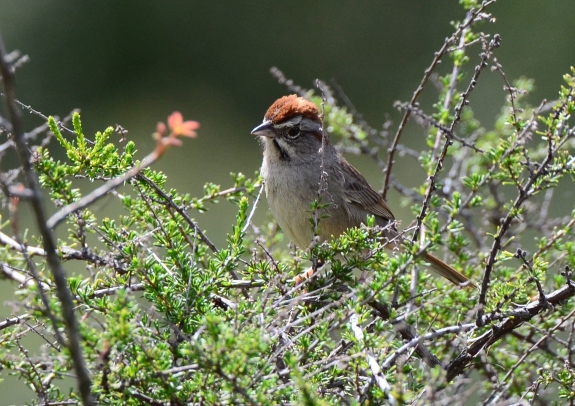
Those of us living in urban areas tend to be very heavily biased towards months with wintering birds and lots of migrants passing through, but obviously no matter where you are, you can't forget about the birds that breed in your 5MR! Much of my radius is urban/suburban hell, but a lot of it is protected open space as well, mostly in the form of oak woodland, modest riparian corridors, and some chaparral. Good summer birds in my 5MR include Black-chinned Hummingbird, Vaux's Swift, Common Poorwill, Rufous-crowned Sparrow and Band-tailed Pigeons. I'm sure the pigeons are here year round but I don't see them around where I live for most of fall and winter. Look at this ridiculous thing mantling my tiny feeder! Need to track down Western Screech-Owl in my radius this year, among other residents/breeders.


I've said this a number of times now but there are a huge number of gulls in my radius in the winter months. I really, really want to find something rare in my 5MR (probably Glaucous, Lesser Black-backed or Slaty-backed) and in fact I'm sure they are around, it's just a matter of being in the right place at the right time. This Iceland was casually soaring over my yard last month.


If gulls and waterbirds are strengths, and perhaps even upland birds, the Achilles Heel of my 5MR is shorebirds. Why do they have to be so hard? Every species of shorebird I have recorded in my 5MR has been from my yard. That would be one species of plover (Killdeer, claro) and 4 sandpipers, of which Wilson's Snipe is the only interesting one, though it is the only expected one besides Spotted. It's pretty bad but I will take my snipes. Solitary is possible but I can't even fathom seeing something like a flock of peeps.


Not only do I have all three mergansers in my radius, I've seen them all from my yard! Red-breasted was a fluke though and I'm not sure if I will get another one in the radius this year. The ponds at Los Gatos Creek County Park are very reliable for Hooded Mergansers (where these cripplers were hanging out), which is probably the most heavily birded hotspot (for good reason) within my 5MR.

In 2018, I fared somewhat better than I thought I would in my 5MR. Birding at the very edge of my 5MR at Santa Teresa County Park in spring gave me some great birds like Calliope Hummingbird, Horned Lark, Grasshopper Sparrow and Rock Wren. The radius is real tricky there, with some sections of trail inside and some outside, but I finally got a good handle on it. Fall migration bestowed upon me a nice array of new 5MR birds like Cinnamon and Blue-winged Teal, Greater Scaup, Palm Warbler and Brewer's Sparrow. A Summer Tanager showed up right before Christmas, and the nearby Phainopepla is wintering at the same site again. I finished the year with 159 species in my 5MR without being really committed to inflating that total, which I'm pretty happy about - a few other 5MRs in Santa Clara County finished slightly below that number, though I have no doubt someone living closer to the salt ponds could do better than me, probably substantially so.


My 5MR has most of the expected Northern California wading species, though White-faced Ibis is not something that will be easy to find. Perhaps a Yellow-crowned Night Heron will turn up behind my house with all the Black-crowneds at some point? Yellow-crowned is long overdue in this part of the state and they have been increasing in Southern California. Until then, I will be content with the expected locals, like Great Blue Herons, when they choose to be confiding. Photographed at Los Gatos Creek County Park.

Of course, just because you don't want to sign up for the 2019 challenge doesn't mean you shouldn't do a 5MR at all! Absolutely none of my 5MR birding last year, or the year before, was done with me thinking about getting freaking year birds for my 5MR list...how embarrassing is that? It's pretty embarrassing...but oh wait I am ALL IN on the 2019 challenge so this year will be different!

Well, maybe not all in...I am about to leave for Belize. So long White-crowned Sparrows, hello Tody Motmots! See you on the other side Bushtit, pleasant good morning to you American Pygmy Kingfisher! Godspeed Hutton's Vireo, oh so good to finally meet you Yucatan Vireo!

Right, but otherwise I am heavily invested. Looking forward to checking out some new spots (a couple cemeteries immediately come to mind), tracking down a few self-found rarities, and really pinning down species that I have yet to see in my 5MR that I could reasonably expect to find here...Eared Grebe, Allen's Hummingbird, Red-breasted Nuthatch, and Tricolored Blackbird all come to mind quickly, though that does not mean they will come easily. I am hoping to see some more 5MRs pop up in Santa Clara County in 2019 as well!

Challenge or no challenge, hope you all have a very radial 2019!


My last Santa Clara County bird of 2018 was also my last new 5MR bird. American Bittern was the closest thing I had to a nemesis bird in Santa Clara. Ugh I love bitterns so much, happy that they are possible in my radius. Photographed at Los Gatos Creek County Park.

Monday, October 2, 2017

Updates From A Yardbirding Empire


Earlier in the summer Band-tailed Pigeons would come feed in the yard on the reg, but for the past couple of months they have been usually observed as flyovers. This crisp, freshly-baked juvenile was an exception, making itself at home for a few hours one evening. This is a plumage I've hardly seen before and was chuffed to get to crush.

Well, well, well...another month has come and gone. What was different about this recently deceased month was that it just so happened to be the best month of the year for birding in California. What was not different was that the Rancho you love to hate has again taken top honors for birdiest yard of the month in California* with 71 species. I could tell a lot of birders tried very hard to dethrone me in September, but the yardbirding empire we have built here in San Jose is quite safe from your pitiful little band. And not only did we dominate the monthly standings, we added a sickening number of new yard birds:

88. Lazuli Bunting (hoped for but not expected)
89. Western Gull (inevitable)
90. Say's Phoebe (not rare in the area, but not expected at all - poor habitat here)
91. White-crowned Sparrow (inevitable but most welcome)
92. Lincoln's Sparrow (a single bird visits the feeders daily)
93. American Wigeon (one day wonder)
94. Ring-necked Duck (small flock has taken up residence)
95. Herring Gull (flyover)
96. Marsh Wren (one calling from mulefat/cattails at the end of the month)

For comparison, I got only four new birds in August (three on the eclipse day!) and a paltry one in July. September was very rewarding, with other highlights being Yellow Warblers in the yard every day of the month and another Golden Eagle.

Though I am hoping to break the yardbirding milestone of 100 species in October, I am merciful, a just yardbirding emperor. That's right, I will not be attempting to win Yardbirder of the Month in California, it will be up for grabs. A bone is being thrown. I'm going to Massachusetts this week to see family, attempt to relax, and see some eastern birds that I haven't checked on in a while.

So good luck California yardbirders! But don't get cocky...when dawn arrives on November 1, the empire will strike back.


* = in eBird. Obvi.

Monday, August 28, 2017

The Serpentine Sparrow, The Frog of The Falls


At the end of March, Billy and I were growing bolder about where we would take Annabelle, as she was a couple of months old and seemed like a fairly robust little creature, at least compared to her ultra-larval state that she was in back in January. We decided to go for a hike out on the Pine Mountain Fire Road in Marin, where I could potentially get a precious Marin county bird and there was a good chance we would see some decent wildflowers. A few Band-tailed Pigeons crossed over the ridge and into another drainage when we arrived.


Look at this sick habitat shot...BB&B is "not just a bird blog", eh? EH? Sound familiar to anyone? Anyhow, it didn't take long to figure out we were in a serpentine zone, as evidenced by the soil color and interesting plant community that made up this large, impressive swath of chaparral. A Black-chinned Sparrow was found out here after I moved south to San Jose, can't say I was surprised.


I reckon this is Bolinas ceanothus (Ceanothus masonii), which is a serpentine-loving Marin endemic. It was blooming all over the place that morning.


Less endemic but more familiar, a handful of red larkspur (Delphinium nudicaule) was in bloom down near Carson Falls.


Rufous-crowned Sparrow was the main draw for me that morning. We managed to find one pair, but oddly they weren't in any of the huge chaparral patches. They were frolicking in a grassland just downslope from a modestly sized patch of chaparral.


Rufous-crowned Sparrow is very uncommon in Marin, so it was great to check out a new zone and snag a desirable county bird at the same time.


We unwittingly found another highly local being, this one even rarer (but perhaps more dependable) than the sparrow. Carson Falls still hosts foothill yellow-legged frogs, which have been extirpated almost everywhere else in the county.


These stream-loving/pond-hating frogs love a good current and some good basking sites nearby. COUNTY FROG!!!!!!


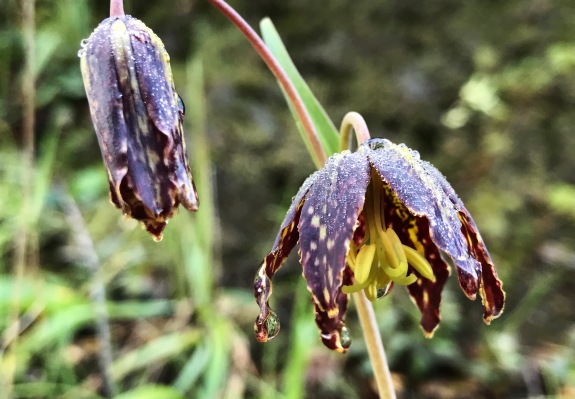
This was the best flower of the day, checker lily (Fritillaria affinis), looking all dewy and soothing.


Little crippler!


My bastard girls with some nice yellow-legged frog habitat. There's so much good stuff in Marin, it was great to be so close for a few months. Now I am in the process of discovering the good things Santa Clara has to offer. There's no Point Reyes...or ocean...but the shorebirding is great. If only there were some sod farms...


On another day in March I was back at the Las Gallinas Ponds. Cinnamon Teal were still looking as Cinnamon Teal should back then. All the ducks are currently recovering from eclipse plumage now, and don't look like a whole lot.


What a strange body type you have Common Merganser.


This is a long bird. Beware.


A Bewick's Wren offered itself up for a solid crush, which I was obliged to partake in. I'm sure I've mentioned it before, but I can't help but mention it again...Bewick's Wrens are so abundant and adaptable in California, it's strange to think that their eastern populations have fared so poorly in comparison. Is competition with other species (other wrens?) to blame?


Bewick's Wrens have little to fear from Marsh Wrens. By this time Marsh Wrens were belting it out in full force, beckoning the Least Bitterns (local legends) to return. It only works when you do the splits though, which this bird knows. I did snag one of the bitterns for my YOHOMBSLBFTINFOLF eventually, though it was heard only.


Pied-billed Grebe is one of those birds I see constantly but photograph rarely. This extra-fluffy one was too good to pass up.


No wings. Only fluff.


Adults in alternate have a solid black throat, which I admittedly forget about sometimes since I don't spend a lot of time looking at Pied-billed Grebes, despite all the opportunities I have to do so. How would you describe the voice of a PBGR? Jon Dunn (via the Natty Geo field guide) says they deliver "a loud series of gulping noises". Pretty good, they are certainly loud, though American Bittern is considerably gulpier. I would go with loud and hollow "coos" and "cowps", and a series of nasal, rapidly uttered "hey-hey-hey-hey-hey-hey-hey-hey" delivered in the same pitch. Ugh, I can't imagine having to describe a field guide's worth of bird vocalizations.

Thursday, June 8, 2017

I Am Yardbirder


Google. Facebook. Netflix. Apple. Bourbon, Bastards, and Birds. What do all these entities have in common? Well, yes...we are all on the internet, that is true. But what you are supposed to deduce is that we are all giants of Silicon Valley. That's right...BB&B pulled up stakes from Albany and Alameda County and moved right into the dark heart of the future of the world, which is in San Jose, California. I'm not endorsing this future, but it's here and people seem to love it.

One reason we are here in San Jose is because of the house we are renting. The house is a very typical suburban home, ideal for the familial situation I am currently in. But the house is ideal in another way...it has a yard...right next to a couple of ponds and Guadalupe Creek, meaning the yardbirding potential is very good. Despite my total lack of interest regarding living in San Jose I couldn't say no to this house. I work from home now, so what better way to stay sane than to yardbird like a fiend?


Our neighbors have a large pepper tree that attracts quite a few birds. A flock of Cedar Waxwings were in this tree every day earlier in the spring.

I knew this place could be interesting, but the yardbirding has totally exceeded expectations so far. As you can see above, in the month of May, Rancho del Bastardos recorded the highest yard list in all of California. Amazing! I've recorded a number of semi-rarities that were flagged in eBird, and one very popular rarity that was chased by a large number of people...luckily they could get to it from the other side of the ponds, instead of rampaging through my yard. I'm still missing a lot of locally common birds though, so when fall rolls around I think I'll be adding a great number of species. 80 species is the current grand total for Rancho del Bastardos, which I am chuffed with since we've only lived here since late April. The water level for one of the ponds behind the house is currently dropping, so if I'm lucky I can get a shorebird or three in July when the migrants return (so far I only have Killdeer and Spotted Sandpiper). Ideally, a violetear or something like that will show up at the hummingbird feeders in the meantime (hey, it happened in Berkeley), but I ain't holding my breath.

Of course, this isn't the first time I've had good yardbirding...field housing can be very rewarding, particularly in places like Veracruz, Mexico, the Aleutian Islands, Midway Atoll, southeast Arizona, etc. Lots of great birds in those yards. However, I was only at those places a few months each...Rancho del Bastardos is my real home, where bastards roam free and I can actually put up 10,000 feeders if I wanted to.


Power lines are unsightly, but they provide great perches! Northern Rough-winged Swallows perch over the yard regularly, since they are often out foraging over the ponds. So far, 5 species of swallows seen from the backyard and 2 species of swift, all of which are here on the reg. I did look for Black Swift last month but it looks like I will have to try again next year.


This Budgerigar was not an expected bird at all. It was here for two or three days and vanished.


Mourning Doves are pleasantly common in the yard. Even more pleasantly, there are not many Eurasian Collared-Doves around here - I have only seen one so far from the Rancho. That's a good dove ratio. Now if only the cowbirds and House Sparrows would stay the fuck away...

Some people, namely Flycatcher Jen, think it's just hilarious that I've apparently gone full Geri and gotten so into yardbirding. I think it is perfectly normal...I just haven't had a suitably birdy yard (not counting field housing) since 2005 or something like that. My last "yard" in Albany was a thin strip of cement, and before that in Oakland it was a cat-ridden hell...attracting birds would have been a bad idea. At any rate, yardbirding is just a natural extension of my birdfiend tendencies, you see?


Any serious yardbirder in this day and age of digital crushing needs to put up more than feeders to optimize their yard...they need to put up some fake perches! This one can support the weight of a couple Band-tailed Pigeons. The Band-taileds are still pretty wary, I had to shoot through the sliding glass door while rolling around on the living room floor all ninja style to get this. Not too bad though eh? That is the power of the fake perch. In fact, I'm considering quitting my day job to become a fake perch consultant.


BB&B has been in the blogosphere since 2008. We are ancient, in blog years. Since then we have told many stories, featured many birds, made fun of many birders. What we have never done in all that time is post a picture of an Oak Titmouse. Let me put your titmouse worries to rest; they are, indeed, still extant. Luckily, titmice are frequent visitors to our feeders and this one decided to use one of my fake crush-perches to work on a sunflower seed.

I've been using a squirrel-proof tube feeder and a hummingbird feeder so far, and just added a nyjer feeder and another hummingbird feeder. Nobody has discovered the nyjer feeder yet, but hopefully the goldfinch hordes will descend upon us soon. A substantial amount of the yard vegetation that was here when we moved in has been removed and replaced...we've planted a grip of salvias and some other stuff too (a coffeeberry is our pride and joy) but none of it has really taken off yet to the point that it is bloggable. We will get there soon...maybe too soon.


How about some of the pond birds? This Mallard family sneaks under the fence to come to our feeder. Black-crowned Night-Herons are always lurking around, but unless I set out a tub of crawfish I don't think I will be feeding any.


This drain is a popular feature among the local pond-lurkers. There are a couple pairs of Green Herons around, presumably nesting in the riparian along the creek on the other side of the ponds. This is a very nice bird to see from your yard on the reg.


Here it is, the star rarity I've found so far...I present to you, in all its irony, a Common Loon. The ponds behind my house are not the sort of place you would expect a loon, and certainly not one arriving in late May. I knew it was a good bird, but I couldn't believe how many people chased it! I would sit here at my desk, look out the window and see birders coming to chase it day after day. Hilarious. Other eBird-flagged birds recorded here so far are Cackling Goose, Ruby-crowned Kinglet and Myrtle Warbler, all of which were unseasonally late.

This is the second loon species I've seen in Santa Clara County...the first was Yellow-billed!


Despite daily disturbance from off-leash dogs that go running by about 10 feet away (who go swimming in the pond) and trespassing fishermen, the Pied-billed Grebe nest below the yard managed to hatch chicks! There are six chicks, all of which have survived their first couple weeks of life. I'm not sure if this grebe pair is super smart for nesting where they did or just super lucky, but they are good parents, dutifully covering up the eggs (which were large and bright white) with algae whenever a dog or person was too close and slinking away inconspicuously. Now they can't slink away as well because of the train of stripey baby grebes that follow the adults around.


Moonrises are crushable from the yard too. Good times at Rancho del Bastardos.

What will the next addition to the Rancho list be? Hell, it's June, it could be anything...the only birds still migrating through the area are eastern vague runts, and I'm not expecting a Rose-breasted Grosbeak on the feeder (though obviously I am constantly hoping for one). Let's face it, Brewer's Blackbird is probably next.

I'll keep you posted on the avian events at Rancho del Bastardos as time goes on...after all, this is where I do most of my birding.