Showing posts with label Nelson's Sparrow. Show all posts

Wednesday, June 28, 2017

I Got Rails, Rails Around My Feet


The bay area is blessed with numbers of a couple very special rail species - Ridgway's and Black. Luckily, Ridgway's aren't nearly as elusive as Black Rail, which I've still never actually seen (they slip in and out of other dimensions at will, it is known). One day last winter I was out in the saltmarsh during a particularly high tide, and the Ridgway's were forced out of their usual haunts. Several rails had their souls stolen on that fateful day. Corte Madera Marsh, Corte Madera, CA.


Behold the peerless grace and unmatched power of this ultra-efficient flying machine.


Though rails are famously good dispersers and accomplished migrants, this bird did little to convince me it was capable of dispersing more than six feet.  Here it is falling out of the sky. Have some dignity, rail.


Ridgway's Rails aren't afraid to go for a swim...in fact, there is little that they are afraid of. Their courage compensates for their wraithlike, shadow-dwelling Black Rail relatives nicely.


This is a weird juxtaposition. Those are 2 Ridgway's Rails aquatically convening in the foreground, which is an odd thing to see in and of itself. More noticeable is San Quentin Prison in the background, which houses a great many inmates on death row.  It was also the venue for one of my favorite live albums, Johnny Cash's At San Quentin (yes, I do think it is better than At Folsom Prison).


I wasn't at Corte Madera for rails though, what really lured me there was this SONG SPARROW.


Just kidding. I can robin-stroke with the best of them, but even I cannot pass off such bullshit to my treasured readers. I was there for the Nelson's Sparrows, obvi.


Sweet, sweet Nelson's Sparrow. A regular wintering bird in many marshes up and down the state (though you are overdue for another, Humboldt), yet rare enough to cause a lot of birders to chase. I suspect they are also regular winter visitors to parts of Baja, but incredibly this species has yet to be eBirded from anywhere in Mexico.


Who will be the first to eBird a Nelson's from Mexico? They have been recorded in the country, just not eBirded yet.


Nelson's, as anyone who has seen one knows, is one of the best sparrows in existence. They are mild-mannered to a fault, inhabit very interesting habitats, and of course are marked boldly with artisinal streaks and stripes. No one would describe their song as inspirational, but few birds are perfect. A high quality county bird to be sure.


On another day, I met up with Matt Sabatine and had good luck with the Harris's Sparrow that was wintering at the Las Gallinas Ponds. Like the Nelson's Sparrow, the Harris's had some mellowing ochre tones in the face that were hard to resist, not to mention a comforting plumpness.


This Cinnamon Teal would not lift it's head up, even though I hurled numerous rocks at it (like any good photog would). This made Matt very uncomfortable, though I have no idea why. In the end I accidentally crippled it with a piece of cement and all I got was this lousy photo to show for it.

Kidding, kidding...I don't really consider myself a photographer.


Let's wrap up this post with Bufflehead, because Bufflehead.

Sunday, March 8, 2015

Winter Hangs On In The East Bay


Mmmmmm....Nelson's Sparrow.  Show me your orange face.  Show it to me at high tide.  Does anyone else think of Nelson Muntz whenever they hear the name of this bird?

Much of the Birdosphere is already talking about spring, and the eastern half of the U.S. is dying for spring, but here at BB&B we are desperately clinging to winter, if only because that is the season we associate with desperately needed rain and snow.  Listservs are being flooded with grave news of birds pairing up and flirting with each other, but that is not a dialogue that BB&B will be joining...not yet.  Foxtrot Oscar Sierra and Foxtrot Oscar Yankee are not phrases that abound, at least not for another couple weeks.  Winter birds are still here, after all, and aside from a swallow here and an Allen's Hummingbird there, the local avifanua remains distinctly winter-flavored.  Well, let's start things off with a rare bird and take it from there.


Nelson's Sparrows winter in California in low numbers (very low numbers), and after trying many times over the last few years to see our local bird or two at Arrowhead Marsh, I finally succeeded.  Although secretive (as expected), the bird was pretty confiding, giving some of the best looks I've ever had.


I had to manually focus for this shot, and bump up the ISO a bit.  Not bad, eh?  If I had a county nemesis bird, this would be the one, so getting such good looks was supremely satisfying. Good luck to you Nelson, on your way back to Saskatchewan or wherever it is you are about to be going.


Like Nelson's Sparrows, Marsh Wrens hate when you look at them, especially if you are nearby with the sun to your back, so it's always nice when they pop out in the open and even better when they sit for a portrait.  Unlike Nelson's Sparrows, Marsh Wrens have yet to be split, although some feel that that would be appropriate.  Photographed at Arrowhead Marsh.


For years I have known that Lake Merritt's outlet, the channel that connects it with the bay, was a good place to see Barrow's Goldeneyes up close, but I had always settled with seeing them occasionally on the lake itself, often at great and uninspiring distances.  I finally decided to check out the channel and was rewarded with this female Barrow's, my Foxtrot Oscar Sierra and Lima Oscar Sierra, which provided some of the best looks I've had of the species.


Interesting pattern on the bill...I'm not sure how much of that darkness is actual pigment and how much is accumulated gunk.  It's possible she is a young bird, retaining some of the mandibular darkness of a juvenile, but I don't think there is a way to conclusively know.


Perhaps you, the discerning birder, were concerned about the first two photos of the Barrow's Goldeneye.  Perhaps you liked the yellow bill, but not the head shape.  This is where your concerns can be laid to rest.  This is where you can tuck them into bed and say goodnight, and sing them the last lullaby they will ever hear.  Birds can change their head shape....it is known. Diving ducks often flatten their crowns when actively feeding...now you know.


It would have been preferable to have the hen Barrow's next to a hen Common, but drakes are better looking so I'm not complaining.


A female Common Goldeneye shows off the classic head shape and bill pattern one would expect of the species, although I wasn't expecting to see her on such a towering perch. Interesting approach.


Greater Scaup are the bane of molluscs, and they take their mollusc-bane very seriously. Photographed at Lake Merritt's outflow.


I wish my digestive system would allow me to just choke down entire shellfish...but if I could do that I might be a type of scaup, which is an odd thing to consider.


Big plumes are sprouting from the backs of egrets everywhere.  Great Egrets are ubiquitous in wetlands around the bay, and despite their abundance they will not be ignored.   I think it's fascinating that birds with such large ranges can be incredibly variable or, to our eye, very homogeneous...for example, there are 13 recognized subspecies of Marsh Wrens in North America, but just 1 subspecies of Great Egret that we know of.  Perhaps if they had more variety in their color palate there would be noticeable geographic variation, but then again maybe not.  Photographed at the Lake Merritt outflow.


Is Willet the new phalarope?  A Peregrine Falcon in the area was keeping the shorebirds from their preferred roosting destination, and out of frustration this Willet flock simply landed on the open water. Photographed at Arrowhead Marsh.


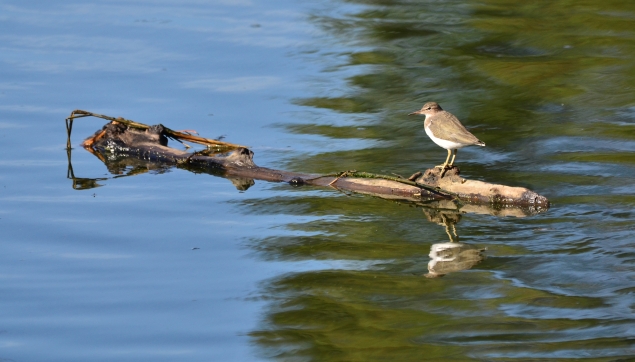
Did that unconvential Willet flock get you worked up?  Relax with this bucolic Spotted Sandpiper. Photographed at Lake Merritt's outflow.


You all know Hank, the world's most famous American White Pelican that lives at Lake Merritt.  I prefer to photograph Hank's wild, free-flying buddies when they are around (Hank is a cripple and was brought here from Oregon, where she collided with powerlines), but Hank just looks so damn sexy this time of year I had to crush her face.  And yes, as far as anyone can tell Hank is a girl, she was presumably named before anyone saw her next to any other pelicans (males are noticeably larger, though there is overlap).


This is my favorite photo I have of her, without a doubt.


In case you were thinking about being in a good mood today, here is a lynched cormorant for you to look at. What a shitty way to die...life is pain. Photographed at Lake Merritt.