Showing posts with label Glaucous-winged X Herring Gull. Show all posts

Thursday, May 18, 2017

Squid, Scum, Styrofoam, Scavengers


It's May. Not much birding lately...except from my exceptional yard. So far this month, I have the best yard list in the entire state, in eBird anyway. What else do you expect from #7? I'm not fucking around over here. Yardbirding has suddenly become very serious. But more on that to come...

Though I haven't been slaying lately, I did bird a great deal this winter and earlier this spring, so let's dip into that, starting with a Squid Crow. I've seen American Crows eat a great many different things, but this is the first one I've seen with a squid. The novelty is compelling; the ramifications are still being fully ascertained. San Leando Marina, San Leando, CA.


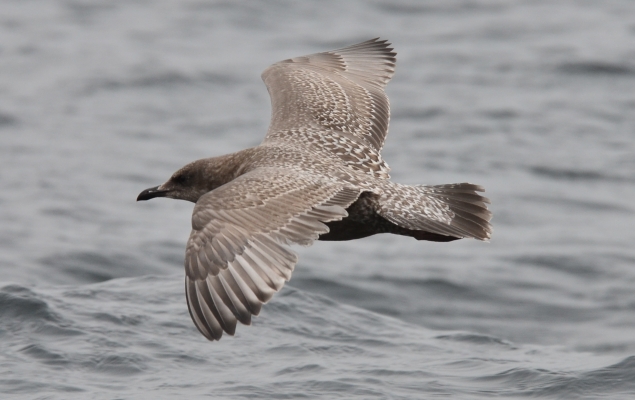
This first cycle Herring Gull was pleasantly typical. Novelty may be something worth seeing with Corvids, but not with large gulls. Revel in the simple gulls such as this that do not leave you wanting to reach for the bottle. San Leandro Marina, San Leandro, CA.


Soon, Thayer's (above) and Iceland Gulls may become much less of an identification headache. We are now in the calm before the shitstorm of butthurt that will come ashore when these birds are lumped. Get you shitjackets ready. San Leandro Marina, San Leandro, CA.


Anyone know who is putting field-readable bands on Western Gulls in the last few years? The banded birds from the Farallones typically just have an unnumbered color band as far as I know. San Leandro Marina, San Leandro, CA.


I'm sure something ended up scavenging this hapless scaup. Life is pain. Lake Merritt, Oakland, CA.


Is this what the future of birding looks like? Scum, styrofoam, and a mopey Mew Gull? Perhaps. Lake Merritt, Oakland, CA.


This Glaucous-winged Gull* has beady black eyes. Trippy. It looks possessed. Look away, nothing novel to see here. Lake Merritt, Oakland, CA.

*Not sure if Olympic Gull can be ruled out, but at the very least it presents as a GWGU.


Here is a more typical-looking Glaucous-wing. Not novel. That is fine. Lake Merritt, Oakland, CA.


We get a lot of birds that look like this in the bay in the winter. They aren't very big, and at first glance they look like a good candidate for a Herring or a pale-eyed Thayer's. In fact, with a second or third glance, they still like one of those two. Lake Merritt, Oakland, CA.


Take a look at the orbital ring...it's almost colorless. A grayish pink? It's not what you would expect on either a Herring or Thayer's. I reckon this is a Herring X Glaucous-winged that looks mostly like a Herring. Oh, and it did not show a Thayer's pattern on the underside of the primaries, if you are wondering.


Since we may be saying goodbye to Thayer's Gull, here is another one. So long, old friend. Pacifica Pier, Pacifica, CA.


Few species in the world have had poorer reproductive success than Heermann's Gulls in the last few years. HEEGs drew the short straw as far as fledging chicks goes...we in California can tell because juveniles have suddenly become rarities. Not mellow. Pacifica Pier, Pacifica, CA.


There are a few places around the bay area where Common Ravens are extremely tame. Though abundant and generally bad for nesting birds, they are pretty impressive up close. Look at that profile! Those cankles! Pacifica Pier, Pacifica, CA.

Tuesday, May 19, 2015

Total Chaos


It's been a while since I've done one of these posts, and I will go ahead and admit it up front: this post is nothing but old-fashioned TOTAL CHAOS.  Anyone remember that band?  Not sure why anyone liked them.  Anyways, this post is nothing but random birds that have not yet found their way into any other posts yet, but here they are.  There is no rhyme or reason, just a smorgasboard of bay area birds from earlier this spring.

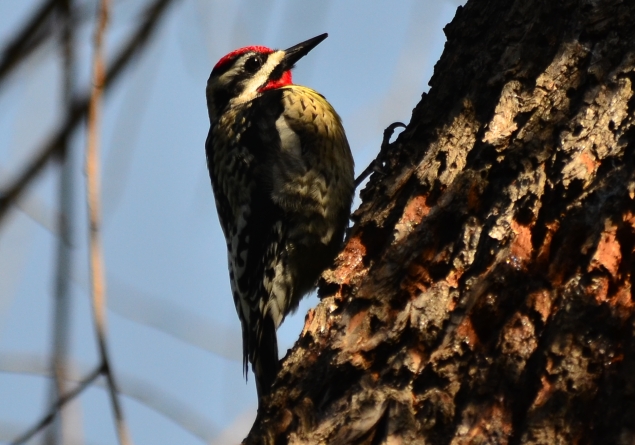
Let's lead things off with a Yellow-bellied Sapsucker.  Yellow-bellied Sapsucker is a rare bird here...nothing anyone would shit their pants over, but it's a good bird to bat leadoff in today's post. This bird has wintered at Don Castro Regional Recreation Area the past few years and I thought it would be best to pay it a visit.


It was hella cooperative, loafing on a tree next to the trail, occasionally sidling over to its sap wells for some sugary goodness.


Did someone say...gulls?  No?  Phew.  Can you imagine if it was gull season year round?  Fuck, that would be brutal.  Luckily, despite how well-adapted gulls are to humanity, they still migrate away from where I live for half the year.  This male Thayer's Gull is a long, long way from here right now.


Despite the identification challenges involved, birders love Thayer's Gulls.  They really do.  That's why I post so many of them on here.  Unlike most birders, I have the opportunity to walk right up to them and crush them with reckless abandon, without any regard to my personal safety.  Why do I do it? Because being scared of a Thayer's Gull is a ridiculous notion.


Far less inspiring, I am also not afraid to get close to Herring X Glaucous-winged Gull hybrids.  It's pretty gross though...I am always left feeling so...impure.  Note the yellowish orbital on this abomination.


Like silent gulls, silent dowitchers can always provide an identification challenge.  The bird coming into alternate plumage on the left (yes, the one with the short bill) has distinct, fine spotting on the breast, which is mellow for Short-billed Dowitcher.  The bird on the right has some different patterning on the breast, but since it is molting I'm not quite sure what to make of it.

A dowitcher is half the size of a Marbled Godwit, if that, though that doesn't seem to prevent them from wanting to unnecessarily roost inches away from one another...maybe the dowitcher was using the godwit as a wind break? At any rate, if this scene doesn't represent total chaos, then I don't know what does.


From one vantage point at a local park here in the east bay, the voyeuristic birder can watch feeding shorebirds directly beneath you on the rising or falling tide.  Western Sandpipers in high spring fashion have fantastically intricate back patterns that are hard to ignore.  I've said it before, but I don't understand the birder who doesn't have the stomach for sorting through shorebird flocks.


Look at those linear chevron patterns on the mantle.  This is really an underrated bird if you ask #7...look at one of these little cripplers for too long, and it will break your will to look at any other birds the rest of the day, abundance be damned.  Feeding in bubbles isn't helping things.


Forster's Terns have finally quit looking horrible and regained their simple yet elegant form of spring.


Up Mendocino way, this Golden Eagle greeted our crew of vagrant-starved nerds as we set out to see the Brownish Shrike.  As far as omens go, it's hard to top a Golden Eagle, and the cooperative shrike popped up after only a couple minutes of waiting.


You may look upon this image and think to yourself, "well this is certainly rubbish"...but you would be wrong.  For this is not a terrible picture of an American Robin, it is actually a profound photograph of a Varied Thrush.  The Varied Thrush is a bird of the ground, and a bird of the shadows.  This image captures the very essence of the Varied Thrush, and you know what that means...you are looking upon art.

Monday, November 17, 2014

Birding Is Hard: Return of the Gulls


Glaucous-winged Gulls, and their associated hybrids, are abundant in the bay area during the winter months. The most straightforward ones to ID look something like this; dark eye, pale bill, dark/barred (as opposed to streaked) hood, and pleasantly pale primaries. All photos from this post were taken at Oyster Bay Regional Shoreline, San Leandro, CA.

Here in the bay area, November is typically the month where birders begin looking at gulls again. I never look forward to this. By this time, I typically have not been obsessively looking at gulls since March, and my Larid skills have gotten a bit rusty. Luckily, November is generally not a great month for vagrant gulls (although Slaty-backed has shown up this early), so it's good to get my inner Gull Machine (a large part of my brain that is devoted to doing nothing but process gull identifications) firing on all cylinders again.

I hate gulls, but I just can't help myself. I must look at them. They demand my attention. I want the glory, the fame, and the sex of finding the state's second Great Black-backed Gull, or another precious Black-tailed Gull. I want to be able to competently discuss such obscure identification features that if I try to describe them to another birder, their eyes will just glaze over in utter horror and confusion...and you know what? I'm well on my way there, but unfortunately many birders are still able to understand what I am talking about, gulls are still frustrating to identify, and birding is still hard...and that is why I fail.


Thayer's Gulls are back; this is the first adult I've seen this year. Note how tiny it is compared to the big hybrid gull in the background. Speaking of the hybrid (note the almost-but-not-quite black primaries), it's clearly part Glaucous-winged, but I'm not sure who the other parent is. It's shaped like a classic Glaucous-winged X Western but the way the mottling/streaking (strottling?) looks on the head makes me wonder if Herring genes are in there. I don't know, you tell me...isn't birding hard?


Check out the massive white apical spots on this bird. Lookin' sharp.


My, what an appealing wing pattern you have Thayer's Gull. This is a pale-eyed Thayer's Gull, which are not uncommon locally.


The adult gulls here are still molting in their new primaries; check out p10 coming in on the leading edge of the wing, and how far it has to go before it's fully grown in. Wonderfully vivid feet on this bird, which is to be expected.

For more on Thayer's Gull ID, or if seeing a bunch of Thayer's Gull pictures is what gets you going, be sure to check out my sprawling Thayer's Gull post from earlier this year.


Shortly after the adult Thayer's Gull flew off, I spied this bird bathing in the same area. It looked rather similar...pale eye, heavily-marked head (not streaky like a Herring), relatively small...another Thayer's?


Hmm...there's no mirror on p9, which is highly indicative of Herring Gulls in the western U.S. And the mottled head is starting to look crosshatched, a very Glaucous-winged trait.


And now the bird seems pretty pale on the underwings...not dissimilar to a Thayer's. So if a gull has a wing pattern that looks like a Thayer's from below but a Herring Gull from above, what is it?


If you guessed that this bird was a Glaucous-winged X Herring Gull hybrid, I would wager that you are correct. If you ask me, this hybrid combination resembles Thayer's Gull more than any other. Fortunately, the "Cook Inlet Gull" is common here during the winter and provide ample opportunities for study. Unfortunately, the "Cook Inlet Gull" is common here during the winter months and I am forced to waste countless hours looking at them trying to figure out what the hell they are.


I only got to look at this bird very briefly in flight, and even more briefly on the water. At first glance I assumed this would be a 2nd-cycle Glaucous-winged X Herring Gull, but with my short look at the bird on the water and looking at these photos now, it appears to be Glaucous X Herring. Nelson's Gulls can be challenging to track down around here (for me, anyway), so this turned out to be a pretty nice bird.


Though a bit dark, I think if you took off this bird's head and attached it to a Glaucous Gull torso, it would look right at home.


Luckily, Bonaparte's Gulls are attractive and don't want to grind cloacas with all their closest relatives. And for that, Bonaparte's Gulls, I thank you.

Wednesday, August 20, 2014

Bravery Applauded: July Quiz Answers


Birding is hard. Quizzes are hard. I know. I applaud the bravery of the disturbingly few birders who submitted answers to last month's quiz, whether publicly or in private. Birders, being nerds, often don't have much going for them outside the birding world, and so it is understandable that many tremble at the thought of publicly misidentifying a bird. If they wrap up their entire identity in their birding skills, and those skills are shown to be lacking...then what is the desperate birder left with? Nothing.

However, my wonderful readers, you have a precious resource available to you. You may have heard of it. It's called, "#7". Since I am, in fact, #7, let me offer you some advice...it's ok to be wrong. Believe it or not, I have been wrong...many times. It's fine. Let go of that horrible, putrid, nerdy arrogance, and allow yourself to be vulnerable. It's amazing what people can learn, with minds and hearts open wide. That's how you get to the next level. If a birder deludes himself/herself into thinking that they are the absolute shit (and most birds are definitively not that), then their capacity for soaking up and being able to use new information is severely diminished. I hope the next BB&B quiz gets more participation.


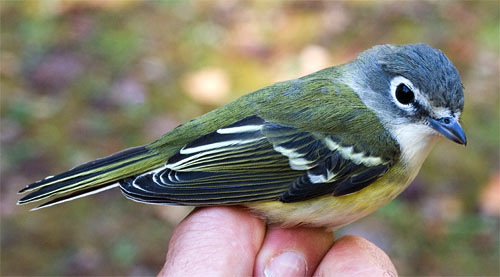
On to the quiz results. A few people guessed White-eyed Vireo for Quiz bird #1, but White-eyed  typcially have more strongly-colored backs and yellower/greener secondaries. The vireo above was photographed on South Padre Island, TX, in the spring of this year. I am comfortable with identifying it as a Blue-headed Vireo, the expected "Solitary" Vireo there, from the drabbest end of the spectrum. The contrast with the throat and head is quite strong, as is the color in the flanks...otherwise, it looks very much like a Cassin's Vireo. The back is somewhere inbetween gray and yellow, and the head is certainly not any shade of blue. If this bird was found in California and submitted to the bird police as a Blue-headed Vireo, would it be accepted? I would wager it would not. That said, I feel a lot of west coast birders do not have a strong grasp of the variability Blue-headed can show...they tend to have their hands full with Cassin's vs. Plumbeous.

I would like to mention at this point how dissatisfied I am with how National Geographic Field Guide to Birds of North America (6th edish) treats the Solitary Vireo complex. For starters, the illustrations suck, and each species only gets one paltry, sucky illustration. On top of that, the web of ID problems these birds can present is not really addressed in the text. Blue-headed Vireos are alleged to have "yellow-tinged wing bars and tertials", when obviously that is not always the case (take a look at this bird...or this bird or this bird). "Greenish yellow edges to dark secondaries", also listed as a Blue-headed field mark, is frequently found on Cassin's. I generally like the Natty Geo guide (it is the only book I've been recommending to other birders since the 90's), but the Solitary Vireo section needs some serious work.

Now, in the interest of embracing being Wrong, let me know if you have a convincing argument for this being a vagrant CAVI instead of BHVI. We can talk this out. The bird does sport "distinct white on outer tail", visible in other photos, but I'm not sure how unique that feature actually is to BHVI. Where is my Pyle guide???


Quiz bird #2 was, admittedly, fucked up. You could see a strongly colored Empid, gray-headed and yellow-bellied, with a solid eye ring and dark throat. These are helpful field marks, but you could not see the bill or primaries. One could deduce that the bill wasn't particularly long, but even that was a bit of a stretch.

Several people did guess correctly, despite that it was almost not possible in that photo to distinguish between Hammond's and Dusky Flycatcher. The dark gray throat, however, is characteristic of fall Hammond's Flycatchers, not Dusky. This Hammond's Flycatcher, photographed in the fall (when Empids are often the most colorful) was at Coyote Hills Regional Park, Fremont, CA.

For the record, I consider HAFL vs. DUFL to be the most difficult ID problem of "common" passerines that we have to face in California. Both species are significantly more difficult to find during fall migration than in spring, so I thought it would be nice to put up a plumage we don't get to see very often.


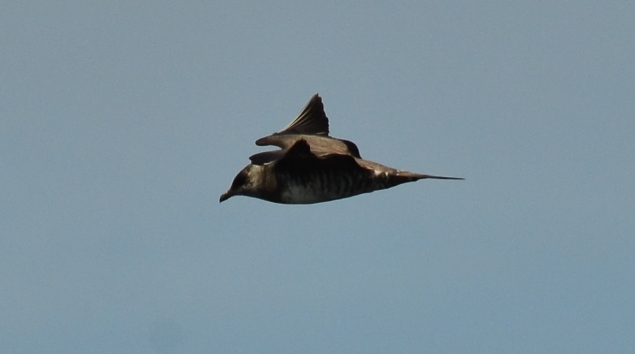
This jaeger suddenly becomes easily identifiable with the wings at a slightly different position. The dark secondaries scream Long-tailed Jaeger, as does the small bill. Bodega Bay CA.


Quiz 4? It's a Brown-crested Flycatcher. Texas birds have relatively petite bills compared to BCFLs further west, similar in size and shape to Great Crested but thicker than Dusky-capped. Ash-throated, of course, lacks the strong yellow coloration on the belly. Hidalgo County, TX.


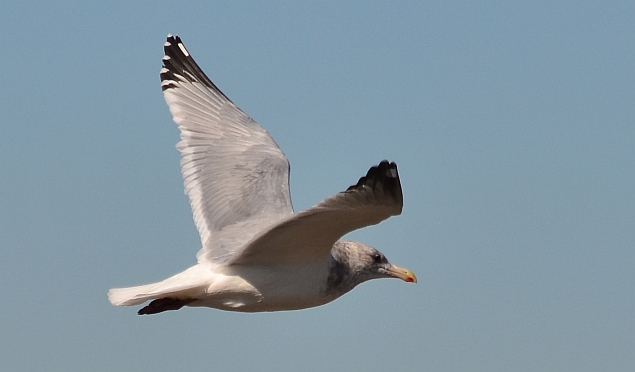
This is a pretty typical Herring X Glaucous-winged Gull. It has the bulkiness of a GWGU, but the bill pattern of a HERG. The primaries are perfectly intermediate in color between what we expect in HERG and GWGU. This hybrid can be quite common in northern California in winter. Golden Gate Park, San Francisco, CA.

So there we have it. Thanks everyone for checking these birds, and we'll see you again soon.

Tuesday, February 18, 2014

Often Sought, Often Misidentified: The Thayer's Gull


Adult Thayer's and a Mew Gull. Something to remember when attempting to ID adult gulls is to keep in mind how lighting, posture and digital photography can affect mantle color; note how pale the scapulars look on the Thayer's compared to the the rest of the wing. Miller-Knox Regional Shoreline, Richmond, CA.

Nothing brings more fear and loathing to the North American birder than gulls. True, birds like storm-petrels and Empidonax flycatchers can be vexing, but they just don't have the amount of staggering variation that "pure" gulls display in their many plumages, let alone the dizzying ensemble of hybrids that are out there.

One of the birds I am most often asked about for ID assistance (and see people constantly struggle with elsewhere) is Thayer's Gull. It is much sought-after by visiting birders, and even the birders that live here struggle with picking them out. Many seek this species, and many misidentify other gulls in the process. Here in the bay area, they are fairly common in winter, and occasionally can be found in large concentrations. So rather than flog the dead horse of Kumlien's vs. Iceland vs. Thayer's, I'm just going to throw up a bunch of pictures of Thayer's and what they are most often confused with here; Herring, Glaucous-winged X Western Gull, and Glaucous-winged X Herring hybrids.

This post isn't going to rewrite the book on Thayer's and I'm not into completely recycling what can be found in field guides, but hopefully this will be helpful/educational to someone down the line.


Same Thayer's, different Mew. This is a classic individual...long-winged, dark-eyed, round-headed, moderate markings on the head and breast. The bill is short and small with a indistinct gonydeal angle.


Another typical bird, with a slightly longer bill, which one would expect in a male. Gulls are sexually dimorphic, which explains a lot of the variation in size and structure within species. This photo also illustrates the pink-purple orbital ring, and most importantly, the inside of the folded primaries. Note the contrast between the whitish undersides of the primaries on the left wing and the standard black and white pattern on the upperside of the primaries of the right wing. This is a very useful field mark for identifying adult Thayer's. Photographed at Lake Merritt, Oakland, CA.


A heavily-marked bird. Even just that sliver of primaries visible from the right wing goes a long way to confirm this bird's identity as a Thayer's. Photographed at Golden Gate Park, San Francisco, CA.


Thayer's on the right, with a California Gull for comparison. Miller-Knox Regional Shoreline.


Light-eyed Thayer's Gulls are not uncommon in the bay area; use the underwing pattern and orbital color to tell them apart from Herring Gulls. Herrings are usually larger, but there is considerable size overlap. Golden Gate Park, San Francisco, CA.


This is the same bird as above. Although "string-of-pearls" is a phrase birders usually associate with Slaty-backed Gull, it's also what you want to see on the open wing of Thayer's Gulls.


Gulling would be a lot easier if you could get every bird to do this pose. The underside of the primary on p10 is a little dark (left wing) but I don't think that is unusual. Miller-Knox Regional Shoreline.


Here's the upperwing pattern of the same Lake Merritt Thayer's from above, for variety's sake.

I don't have much in the way of third cycle birds, so on to second cycles. As with younger birds, key in on the contrast between the inner and outer webs of the outer primaries to differentiate these from Herring Gulls. This bird was photographed at Golden Gate Park.


Same bird as above. Note the small, mellow bill and round head, creating a big-eyed look. This bird has slightly paler primaries than what I'm used to for second-cycle.


This isn't a particularly educational photo, I just like it a lot. Second-cycle Thayer's Gull, Golden Gate Park (different individual than previous photos).


Second-cycle. Marin Civic Center, CA


First-cycle with a lot of pink coming in on the bill. This is not unusual to see by mid-winter, although this bird is showing more than most. Photographed in Golden Gate Park.


Another first-cycle. Photographed in Golden Gate Park.


Same bird as above. This is typically what primaries of first-cycle Thayer's Gulls look like in mid-winter; long, dark brown with pale edges.


Another standard-issue first-cycle. Miller-Knox Regional Shoreline.


Similar to the above bird, but with more pink coming in on the bill. Miller-Knox Regional Shoreline.


Here is a very fresh, relatively dark bird photographed in mid-October, which is when Thayer's start arriving in the region. In fact, when I first saw the bird sitting on the water I thought it was a Herring because of how dark the primaries were. Note the pale inner primary panel and pale inner webs to the outer primaries, which separates this bird from Herring. This bird was far offshore, so those going on late-season pelagic trips should be on the lookout for Thayer's and other interesting gulls in the chum line. Photographed off Bodega Bay, CA.


Remember that dead horse I talked about? I guess I'll give it a kick after all. In the bay area, in late winter it is not unusual to see very worn and bleached Thayer's Gulls that look disturbingly whitish. Don't be fooled by these Kumlien's imposters. Photographed at Golden Gate Park.


Unlike the above bird, this one has feathers in good condition and is not heavily bleached. This creature has much more white in the coverts and flight feathers than the typical Thayer's. Could it be a Kumlien's? Maybe. Would birders in the eastern U.S. call it  Kumlien's? Maybe. Would California's Bird Police accept it as a Kumlien's? Nope. Do I know what it is? Not really, but I like it. Lake Merced, San Francisco, CA.


First-cycle Herring Gull. This individual is structurally very similar to Thayer's (many are not), but has a whitish head, extensive pink in the bill, and black primaries. Photographed in Golden Gate Park.


This Herring Gullish monstrosity bears more than a mild resemblance to first-cycle Vega Gull (note the white uppertail...more photos are available), but has a distinctly Thayer's Gull pattern to the outer primaries, and some bizarre mottling going on in the pale inner primary panel that doesn't belong on anything that I know of (double click for a closer look). I don't know what this bird is, but it's worth mentioning that given the tendency for large white-headed gulls to interbreed, we just don't know if/how much Thayer's Gulls are interbreeding with other species, as their breeding grounds are largely inaccessible. Seriously though...any ideas? Miller-Knox Regional Shoreline.


Here's a typical Herring Gull. Note the yellow orbital ring and obvious black and white pattern on the underside of p10 on the left wing. Golden Gate Park.


Olympic Gulls (Glaucous-winged X Western) are common in the bay area in winter. This bird is superficially similar to Thayer's in plumage but not in structure; it has short wings and a big bill that could give a smaller bird a brutal pummeling. Note the back pattern is somewhat sloppy and there are some new, dark gray feathers molting in on the mantle. Although this bird is pretty typical for a first-cycle Olympic Gull, its important to keep in mind that hybrids are incredibly variable. Olympic Gulls tend to be almost always larger and bulkier than Thayer's though (as there parent species are), so are not quite as challenging as Glaucous-winged X Herring, which to me show much more range in size. Miller-Knox Regional Shoreline.


Here is a putative Glaucous-winged X Herring hybrid. They are excellent impersonators of Thayer's Gulls, and can come in many shapes and sizes. On this one, note the heavier bill and indistinct patterning on the back; Thayer's are usually more boldly marked with primaries a tad darker, although with wear and bleaching that may not be the case. Golden Gate Park.


Another Glaucous-winged X Herring type (I don't think first-cycle GWGU x WEGU would get so much pink in the bill), perhaps resembling Thayer's more in plumage than the above bird, but with an even heavier bill and a small-eyed look. The tertials on this one appear very long compared to the length of the primaries, which is not something I associate with Thayer's. Miller-Knox Regional Shoreline.


An attractive Glaucous-winged X Herring adult. It could be confused with a pale-eyed Thayer's, but the gray primaries give away its hybrid vigor. Miller-Knox Regional Shoreline.


Here's a bird doing a good Thayer's impression...but look at the color of the underside of p10 on the right wing. It's too dark! When it took flight it confirmed an unlikely wing pattern for Thayer's Gull...I would guess this bird is also carrying a mix of Glaucous-winged and Herring genes, although in the field I thought the mantle seemed dark for that. I'm open to ideas. San Leandro Marina, San Leandro, CA.


Same bird as above. Note the extensive black in both the underside and upperside of the primaries (no string of pearls). The gonydeal angle looks very pronounced in this photo as well.


Thayer's have a reputation for being very small among those who don't actually see many of them, but in my experience that is not always the case. For example, take this light-mantled bird in front of these Western Gulls. I strongly suspect it is a big male Thayer's, but it could be a dark-primaried Glaucous-winged X Herring hybrid (or backcross) like the previous bird, as I didn't get a look at the wing pattern. Oyster Bay Regional Shoreline, San Leandro, CA.

Phew. That's a lot of gulls. If you would care to argue about any of the IDs I made in these photos, feel free to leave a comment. I'm ALWAYS willing to learn more about gulls, and for most of these individuals I have additional photos. At any rate, I hope you found this post educational, or at the very least, accurate. Gulling is a bitch.