Showing posts with label rose-breasted grosbeak. Show all posts

Tuesday, May 22, 2018

Smith Oaks, Hooks Woods, Eubanks Woods Sanctuaries


Smith Oaks was extremely productive for us on multiple days and hella fun to bird, generally better than Boy Scout overall. Smith was consistently somewhere between "moderately birdy" and "guhhhhhh birds everywhere" throughout the week...eBird checklists were best characterized as "corpulent". Here are a few of the hundreds of migrants we met there, starting with this Chestnut-sided Warbler.


As expected, the always becoming CSWA was a fairly common migrant throughout the week at all the migrant traps we visited.


A female Blackburnian Warbler with a trophy-sized worm of inches.


This is the same male Blackburnian that was hanging out next to the egret rookery in the last post. I'm still suffering from heart palpitations from seeing so many of these crippling heart-stoppers that week, which were one of the most common warbler species. So many glowing Blackburnians everywhere were difficult to cope with, physically, emotionally and spiritually.


Another crippling gasper, Golden-winged Warbler was certainly not a common migrant, but we did connect with more than I thought we would. We didn't come across any particularly confiding birds unfortunately, but who is complaining? Not me. A couple of them were singing, which is the first time I've ever heard them.
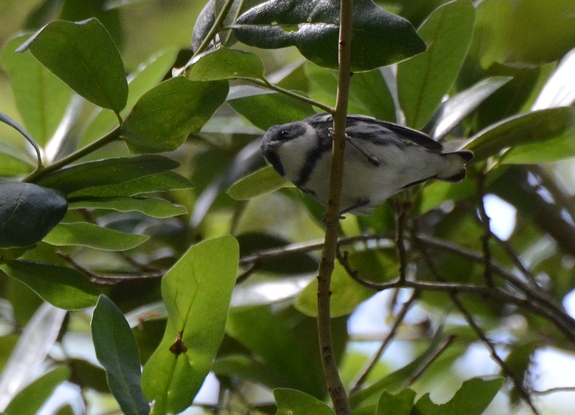

Though not a lifer, Cerulean Warbler was one of the main target birds of the trip for Yours Truly, #7. We had great success, and pleasantly saw a modest number of them.


Also like Golden-wingeds, they were hard as fuck to photograph/see well. Fitting, I suppose, for such a sought-after gem of a bird.


Female Cerulean, showing off her distinct long undertail coverts and almost stub-like tail.


Hella Wood Thrushes that week; we saw hundreds of them. This is not something I expected or have experienced before. Stoked.


When one encounters This Machine Nate on a trail, only one thing can be said for sure: you are in for a treat.


Nate's treat was met by a mix of intrigue and revulsion.


We also spent a lot of time at Hooks Woods. It's a lot smaller than Boy Scout and Smith, but it's the closest patch of trees to the coast, the habitat is good, and the concentrations of Geri there seem to vary between "low" and "bearable". This was the first Blue-headed Vireo of the trip; we would go on to see a handful spread out over the week.

I should mention that birding the road in front of the sanctuary can also be productive; this is where This Machine lifered Black-billed Cuckoo.


Here it is, your friend and mine, SWAINSON'S WARBLER, THE BROWN WONDER. This one was Dipper Dan's lifer. This was a good spring for these skulkers on the UTC apparently.


A surprise to one, Eastern Wood-Pewees adorned the migrant traps in large numbers. Lord knows how many of them were misidentified by Geri and friends.


Veeries were uncommon but dependable throughout our trip. Hooks Woods, and the lawn directly across the street from the entrance, was spilling over with Catharus the entire week. Thrushes were just littering the ground. We even saw some poor completely black thrush that had clearly just taken a bath in an oil pan someone had left out.

What a fucking bummer.


Where there are mulberries, there are Rose-breasted Grosbeaks. Mulberry trees are magic.


On our last day of birding the coast (April 27), Officer Shaw picked out this Olive-sided Flycatcher up in the canopy at Smith Oaks. Though not a late migrant on the west coast, it is in the eastern half of the country. It would be the only classic "late" migrant we would end up seeing; we did not connect with Alder, Willow or Yellow-bellied Flycatchers, or Mourning Warbler. We somehow dipped on Least Flycatcher as well, which seemed bizarre to me. I don't know if they are just not abundant on the UTC, or if they simply weren't moving through the area that week for whatever reason. We had several days with tons of Acadians...migration is weird.

Wrapping up High Island...Dipper Dan and I birded the High Island Historical Park (walking back to Guirdy Road) during the one very brief "slow" period we encountered....it was predictably slow, but I could see it being good when there are migrants around. We checked out Eubanks Sanctuary (mostly because we kept driving by it) on a birdy day and found it to be rewarding, although the habitat is overgrown and pretty much the same throughout the patch. Here is our eBird checklist; of note were Cerulean, Golden-winged and Canada Warblers (a new bird for the trip at the time). There is a pond in the back of the sanctuary that attracts a lot of birds, it is worth loitering around there for a bit. And amazingly, there were no other birders there! So if there are birds around and you want to take shelter from Geri, it is worth taking a look. We never did make it to the Crawford or Gast sanctuaries.

That wraps up our High Island coverage; in summary, it was as advertised. Absolutely ace birding, hordes of Geri, rampant misidentifications, and worthy of revisiting repeatedly.

Anahuac is up next!

Tuesday, October 11, 2016

The Death of The Bird Blog


This gleeful horsetender used to dwell in the Birdosphere. In fact, that is the only reason I know her. Like many, she got sucked into the gravity well of a non-blogging black hole, where so many of my comrades have met their fate.

Ah, the bird blog. At one time, it was very popular to be a blogging birder...but like so-called patriots telling us to "never forget", those days are long behind us. Most bird blogs lie fallow, with no fresh material being added for years. My flock, once large and thriving in the Birdosphere, is dwindling rapidly...there are only a handful of bird blogs I look forward to checking now. We are going the way of the Dodo...or to be more contemporary, our population decline mirrors that of the Lesser Prairie-Chicken. Our fate is uncertain, but it is decidedly gloomy for now.

So what has lead to the decline of the bird blog? It's not difficult to figure out.


Sometimes, when I'm not feeling particularly creative, I can slap something like this into a post and all I can really think of saying is "This is a Double-crested Cormorant...I sure see a lot of these. Yup...Ok moving on now...". That is neither fun to read, nor is it fun to write.

Most bird blogs are really similar in content and format. The vast majority of bird blogs that have surfaced followed the tried and true "I-went-here-and-saw-these-birds" format, with little variation. I'm not the first one to point this out, nor is this the first time I've stated this here. Obviously there is nothing wrong with this format (I follow it constantly) but unless you can really make your posts interesting and not the same stale, recycled trip report over and over again, it can be hard to get much of a readership...and knowing people actually read your content is key to having the motivation to create more. This leads us to a plain and simple fact:

Most people are not good writers. There is a reason that not all people are writers...most people are not good at it. That includes birders. If you don't have the ability to write in a way that draws people in, that makes people want to come back for more, then your writing won't gain much traction. Sure some bloggers honestly don't care about accruing readers, but hella people do. Of course, another reason bird blogs were popular was because it was a good place to see bird porn, which leads us to...


I like this Magnificent Frigatebird photo. It's not the most amazing photo, but I think it's definitely likable. Good bird, good pose, sharp, good light, no editing done except the slightest bit of cropping. Not long ago you wouldn't see bird photos of equivalent quality plastered all over Facebook or embedded in every listserv post or eBird checklist; blogs were actually a good place to check out bird porn. Bird blogs no longer have the significance they once did for photographers.

Photographers. Everyone is a photographer now. More birders carry some kind of camera than those do not, at least that is my impression, and there are a great many photographers (who aren't really birders in the traditional sense) who specialize on birds. This was not the case 6 or 7 years ago. And not only are there more photographers now, everyone is also sharing their photos everywhere they can. It's easy to see tons of bird porn on Facebook without even trying. Ugh, remember the "seven day nature photo challenge"? Glad that's over...I wasn't in to the whole birdspam thing. You couldn't avoid seeing bird photos if you wanted to.


A spring male Rose-breasted Grosbeak is a true thing of beauty, the sort of bird that can turn someone into a birdwatcher (sorry Savannah Sparrow). Is there room on Facebook to do this bird (verbal) justice? Is someone really going to launch into a profound ode to Rose-breasted Grosbeaks in a podcast? If so, please tell me when that becomes available. 

Social media is not just for sharing photos of course, the anecdotes and stories that once were prime blog fodder now get posted elsewhere as well. Aside from Facebook, podcasts have also begun to take up space in what was formerly blog territory. Who doesn't love podcasts? That said, if you are going to do a birding podcast you have to put a lot more effort into that than a blog post, and you better be good at it if you are going to have an audience. I can only imagine that making a consistently entertaining podcast is a hell of a lot more difficult than slapping a string of decent blog posts together, so I am very skeptical that podcasts are really going to catch fire in the birding world considering the necessary talent and effort required...also, birders tend to be very conservative in their public displays of humor, and that is not a recipe for good podcastery.

Many bloggers quit out of sheer laziness. That's cool, laziness happens. I can be pretty slothful myself. Life can get in the way too; yup, some birders have those. This is all totally understandable.

So there you have it - the bird blogger population is dwindling rapidly, and it is no great mystery why. With that all said, BB&B is going to call it quits.

Nah. I lied. BB&B has no plans for throwing in the proverbial towel...what would all of our interns do? Maybe we are atavistic scum-nerds with shit for brains, but we will blog onward. There are stories to tell, birders to lampoon, photographs to post in between the realms of Facebook and Flickr. The Birdosphere is not a popular place to be anymore, and that's just fine by me...if you really care about what is popular, then you shouldn't be birding. However, I will soon be facing a hurdle in my blog output...I'm going to be a daddy in a few months. Isn't that fucking crazy??? Not that it should surprise you (have you read the title of this blog?). I won't use that as an excuse to bury BB&B though, you have my word. As I said, what would all of our interns do?  

Wednesday, May 7, 2014

Migrants Oscar Mike


We are just past the peak of spring migration down here, but the migrants are still Oscar Mike and should be for a while. They say that May means empids in the LRGV...I've fared poorly so far...some Least Flycatchers and a "Traill's", and that's it. EBird is lighting up with Alder and Acadian reports, which I prefer to just think of as mostly misidentified Least Flycatchers and Eastern Wood-Pewees. This may be wishful thinking, but if you want to see some astounding feats of bird identification failure, this is a good place for it. The best one I've seen so far was a lady who identified a Black-bellied Whistling-Duck as a woodpecker.

As you know, I've been birding South Padre Island relentlessly this spring. I have major FOMO when it comes to missing interesting migrants on the coast, although by now I have seen many of them, and it is getting late for the one I am still really lusting after (Swainson's Warbler...there is a reliable eBird report from there this year...life is pain). So now I'm basically just going out to find some new Empids for the year, hang out with the expected migrants, and hopefully find a fantastic rarity like Black-whiskered Vireo or something that boggles the mind in a similar manner.

Mostly, I'm just enjoying eastern flavored spring migration, and seeing birds I don't normally get to crush or otherwise bump into very often. Newly-arrived birds drop in throughout the day, so the longer you spend on island, the more you will see. Just when you are ready to call it quits something fancy will show up, and after an hour, the process tends to repeat itself until you wonder how you managed to spend all day at two or three tiny spots.


Canada Warblers should be more regular this month, I only saw one in April. This bird is a real, honest-to-god crippler. The face pattern face melts. I mean, the eyering is two different colors...intricacies abound within the blinding goodness.


Thankfully, Chestnut-sided Warblers have become easy to find on SPI. They are very crushable. I find their plumage to be quite innovative.


It's like they have a moustache that goes all the way down their flanks. Pretty sick.


The Blue-winged Warbler photos I have now have improved since the last couple I posted. Like many warblers, this is a species that frequently is feeding only a foot or two off the ground here. Not what I would expect, but I'm not complaining.


I struggle to think of a caption for this. Not the crushiest shot, but you get the general impression of the bird. How do I go years at a time without seeing them? It can't be healthy.


After the scourge of Yellow-rumped Warblers departed (mercifully early), Tennessee Warbler quickly became the most abundant migrant warbler. Being nectar junkies, they are often quite confiding (see crush above). As of this writing, it still is the most abundant warbler out there. I have seen far more TEWAs in the last month than in all my life leading up to this spring. There sure are a lot of Tennessee Warblers out there.


Of course one of the downsides of having so many TEWAs around is that A) people misidentify them as Philadelphia Vireos and B) if you hear about a Philadelphia Vireo, you instantly become overly suspicious that this "vireo" is actually a Tennessee Warbler.

Rose-breasted Grosbeaks are often around in good numbers, although they don't seem to be quite as predictably abundant as the orioles. I think I like them better than Black-headed Grosbeaks. Sorry Black-headed Grosbeaks.


This one lacked the black breast streaking of the above bird. Younger individual?


Migrant sparrows are few and far between on the coast...Savannah and Lincoln's Sparrows, and some Clay-colored Sparrows (above), and not much else. Ever since my time working for Lostwood National Wildlife Refuge, I think of North Dakota whenever I see a Clay-colored. Their style is economical but I am a proponent of all the humble prairie birds.


Oops...not a migrant. Even Mottled Ducks come in to the bird seed that is scattered at the convention center. This is a bird that will never get anyone's pulse racing, but then again I'm happy to see one up close for once.


For some reason it seems immature and female Painted Buntings not only far outnumber adult males, they are also much more fearless. This is unfortunate. Can't say the same for Indigo Buntings.


Here's one of the few cooperative male Painted Buntings I've seen recently. Why does this exist? It's too much.


I have had the misfortune of seeing several mildly rare, western birds on South Padre Island. Of course a male Townsend's Warbler is certainly a crippler, but I would much rather see mildly rare eastern birds. Cape May Warbler? Yes please. I have no doubt that in the blink of an eye I will be knee deep in Townsend's Warblers again and longing for Black-throated Green Warblers.

Thursday, February 27, 2014

The Perpetual Weekend Bites The Dust


Brown Jay. I have seen many of these, but not in the U.S. I would like to see more. Photographed in Chavarrillo, Veracruz, Mexico.

It's been a good run, but all good things must come to an end. I must lay this Perpetual Weekend down to rest. It's day has come and gone, and I have found gainful employment once again. Next week I will be on my way to Texas...south Texas. The Lower Rio Grande Valley in fact. There are worse places to find yourself, if you're a convicted bird junkie like myself. In fact, the overwhelming majority of the United States' surface area is probably worse.


Rose-breasted Grosbeak. I have seen many of these. Soon, I will see more. Photographed at Des Lacs National Wildlife Refuge, North Dakota.

I've birded a bit in the LRGV and eastern Mexico before, so I'm not set to be hounded by lifers, but the birding will be fun. I'm really stoked on getting to experience spring migration in that part of the world...besides the Mexican specialties, the LRGV gets a lot of eastern species passing through, and the fantastic migrant trap that is South Padre Island is less than an hour away.


Piping Plover. I have seen many of these. Maybe I will run into one of my old piping friends from North Dakota? Photographed at Redmond Lakes, North Dakota.

My friends in California will be longed for, and Booby Brittany will be missed like never before. The stringers will run rampant in my absence. But remember these words: #7 will return.

Wednesday, October 31, 2012

Sandy Thoughts, Key Westerly Shots


I am now the proud owner of a decent Black-and-white Warbler picture. As far as I know Black-and-whites are completely unique in their nuthatchish lifestyle, but I wonder if there isn't an obscure Central or South American warbler that has the same act. Zachary Taylor State Park, Key West, FL.

With both the birding and nonbirding media squarely focused on Hurricane Sandy and associated storms, we here at BB&B feel it must be addressed. First and foremost, I hope all you Northeasterners, birders and nonbirders alike, weathered the storm successfully. It sounds like the storm-waifing was quite good...quite a few birds that were shifted about due to the "Frankenstorm" would be life birds for me. But, of course, lifer-envy is tempered by the significant loss of life and the vast destruction loss and destruction of property that occurred in multiple states.

I really wonder how long our elected deniers of climate change (whom, in my opinion, may as well believe the earth is flat) can publicly continue to stay the course of ignorance. Yes, it is politically expedient in some places to either deny or ignore global warming (as Sir David Attenborough recently noted), but climate scientists are increasingly able to put the pieces together about why the United States seems to be rocked with more and more extreme weather....the obvious answer is, you guessed it, climate change. Scientific American has a great article up on climate change and hurricanes, and why the magnitude of the Sandy Frankenstorm can be directly linked to the loss of Arctic sea ice. I do not doubt that the United States and other nations will act significantly on climate change, but I am fearful of what habitat (for wildlife and humanity) will have been destroyed or seriously altered by the time this happens. Lastly, I will make the obvious point that if this is something you think is important, you should be screaming from the rooftops (perhaps in a flooded neighborhood, where this is the best means of communicating) that no one in their right mind should be voting for Mitt or any Republican candidate in the upcoming election...as Mitt bluntly put it for all of us in the first presidential debate, "I'm not in this race to slow the rise of oceans or heal the planet."

But I digress. Here is another moderate-sized glut of Key West pics. Bird onward.


Great Crested Flycatcher. This bird has the typical big flesh-colored patch at the base of the bill, unlike the bird Christian nailed (with his eyes) in Santa Cruz County (CA) earlier this fall. Indigenous Park, Key West, FL.


Short-tailed Hawks (year bird) were surprisingly not hard to come by. All but one of them that I saw were dark-morphed individuals, which for South Florida are pretty unique looking...they have a very different shape than the only other dark Buteo that is likely to be found in the state (Broad-winged Hawk). Key West Botanical Gardens, Stock Island, FL.


Great White Herons were easy to find in the keys...hard to believe this white thing is the same species as Great Blue Heron. I like the big rusty patch that adds some character to this shot. Key West, FL.


Note the bluish face and heavy bill, good ways to tell these apart from Great Egrets.


The pale legs also set these apart from Great Egrets, although as you can see this bird must not have read the field guides before it came out of the egg.


This monstrosity is a very old Green Iguana. Once they reach a certain age they cease looking like something that is real. Zachary Taylor State Park.


This thing was pretty wild. It looks like a party. Uberblogger Nate Swick informs me it is a Roseate Skimmer. Key West Botanical Gardens.


My only Rose-breasted Grosbeak (year bird) of the trip. This bird acted less like a grosbeak and more like a Connecticut Warbler...a true master of the Skulk & Lurk. Indigenous Park.


Northern Waterthrush is a common bird in the keys, but it can still take some effort to get a good look at one. Finding them is easy though...they are loud and have a distinct call, and have a penchant for taunting birders from the mangroves. Photographed at Indigenous Park.


I took several dozen pictures of this bird at a high ISO, and only came out with a handful of usable pictures. Besides being a denizen of the shadows, the constant tail-bobbing didn't make things any easier. You win this round, waterthrush.


Believe it or not, I have actually taken pictures of humanoids from time to time. This is Booby Brittany on vacay.