Wednesday, December 28, 2016

Puerto Rico Winter Tour Y2K16: Comerio to Guanica


Our time in Ceiba was done, so the nerds got up early for making the Kessel Run trip to get the final east side target bird, none other than the rare, legendary and highly-localized endemic subspecies of Plain Pigeon. This is not a bird you will blunder into while birding in Puerto Rico; you definitely need to make a targeted effort to see them. Google Maps was highly ineffective in getting us to the right spot (again, beware the app's suggestions for shortcuts in Puerto Rico), but eventually we made it. It was a weird place...basically, you look for the birds from a baseball field. Lifer situation.

Adam and I immediately had a Plain Pigeon fly directly overhead when we arrived, basically looking down the first base line, though better views were definitely desired. Looking at the trees beyond the outfield was unproductive after the initial flyover, so I turned the scope around and started scanning the hillside beyond home plate....BINGO. We had distant but prolonged looks at two Plain Pigeons feeding in the blooming African tulip trees (local photogs call them tulipans)...fuck yes. A scope was essential here, so if you plan on seeing Plain Pigeon in any satisfactory way, do bring a scope or you run the risk of stringing a Scaly-naped Pigeon. We ran into some local bird photogs who were about to head up a road to the general area where we had seen the birds, so if you want to try and get closer to the birds you can walk up the small road at 18.222429°, -66.201390°.


Ground Zero in the valley of the Plain Pigeon.


Gray Kingbirds seem to run things in any remotely open habitat on the island.


The most conspicuous reptiles of Puerto Rico are the introduced green igaunas. They are everywhere. Any loud, crazy thrashing sounds you hear coming from shrubbery, plopping into ponds or falling out of trees are iguanas.

After the pigeon victory we headed down to the south coast, hoping to check out some random spots between Jobos and Guanica, where we sould be spending the night. This stretch of the island is seemingly unbirded by anyone who doesn't live in Puerto Rico, as this large area is completely absent from any trip reports I've found. Dipper Dan worked on trying to find some places to bird switching between eBird and Google Maps with mixed success...we managed to get to 2/4 spots we attempted to bird. Again, Google Maps on the island is not your best friend, but it's not worthless either.

Playita-Vertedero Salinas was a totally random spot Dan found on eBird that was not hard to access (17.955920, -66.286848). Just drive down the dirt road and park in the obvious dirt parking area next to the lagoon; scope the lagoon and bird further on down the road. The lagoon and salt flats were not overly birdy but did net us a number of trip birds (most notably the one and only Gull-billed Tern of the trip), and the mangroves along the road held Black-faced Grassquits (common and widespread on the island) and a smattering of warblers.


By far the best bird here (for me anyways) was this cooperative Green-throated Carib, which we got much better looks at than back at Humacao. Caribs appear to have their eyes set further back in their heads than other hummingbirds, which gives them a unique facial expression.


The deep blue belly contrasting with the emerald throat is a nice touch. This would be the last carib we would see on our trip, and we never saw Antillean Crested away from Humacao and the Fajardo Inn.


Palm Warbler was a new trip bird; we finally got our first Yellow Warblers of the trip here as well. The local Yellow Warbler subspecies turned out to be much more uncommon than we thought they would be.

Dipper Dan worked furiously on eBird, trying to figure out how to access other hotspots...attempts to access a couple bird areas east of here were met with abject failure (thanks Google Maps), but we did successfully reach Laguna Salinas (yes, another Salinas) after an awesome lunch at the Oasis Cafe and Bakery in Santa Isabel. Their coffee was unlike anything I've ever had...hot damn!

Accessing this site is interesting...you have to get on an eastbound onramp to Hwy 2 and then make a sharp right turn onto a dirt road directly off the highway. The dropoff between the highway and the road is pretty big, so I'm not sure how well this would work with a sedan (we had a jeep, so it was mellow). At any rate, the turnoff to the laguna is at 17.974407, -66.673697. The birding here was decent (in other words, more trip birds), with close looks at a Clapper Rail being one of the highlights. Lifer subspecies!
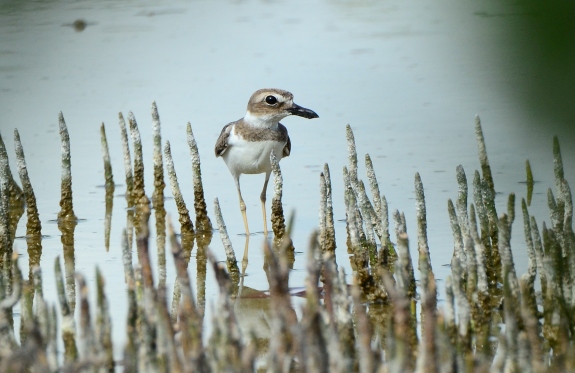

I hadn't seen Wilson's Plover since I was working in Texas a couple years ago...this bird was standing in the middle of the road, a niche typically occupied by Killdeer. Lifer situation. I had forgotten what a massive bill is attached to that cute little plover face.

At the end of the day we finally pulled in to our Airbnb, a few minutes southeast of Guanica. As we had hoped, the area had some decent birding to offer...a big semi-birdy (genuinely birdy places are apparently rare in Puerto Rico) lagoon was right next to our place. Venezuelan Troupial was a facemelting but reluctant lifer (they are an introduced species), and were very common here. This would be home base for the next four nights. One of the beds smelled like piss and the tap water was burly (not the owner's fault obvi, but tap water in other parts of the island was excellent), but otherwise it worked out really well. Lots of great birding within an hour's drive!


The view from the balcony, a mellow mangrove-lined lagoon with the famous Guanica Dry Forest cloaking the hills in the background. Tranquilo, though the mosquitoes got annoying. This was one of the best views of any Airbnb I've ever stayed at, though I still think "The Edge" in Lubec, Maine, still has...an edge.


These amazing/terrifying lobster-tailed things were crawling all over the place. You never know what is waiting in the bushes of love.


The lagoon was filled with Lesser Yellowlegs and Stilt Sandpipers; more than 400 Stilt Sandpipers could be seen roosting from our balcony every day, which is hella to a California birder. The only place we can see that (well, maybe not anymore 😓) is down at the Salton Sea.


White-cheeked Pintails were the commonest ducks here, which were always visible in some numbers. Fantastic. I no longer need to feel the pain of a stinging gripoff whenever one is seen in Florida.

The next day we would bird a lifer habitat in the Guanica Dry Forest, which was very kind to us. Spoiler alert: lifers.

Tuesday, December 20, 2016

Puerto Rico Winter Tour Y2K16: Humacao and Ceiba Country Inn


December 3: Again we woke up fighting the blear (do you blear what I blear?) that always comes with getting up hella early in tropical places with jetlag and without coffee. We birded briefly around Ceiba Country Inn before breakfast. We have realized by now that Zenaida Doves are abundant and widespread (though I did not come back with good enough photos), and a couple were poking around the driveway early in the morning.


Red-legged Thrushes are also easy to find in areas with second-growth forest. Unfortunately, most of the birds we saw were on the shy side. The one bird that sat 10 feet away in the sun glowing like a bastard chose to appear while my camera was out of reach (typical), though Dan and Adam got to crush it (also typical). If you go to PR, don't expect these birds to be hella approachable unless you blunder into a tame mall bird like we did.


Loggerhead and Gray Kingbird combo! A pair of Loggerhead Kingbirds briefly hung out near the inn, which we had not seen the day before. They remind me of a cross between an Eastern Kingbird and a large Eastern Phoebe.

After breakfast (toast AND cereal this time...luxurious!) we rolled down to bird Humacao ("Reserva Natural de Humacao" in eBird) on the east coast, a site that can be good for waterbirds and the two "eastern" hummingbirds of the island, Antillean Crested Hummingbird and Green-throated Carib. According to the birder's guide, this area was good for West Indian Whistling-Duck and Masked Duck, but eBird suggests that this has not been true in recent years - as both species are prone to wandering, Humacao may eventually become a good spot for both species again. Unsurprisingly, we did not see either species here.

The access situation is a bit odd - there is the "official" access along Rte 3, which has limited hours and is closed on weekends, but immediately east of there is some kind of park (across from the tire store) with concession stands and an information kiosk that essentially allows access to the same areas. This is where we entered (18.150726°, -65.772021°), and it worked out quite well. We did not try birding the northern part of the reserve (north of 3), where it looks like there is a lot of good habitat as well.

The birding here was interesting; the habitat looked very good, but it wasn't a particularly birdy place. It seemed like Humacao would be dripping with North American warblers, but as we noticed the previous day at Ceiba and El Yunque, there were relatively few migrant warblers (Northern Waterthrushes, redstarts, a Prairie Warbler, and some dude playing an Ovenbird tape). This would become a theme for the entire trip; we only found two sites that had more than a handful of warblers, but that would come later. The one exception to this rule of warbler scarcity was Northern Waterthrush, which were abundant in mangroves everywhere.


The first birds of note were white-shielded American Coots, which until recently were Caribbean Coots. Soon afterward, we got on two White-cheeked Pintails in one of the lagoons...what a refreshing lifer. I haven't seen a new duck in a long time...a long time.


As with practically every vegetated place in Puerto Rico, there were Bananaquits galore, though this photo was taken in El Yunque. In Puerto Rico, they seem to have a foothold in a wide array of terrestrial niches.


Puerto Rican Flycatchers were widespread and common during our trip at lowland and mid-elevation sites. This is another very Eastern Phoebeish bird from certain angles.


It was here at Hamacao that we had a run-in with our second Reluctant Lifer of the trip, in the form of Tricolored Munia (the first was Bronze Munia/Mannikin back at Ceiba). None of us were interested in going out of our way for filthy, disgusting exotics, but it was inevitable that we would be dealing with them. Much more interesting than the munias were our first visuals of Mangrove Cuckoos of the trip.


Mangrove Cuckoos are surprisingly common in Puerto Rico, and can be found in many different habitats.


I'd only seen them once before (in Costa Rica), so this was a nice bird to get to see almost every day.


Most sites were teeming with lizard or frogs or both. In the lizard department, we saw a lot of whiptails.


This big one was rocking an indigo belly patch. I'm into it. It could be a different species than the yellow-striped duder above or just an adult. It's not like I'm #7 in whiptails, cut me some slack.


We plodded through the mud, slowly accumulating trip birds. Dan got looks at the first Green-throated Carib of the trip, while Adam and I were gripped off and forced to stew in our juices. Further on down the trail we ran into a patch of Antillean Crested Hummingbirds (lifer!), one of which Adam brought in by hanging an orange bag in a tree. Brilliant.

On the way back to the car, we noticed the tree behind Adam (above) had a lot of yellow blossoms, and waiting around the tree ended up producing both Green-throated Carib (lifer!) and another Antillean Crested Hummingbird. I was very fucking relieved to see these birds, as we had missed them the previous day and they are much harder to find on the west side of the island, where we would be spending most of our time. The night before, in a dream, I thought I found a Carib...but it turned out to be some sort of weird Anna's Hummingbird hybrid...talk about a fucking nightmare. I took it to mean that we would be doomed in finding this bird, but fortunately it was probably just the fruit of all the emotional baggage I have with Anna's Hummingbirds. Anyways, it is worth mentioning that there were hardly any flowering trees at Humacao when we were there, and we found hummingbirds at all of them.

Having succeeded with multiple target birds (our eBird checklist is here), we decided to try the Fajardo Inn to see if we could put the crush on any hummingbirds there (there didn't seem to be much blooming across from the police station at the time, another suggested spot). It seemed pretty barren for a while.


This large, plain anoley thing was one of the few noteworthy finds at the hotel.

Eventually, Adam got on an Antillean Crested Hummingbird in a bottlebrush tree next to the tennis courts, where we had some mild success in getting photos of this little facemelting bastard with flash.


What a good bird.


These things are tiny and blackish with short little bills, quite different from the island's other hummingbirds. The males have amazing crests that glow blue in natural light. I dig the subtle iridescent feather tips on the underparts you can see here too.

That night would be our final night staying in Ceiba, so after we got back from farting around Fajardo we put on our rally caps and started looking for Puerto Rican Screech-Owls, our last remaining local target, which again seemed to be very quiet compared to our first night there. After doing many laps around the inn (these are very short laps) and walking all the way down the driveway and back up again, we got visuals of two Puerto Rican Screech-Owls next to the parking lot. Talk about grinding out a bird! Getting long looks at these birds turned out to be clutch, as not surprisingly we would not see any more during the trip. For those of you thinking about staying here, Ceiba Country Inn is a very good place to get the owls, and one of the guys running the place seemed surprised that we failed to see them our first night when they were constantly calling. Though it was hard to recover from this ruthless browbeating, we took advantage of our final chance and got quality looks.

Having secured all our local target birds in the nick of time, it would be time to move on in the morning. Up next, the nerds go west on a Plain Pigeon odyssey, and make the long sandwichy trash fire trek to Guanica.

Tuesday, December 13, 2016

Puerto Rico Winter Tour Y2K16: Ceiba Country Inn, El Yunque National Forest


Pearly-eyed Thrasher is a common and confiding bird in Puerto Rico. I'm not quite sure what to make of them though...they are like drab, friendly, fat-legged super-robins.

Puerto Rico is in the books. Birded, done. Thanks to the marvelous MAX REBO BIRDING TOURS who hired me on as a guide, in eight (8) full days of birding, we tallied 137 species. That doesn't seem like a whole lot coming from California, but to put things in perspective that makes us #18 in eBird for Puerto Rico for 2016! So we did pretty good with the time we had, because it's all about the trip list...or maybe the year birds...ok, lifers. Basically, we birded the northeast end of the island, then west to Comeria (the Plain Pigeon area), the southwest, then along the north coast west of San Juan. For those who have as much time as we did, I think it was a really good route - those focused solely on endemics should focus more on the western half of the island though (none of us had birded the Caribbean before, so there were a lot of new native birds we could get elsewhere). Several target birds were easier, or only seen on the east side of the island.

Puerto Rico...why Puerto Rico when you can go to Mexico? Belize? Jamaica? There are a great many other alternatives for a shortish winter trip, but I had some good reasons to put together a trip to PR.

- PR is part of the U.S., so travelling here is relatively easy and free of hassles. Road systems are pretty good, no passport required, English-speakers aren't rare. Tap water was awesome 2/3 places we stayed.

- PR is small. In the amount of time we had, we covered the island very well, and didn't spend a whole lot of time on the road.

- Endemics. PR has 17 endemic species at the moment, with the island's pewee a possible 18th. If you want to see these birds, Puerto Rico must be visited. All can be seen in a short amount of time.

- Caribbean birds. Caribbean species were almost totally new to us, and this is a great introduction to species that can be found on multiple islands.

- Habitat. Though PR isn't the most species-rich place, there are a lot of places to bird, though some species and subspecies are highly endangered.

- Birding on islands is fucking great.

Some general notes for those planning on visiting:

- We rented a 4x4 Jeep on the advice of Officer John Garrett. We did use four wheel drive several times, as a number of roads were very muddy with deep puddles (i.e. 306 in the Lajas Valley, the access road to Laguna Cartagena). Muddy roads may not be as much of an issue later in the dry season, but having 4x4 available with high clearance turned out to be very useful. We were there at the very beginning of the dry (EL SECO) season.

- Google Maps is only partially effective. Do not expect Google Maps to navigate you through Puerto Rico with ease. Many roads that show up in Google Maps are unmaintained tracks, or private roads that cannot be accessed. Be very wary of shortcuts the app may suggest - it works fine for the real highways though.

- Emergency vehicles often drive with their flashing lights on, even though they may not be in a rush to get anywhere. Semi trucks often are equipped with crazy, extravagant flashing lights for seemingly no reason at all. Do not let this alarm you.

- This is the first place I've visited where drivers seem to have no concern about staying in their lanes, often swerving into oncoming traffic. It is baffling. People also seem to be really into driving with their high-beams on all the time.

- Potholes and topes are everywhere.

- Knowing Spanish is helpful, obvi, but many people speak English....not everyone though.

- Gas is pretty cheap. Food can be cheap or pretty expensive, depending on your proximity to tourist areas. Cheapest lodging is airbnb (we stayed in three different places; two were airbnb apartments).

- Biting insects were mildly to moderately annoying - no-see-ums were worse than the mosquitoes, in my opinion, and the chigger scene wasn't bad. Mosquitoes were the worst in the Guanica area and in other low-lying spots, though oddly absent in some places. Obviously, Zika is a thing here, but we weren't exactly terrified of it.

- We brought a spotting scope. Not as clumsy or random as a blaster; an elegant weapon for a more civilized age. You should bring one too.

- Mofongo is weird.

December 1: I meet up with Dipper Dan and Officer Adam Searcy and the rest of the MAX REBO BIRDING TOURS group in the baggage claim of the San Juan Airport. Between baggage claim and the rental car center, we get our lifer Zenaida Doves and Greater Antillean Grackles; both species would end up being very abundant, though not obnoxiously so. Without any bullshit, we quickly and effortlessly pick up our Jeep from Hertz, who I am now a big proponent of (Gold Club!). We immediately get lost in San Juan, and then watch a hapless Zenaida Dove get run over by a car right in front of us! Fuck! Finally we reorient and slog through traffic to get east to Ceiba, seeing some roadside Scaly-naped Pigeons and Gray Kingbirds on the way (some of the most abundant birds on the island). We arrive at Ceiba Country Inn, where we would stay the next three nights. The Inn's Puerto Rican Screech-Owls were present as advertised, but we failed to see them despite the birds calling loudly and frequently. There is a SHITLOAD of nocturnal activity around the Inn...coqui frogs, anoles, tarantulas...it was awesome. If being deafened by frogs turns you on, this is where you want to be staying. We got dinner at the Broadway in Ceiba, which was cheap and great.


We saw a staggeringly large number of coqui frogs and anoley things at Ceiba Country Inn, none of which were identified (herpers, feel free to cut loose here), but all of which were appreciated.

December 2: We woke up before dawn and started birding around the Inn. Lifers started piling up quickly...Red-legged Thrush, Pearly-eyed Thrasher, Puerto Rican Oriole, Puerto Rican Flycatcher, Puerto Rican Woodpecker. Adelaide's Warbler, Mangrove Cuckoo and Puerto Rican Lizard-Cuckoo sang from nearby. The Inn turned out to be the easiest place to see the oriole for us on the entire island. Bananaquits were also abundant, and we would see them in numbers practically everywhere we went. 

After a minimal and unimpressive continental breakfast (this place is more like a hotel than a bed and breakfast, which is how it is advertised), we headed up to El Yunque for the day. We birded the gravelled trail behind the visitor's center, and got our lifer looks at Puerto Rican Bullfinch and Puerto Rican Lizard-Cuckoo, which we watched capture a scorpion directly us. I also lifered the tody, which I had missed back at the Inn. Both the cuckoo and the bullfinch are common, but not the easiest birds to see.


Puerto Rican Orioles were common early on in the trip. They are obnoxiously nifty looking.


Lifer Puerto Rican Lizard-Cuckoo, dismantling a scorpion right above our heads.....fuck!


I love cuckoos. This bird is absolutely facemelting.

The next stop of consequence was the Yokahu Tower, where we lifered a Puerto Rican Emerald taking a bath in a leaf. After the emerald disappeared, we were suddenly besieged by lifers.


Puerto Rican Spindalis (this is the only one I would end up photographing, what a bummer)...


Puerto Rican Tanager (competing for Drabbest Tanager award)...


Green Mango (not expecting this today, especially not one so cooperative)... 


and Loggerhead Kingbird (a bird that has evoked much drool from me in the past)...what a stop!

The mango was a definite bonus bird, as they are less common on the east side of the island, and most visiting birders only seem to get them in Maricao. Some other stops in the park weren't particularly noteworthy on the bird front, but walking the Las Minas trails were very productive. Immediately after getting the first Black-throated Blue Warbler of the trip, it started dumping rain so we took cover in one of the great many rain shelters present (really, there are a lot). The birding here was excellent, even though we spent a significant amount of time birding from rain shelters.


The lush forest at Las Minas soaks up the rain.


Nerds avoid soaking up the rain.


Scaly-naped Pigeons are very appealing.


Puerto Rican Bullfinches are common, thankfully. I was really taken by them.


As great as the bullfinches are, it's hard to match the legendary Puerto Rican Tody.


Northern and Louisiana Waterthrushes (above) foraged in the creek (and in a rain shelter) at Las Minas. Check that raging supercilium! This was the only LOWA we would find in PR.


Lots of awesome orchids were blooming in El Yunque...but this is an iris I misidentified as an orchid. Anyways, don't you love the tropics?

We visited El Yunque on a Friday, to avoid the weekend crowds, which I would recommend. The Big Trees parking lot was full but otherwise the people sitch was pretty manageable. We did not try for the Elfin in El Yunque, opting instead to look for it at Maricao ("Elfin-woods Warbler siempre en Maricao" - random local photographer we met). After Las Minas, we randomly ended up in Fajardo, hoping to blunder into some trip birds at accessible beaches. And blunder we did! We got our only Sandwich Terns of the trip, as well as the first Brown Boobies, which seemed to be fairly common.


Pelicans, Sandwich and Royal Terns roost at sunset, while frigatebirds wheeled overhead. Life is better with frigatebirds wheeling overhead. We grabbed dinner at an overpriced place a couple blocks away, but I have no regrets about putting away those damn fine shrimp.


We put these Smooth-billed Anis to bed. We would see many more during the trip.

Back at Ceiba Country Inn, we drank much Medalla and failed again to see the screech-owls, which were very quiet that night. This may have been because a nearby neighbor was blasting some of the shittiest music I've heard in my life...and believe me, these ears are no stranger to shit.

Ugh, so many lifers in one day...the mind reels...More Puerto Rico coverage coming soon!


Tuesday, December 6, 2016

The Five Mile Challenge


Like Jesus once did, Flycatcher Jen's blog has arisen from the dead to make the world a better, more Christian place. Well maybe that isn't entirely true, but I Used To Hate Birds is back, and it makes me feel a lot better about things. I was reading one of her new posts the other day and she mentioned an idea that struck a chord with me...she is starting to track birds she has seen within a 5 mile radius of her house in PDX. Her 5 mile list is quite impressive, definitely larger than mine, and features a number of Vague Runts. My 5 mile list, if I were to try to put it together, is not something I would relish in comparison. I just moved to my new place a few months ago, and my old patch (Middle Harbor Shoreline Park in Oakland) is not even in my new circle...what horeseshit. I don't even have any hotspots I check regularly in my new 5 miler.  Good places like Ferry Point, Lake Merritt and Arrowhead Marsh are just out of reach...but I do have the Emeryville Marina, the Albany Bulb, and Tilden Park...it could be much, much worse.

But I digress. I am not about to start a 5 mile list...but how about doing a 5 mile Big Day? It's pretty much a lazy Big Day, which sounds extremely appealing. I'm down to bird more locally (I may not have a choice soon!) and it would be cool to actually check out a couple new spots. So, coming this January, Flycatcher Jen, This Machine Nate (in Austin) and myself will challenge one another to see who can bag the highest number of species within 5 miles of where they live in 24 hours. Simple. We are aiming to all do it the same day in order to make it more suspenseful, but rescheduling is allowed if someone is totally rained out.

What does the winner get? Bird books. I need more bird books, and if I win, each loser will buy me one. This is nerdy as fuck, yes, but at what point have I claimed I wasn't a nerd?  The brand new Peterson Field Guide to Birds of Northern Central America would be an awesome pickup, and something like this would be cool too. Basically, FJ and Nate losing will directly result in me gaining more knowledge and sacred bragging rights, and that's just too good to pass up. Bring it on goddammit!