I've seen some Orcas. Not hella, but a handful. I've seen them in the Aleutian Islands (Attu and Buldir), one out of Half Moon Bay, and now one out of Bodega Bay. Shearwater Journeys had a trip out of Bodega Bay last week, and I had the good fortune to be leading that day. In my book, it was a Great Success.
The uncanny thing is that almost every time I see Orcas (and possibly every time...if only I had kept this very important data) I end up getting a life bird the same day...last time it was a double lifer day, with Salvin's Albatross and Craveri's Murrelet. So although many people who have seen Orcas in the wild feel a strong, almost mystical attraction to them, their feelings for The Grampus pale compare to mine.

And as you have deduced by now, I got a life bird.

Let's not waste any time. This was my life bird, one I was really hoping for this fall due to the warm water that has been sitting off the coast for several months now. It is none other than the legendary GUMU (Guadalupe Murrelet), an extremely good bird in northern California and a difficult and unpredictable find anywhere in U.S. waters. Very few have made it this far north in recent years, at least close enough to shore to be found by boats making day trips.

Compared to Scripps's Murrelet, note the longish bill, huge white spur in front of the eye, and also the white kinda creeping up behind the eye, giving the eye a "framed" look.

The bird was quite cooperative, and I have no doubt that everyone on the boat was able to see it. This was the last alcid I needed to see from the eastern Pacific!
Before all the Synthliboramphus excitement, the day began with seeing some familiar faces from SoCal boarding the boat in Bodega Bay, which is a difficult thing to process when you woke before 5 AM, your morning coffee is wearing off and your dementia-inducing seasick medicine is beginning to kick in. Luckily I remembered everyone's names and awkwardness was averted, which in some circles is enough to make me a BIRDING HERO.
As we got a few miles out, the expected fog bank closed in. A (presumable) Wilson's Snipe whizzed by, which was not a bird anybody expects to find offshore. Gulls following the boat began attracting Common/Arctic Terns in decent numbers, which zipped in to view and back into the fog in a matter of seconds. This was odd, since we were not very far out and these terns are typically not very numerous. Once we cleared the fog, the true picture emerged....there were Arctic Terns everywhere. For almost the entire day, one could scan the horizon and see Arctic Terns. There were only a handful of confirmed Commons. Personally, I would guess that I saw 150+ Arctic Terns that day, which is more than I'd seen in my life combined.

When encountering small terns at sea and you have a decent camera, I highly recommend on-the-spot chimping to help confirm the identity of uncooperative terns. That, or have Steve Howell near you at all times. These are both Arctics...check out the almost Sabine's Gullish wing pattern of the young bird on the left.

Note the crisp black edges on the primaries.

I've never had such good looks at these birds before. Hella cooperative.

Here's a classically streamlined, long-tailed Arctic. Of course, as you can see from the above photos, not all of them are going to look like this.

Here is a Common Tern, which looks dumpy and ungraceful (disgraceful?) in comparison. Note the slighly longer bill and the slightly different shape of the "keel". The black on the primaries looks messy in comparison to what Arctics show.

Less numerous but also omnipresent were Sabine's Gulls. We never had a single flock, but they were with us the entire day as well, almost all the way back in to the harbor.

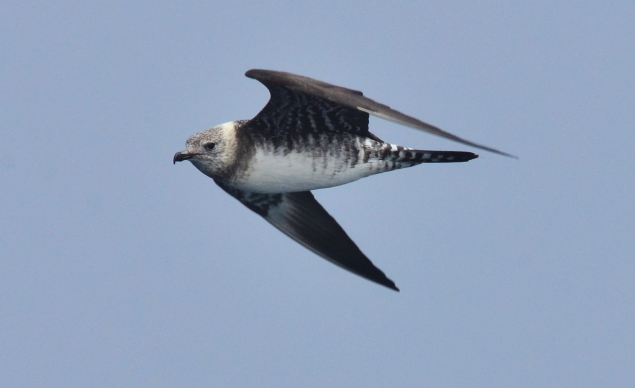
And what do hella small pelagic gulls and terns mean? It means jaegers, obviously. And we did have hella. Only 3 Long-tailed for some reason, but lots of Pomarine and lots of Parasitic, most of which were pretty far offshore. There was much thievery to be had on the high seas with so many small terns and Sabine's Gulls around...here dark and light Parasitic Jaegers team up on a really bummed out Arctic Tern.

A different Parasitic Jaeger, this one a very clean adult.

Black-footed Albatross, Arctic Tern, Black Storm-Petrels, a shearwater sp. and a California Gull all converge on where the Orca made a kill. Pretty cool collection of birds if you ask me.

Pomarine Jaegers do not fear the boat. This bird came right in for a brutal crushing.

Look! Jaeger talons!

Here's one that still has it's spoons, although they look pretty thrashed.

Long-tailed Jaegers remind me of falcons sometimes...I reckon this photo illustrates that nicely.

The cap on a Long-tailed Jaeger is very different from the other jaegers...it's very neat and confined, which for some intangible reason helps make them a cut above the rest..

Yes, we had some skua too. This was my first JAEGER SLAM of the season. It is typical, by the way, to capitalize JAEGER SLAM, in the event you experience one (slammed by one). This is also an extremely typical skua picture, in case you are wondering.

Enough of the kleptoparasites. We also had a single Tufted Puffin on the trip, in Sonoma County waters.

This bird is either going through a gnarly molt or is rapidly evolving into a new sort of penguin-being (interesting if true). I've never seen a healthy-looking alcid look so poorly equipped for flight before.
It was a great way to kick off a grimy weekend of high-quality September birding. I'll be on Debi's Monterey boat this Saturday...see you there.