Showing posts with label Common Goldeneye. Show all posts

Monday, February 3, 2020

South Bay Winter Slumber


While Santa Clara is not known as one of the premiere gulling counties in the state, that is not because there are a lack of gulls. There are many thousands of Herring Gulls (like the one above) in the county right now, and where there are Herring Gulls there are rare gulls...sometimes anyway. I have at least managed a Santa Clara Glaucous Gull already this year and a 5MR Western Gull, which I didn't see in the radius until November last year. Photographed at Don Edwards NWR.

Uhhhhhhhhhhhhhhhhhhh it's February. I don't know how I feel about that. It sure got here quickly, and as I say in BB&B pretty much every year I'm leery of March birding around these parts. Things have been pretty slow this winter here in Santa Clara, especially if you opt to not attempt feverish county year birding and rechase all the rarities you already chased a month or two ago, or the previous winter. But! But. BUT...the middle of winter is generally a great time to be birding around these parts. If you really need to see a rarity or a year bird or whatever every time you go birding, then just give up birding and be honest with yourself and everyone else...you are not a birder. You are a chaser. You don't enjoy the activity of birdwatching, you like birdchasing.

I think the quasi-elitist and increasingly obsolete notion that listing is something to scoff at now borders on being something to scoff at itself. Let's face it, most of us have bird lists that we care about. Listing is not the problem here, heck chasing isn't even the problem. I happily chase stuff on the reg and recommend it highly. The problem is when you get so locked into certain lists that they dictate that you run after other people's birds every time you go out. Going out with the hopes of finding something interesting yourself, once standard practice when one went out birding, is becoming increasingly uncommon and comparatively bold.

Is it time for a great schism in birding? Is it time for the strict chasers to separate themselves from the rest of us? There is already a large and still growing subset of photogs who seem to chase every rarity but never find anything rare themselves. Something to ponder on a cool February day.

But now that I've begun to peel back the lid on that can of worms, I'm going to put it back on the proverbial shelf for another post. That was not a road I intended to go down! Shifting gears (but probably still instilling some butthurt anyway), I've really been enjoying my new CANON gear after kicking Nikon to the curb. With the assistance of CANON, here is a sampling of our winter birds from along the edge of the South Bay.


Iceland Gulls can be be quite common at certain sites right now. Here is a particularly eye-catching bird with a big dark hood. Photographed at Don Edwards NWR.


Here is a more typical looking Iceland (darker eye, whiter face) photographed from the same spot. Photographed at Don Edwards NWR.


While Herring x Glaucous-winged are often the most common hybrid in Santa Clara gull flocks, along the bay Western x Glaucous-winged like this one can be more abundant. The Olympic Gull is a particularly unpleasant creature and I have nothing more to say about them. Photographed at Don Edwards NWR.


Mew Gulls, with their small size and delicate build, are absolutely delightful in comparison. They should have named Daymaker Gulls. Photographed at Don Edwards NWR.


I thought this COMBO was worthy of posting, a ring-billed Mew Gull and a ring-billed Ring-billed Gull. Photographed at Don Edwards NWR.


The occasional close pass by a Northern Harrier is always appreciated. Photographed at Don Edwards NWR.


Familiarity breeds contempt, but as common as they are Turkey Vultures are still cool to see close up. Photographed at Don Edwards NWR.


Santa Clara is not a very goosey county, but we get a light smattering of non-Canadas every fall and winter. Here is part of a family group of Snow Geese that have been wintering next to Shoreline Lake near Mountain View. Photographed at the Shoreline Park kite flying area.


A group of Greater White-fronted Geese is also wintering in the same area and are similarly acclimated to people, no doubt due in large part to the large flocks of JUDAS GEESE (nonnative/tame Canada Geese) here. I like the lawn-mowing lineup.


Sometimes, I think about grebes. Luminous beings are grebes. I am a fan of Horned Grebes, but it is one of those species that makes me wonder why, know what I mean? Like if someone could do a brain scan while I looked at a Horned Grebe vs a Western, there would probably be more HOGR-related brain activity even though WEGRs sound way cooler and have a legendary courtship display. Maybe it all goes back to when I first started birding, where HOGRs are harder to come by. I'm sure a great many of my feelings and opinions about certain birds, and birding in general, are heavily colored by those early years more than I realize. Photographed at Shoreline Lake.


EARED GREBE/HORNED GREBE COMBO!!!!!!! The HOGR is showing off its flatter crown, thicker bill, and more contrasting face/neck/flank pattern.


While I think of it, I wanted to mention another aspect of my new Canon gear that I forgot to bring up in my previous post about it. For all previous combos and iterations of Nikon bodies and lenses I've used (which are numerous), one flaw that all of them had was that when the subject was on a flat surface (i.e. sitting on or flying low over water, on mudflats, in short grass) and not close up, the camera invariably have a very difficult time focusing on the intended subject. I could shoot 50 similar frames and sometimes less than 10 would have the subject acceptably sharp with good light and good settings and a near-stationary bird, which is a really shitty ratio. I have no such problem now with the Canon 90D/100-400mm II and couldn't be happier. Photographed at Shoreline Lake.


These Western Sandpipers just had to probe the same exact spot. Must be awkward to bump bills under the mud. Photographed at Charleston Slough.


Let's wrap things up with some avocets, photographed at Charleston Slough. Avocets simultaneously look gangly and awkward in flight, but somehow also striking and graceful. There are a shitload of avocets in the South Bay and I'm pretty happy about it. 

Wednesday, March 21, 2018

The Rancho, Rarities, Radii and Rebo

Christ on a cross! Should I just quit while I'm ahead? Put BB&B to sleep forever? The 5MR post has quickly shot up to the third most popular post we've ever had...and in case you've forgotten, that is ten years of blogging, close to 1,000 posts! What have I been doing with my life?! The only more popular posts are LIFE IS PAIN (thanks to Reddit) and RISE OF THE STORM WIGEON (thanks to birders and hunters).

Well, I'm not sure how to follow that up, so I suppose I can just cover some recent birding, which I've practically stopped doing somehow...blogging about it, that is.

March vagues. Well, somehow suddenly spring is here. It's been a real slow winter for yours truly as far as vague runts go, but the previous winter featured a Ross's Gull, so I can live with that. While great for wildflowers and so-so for spring migrants, this month is a mediocre (and I'm being generous with that adjective) time in the state for seeing chronic rarities. There have been a handful of notable exceptions in the state recently though...but I'm sure as shit not going to chase the goddamn Gyrfalcon again, which was well photographed this month and is quite possibly still here. As usual, Humboldt/Del Norte sucked in another winter MEGA in the form of a Black-tailed Gull, which (this year) is too far for me to see. A more-or-less-confirmed Steller's Eider has been seen by several observers in Humboldt County, which would fulfill a prophecy made by a certain visionary birder back in November. I would be exceptionally gripped off if other birders were having much luck refinding it, but high surf, bad weather and a lack of an elevated viewpoint is preventing that from happening...but I could really use seeing a megaeider right about now.

Closer to home instead of Nome, I dipped on a Slaty-backed Gull over the weekend here in Santa Clara County, which is very typical for me and that species - in general, February and March seems like a great time to find them in the state though. It's only the second in the county, but with all the gulls that winter here and the relatively few observers around who could identify one, I suspect they are here with some regularity. The bizarre, long-staying Garganey may have finally left its duck pond (mostly a Mallard pond) down south, as it has not been seen for a week.


Inexplicably, this year has been heavy on Bald Eagles for me so far, despite putting in no effort to see them (very nice, I like) - I've seen three from my yard alone! This one was next to my house at the Los Capitancillos Ponds.


This Anna's Hummingbird had the brilliant idea of building a nest right next to my hummingbird feeders...talk about convenience! She was able to incubate eggs while protecting her feeders at the same time. I suspect the chicks got eaten though :/

Rancho de Bastardos. The yard birding is pleasant as usual, but it has been a long time since a new bird has been added to the yard list. The most recent highlight was a California Towhee with a white head that bounded through the yard. The yard list sits at 120 species (newest addition was Red-breasted Merganser in January), with 87 recorded so far this year...that is tied for #1 in all of California, by the way. With spring migration in effect, I'm hoping it won't be long before we get something new...Orange-crowned Warbler, Bullock's Oriole, Allen's or Rufous Hummingbird would be nice.


March is a good time for scouring your 5MR. This White-tailed Kite was along the Los Alamitos Creek Trail, a part of my radius that I plan on giving more attention to this year.

The 5MR. What's funny (in a sad way) is that I've seen and heard about a ton of other 5MRs in the last week or so as this thing has blown up, and it turns out mine is one of the worst of them all in terms of potential for species diversity and rarities. No matter, I will keep on toiling! Incredibly, my last new 5MR bird (Rufous Hummingbird) was also a county bird....fuck yeah.

Winter rarities. As I said earlier, I've given up on catching the blog up on all the birding I've done...but it's not like it's been a completely dull winter, despite the lack of lifers and state birds. Here's some of the rarities I've met up with from the past few months.


I was hoping that this Barrow's Goldeneye (surrounded by Commons) would return to Shoreline Lake this winter, and the dude obliged. Nice county bird, and typically a species I only see a handful of times each year anyways.


After seeing the goldeneye, I bumped into this "Common" Teal in Charleston Slough, which I had totally forgotten was present. Sweet. We Nearcticans think of them as just another subspecies (or two, can't forget nimia), but the IOC treats them as a separate species. Will the AOS ever be persuaded to embrace this vision of distinct tealness?


Vesper Sparrows are really hard to come by in the bay area; they just don't venture to the coast very often. This obliging and confiding stub-tailed bastard at La Honda Creek Open Space Preserve (San Mateo County) was the first I've seen locally.


I went to San Luis National Wildlife Refuge for the first time this winter; it was mellow, not as birdy as Merced, but this Swamp Sparrow at a random part of the auto tour route was a nice find. It is only the 8th eBirded record for Merced County, though I'm sure with the amount of good habitat out there they occur on the reg.


This Vermilion Flycatcher wintering in Coyote Valley is the first Santa Clara County record, and was a great way to kick off local birding in 2017. This species has become considerably more regular in much of the state since when I started birding in the mid-90's, even factoring in the increase in observers.

And just like that, winter is singing its swan song and spring will be in full effect before you can say "five mile radius". I look forward to the year birds....and county birds! I didn't get out a ton in Santa Clara last spring, for reasons too boring to state here, but this year is different.

Of course, spring birding is really going to be kicked up a notch when I get out to Texas to lead a trip for MAX REBO BIRDING TOURS (no one finds Ortolans like Ortolans!), where every day will cough up all manner of avian rewards. I will be gagging on neotropical migrants. It will be truly gluttonous birding, even with slow days at the migrant traps. And while I mention it, a space just opened up on the trip...don't miss this opportunity!

Contact MAX REBO BIRDING TOURS for details.

Thursday, July 6, 2017

The Bra Collector, A Touch of Turd, The H-Word


When you see a bra strung up on a fence, that can only mean one thing...


...a Loggerhead Shrike has been very busy. Clearly mice and sparrows are not enough for this insatiable fiend.


This fearless, woman-eating shrike (which is pooping out woman in this very photo) was in the Robinson Road area near Rio Vista in Solano County, which is a fantastic area for grassland birds. I dipped on the reliable Mountain Plovers, but it was a very successful day otherwise.


Sometimes a combo just needs to be shown, despite the rubbish photo. This Ferruginous-Swainson's Hawk combo was unexpected, and very much appreciated. Swainson's overwinter in the state in low numbers, primarily in the Delta region. I would go on to see double-digit numbers of Ferruginous Hawks here that morning, as well as several Rough-legged Hawks, one of 2016's big dips. I don't think I've had all three [lovable/amazing/inspiring/thirst-quenching] of these Buteo species in one place before, stoked.


A few Burrowing Owls were holding it down as well. Note the turd in the bottom right...much like myself, the Burrowing Owl loves decorating the entrance of its home with turds.


After giving up on the plovers, I went north for a staked out Glaucous Gull on the side of Yolo Bypass. It was pretty amazing to see the bypass being fully utilized...to the west of the dike I was on it was dry, to the east it was an inland sea out to the horizon! Yolo Bypass exists to keep Sacramento and other cities from flooding; when there is a lot of precipitation in the northern half of the state, a series of weirs upstream divert water from the Sacramento River into the bypass, which is mostly farmland. The farmland floods, the cities don't. Anyways...I was able to haynor the Glaucous Gull from an excruciating distance, and eventually it flew in a bit closer to feed on a dead coot. Not only did this end my stupid stupid 5-year drought of not seeing Glaucous Gulls, this was my lifer adult. Siiiiiiiiick.

Other highlights that day were Surf and White-winged Scoters (the latter was another bird I somehow missed in 2016) from Sherman Island, and a huge Tricolored/Yellow-headed Blackbird flock in a feedlot on the way home. Good times in The Great Valley.


In between winter storms I went out to Richmond Marina to see if anything needed crushing. This Forster's Tern did.


As did this one. That's quite the glaucous upperwing.


This female Common Goldeneye threw its feet out to help brake for landing, which made for a quick tasty crush.


I think it is time to come clean...Aechmophorus make me uncomfortable sometimes, I will admit it. You know, they are totally entitled to do what they do, but when certain individuals are around me I just want to get the hell out of there...not that I'm a Aechmorphobe.

Take this bird for example. Bright yellow-orange bill, pale flanks...solid Clark's field marks. But the black cap is sitting right on top of the bird's eye, and the dark nape stripe has a lot of girth to it. I'm inclined to call this a Clark's x Western Grebe hybrid, and you know how I feel about dropping h-bombs. Both Aechmorphorus may look different in the winter than in summer, but I don't think Clark's broaden that nape stripe when temperatures drop.


Here is a typical winter Western, with paler lores and dusky cheeks.


Aesthetically this photo has nothing to offer, but it does give you a good comparison of the broad nape stripe of a Western Grebe (left) with the narrower stripe of a Clark's (right).


When I still lived in Albany, I tried a number of times to see the Burrowing Owl that lived next to the parking area for Albany Bulb. Who does not want to see a Burrowing Owl just down the road from their house? However, I failed repeatedly, and all I got was judgement from this Say's Phoebe.


Luckily, Say's Phoebe did not go home with the "bird of the day" award. Small numbers of crecca Green-winged Teal, presumably from Siberia, make their way to California every winter; they are easier to find than Tufted Ducks, but rarer than Eurasian Wigeon. This is no crecca though...this is crecca x carolinensis. Not something you see every day. Don't let your kids look at this image, as few photos have been taken of something so impure.


A nice, clear-cut intergrade. The white lines on the face are pretty weak (carolinensis), but the bird possesses both a strong white vertical breast bar (carolinensis) and horizontal scapular bar (crecca). Cool bird. Albany Mudflats, Albany, CA.

Sunday, March 8, 2015

Winter Hangs On In The East Bay


Mmmmmm....Nelson's Sparrow.  Show me your orange face.  Show it to me at high tide.  Does anyone else think of Nelson Muntz whenever they hear the name of this bird?

Much of the Birdosphere is already talking about spring, and the eastern half of the U.S. is dying for spring, but here at BB&B we are desperately clinging to winter, if only because that is the season we associate with desperately needed rain and snow.  Listservs are being flooded with grave news of birds pairing up and flirting with each other, but that is not a dialogue that BB&B will be joining...not yet.  Foxtrot Oscar Sierra and Foxtrot Oscar Yankee are not phrases that abound, at least not for another couple weeks.  Winter birds are still here, after all, and aside from a swallow here and an Allen's Hummingbird there, the local avifanua remains distinctly winter-flavored.  Well, let's start things off with a rare bird and take it from there.


Nelson's Sparrows winter in California in low numbers (very low numbers), and after trying many times over the last few years to see our local bird or two at Arrowhead Marsh, I finally succeeded.  Although secretive (as expected), the bird was pretty confiding, giving some of the best looks I've ever had.


I had to manually focus for this shot, and bump up the ISO a bit.  Not bad, eh?  If I had a county nemesis bird, this would be the one, so getting such good looks was supremely satisfying. Good luck to you Nelson, on your way back to Saskatchewan or wherever it is you are about to be going.


Like Nelson's Sparrows, Marsh Wrens hate when you look at them, especially if you are nearby with the sun to your back, so it's always nice when they pop out in the open and even better when they sit for a portrait.  Unlike Nelson's Sparrows, Marsh Wrens have yet to be split, although some feel that that would be appropriate.  Photographed at Arrowhead Marsh.

For years I have known that Lake Merritt's outlet, the channel that connects it with the bay, was a good place to see Barrow's Goldeneyes up close, but I had always settled with seeing them occasionally on the lake itself, often at great and uninspiring distances.  I finally decided to check out the channel and was rewarded with this female Barrow's, my Foxtrot Oscar Sierra and Lima Oscar Sierra, which provided some of the best looks I've had of the species.


Interesting pattern on the bill...I'm not sure how much of that darkness is actual pigment and how much is accumulated gunk.  It's possible she is a young bird, retaining some of the mandibular darkness of a juvenile, but I don't think there is a way to conclusively know.


Perhaps you, the discerning birder, were concerned about the first two photos of the Barrow's Goldeneye.  Perhaps you liked the yellow bill, but not the head shape.  This is where your concerns can be laid to rest.  This is where you can tuck them into bed and say goodnight, and sing them the last lullaby they will ever hear.  Birds can change their head shape....it is known. Diving ducks often flatten their crowns when actively feeding...now you know.


It would have been preferable to have the hen Barrow's next to a hen Common, but drakes are better looking so I'm not complaining.


A female Common Goldeneye shows off the classic head shape and bill pattern one would expect of the species, although I wasn't expecting to see her on such a towering perch. Interesting approach.


Greater Scaup are the bane of molluscs, and they take their mollusc-bane very seriously. Photographed at Lake Merritt's outflow.


I wish my digestive system would allow me to just choke down entire shellfish...but if I could do that I might be a type of scaup, which is an odd thing to consider.


Big plumes are sprouting from the backs of egrets everywhere.  Great Egrets are ubiquitous in wetlands around the bay, and despite their abundance they will not be ignored.   I think it's fascinating that birds with such large ranges can be incredibly variable or, to our eye, very homogeneous...for example, there are 13 recognized subspecies of Marsh Wrens in North America, but just 1 subspecies of Great Egret that we know of.  Perhaps if they had more variety in their color palate there would be noticeable geographic variation, but then again maybe not.  Photographed at the Lake Merritt outflow.


Is Willet the new phalarope?  A Peregrine Falcon in the area was keeping the shorebirds from their preferred roosting destination, and out of frustration this Willet flock simply landed on the open water. Photographed at Arrowhead Marsh.


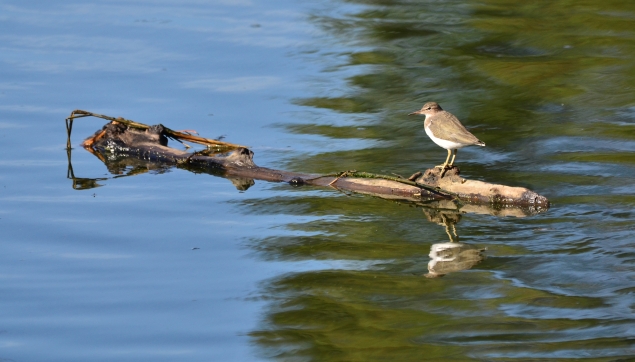
Did that unconvential Willet flock get you worked up?  Relax with this bucolic Spotted Sandpiper. Photographed at Lake Merritt's outflow.


You all know Hank, the world's most famous American White Pelican that lives at Lake Merritt.  I prefer to photograph Hank's wild, free-flying buddies when they are around (Hank is a cripple and was brought here from Oregon, where she collided with powerlines), but Hank just looks so damn sexy this time of year I had to crush her face.  And yes, as far as anyone can tell Hank is a girl, she was presumably named before anyone saw her next to any other pelicans (males are noticeably larger, though there is overlap).


This is my favorite photo I have of her, without a doubt.


In case you were thinking about being in a good mood today, here is a lynched cormorant for you to look at. What a shitty way to die...life is pain. Photographed at Lake Merritt.