Showing posts with label red-shouldered hawk. Show all posts

Tuesday, November 11, 2014

I Still Fiend For Vague Runts, But I Can Actually Look At A Common Bird (And Enjoy It)


Hey buddies. Felonious Jive (The Great Ornithologist) and I have just not been good bloggers lately. We've hardly been birding, to be honest. Between work and raging super fucking hard various social obligations, life has been pretty eventful, but not in any avian sense. In fact, I've been birding so rarely of late that I can now actually look at a common bird and enjoy it. Like today I looked at avocets and was able to appreciate them, instead of wishing they were a different shorebird species that were more apt to have rarities associating with them. Of course I still fiend for Vague Runts, but in time, my urges will be sated, once again. Thank Christ that goddamned pipit is gone so I don't have to think about it anymore; the Brambling doesn't hurt nearly as much.


That said, let's start this post with a Vague Runt Tropical Kingbird. Tropical Kingbirds are not unusual in late fall up and down California, generally a low-level rarity along the coast, but we don't get tired of looking at them...especially when they are vomiting. Lake Merced, San Francisco, CA.


Did you think I was being cute or something? That UFO on the left side of the photo came out of the kingbird's mouth. Look how far away the kingbird was able to fling it! Talk about hurling.


This female Black-throated Blue Warbler spent some time at Mendoza Ranch on Point Reyes last month. I know this isn't really a crush, but bear with me...it was really dark under the canopy and my ISO was set at something like 50,000, so it's amazing that anything is visible at all.


Also amazing is how confiding members of this species can be. It always astounds me...for whatever reason, they just don't seem to give a fuck. A bird on the Dry Tortugas brushed me with it's wing. This bird was feeding at eye level, less than 3 feet from my face. If you want to suck someone into birding, arrange for them to have a meeting with a Black-throated Blue Warbler. They will be hopeless bird junkies after that.


I said I would give you common, so I'm going to give you common...here is a Common Raven having an aerial tangle with a Red-shouldered Hawk. Photographed at Lake Merced.


The same two birds. I would imagine that if you are any sort of bird of prey larger than a Sharp-shinned Hawk, you would hate ravens. They are relentless in their harassment of raptors, and apparently impossible to kill. Anyone ever see a bird of prey get a good whack at a raven?


Not common, but Tricolored Blackbirds are to be expected on outer Point Reyes. This male is showing off that long bill that can often be of great use in distinguishing them from Red-winged Blackbirds.


Here are a pair of female Tricoloreds, wallowing in shit. Don't feel bad for them, they love it!


Golden-crowned Sparrows are horrendously abundant this time of year, but they are still fun to encounter by eye and ear. Even though the bird is sitting on an "artificial perch", I'm kind of into how intensely brown this photo is. #Shadesofbrown is the new #Shadesofgray. Arrowhead Marsh, Oakland, CA.


Although I've met a number of Common Loons that seemed pretty fearless, I don't meet Red-throateds very often that lack their species' usual disdain for humanity. Photographed at Arrowhead Marsh.


Brown Pelicans are truly charismatic birds, being capable of both inspirational majesty and baffling clumsiness. I honestly think this is a species that nonbirders (with the exception of some fishermen) appreciate more than birders do, since they are huge, abundant, highly visible, and prefer to fly awesome routes in tasteful formations. Photographed at Arrowhead Marsh.


Raptors aside, I can't think of another bird in the bay area that is more fun to watch while they are feeding. Photographed at Arrowhead Marsh.

Sunday, November 11, 2012

A Lack of Pronounced Eye Ridges, The Umbrella Move, A Calming Calm


American Crocodile. In the United States, crocs are only found in extreme southern Florida...probably the easiest place to see them is in the marina area and Buttonwood Canal at Flamingo in Everglades National Park. Crocs can be told from gators by their pointed snout, lack of pronounced eye ridges, obvious teeth sticking out, and their preference for salt (and sometimes brackish) water.

How do you like that? Starting off a post with a nonavian organism? Yeah, we get pretty crazy around here, no question.

Now that we know exactly what a birder is, here's another slough of photos from the Everglades for your enjoyment.


I somehow managed to not photograph an alligator while in the Everglades this time, although we saw (and heard!) a few. Crocodiles are listed as "Threatened" in the U.S.


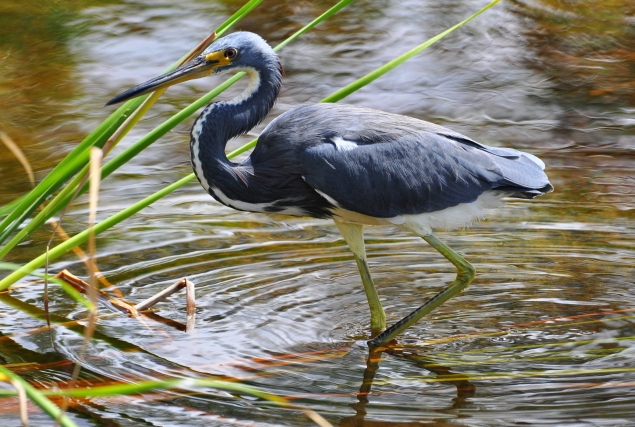
I did not expect Mrazek Pond to be particularly birdy, but there was a lot going on. This Tricolored Heron was feeding hyperactively right next to the road.


Yup, it even busted out the classic umbrella move. Reddish Egrets aren't the only waders that can dance. Nice primaries eh?


Showing off it's tricoloredness while Blue-winged Teal lurk in the shadows.


I really like how the water appears in this picture, even though the heron is a bit backlit. They really are striking birds.


Red-shouldered Hawk is another South Florida classic...it even has it's own subspecies (extimus). They are common and unwary in a lot of places. 


The hawk scans its sawgrassy domain.


The top end of the Buttonwood Canal, nicely framed by mangroves. You need a craft of water to get here...the calm water is indeed calming. Also worth mentioning are the hundreds of White-crowned Pigeons that flew over on the way to this spot.


I think this is some kind of Needlefish (Belonidae). They seem to be everywhere in South Florida and the keys, often right on the water's surface.


White-eyed Vireos are hard to miss in Florida, as with much of the southeast. Their songs are fun to hear, they seem to be gifted with a larger repertoire than other vireos. Whoever named them should get an award for common sense.

Friday, October 28, 2011

It's Thought Parole, Population Control


Least Bittern. So, so sick. Martinez, CA.


Well birders. It's almost Halloween...this month has really flown by, you hear me? The best of fall birding is most likely behind us, and birders to the north are already slipping into a state of catatonic depression...winter is nigh. Of course, its not so bad for us Californians...we get almost as many ubervagrants in winter as we do in September and October. All is not lost.

There are all pictures from last winter that never made it up on BB&B for some reason. Drink them in with your eyes. Then drink something else, because the weekend is here.


Hooded Merganser. Golden Gate Park is one of the easiest places to see "Hoodies" anywhere in the state. San Francisco, CA.


Blue-winged Teal. Hella common in the east, hella uncommon on the west coast. Redwood Shores, CA.


Red-shouldered Hawk. Ventura, CA.


Green-winged Teal pair...I like how the colors on the drake turned out. Redwood Shores, CA.


Western Scrub-Jay, with a hookier (shrikier?) bill than normal. Ventura, CA.


Red-tailed Hawk dispute. Voles are in high demand. Martinez, CA.


Black-necked Stilts. Heck of refined. Martinez, CA. 


Thursday, October 13, 2011

The World Is An Oyster Locked In A Shell


A Red-necked Phalarope takes off with a valuable piece of crud. Somewhere in San Mateo County waters, CA.

Ouch. Excruciating back pain and a ravaging illness....all completely unexplained...are both pummeling my body as we speak. The thought of producing any sort of output, creative or otherwise, makes me wince. But BB&B readers must be satiated, or I fear they will throw their laptops into their bath tubs with them and call it a day.

I understand this. We are doing new and fantastic things at BB&B headquarters that have never even been conceived of before, let alone actually tried. The Birdosphere is abuzz, the kudos and accolades are rolling in with the speed and power of an Indonesian tidal wave. Things may never be the same.


Red-shouldered Hawk. Looking for things to murder with its feet. V Street Loop, Arcata, CA.


Juvenile Long-billed Dowitchers sew the mud for deliciousness. Arcata Marsh, Arcata, CA.

I was kept, for the most part, remarkably busy while in Arcata, both with bird and nonbird beings alike. Please accept my apologies for leaving you hanging for so long. I assume you are aware of some of the other excellent bird blogs out there....and if not, there is a handy list located somewhere on the left side of your screen. Few offer the same taste of insightfulness, absurdity, and bullshit that BB&B deals out, but they are good (lets face it, better) for many other reasons.


American Goldfinch with cool tail molt. Lake Merced, San Francisco, CA.

Today's suite of bird porno shots have been taken from the last couple weeks of my travels, which are anywhere from 40 miles offshore from Half Moon Bay, California, north to Humboldt County. The year list continues to climb, and the occasional rare bird makes it all the sweeter. As I have stated before, now is the time to find one yourself...the Marsh Sandpiper just found in Baja California speaks for itself, and makes a mockery of all self-respecting birders on the continental west coast of the United States and Canada.

How did we miss it? Where were you when the Marsh Sandpiper flew overhead? These are disturbing questions, and the only answer is to find a bird so rare that it will make you forget these horrible doubts.

There you have it. Now go forth and bird.


Cassin's Auklets are poorly built for flying, but they clearly inspired Jesus to attempt a remarkable feat. With his feet. San Francisco County, CA.

Tuesday, September 27, 2011

Passions Just Like Mine


The Glory Days Of Fall, written by one Felonious Jive, is up now at 10,000 Birds! Please go birding as much as you can this week, especially if you live in California...the consequences of staying in could be dire. I managed an American Redstart, Olive-sided Flycatcher and MacGillivray's Warbler in one of San Francisco's tiny, scummy parks this morning, so who knows what else is out there?

Your picture of the day is one of the noisy Red-shouldered Hawks that live at San Francisco's Lake Merced.

Monday, June 20, 2011

What Was Once Rebellion Is Now Clearly Just A Social Sect

Check out the half-open nictating membrane on this Allen's Hummingbirds. If this bird doesn't know how to sell a second pair of eyelids, then I don't know who can.

It's all been leading up to this birders. How do you feel about it? Are you happy with your station in life? Do you get to bird enough? Are you making a positive impact on....anything? Strange questions linger in the air on this summer Monday.

Monday is the traditional day for mournful contemplation of your personal status quo. I know. I understand. I've been there. So on this day of regression, I thought I'd go back to some California birds for a change...they are, as they say, my roots. All photos are from the Ventura area, except for the tern, which graced Morro Bay.

If you're reading this at work, no doubt you're deep into the time-honored tradition of attempting to do whatever you can do to avoid working. I applaud this move. We are not little worker bees, despite what our employers would have us believe...no. We are meant to be as free as birds! But, lord knows it's not easy to do that.

Get some Bushtit, get some.

"Sand crabs" are a popular item on the shorebird menu in California...makes me wonder what they taste like. Willet.

Elegant Tern, one of California's "specialty" birds. Have you ever thought about how strange it is to refer to birds as specialities?

I'm rambling, and being vague. Not enough coffee...that is surely my problem.

The sexy and very competent interns here at the BB&B compound have been working night and day for the BB&B third anniversary, which is coming next up in July. I flogged them for missing BB&B's 300th blog post, so they are working extra hard this time around. Expect lots of rad features and shocking exposes on the scandalous birding community, including another installment in the Human Birdwatcher Project's interview series.

Right. I'll leave you to it to soldier through the rest of your Monday, however you see fit. But if you need another diversion, check out this article on pelagic Gyrfalcons. Pretty gnarly.

Red-shouldered Hawk. Always a popular bird.

Traditionally a forest bird, Band-tailed Pigeons have made the transition to suburbanites in many parts of California, where they wage war with invasive Eurasian Collared-Doves.

One of the Western Scrub-Jays that has come to trust the Tucker family over the years (I used to let them into the kitchen as a kid). The key to their hearts is peanuts. As a reward they'll let you hear their bizarre, completely unjaylike whisper song.

Wednesday, December 15, 2010

Not One More Word Tonight


I was hoping to see an Ivory Gull perched on this Mola-mola. This event did not occur. Arroyo Grande, CA.

It is my honor, and privilege, to announce that I now number amongst the courageous few who have seen the Brown Shrike....or, as some call it, the Humboldt Brown Rain-Shrike. This species would normally be found on western Pacific islands this time of year, or mainland India, but we birders were lucky enough to have one come our way. (Stereo)Typically, what's bad for the bird is good for the birders. It will (hopefully) at least know to go north again if it makes it through the winter, but there is no way to say if it makes back to its homeland, which is likely someplace in Siberia.


A drake American Wigeon. Golden Gate Park, San Francisco, CA.

Which is a bummer. It's impossible to say how many passerines (songbirds) meet their doom far out at sea during their long migrations, with no land in sight. But to underestimate the ability of any given bird to navigate and travel vast, almost inconceivable distances would be a grave mistake. So I have faith in the Rain-Shrike. And no, I did not even bring a camera of any sort with me to see this bird. From past experience, having no way to document such a marvelous, crippling rarity would substantially increase my chances of getting a good look at the thing. I highly recommend attempting this method, as it "showed well".


Immature Red-shouldered Hawk, lurking outside the PRBO office. Surely it was hunting the many small and timid birdwatchers coming to and from the building. Schoellenberger Park, Petaluma, CA.

Along with the Brown Shrike, I also picked up Pacific Golden-Plover, Rough-legged Hawk, Ferruginous Hawk and Tundra Swan as year birds, snapping my long drought of new bird species seen in 2010. If I was from the south, I would tell you that I'm happier than a pig in shit right now....but being San Franciscan, I will say I'm giddier than a cokehead at Delirium. That's pretty giddy right? You San Francisco people know.

So let's just get down to The Heart of The Matter. Brown Shrike. Rarest bird I've seen in California in years. Good job team.


A Pelagic Cormorant keeps an eye to the sky. Morro Bay, CA.

Speaking of San Francisco, you may be surprised to learn that Mercury 'turns' wetland birds homosexual. Who knew?

Wednesday, November 18, 2009

So It Seems The Well Is Running Dry


A Red-shouldered Hawk suns itself at first light.

Do many of you write? For shits and giggles? Probably not. Those that do can probably can do it with some artistic bent, either for poetry, music, etc. I wish I could do that.....but I generally can't stand all the lyrics I write. If I write a whole song, I'll usually want to keep about two (2) lines out of everything. I'm just not cut out for it, I suppose.

And so I am relegated to BB&B and the birdwatcher niche. With extremely few exceptions, birdwatchers are pretty poor writers. And those that do write with some style and flair have to do it for the mass market, so it leaves you wondering about his/her potential....but in the end you feel cheated, because you know the work is neutered, to some extent. The octogenarian demographic is not an edgy one.

Of course, this allows us here at Team BB&B to grow and thrive so you are presented with the uberblog that you are reading right now. Surely, processing these golden words and looking at the flashy pictures is like getting a deep-tissue brain massage.


Flamingo, the "town" on Florida Bay in the Everglades, is a hotspot for southwestern birds. In a few days, I found a White-winged Dove, Scissor-tailed Flycatcher, and this Bronzed Cowbird all within a mile of each other. Weird.

When I'm searching far and wide for ideas of content to toss into here, I am always predisposed to the negative, i.e. news and research that points toward the idea that we are all doomed, rather than more positive anecdotes about how the Ruby-crowned Kinglets have arrived, and oh, aren't they lovely! Ostensibly, reading this blog can give one the idea that the great ornithologist Felonious Jive and I are mired in a deep malaise, which we are fated to be rooted deeply into for the rest of our lives. And you know....who am I to argue with that? I only have a vague idea of how you, my cherished readers, perceive me. I certainly feel an impending sense of doom, especially lately.....not quite like the bullshit-ridden apocalypses that many major and minor religions portend, nor any kind of bizarre Beyond Thunderdome scenario.....it's hard to put my finger on it.


Willets. Can't live with them, can't live without them.

But Jesus, who wants to read about that? I certainly don't. What a bummer. I think that since I've been sick lately my mind is more skewed that direction than normal. We should talk birds, really. I've still got scads of pictures from the fall tour that I can put up, and today we have a selection from the Everglades. Numerous signs warn you that vultures will vandalize vehicles if left to their own devices, but they left the Honda alone.....maybe they were waiting for bigger prey.....maybe a Hummer?

To be honest, the 'glades weren't quite as crippling as I imagined they would be....this can be chalked up to the rainy season I think. The huge (maddening?) concentrations of wading birds that is a part of Everglades lore were not quite there, as they were widely dispersed. When a lot of water is available, that means prey is not as concentrated as it is in the dry season....I would love to see what the place looks like in February or March. But with lifer White-crowned Pigeons, Short-tailed Hawk and Sedge Wren in the park, what am I doing complaining?


Black Vulture with Turkey Vultures sunning themselves in the background.