Showing posts with label Hammond's Flycatcher. Show all posts

Wednesday, January 27, 2016

Winter Mexican Tour Y2K16, Day 5: Ant Swarm!


Just on the south slope of Cerro San Juan, the nerds walked up a side road to see what they could find. Quickly, they hit a solid mixed flock. Hermit Warblers were very confiding and a nice trip bird; bizarrely, this was a life bird for Stilt, which enraged Dipper Dan. We all still wonder how she could have waited so long to see one; she wept openly and without remorse (a history she will no doubt attempt to revise), while Dipper Dan screamed at her in anger. Flycatcher Jen said nothing, plotting her next move to draw more attention to herself. Don Francisco contemplated all the money he was not spending by being in the middle of a Mexican forest. I, the birder philosopher-king, passed judgement on all of them, bitterly telling them they were doing it wrong.


The birds in this flock were unusually confiding. They wouldn't leave; it was a sedentary flock...the kind of flock dreams are made of. This Hammond's Flycatcher anchored it from a fenceline.


Finally, the five gringo idiots realized why the flock wasn't going anywhere...it was sitting on top of an army ant swarm! Massive columns of ants marched across the road, while the birds lurked just overhead, ready to grab insects flushed by the deadly swarm. This heavily-armed caterpillar was found in the midst of the ants, not giving a fuck. It's long, protective hairs repelled ant attacks with great efficiency; it was an unusual addition to one of the ant formations it had become swept up with.


Hepatic Tanagers were quite common during out trip, and were particularly keen on taking advantage of the ant swarm.


Can a bird be both red and subdued? Let this question cause you pain and heartache no more, for the answer is a male Hepatic Tanager.


Confiding bird. I think I like Hepatic Tanagers more now.


The star of the flock was this crippling male Flame-colored Tanager; this species never ceases to melt face.


Different members of the flock would often line up on barbed wire fences, as the ants would travel directly beneath them. This led to a number of amusing combinations of birds sitting in close proximity to each other. Here is the Flame-colored and the female Hepatic.


Painted Redstart (Whitestart) and pineish flycatcher.


A couple Ivory-billed Woodcreepers added a bit of tropical flavor to the flock, which otherwise contained a lot of species that make it to southeast Arizona.


Finally we left the ants and headed downhill in search of new, non-sedentary flocks and other birds. This Blue-throated Hummingbird was the first of the trip.


White-throated Thrushes were encountered on the regular; at least they are more interesting to look at than Clay-colored Thrushes.


Red-headed Tanager was the final group lifer of the day; we found a flock eating coffee berries right next to the road on the way down the road. Crippling little bastards. Getting these birds this afternoon turned out to be critical, because we didn't see any for the rest of the trip!


Pine Flycatchers turned out to be pretty common in higher elevations during this trip. How do I know this? Empids in Mexico are bizarrely cooperative.


Here is a female Mexican Woodnymph; we found this highly range-restricted species in multiple locations. Too bad that luck didn't carry over into many other species of hummingbirds.

Cerro San Juan was fantastic birding; if you are so inclined, our eBird checklist is right here.

Wednesday, August 20, 2014

Bravery Applauded: July Quiz Answers


Birding is hard. Quizzes are hard. I know. I applaud the bravery of the disturbingly few birders who submitted answers to last month's quiz, whether publicly or in private. Birders, being nerds, often don't have much going for them outside the birding world, and so it is understandable that many tremble at the thought of publicly misidentifying a bird. If they wrap up their entire identity in their birding skills, and those skills are shown to be lacking...then what is the desperate birder left with? Nothing.

However, my wonderful readers, you have a precious resource available to you. You may have heard of it. It's called, "#7". Since I am, in fact, #7, let me offer you some advice...it's ok to be wrong. Believe it or not, I have been wrong...many times. It's fine. Let go of that horrible, putrid, nerdy arrogance, and allow yourself to be vulnerable. It's amazing what people can learn, with minds and hearts open wide. That's how you get to the next level. If a birder deludes himself/herself into thinking that they are the absolute shit (and most birds are definitively not that), then their capacity for soaking up and being able to use new information is severely diminished. I hope the next BB&B quiz gets more participation.


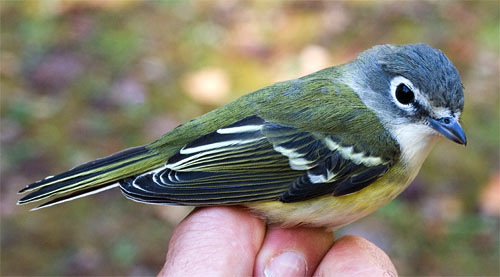
On to the quiz results. A few people guessed White-eyed Vireo for Quiz bird #1, but White-eyed  typcially have more strongly-colored backs and yellower/greener secondaries. The vireo above was photographed on South Padre Island, TX, in the spring of this year. I am comfortable with identifying it as a Blue-headed Vireo, the expected "Solitary" Vireo there, from the drabbest end of the spectrum. The contrast with the throat and head is quite strong, as is the color in the flanks...otherwise, it looks very much like a Cassin's Vireo. The back is somewhere inbetween gray and yellow, and the head is certainly not any shade of blue. If this bird was found in California and submitted to the bird police as a Blue-headed Vireo, would it be accepted? I would wager it would not. That said, I feel a lot of west coast birders do not have a strong grasp of the variability Blue-headed can show...they tend to have their hands full with Cassin's vs. Plumbeous.

I would like to mention at this point how dissatisfied I am with how National Geographic Field Guide to Birds of North America (6th edish) treats the Solitary Vireo complex. For starters, the illustrations suck, and each species only gets one paltry, sucky illustration. On top of that, the web of ID problems these birds can present is not really addressed in the text. Blue-headed Vireos are alleged to have "yellow-tinged wing bars and tertials", when obviously that is not always the case (take a look at this bird...or this bird or this bird). "Greenish yellow edges to dark secondaries", also listed as a Blue-headed field mark, is frequently found on Cassin's. I generally like the Natty Geo guide (it is the only book I've been recommending to other birders since the 90's), but the Solitary Vireo section needs some serious work.

Now, in the interest of embracing being Wrong, let me know if you have a convincing argument for this being a vagrant CAVI instead of BHVI. We can talk this out. The bird does sport "distinct white on outer tail", visible in other photos, but I'm not sure how unique that feature actually is to BHVI. Where is my Pyle guide???


Quiz bird #2 was, admittedly, fucked up. You could see a strongly colored Empid, gray-headed and yellow-bellied, with a solid eye ring and dark throat. These are helpful field marks, but you could not see the bill or primaries. One could deduce that the bill wasn't particularly long, but even that was a bit of a stretch.

Several people did guess correctly, despite that it was almost not possible in that photo to distinguish between Hammond's and Dusky Flycatcher. The dark gray throat, however, is characteristic of fall Hammond's Flycatchers, not Dusky. This Hammond's Flycatcher, photographed in the fall (when Empids are often the most colorful) was at Coyote Hills Regional Park, Fremont, CA.

For the record, I consider HAFL vs. DUFL to be the most difficult ID problem of "common" passerines that we have to face in California. Both species are significantly more difficult to find during fall migration than in spring, so I thought it would be nice to put up a plumage we don't get to see very often.


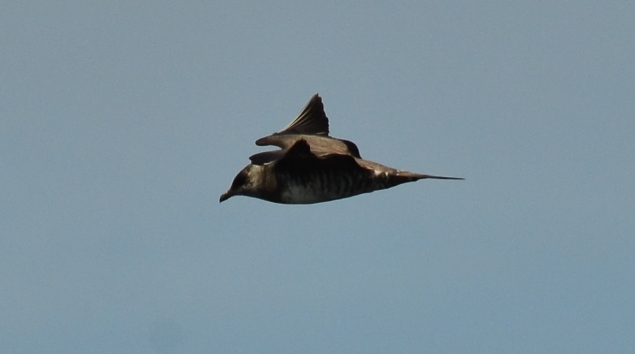
This jaeger suddenly becomes easily identifiable with the wings at a slightly different position. The dark secondaries scream Long-tailed Jaeger, as does the small bill. Bodega Bay CA.


Quiz 4? It's a Brown-crested Flycatcher. Texas birds have relatively petite bills compared to BCFLs further west, similar in size and shape to Great Crested but thicker than Dusky-capped. Ash-throated, of course, lacks the strong yellow coloration on the belly. Hidalgo County, TX.


This is a pretty typical Herring X Glaucous-winged Gull. It has the bulkiness of a GWGU, but the bill pattern of a HERG. The primaries are perfectly intermediate in color between what we expect in HERG and GWGU. This hybrid can be quite common in northern California in winter. Golden Gate Park, San Francisco, CA.

So there we have it. Thanks everyone for checking these birds, and we'll see you again soon.

Thursday, May 15, 2014

Pro-tip From #7: The Truth About Empidonax


Hammond's Flycatcher is a bird I have misidentified. I can admit it. If they vocalized as often as some claim they do, this tragedy would never have occurred. Photographed at Coyote Hills Regional Park, CA.

As a great birder once said, birding is hard. An example? Empidonax flycatchers. Along with Catharus thrushes, they can be some of the most frustrating birds to identify during migration. Only two members of the genus (Buff-breasted and Black-capped) are an effortless ID, and many are so difficult and indistinct that it can be sketchy to make an ID on appearance alone. Being the #7 birder in the country, the struggles surrounding these birds are of grave concern to me. Time and time again I have seen birding "experts" advise caution in these situations (which is warranted), and to simply wait for the bird to vocalize. "Migrant Empids will almost always vocalize, eventually" or a similar phrase is something that has been uttered to the confused masses over and over again, to the point where it seems to be common knowledge. Well friends, I have news for you.

It's not true.

That's right. Lies. Total rubbish. Think about it...if Empids really vocalized so much, they wouldn't be very hard to identify, would they? Look, I have seen thousands of Empids. My sample size? Gargantuan. They often don't vocalize very much unless on breeding territory. Ask me to show you a migrant that will often call, and I will show a Yellow Warbler. I will not be showing you a Dusky Flycatcher. Sometimes they do call, but there is no way you can just expect an individual to pipe up if you wait around 10 minutes, which is more time than we often get to spend with a bird anyways. Do you know how much time I've spent in the last couple weeks waiting for silent Willow/Alder Flycatchers to call? It's not even funny.


I spent a good couple of hours with this confiding Acadian Flycatcher the other day. It was completely silent the entire time. Migrant Empids may not always call, but it's not always necessary to wring a solid ID from them either. Photographed at South Padre Island, TX.

Even if the bird decides to utter a quiet "whit" or "peep", then you have to contend with other random bits of bird sound in the area, especially at migrant traps where other confounding flycatchers can abound. The Two Bird Theory can wreak havoc in these situations. Eastern Wood-Pewees, experts at tricking unwitting birders, sure make a lot of noise compared to the average Empid...their "chip" note can be misinterpreted for all sorts of different Empids. Hell, the other day one skipped the call notes altogether and told me "Jose Maria!". I practically had a heart attack.*

So from the Global Birder Ranking System's #7 birder in the U.S. to you, I recommend you look at the bird. Look at the parts of the bird you are supposed to look at. Sharpen your visual skills. You may not be able to figure it out, and that's ok...despite yourself, you will live to bird another day. If the ID isn't coming to you, all is not lost...wait for it to call. But if you think the bird is obligated to vocalize, you might as well be looking for goshawks over Tucson.


* = Only Greater Pewee is supposed to say that. It was not a Greater Pewee. Neither species are Empidonax. Everything is fine.

Friday, October 25, 2013

October at Coyote Hills


Damn...I'm getting way behind here...many apologies and condolences. I know BB&B readers need TOTAL COVERAGE of what Felonious Jive and I get into...everything from eBird checklists to what Booby Brittany ate for breakfast to what I've dipped on (Yellow Rail) and scored on (Red-throated Pipits) lately...so some catch up is overdue.

There have been many complaints made over the years (and many butthurt defenses) of the tried-and-true "I went to ___ and saw _____" format of bird blogging, but I think its something that must be done today, due to the quality of the visit and number of crushings accomplished.

All photos in this post are from October 9 at Coyote Hills Regional Park in southern Alameda County, along the bay. It has a diverse mix of upland and wetland habitats, and turns up interesting birds in both fall and winter...the locals bird there regularly, and I think it's worth your time if you're just visiting.


Sage Thrasher is a rare bird around these parts, and my first of the year. With the relatively poor showing of vagrants in the bay area this fall, this was one of the "better" birds I've come by.


Of course, we must give respect to our ubiquitous thrasher, the Northern Mockingbird. I don't think I've ever posted one on BB&B before, so here you go.


John Hammond once said, "We've made living biological attractions so astounding that they'll capture the imagination of the entire planet ". Hammond was right, of course, which leads us to this astounding, block-headed, richly-colored Empidonax; a Hammond's Flycatcher, a bird that's hard to come by in fall on the coastal plain. Field guides tell you to expect a dark lower mandible on this species, but I've found that to be an inconsistent field mark.


It skillfully dismembered and consumed a yellowjacket right in front of me. Can you imagine being the size of that bird and getting stung in the face? It could be lethal...what a brave little flycatcher, truly the Velociraptor of its genus.


One of the highlights of the day was the fennel patches...they were swarming with migrants, including more gray-headed Orange-crowned Warblers than most people are comfortable just hearing about. The legions of orestera were practically begging to be crushed; I often stood a mere 15 feet away, firing off hundreds of rounds (er, frames) at incredible speed.


The California birder who goes out in fall without these birds on the radar is doomed from the start. Orestera Orange-crowned Warbler is one of the most frequently-misidentified migrants on the west coast; they are uncommon along the coast in the fall, and many noob birders are simply unaware that gray-headed Orange-crowned Warblers exist...and so birder magic frequently renders them into Nashville, MacGillivray's and even rarer warblers.


Here is a typical lutescens Orange-crowned Warbler for comparison; this is the standard flavor of OCWA in California.


This young Wilson's Warbler was also lens fodder. The avian fennel fruit was plentiful on this day.


Watching a flock of Bushtits at work is a lot like eating comfort food.


It's neither enthralling or exotic, but its a soothing and familiar experience...perhaps less salty though.


A greatly underappreciated field mark for young accipiters is the breast and belly pattern; while both young Sharp-shinned and Cooper's can have streaked underparts, only young (HY) Sharp-shinned Hawks like this one get heavy spotting.


It's always nice to crush the shade-addicts, the birds who seem reluctant to ever make direct contact with full sunlight when a camera is around. This is one of the better Hermit Thrush pictures I've gotten.

That's all from Coyote Hills. One last thing...the Great Ornithologist Felonious Jive recently made his monthly post at 10,000 Birds, this time on how the birdscape/birderscape has drastically changed over the last 15 years. Check it out.

Sunday, March 18, 2012

Arizona Abides


Black-chinned Hummingbird is a sort of bland species, unless you catch them in jussssssssssst the right light. Florida Canyon.

Back when nobody read this awful waste of cyberspace, I was living in Southeast Arizona...while many think of this area of the country as a cultural wasteland and racist snakepit, most of you reading this know it as Birder's Mecca, due to it's vast array of desert and Mexican species that pour over the border in that corner of Los Estados Unidos. While Mexicans of the human persuasion find themselves being controversial in the region, everyone embraces the avian Mexicans. Birders spend insane amounts of money in the area and travel from far and wide to see these birds, after all. When I was offered a seasonal job to study migrating songbirds there, I jumped at the chance. I made my first trip to the area way back in 1998, and have been drawn to the place ever since.

For much of the time of my work stint we stayed at the research station Florida Canyon, where birds like Black-capped Gnatcatcher and Rufous-capped Warbler lived within walking distance, and a Ring-tailed Cat lived in our attic. Yes, it was the best roommate ever, thank you very much. Our survey sites were, not coincidentally, some of the best birding spots in the area...Miller Canyon, Carr Peak, Madera Canyon, the Nature Conservancy's Patagonia reserve....you get the picture. One gets to feel a bit smug to essentially just go birdwatching in areas people pay large sums of money just to get to. Part of the charm of the area (granted, this is arguable) is the vast numbers of birders you will meet, and the number of homes and yards that have been opened up to birders simply so we can stare at the birdfeeders...I thought it was quite funny to be doing a point count next to the Patons' legendary backyard, counting Violet-crowned Hummingbirds for SCIENCE!

Oh yeah, I just noticed that all these pictures are of birds that are relatively early migrants, and should all be "in" by the end of the month...care to meet them? They will be there.

Props to Jeremy at AZ Birdbrain and Laurence at Butlers Birds And Things for keeping the Birdosphere posted on what's happening down Arizona way.


Southeast Arizona features a strange mix of birds that live by the Economy of Style, such as this Lucy's Warbler, and unholy looking rainbow-creatures like trogons and Varied Buntings. Santa Cruz River.


Rufous Hummingbird. We put up several feeders up while living at our cabin, and drew in Magnificent, Violet-crowned, Anna's, Rufous, Calliope, Broad-tailed, Broad-billed, Black-chinned and Costa's Hummingbirds. Too bad we couldn't stay longer that mid May, who knows what other Mexican goodness we could have attracted? Florida Canyon.


Most birders looking for their lifer Common Black-Hawk make treks to sites north of Tucson, but I saw quite a few on the Santa Cruz River (Tubac area)...most were migrants, but I think they do nest there as well.


Hammond's Flycatcher is one of the many Empidonax that frequent the area, much to the chagrin of Tyrannid-challenged folk. Patagonia (I think).


The view from atop Mount Lemmon. A lot of birding spots are going to have forests that look more like this this year, as a result of last year's raging wildfires. And if you are wondering, no, migrants don't find snowbound burnt-out forests very appealing.


One of the state's celebrity birds is this Rufous-capped Warbler, one of 2 birds that are more often than not hanging out in Florida Canyon for several years in a row. These are usually the only known individuals residing north of Mexico.


Violet-crowned Hummingbirds live up to their name, at least in the right light. Birders usually go to Patagonia to see Violet-crowns (as they should), so I felt lucky to get this as a yard bird in Florida Canyon. By the way, for those not savy, the work station in the canyon is definitely OFF LIMITS to birders...stay away or a man who goes by "Greg" will have to come out and keep it real with you.


Rufous-crowned Sparrow is one of those weird species where you may have to go to great pains to see one, but once in a while they just won't leave you alone. Greaterville Road, Coronado National Forest.


Looking eastward towards the northern Santa Rita Mountains. Look at that wash! It's got some nice birds in it.


Not the best image, but I had to throw in a gratuitous Vermilion Flycatcher. I still remember the first time I saw these birds, and still carry the scars to show for it...yes, my face is partially melted off now.