Showing posts with label Fork-tailed Storm-Petrel. Show all posts

Monday, October 3, 2016

ID Challenges: The Worst of The West


Birding...it's not easy. Sure, there are times when you get out of the car, walk over to a group of birders, and they wave their hand at the staggering mega that is sitting there in front of you. Some birders will chase rarities, see the bird, then ask to have the field marks explained to them by others...how easy! How great! What else is great? Harlequin Ducks, Roseate Spoonbills, Elegant Trogons, Scissor-tailed Flycatchers, Scarlet Tanagers...those are beautiful, unmistakable birds.

Most birds? Not that easy. Not that easy to find, not that easy to see well, not that easy to identify. I thought I would take the time today to run down some of the hardest families of birds in the western Lower 48...people like lists, after all, particularly birders. There is some overlap here with other parts of the country, but there are distinct differences...for example, the east coast has more terns and thrushes, but less storm-petrels and hummingbirds.

Before we get to the list, I should name some Honorable Mentions that didn't quite make the Top Ten:

- Swans. Tundra vs. Trumpeter can be extremely challenging. Luckily, we only have two swan species to really worry about (until Bewick's Swan is split). That's a Tundra Swan up top there.

- Petrels. Petrels are arguably the most difficult of our birds, period. A large suite of them can potentially show up off our coast, very few birders know them well, and they rarely cooperate with boats or come close to seawatching sites. They fly incredibly fast and all come in white, gray, black and brown. However, they are rarely encountered relative to all the other birds we are discussing today; while often seen on repositioning cruises, there are few other instances when you can realistically expect to see them.

- Hawks. Hawk ID is not exceptionally complicated west of Texas, in my opinion, though obviously there are problematic plumages out there. Of course, Accipiters will always be misidentified by everybody, so hawks are deserving of a mention (an honorable one).

- Oystercatchers. This problem is unique to Southern California...Black Oystercatchers are as distinctive as any bird we have, but Black X American Oystercatcher hybrids and our local American Oystercatcher subspecies look confoundingly similar. American Oystercatcher is one of the most overreported birds in the area.

- Plovers. Telling apart American and Pacific Golden-Plovers can be absolutely excruciating. Beginning and intermediate birders will often misidentify Black-bellied Plovers for either Golden-Plover species. The smaller plovers aren't bad though.

- Crows and Ravens. Some birders can't tell crows and ravens apart from one another...well what about Common Raven vs. Chihuahuan Raven? American Crow vs. Northwestern Crow? In some places, these ID challenges can seem almost impossible to overcome, particularly with the crow situation in Washington.

- Gnatcatchers. If you are birding someplace where Black-capped Gnatcatcher can reasonably be found, the other two southwestern species can give you a world of trouble, especially if you don't find yourself birding down there very often and don't know the calls well. They are hyper little bastards, which makes seeing already subtle field marks an extremely taxing ordeal.

And now...the list!


#10 - Sparrows. The western U.S. is blessed/cursed with an impressive diversity of sparrows. The majority of them are migratory and/or have a tendency toward vagrancy, and they are all brown, brown, brown, brown, brown, brown brown...gray, and brown. However, though they are terrifying for beginners, sparrows aren't so bad once you've put some birding years in the rearview, and some of them are downright difficult to misidentify. That said, Spizella sparrows (like the Clay-colored above) can be especially vexing. Savannah Sparrows, one of the most abundant sparrows in the country, are arguably also the most misidentified of them all, as they can pass for Song, Lincoln's, Vesper and Baird's.
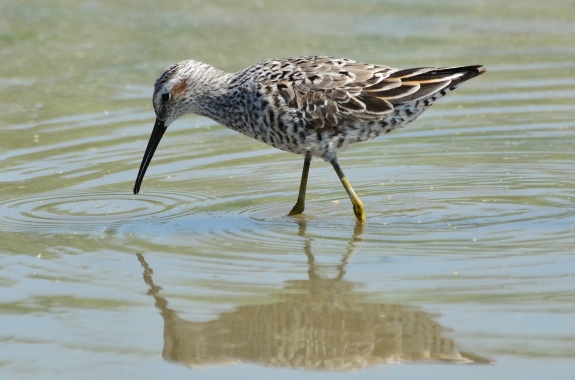

#9 - Sandpipers. Show me a rookie birder and I will show you someone who is going to be greatly troubled...by shorebirds, sandpipers in particular. The dowitcher duo is legendary, peep problems are relentless...to put it bluntly, almost every sandpiper species is at a high risk of being misidentified for something else. Those of us on the coast always have Siberian species on the brain, which complicates the picture even further...yikes. However, the "expected" species do become pretty familiar in time.


#8 - Warblers. Spring warblers are decidedly unproblematic, with the exception of waterthrushes (that's a whitish Northern above). However, you may not be aware that there are three other seasons. Most warblers do not have the same snappy facemelt in October that they do in April. They are referred to as "confusing fall warblers" for a reason, though I despise that tired and overused phrase. There are so many identification pitfalls here that there is no point in even starting in to them. Californians have it especially bad, since we have multiple records of almost every breeding warbler species in the country.


#7 - Vireos. Vireos make people very uncomfortable. Seen poorly enough, every single vireo species (with the exception of a vagrant White-eyed) stands a good chance of being misidentified. Just a few days ago on Facebook, I watched (seemingly in slow motion, like a car crash) in horror as a birder sought out the expertise of an expert, to identify a bird she had photographed very well. He called it an Orange-crowned Warbler...it was a Warbling Vireo. At least with a sandpiper you know it's a sandpiper...with vireos, people call them warblers (and vice versa) on the regular. The hardest vireos? Warbling vs. Philadelphia, and Blue-headed vs. Cassin's vs. Plumbeous. That's a Philadelphia above.


#6 - Longspurs. Away from the prairies of eastern Colorado, Wyoming and Montana, we don't even get to see longspurs in spring. When we get them, they always look like rubbish. Lapland (above) can look like Smith's, Smith's can look like Chesnut-collared, Chestnut-collared can look like McCown's. And 90% of the time, you are getting total garbage looks at them. They all look similar, their calls are not drastically different, and they hate being cooperative for birders. That is a recipe for pain.


#5 - Hummingbirds. Unlike sneaky longspurs and skulky warblers, you can typically get really solid looks at hummingbirds. That said, this may not be of much use to you if you are not prepared...male hummingbirds are facemelting birds, but young males (like the Costa's above) and females can be brutal. With the exceptions of Violet-crowned and maybe Berylline, I think every one of our young/female hummingbird species is at an extremely high risk of being misidentified. Don't believe me? Go geri-birding in Arizona and watch the carnage unfold.


#4 - Storm-petrels. I lead a lot of pelagic trips, and I will tell you that no group of birds strikes more fear into the heart of an inexperienced birder than these. When it comes to these birds, people seeing them for the first time completely surrender any attempt at an ID to the leaders on the boat. We could tell them whatever we wanted and get away with it (fortunately, we want to tell them the truth). Other than the lovely Fork-tailed Storm-Petrels (most of the birds above), they are either all small black birds or small black birds with white rumps. Generally, they want nothing to do with the boat you are on and you are going to be really unsatisfied looking a them if there is a big swell that day. New developments in the Leach's complex have everyone reeling. These are the birds your nightmares are made of.


#3 - Jaegers. You probably didn't see this being #3....but the difficulties of jaeger ID are legendary. Even dark Pomarines and South Polar Skuas get mixed up. Trying to ID certain individuals can lead to such circular logic and mental numbness that I am getting tired just thinking about it. Just be happy when you get to see "easy" individuals, like this Pomarine above.


#2 - Flycatchers. You know what? I haven't done a quiz in a while. What do you think this bird is? The answer is at the bottom of the post. Hint: It's a flycatcher.

Flycatchers are just heinous. Think about each gnarly genus we have all lumped into one jaw-clenching, teeth-grinding family...Contopus, Empidonax, Myiarchus, Tyrannus, etc. That's some heavy shit. The first three genera are especially bad. I don't even know what to tell you here, except to advise you that you can at least get close to the right species. Hammond's and Grays are not similar. Willows and Pacific-slopes are not a confusing couple. Buff-breasted do not look like pewees.

Pewees....yeah. Just identify pewees correctly (don't misidentify them for Empids) and you will command at least a small modicum of respect. Don't report an Eastern unless it's calling though, or you will be run out of your state.


#1 - Gulls. Obvi. I have nothing to say about gulls that you haven't heard before. This is a perfectly typical Herring Gull...I bet not many of you knew that.

There you have it, the list, for your edification and mine. Do you agree, or do I have it all wrong? Are ducks and geese deserving of being on the list? Are alcids alarming? Do Wrentits cause your brain to boggle? I hope not. At any rate, feel free to let us know.


p.s. The quiz bird is a Least Flycatcher. Props if you got it right. And before you descend into a nerdy rage, yes it is a flycatcher that breeds in western states. #notjustavaguerunt

Monday, August 10, 2015

Raft Rage Out of Half Moon Bay


Pelagic season has started off with a bang...not with any proper rarities, but with the next best thing...huge rafts of storm-petrels!  I've seen bigger flocks, but these birds were relatively approachable and were very diverse. I was one of the leaders on the August 2 Shearwater Journeys trip out of Half Moon Bay, which featured warm temperatures, calm seas, and a solid variety of seabirds.  But before the petrels came to pass, there were a lot of other highlights. Right out of the harbor I got my county sea otter, which is a rarity this far north.


Marine mammals were plentiful offshore, with numerous humpback whales, including a few who were engaging in some facemelting breaches, which this obviously is not a picture of.


Pink-footed and Sooty Shearwaters. There were some big shearwater flocks in relatively shallow water, feeding in big groups alongside assorted marine mammals.


This shearwater flock was diving into the water amongst a big pod of short-beaked common dolphins. It was a vulgar display of marine life.


Common dolphins are more of a SoCal species, so they are always a nice surprise this far north. They also really like bowriding, so they almost always come in close to the boat.


Can't complain about looks like this.  We also had Dall's and harbor porpoises, and Pacific white-sided dolphins during the day.  Other nonbirds of note included fur seals, Steller's sea lion, and two blue sharks.


Sabine's Gulls in alternate plumage are one of the best things to see offshore, not so much for rarity or majesty, but for overall aesthetics.


Aesthetically pleasing is an understatement.


As I've mentioned in one of the recent Maine posts, Arctic Terns are missed on many boat trips and are often tough to get a respectable look at.  This bird was loafing on some driftwood and was much more cooperative than the average offshore tern.


Nice wing pattern on this young bird.


Unlike the Arctic Terns and Sabine's Gulls, this Scripps's Murrelet was butt ugly. It's undergoing some serious molt, and has a bill deformity to boot. I generally do not talk ill of murrelets of any kind, but this one was astonishingly trashy. I'm sure it'll look much better in a few weeks.


No matter how often I see Black-footed Albatross, and no matter how many photos I take of them, I can't seem to stop, and they invariably make it into pelagic trip posts no matter what. So here is a gratuitous albatross photo, I hope ya'll have the same tireless enthusiasm for them that I do. Apparently the captain of another boat saw a couple Laysan Albatross in the same area the day before, but we had to be happy with BFAL.


I said storm-petrels made this trip, so lets get into some storm-petrels.  This is an Ashy Storm-Petrel, and amazingly enough you can actually make out its ashy color tones.  Compare the relative paleness of this bird with the Black Storm-Petrel a few photos below.


We had over 100 Wilson's Storm-Petrels on the day, which is a new record in California.  It was weird to see so many...this was California, not North Carolina. They aren't as wary of boats as the other storm-petrel species here can be, so we typically get pretty good looks at them when they are found.


Although the number of Wilson's present were surprising, I couldn't get over how many Fork-tailed Storm-Petrels were out there.  There were hundreds of them, and I didn't see a single one on trips last year...in fact I'm not sure if anyone did!  Talk about an unpredictable bird...


To round out the storm-petrels for the day, here is a Black Storm-Petrel.


This is a part of one of the rafts of petrels we came across.  Some of us on the boat were getting weak at the knees at the sight of so many clustered together...these flocks are fertile grounds for holding some kind of rarity, and it does not help that both Wedge-rumped and Tristram's Storm-Petrels were found a few miles away on the Farallones earlier this year.  All four species shown above are visible in this photo.

I like how this little group of Fork-taileds has composed themselves.  That's an Ashy on the bottom right, note the dark gray (not black) color compared to the silvery Fork-taileds, which are seemingly manufactured to be the color of a fog bank.


Bear witness to another storm-petrel raft, with all four species.  Hopefully the storm-petrels will be holding it down for a while longer, it would be great to track these flocks down again.  Big storm-petrel flocks are a luxury, not a reliable thing at all, and seeing so many at the very beginning of August totally took me by surprise.


I worked with Fork-tailed Storm-Petrels in Alaska, so I have a soft spot for them.  Here's one of the closer shots I got.


On the way back in we came across this juvenile Tufted Puffin, doing its best Rhinoceros Auklet impression, which they are prone to do.  That's a Common Murre on the left.

So, all in all a hella good trip, though I still have not met a Hawaiian Petrel...I'll try again this weekend.

Tuesday, October 29, 2013

Cordell Bank Storm-Petrel Uberflocks


On the September 20th Shearwater Journeys trip out of Bodega Bay, I spotted a distant shimmering haze that I knew was a large flock of storm-petrels rising and settling on the water. We motored over there knowing there would be hella birds, but none of us had any idea how many we would actually be dealing with.


There were hordes of birds. We encountered enormous storm-petrel rafts on both the east and west sides of the northern tip of the Cordell Bank. It was flabbergasting. Unbelievable.


At first, the number of Fork-tailed Storm-Petrel in the flocks was really eye-catching. There were more than I had ever seen, thousands of them. But once we started to realize the number of birds present, several on board began paying more attention to the Ashy Storm-Petrels, clearly the most abundant birds there.


Ashy Storm-Petrels occupy a relatively small range off the west coast of North America, most of which stay in California and nest on the Farrallon Islands. Previous population estimates numbered them at about 10,000 birds. Note the Black Storm-Petrel on the left, appearing significantly larger and darker than the Ashies, which are smaller and darker than the Fork-taileds.


It was really difficult to effectively capture the sheer number of birds out there. Here is a full sized photo of a slice of one of the rafts (click above to enbiggen), it should at least give you an inkling of what we were dealing with.

Luckily, bird wizards Peter Pyle and Steve Howell were on board and did their best to count the birds and arrived at similar estimates. Their final counts for these flocks were 10,500 Ashy Storm-Petrels, 6,500 Fork-tailed Storm-Petrels, 300 Black Storm-Petrels, and 25 Wilson's Storm-Petrels, totaling 17,325 birds...insane!

Assuming the Ashy Storm-Petrel estimate was anywhere near correct (it was quite possibly low), that gives an informal new world population estimate for the species...and if one assumes that those rafts did not contain every single Ashy Storm-Petrel in the world (a safe assumption), then their actual population size becomes more of an open question.


6500 Fork-tailed Storm-Petrels also seems to be a new high count for the state (at least in recent years) according to eBird.

A pelagic trip to the same area reported similar numbers of birds two days later, but to my knowledge these huge flocks were never seen again. It's a mystery where a lot of these birds feed during much of the year...all part of the fun of seabirding, which truly is a different frontier of birding.

Friday, October 18, 2013

September Over Cordell Bank


Well, it turns out that my October 6 boat was not my last pelagic of the year...I wam returning to Bodega Bay today for yet another boat. Why not? This time I am filling the shoes of both Steve Howell and Peter Pyle, which should be really, really easy. In case you haven't heard, I'm #7.

Cordell Bank and Bodega Canyon have amassed a long list of pelagic rarities over the years, and with this being possibly the last pelagic in the area for the year, now is the time to make something happen. Recent reports from there mention lots of albatross right now, which bodes very, very well.

But who knows what will happen...perhaps we will see nothing but Mola Molas all day, you never know. This post covers some of what was on my last Bodega trip, back on September 20.


Black-footed Albatross is often a common bird found on pelagic trips, but my last boat (October 6) somehow missed them altogether...I reckon they are concentrated offshore from Bodega Bay. Next month both adults and subadults alike will return to their breeding colonies in the Northwestern Hawaiian Islands, and get down to some serious dancing.


Dall's Porpoise are encountered on many pelagic trips...they are fickle bowriders, sometimes enthusiastic about the boat and sometimes completely disinterested. Even when they are swimming right next to you, they are bloody hard to take a photograph of...they are in and out of the water so quickly that you typically only get a picture of a big splash. Anyways...they are black and white, a very modern cetacean.


Pacific White-sided Dolphins are a little more confiding. This is often the most abundant dolphin species to be found offshore.


This photo is hella grainy...photography is hard. Anyway, it's a Pomarine Jaeger.


This is a second-year Long-tailed Jaeger. The stubby bill and slender body confirm the bird is a Long-tailed, but they generally have 2-3 white primary shafts, unlike this bird. Insert tired cliche of birds not reading field guides here.


Another very useful mark for Long-tailed Jaeger is the significant contrast of the secondaries with the rest of the upperwing...it's pretty obvious on the bird's right wing. Unfortunately, I think I have already seen my last Long-tailed of the year.

By the time people are spending more and more time contemplating what they Halloween costume is going to be, Sabine's Gulls have just about finished migrating through California...Black-legged Kittiwakes might be more likely small gull offshore now. Winter is coming...Nothern Fulmars are here, and Short-tailed Shearwaters have just begun to show up.


This South Polar Skua has an eyering, and is adept at shitting.


Just a Pink-footed Shearwater. I like that strange, plated bill, but that eye is something else. It's blacker than black. It has no depth. It is the eye of a creature that knows a fundamental truth that I will never, ever come close to knowing.


Whales have been in abundance this year. This is a Humpback. Whales are great, but they are surprisingly easy to ignore if there are a lot of birds around. This understanding comes with a high GBRS score; other people (and birders) cannot begin to fathom how this could be.

It should be noted that this whale was mortally harmed by the force of me crushing it so hard. Shortly after this photo was taken, the flukes crumpled and fell off it's tail.


The Blue Whale show offshore has been great this year. The seas are loaded with corpulent krill consumers.


Blue Whale flukes are clean, trim and streamlined compared to the rest of the whale's body. For whatever reason they rarely seem to have as much shit hanging off of them as Humpbacks.


Of course, the real highlight of this trip was the storm-petrels...more Fork-tailed than I have ever seen, and more Ashies than possibly ANYONE had ever seen...but I'll leave that for another post.