Showing posts with label costa's hummingbird. Show all posts

Wednesday, February 8, 2017

Roadside Attractions, A Particular Cuteness, Sustained Facemelt, Dorsal or Death


One of the good birding opportunities that comes packaged with going to SoCal every year is my favorite rest stop on Highway 101. That's right, the Patagonia rest stop is not my favorite rest stop...ya'll can have that one. If I hear someone describe the Patagonia Picnic Table Effect one more time like it's some novel new idea, said someone will be destroyed. Anyhow, I want the rest stop with Yellow-billed Magpies.


Those that live in the valley may get to see a lot of magpies on the regular, but for those of us who don't (which is most of us), they are not a trash bird by any means...they are a glorious endemic, and are aesthetically superior to the continent's other magpie. Just look at this especially leggy individual with yellow eyeliner.


Another quick stop off Highway 101 on the way south was productive; this FOY/LOY Ross's Goose had been living at a dirty little duck pond at the Gonzales Winery for several years. Like every Ross's Goose, it was small and mellowing. A few Ross's have been known to make this tradeoff in California in the past, seemingly exchanging the chance to pass on their genes for endless free handouts. Interesting approach.


Though I haven't lived there since the year 2000, my Ventura County list is still higher than any other county list I maintain...and though that statement was supposed to reflect on how good birding can be in Ventura at times, it probably reflects more on how pathetic I am at county listing, which I am very proud of. Anyhow...aside from success with the Little Gull, I managed to get a modest amount of additional birding in. Burrowing Owls winter in low numbers on the Oxnard Plain, sometimes right next to poison dispensers meant to kill their ground-squirrel friends. Yikes.


Unfortunately, life is not all Yellow-billed Magpies, Little Gulls and Burrowing Owls. Life primarily consists of Savannah Sparrows. That's right, life is Savannah Sparrows. Your average day is a Savannah Sparrow, a bird that is neither that good or that bad, and ultimately not incredibly memorable. Photographed at Arnold Road on the Oxnard Plain.


My parents' yard in east Ventura has been made into a hummingbird magnet of sorts since I moved away...though they are still waiting for a Broad-billed or Violet-crowned (which is a way overdue bird to be refound in the state), they do get a pretty good showing of the expected California species. I never got a Calliope in Ventura County, but a number of them have passed through their yard...there is nothing like getting gripped off by your own flesh and blood. They get multiple Costa's Hummingbirds every year, one or two of which often overwinter.


Aside from the typical field marks, female Costa's have a particular "cute" quality overall that female Anna's and Black-chinned lack. These species, which are admittedly very similar, are frequent sources of confusion for birders in the western states, particularly in geri-bound Arizona, where there are a great many hummingbirds and a great many birders unable to identify them very well.


If a jet of hot sugary hummingbird pee being fired out of an Anna's Hummingbird is the sort of thing you're into, then I don't have to convince you to spend some time looking at this graphic photo.


After seeing many thousands of Anna's Hummingbirds over the years, I can tell you that the facemelt wrought by an adult male Anna's is still alive and well.


Isn't this absurd???


As one of LA's leading lights of birding recently pointed out via listserv, this angle is not at all helpful in identifying male Allen's or Rufous Hummingbirds...give me dorsal or give me death. Though some could be tricked into thinking that this a Rufous Hummingbird, this is actually a very typical-looking Allen's Hummingbird when viewed at other angles.


Here is a immature male Allen's, displaying no real helpful field marks at all. These days Allen's are much more common year-round residents at my parents' place than 20 years ago; I think there's a lot more overwintering in east Ventura overall now.


In a bid to bring BB&B even more fame and fortune, let's wrap this post up with a bird that almost no one has any interest in...a hen American Wigeon. No one is at fault for that, since this lawn-loving grazing machine aesthetically brings little to the table. This individual doesn't have much of a black gape border, which is a field mark that can help differentiate female Americans from Eurasians. The popularity of this field mark has always been a bit of mystery to me, because if you are close enough to see this obscure bit of coloring you shouldn't be struggling to tell the two species apart. Photographed in Conejo Creek Park, Thousand Oaks, CA.

Monday, October 3, 2016

ID Challenges: The Worst of The West


Birding...it's not easy. Sure, there are times when you get out of the car, walk over to a group of birders, and they wave their hand at the staggering mega that is sitting there in front of you. Some birders will chase rarities, see the bird, then ask to have the field marks explained to them by others...how easy! How great! What else is great? Harlequin Ducks, Roseate Spoonbills, Elegant Trogons, Scissor-tailed Flycatchers, Scarlet Tanagers...those are beautiful, unmistakable birds.

Most birds? Not that easy. Not that easy to find, not that easy to see well, not that easy to identify. I thought I would take the time today to run down some of the hardest families of birds in the western Lower 48...people like lists, after all, particularly birders. There is some overlap here with other parts of the country, but there are distinct differences...for example, the east coast has more terns and thrushes, but less storm-petrels and hummingbirds.

Before we get to the list, I should name some Honorable Mentions that didn't quite make the Top Ten:

- Swans. Tundra vs. Trumpeter can be extremely challenging. Luckily, we only have two swan species to really worry about (until Bewick's Swan is split). That's a Tundra Swan up top there.

- Petrels. Petrels are arguably the most difficult of our birds, period. A large suite of them can potentially show up off our coast, very few birders know them well, and they rarely cooperate with boats or come close to seawatching sites. They fly incredibly fast and all come in white, gray, black and brown. However, they are rarely encountered relative to all the other birds we are discussing today; while often seen on repositioning cruises, there are few other instances when you can realistically expect to see them.

- Hawks. Hawk ID is not exceptionally complicated west of Texas, in my opinion, though obviously there are problematic plumages out there. Of course, Accipiters will always be misidentified by everybody, so hawks are deserving of a mention (an honorable one).

- Oystercatchers. This problem is unique to Southern California...Black Oystercatchers are as distinctive as any bird we have, but Black X American Oystercatcher hybrids and our local American Oystercatcher subspecies look confoundingly similar. American Oystercatcher is one of the most overreported birds in the area.

- Plovers. Telling apart American and Pacific Golden-Plovers can be absolutely excruciating. Beginning and intermediate birders will often misidentify Black-bellied Plovers for either Golden-Plover species. The smaller plovers aren't bad though.

- Crows and Ravens. Some birders can't tell crows and ravens apart from one another...well what about Common Raven vs. Chihuahuan Raven? American Crow vs. Northwestern Crow? In some places, these ID challenges can seem almost impossible to overcome, particularly with the crow situation in Washington.

- Gnatcatchers. If you are birding someplace where Black-capped Gnatcatcher can reasonably be found, the other two southwestern species can give you a world of trouble, especially if you don't find yourself birding down there very often and don't know the calls well. They are hyper little bastards, which makes seeing already subtle field marks an extremely taxing ordeal.

And now...the list!


#10 - Sparrows. The western U.S. is blessed/cursed with an impressive diversity of sparrows. The majority of them are migratory and/or have a tendency toward vagrancy, and they are all brown, brown, brown, brown, brown, brown brown...gray, and brown. However, though they are terrifying for beginners, sparrows aren't so bad once you've put some birding years in the rearview, and some of them are downright difficult to misidentify. That said, Spizella sparrows (like the Clay-colored above) can be especially vexing. Savannah Sparrows, one of the most abundant sparrows in the country, are arguably also the most misidentified of them all, as they can pass for Song, Lincoln's, Vesper and Baird's.


#9 - Sandpipers. Show me a rookie birder and I will show you someone who is going to be greatly troubled...by shorebirds, sandpipers in particular. The dowitcher duo is legendary, peep problems are relentless...to put it bluntly, almost every sandpiper species is at a high risk of being misidentified for something else. Those of us on the coast always have Siberian species on the brain, which complicates the picture even further...yikes. However, the "expected" species do become pretty familiar in time.


#8 - Warblers. Spring warblers are decidedly unproblematic, with the exception of waterthrushes (that's a whitish Northern above). However, you may not be aware that there are three other seasons. Most warblers do not have the same snappy facemelt in October that they do in April. They are referred to as "confusing fall warblers" for a reason, though I despise that tired and overused phrase. There are so many identification pitfalls here that there is no point in even starting in to them. Californians have it especially bad, since we have multiple records of almost every breeding warbler species in the country.


#7 - Vireos. Vireos make people very uncomfortable. Seen poorly enough, every single vireo species (with the exception of a vagrant White-eyed) stands a good chance of being misidentified. Just a few days ago on Facebook, I watched (seemingly in slow motion, like a car crash) in horror as a birder sought out the expertise of an expert, to identify a bird she had photographed very well. He called it an Orange-crowned Warbler...it was a Warbling Vireo. At least with a sandpiper you know it's a sandpiper...with vireos, people call them warblers (and vice versa) on the regular. The hardest vireos? Warbling vs. Philadelphia, and Blue-headed vs. Cassin's vs. Plumbeous. That's a Philadelphia above.


#6 - Longspurs. Away from the prairies of eastern Colorado, Wyoming and Montana, we don't even get to see longspurs in spring. When we get them, they always look like rubbish. Lapland (above) can look like Smith's, Smith's can look like Chesnut-collared, Chestnut-collared can look like McCown's. And 90% of the time, you are getting total garbage looks at them. They all look similar, their calls are not drastically different, and they hate being cooperative for birders. That is a recipe for pain.


#5 - Hummingbirds. Unlike sneaky longspurs and skulky warblers, you can typically get really solid looks at hummingbirds. That said, this may not be of much use to you if you are not prepared...male hummingbirds are facemelting birds, but young males (like the Costa's above) and females can be brutal. With the exceptions of Violet-crowned and maybe Berylline, I think every one of our young/female hummingbird species is at an extremely high risk of being misidentified. Don't believe me? Go geri-birding in Arizona and watch the carnage unfold.


#4 - Storm-petrels. I lead a lot of pelagic trips, and I will tell you that no group of birds strikes more fear into the heart of an inexperienced birder than these. When it comes to these birds, people seeing them for the first time completely surrender any attempt at an ID to the leaders on the boat. We could tell them whatever we wanted and get away with it (fortunately, we want to tell them the truth). Other than the lovely Fork-tailed Storm-Petrels (most of the birds above), they are either all small black birds or small black birds with white rumps. Generally, they want nothing to do with the boat you are on and you are going to be really unsatisfied looking a them if there is a big swell that day. New developments in the Leach's complex have everyone reeling. These are the birds your nightmares are made of.


#3 - Jaegers. You probably didn't see this being #3....but the difficulties of jaeger ID are legendary. Even dark Pomarines and South Polar Skuas get mixed up. Trying to ID certain individuals can lead to such circular logic and mental numbness that I am getting tired just thinking about it. Just be happy when you get to see "easy" individuals, like this Pomarine above.


#2 - Flycatchers. You know what? I haven't done a quiz in a while. What do you think this bird is? The answer is at the bottom of the post. Hint: It's a flycatcher.

Flycatchers are just heinous. Think about each gnarly genus we have all lumped into one jaw-clenching, teeth-grinding family...Contopus, Empidonax, Myiarchus, Tyrannus, etc. That's some heavy shit. The first three genera are especially bad. I don't even know what to tell you here, except to advise you that you can at least get close to the right species. Hammond's and Grays are not similar. Willows and Pacific-slopes are not a confusing couple. Buff-breasted do not look like pewees.

Pewees....yeah. Just identify pewees correctly (don't misidentify them for Empids) and you will command at least a small modicum of respect. Don't report an Eastern unless it's calling though, or you will be run out of your state.


#1 - Gulls. Obvi. I have nothing to say about gulls that you haven't heard before. This is a perfectly typical Herring Gull...I bet not many of you knew that.

There you have it, the list, for your edification and mine. Do you agree, or do I have it all wrong? Are ducks and geese deserving of being on the list? Are alcids alarming? Do Wrentits cause your brain to boggle? I hope not. At any rate, feel free to let us know.


p.s. The quiz bird is a Least Flycatcher. Props if you got it right. And before you descend into a nerdy rage, yes it is a flycatcher that breeds in western states. #notjustavaguerunt

Friday, February 14, 2014

Flying Nightmares, Beloved Belding's Yellowthroats, and The Hummingbird of Anxiety


Old Man Pelican. All photos today from the Todos Santos area, Baja California Sur.


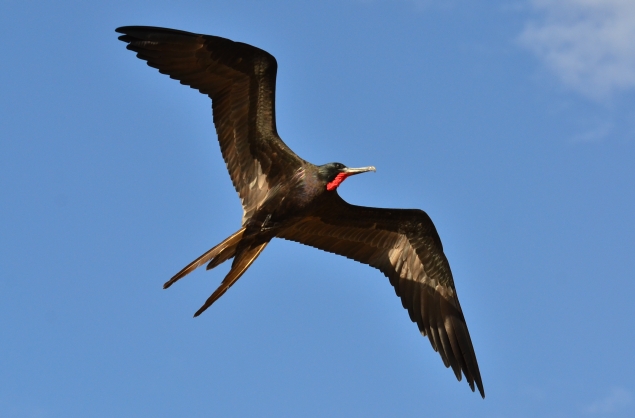
Frigatebirds are the best. They usually look like this; majestic, awe-inspring, and confident. However, it does not take much for them to turn into living nightmares.


If I showed this photograph to a nonbirder and told them these birds have been known to snatch babies from their cribs, they would probably believe me.


Ah yes, the last thing countless toddlers will ever see.

I struggle to come up with an apt description of this...perhaps an example of post-nuclear-fallout-avifauna.


Motmots aren't the only birds who can tick-tock their tails...which perhaps is a scary notion to some.

Laughing Gull, Mexicrushed.


We saw a handful of Herring Gulls at Punta Lobos, just south of Todos Santos, which seemed to have the best gull concentrations in the area. Larids gather there in the afternoon to eat discarded fish scraps from the panga fisherman; unfortunately I failed to pull out anything very remarkable; the best was the Laughing Gull (above) and a disturbing number of yellow/orange-legged Western Gulls. If you go there expecting Yellow-footed Gulls, I can only offer the old adage "caution is warranted".


If you are a white person and move to Baja, you end up looking something like this after a few years.


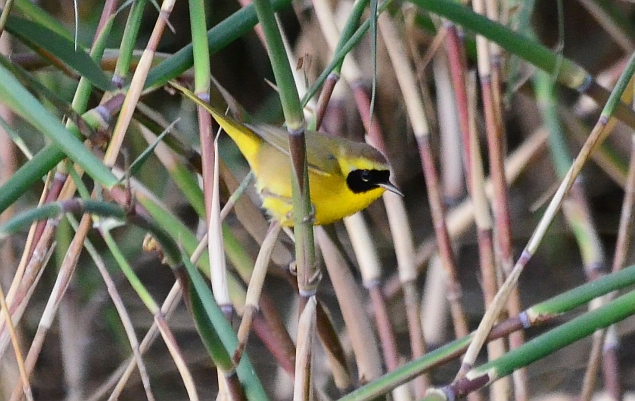
There are hordes of Belding's Yellowthroats at La Poza, the big pond on the beach in Todos Santos. It was nice to see so many, considering the tiny distribution this subspecies (beldingi) has.


Hella yellow underparts.


Here's a considerably duller-looking individual, but still with significant yellow coming up the side of the mask and onto the forehead. A younger male?


Females were surprisingly pretty easy to tell from Common Yellowthroat...surprising because I wasn't using a field guide and just thought I'd wing it. As with males, there is much yellow on the head, which frames a grayish auricular patch.


Scott's Orioles were greatly outnumbered by Hooded, but they were still easy to find. Every morning I could hear their soothing meadowlarky songs sung from our house.


There are birders out there who think it is completely unethical to photograph a bird on its nest...ever. Why? Because birds can't handle the stress and will abandon their nest, which is often true...but always is a considerable stretch of the imagination. Well, have a look at this disturbed, stress-ridden bird. It is the Hummingbird of Anxiety. What do you say to do this crush? The bird is pretty much life-sized in this picture. Is your blood boiling?


Look at her sleep. What a sleepy hummingbird. This Xantus's Hummingbird was nesting inside a restaurant in Pescadero where we had lunch one day, so I wasn't exactly worried about disturbing her. Maybe she likes the big fiestas and live music they have every weekend...the waitress said she nested there last year too.


Male Xantus's Hummingbirds are too cool to not stand next to and blow hundreds of photos on.


Young male Costa's Hummingbirds have some fresh facemelt growing into their faces, but only when the sun hits them right.


I could not identify this bird.

Wednesday, January 22, 2014

To Bird or To Rage? Todos Santos (Part 1)


Costa's Hummingbirds are the wee kings of cripple, tiny bastions of facemelt. Much sought-after by many birders, to find where they are truly common, one usually has to find oneself in the middle of some strange and random spot in the desert. For any birders who find themselves in Todos Santos, Baja California Sur, any longings for Costa's Hummingbirds would be more than satisfied.

Baja California Sur. Most people go there with one thing in mind...raging. Cabo San Lucas is known worldwide for its rage opportunities and beaches (but mostly for rage). However, others go to BCS with something in mind besides forcefed tequila shots, and there is much more to see other than the debauchery in Cabo.

One such place is Todos Santos, just over an hour's drive northwest of Cabo San Lucas on the Pacific side of the peninsula. It's not unknown by any means. Many gringos go there to both visit and live, as the town is known as a small art community and has an abundance of good food (which, to be fair, can be said of most Mexican towns). Birders make it there from time to time as well, and can get a decent fix while birding areas in and outside of town. Xantus's Hummingbirds, Gray Thrashers and Belding's Yellowthroats can all be found without difficulty in the pueblo, and many western migrants and desert residents lurk as well.


I almost felt bad crushing this fragile little gem...almost...


Of course, I have to point out the obvious fact that any birder travelling to Todos Santos is probably more interested in this hummingbird, the one found in Baja California Sur and no place else. Xantus's Hummingbirds (LIFER) are common in the lowlands in winter...and crushing them felt really, really good.


The avian community down in southern BCS is strange, at least for someone who has not been there before...a strange mix of species one would associate with California's coastal chaparral and the Sonoran desert, with some endemic passerines and a pygmy-owl thrown in. Crested Caracaras (above) are, thankfully, a regular sight in the desert and near the edges of town.

I was lucky enough to recently sample the BCS avefauna (truly, it was a sample, not a gorge), mostly while based out of Todos Santos. BB&B and 10,000 Birds (where the Great Ornithologist Felonious Jive will post) will have total coverage, and tips for any future visitors. It was a very interesting birdscape, and we did not even get into the Sierra de la Laguna or the sewage ponds at La Paz.

And for the record, I highly recommend both tequila consumption and debauchery, just do it on your own terms...unless you are in college, then all bets are off.


Mmmmmmm...another life bird, and a Baja endemic at that. Meet the Gray Thrasher, denizen of the peninsula's desert scrub.


We were lucky enough to have all three of the lowland Baja endemics lurking within walking distance of our house. Gray Thrashers were the least numerous of the three, which is kind of funny considering how globally rare the local subspecies of Belding's Yellowthroat is...more on them later.


Cactus Wrens roam around in small, raucous groups, bearing little resemblance to the smaller Troglodytes (that's wrens, not cave-dwellers) that are found throughout the U.S. Strangely, it was here in Todos Santos where I really got the feeling that these birds were behaving much like Rufous-naped and Spotted Wrens, other Campylorhynchus I've seen in other parts of Mexico.


I like this pose...the barred flight feathers melt easily into the barring on the tail. What is the significance? I'm not entirely sure, but a nerve has been struck.


Among the throngs of Common Ground-Doves in Todos Santos, the semi-aware observer can pick out Ruddy Ground-Doves as well. We saw two different birds on the trip, both along a random road in the north part of town. EBird has a couple of reports of substantial numbers of RUGDs in the area, so be vigilant.


Seemingly the most abundant bird in Baja California Sur, White-winged Doves are everywhere. They are thriving. They even invite American Kestrels into their flocks, for good or ill. It is worth mentioning that during our stay, we saw no Eurasian Collared-Doves in either Todos Santos or La Paz...in fact, eBird does not show any records for Todos Santos at all.

Behold, the White-winged Dove. Their wings may blind you in flight, but the face pattern allures.


It's been a while, so I am now dismayed to have the dishonor of presenting to you, yet again, a terrible photo of a good bird. This is a male Varied Bunting, photographed near Punta Lobos, just south of Todos Santos. These cripplers are uncommon in BCS, but not unexpected.


One afternoon we tried to get out into the desert to find a nice cactus forest to walk through. The road I chose was a poor choice (there was a lack of large cactus to admire), although we may have gotten somewhere interesting if our completely overpacked car had not overheated. Still a nice sunset though, despite the heaps of garbage and animal bones.