Showing posts with label Sooty Shearwater. Show all posts

Tuesday, September 1, 2015

Pelagic Recap: August 16, Half Moon Bay


On August 16 we once again headed offshore, on the neverending quest to find Vague Runts. This was my second pelagic of the season, and high seas made it unlikely we would have a repeat performance of the storm-petrel show two weeks prior, but these were good conditions for finding Hawaiian Petrel. Of course, Hawaiian Petrel failed to show and I was burned yet again...which is getting really tiring...but it was a fun and birdy trip despite the swells.


Pigeon Guillemots breed in the breakwaters at the Pillar Point Harbor, and we had quite a few of them.  Oddly, this charming bird has not made it onto BB&B before, though they are certainly deserving.  In other embarrassing news, when I started birding I thought they were actually called "guillemonts" for several years.


As soon as we left the harbor, we could see vast numbers of Sooty Shearwaters moving north in a seemingly never-ending flock. It was truly an impressive number of birds...I had not seen numbers of them like that in quite a while. We motored up to them and watch them stream by for quite a while.


Sitting next to the massive river of shearwaters was a great way to start the morning.


Here's a Sooty in more typical lighting...they look more sooty, a little less magical.


Among things that I can never cease taking pictures of are humpback whale flukes.


If you've ever been on a pelagic trip and are confused about what people are talking about when they mention a "footprint" out in the water, then this really boring picture is for you!  The patch of slick water, the footprint, is what is left on the surface after a whale dives.


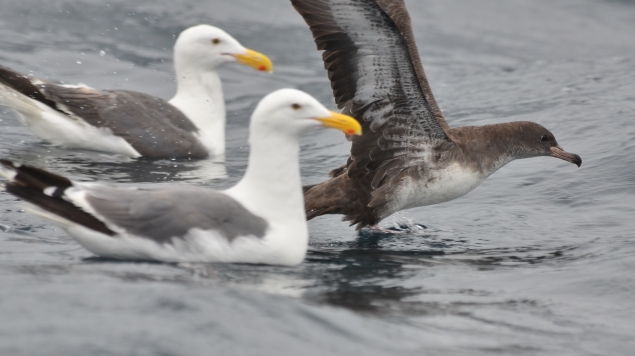
Shitty photo, I know, but Flesh-footed Shearwater (bird on he left, Pink-footed Shearwater on the right) is always a nice bird. 2013 was a great year for them, but I didn't see a single one in 2014, which I suspect is strongly correlated with the fact that there were hardly any Buller's around in 2014. Rare shearwaters appear to enjoy the company of Buller's it seems.  We did have a handful of Buller's, which is a good omen for later in the season.

It's not unusual to see banded Black-footed Albatross offshore, as there have been banding programs going at several of their breeding sites for many years now.  This black on yellow field readable band is from Tern Island (French Frigate Shoals), about 2,730 miles west of where we saw this bird. I did report this band resight, and promptly got a response in two days! Way to go USGS!


Black-footed Albatross are not wary birds. Reading albatross bands is not difficult. This bird was banded in May 2010 as a chick, and will be old enough to breed in about three years.

Albatross can surf with their big feet. With the way they can move offshore you would never guess how ungraceful they can be on land.


Storm-petrels put in a modest showing, but with a robust four species representing. This Ashy made a close pass by the boat.

Wilson's almost always seem to come in close to the boat eventually. It's a nice bird to see out here regularly, they were considered quite the rarity not too long ago.


Bird of the day, as far as the most unexpected species, easily went to this Surfbird that briefly followed the boat way out in San Francisco County waters. It's the first one I've ever seen offshore, and I never expected to see one in the company of Black-footed Albatross (the bird in the background). You never know what weird migrant you might cross paths with out there.


Steller's sea lions were hauled out on this buoy just offshore from the Pillar Point Harbor. Note the blunt snout, "bear-faced" look and blonde fur. That's a California sea lion head poking out on the right side for comparison.

There you go, a nice, succinct blog post with little writing and lots of photos...had to change things up after that last post. I'm going out again this weekend, on the hunt (as always) for sweet sweet Pterodroma goodness.

Thursday, February 19, 2015

Sustainable Blogging In The Birdosphere


BB&B was birthed into the Birdosphere in 2008, back when my photography efforts were limited to the occasional digiscoping.  Unlike in 2015, there wasn't much crushing going on back then (or even proto-crushing), but I think this Lucifer Hummingbird is decent. Ash Canyon B&B, AZ.

BB&B will turn 7 years old this year.  Sure there are other active Birdosphere blogs that have been around longer (10,000 Birds, A DC Birding Blog, Nemesis Bird, etc.), but in blog years BB&B is something like 60 years old.  You see, although there is no shortage of bird blogs out there (and thank you for choosing this one today), there is a very high mortality rate among bird blogs...they just don't last.  Bloggers, for whatever reason, simply lose interest in their projects, regardless of the topic. Granted, there are good reasons for this...lack of time due to a job and/or kids, or a major life event that rearranges all your priorities, leaving your blog in the dust.  It happens.  That said, I don't think this is why most blogs fall by the wayside.

I'm an old hand at blogging now.  Sure I still don't know a thing about html or how to do anything to make BB&B look like a well-oiled blogging machine, but aesthetics aside I do have some kind of idea about what I am doing.  I am even getting used to being recognized in the field by people I've never met before, simply for blogging....which, aside from being a monumentally nerdy reason to be recognized, is weird because I hardly ever post photos of myself on here.  I never saw this coming. Felonious Jive, the Great Ornithologist, says he saw this coming from the start...but when he's not talking about birds, that guy is full of shit.

Which is not why we are here today.  Here are some tips on how to keep your blog alive and kicking.

1. Feeling like no one is listening?  Have confidence!  Assume people care about what you have to say, because they will.  Every bird blog will have an audience once it's been around long enough, regardless of your writing and photographic skills.  I know that sounds crazy but I swear its true. There are numerous bird blogs out there that I consider profoundly boring, yet its clear they get a hell of a lot more traffic than me so they are doing something right.  If you write it, they will come.


I'm equally comfortable with making fun of birders, talking about vagrants, and discussing the joys of "shaking hands" with Laysan Albatross (seriously, it's awesome).  For the birdosphere, that makes BB&B a pretty loose place, but that approach doesn't work for everybody. 

2. To niche, or not to niche?  If you ask me, I think a bird blog can go one of two ways...carve out a niche and own it (i.e. Earbirding, Anything Larus) or be very open to a wide range of topics, which is the route BB&B has gone.  Either way will give you plenty to talk about, and if your blog is going to be around for a while, you need plenty to talk about.  If you stick to the worn path that is I-went-here-and-I-saw-this, you will always have readers, but you as the writer might find that format getting stale after a while.  After all, sometimes you go birding and it sucks...I certainly am not motivated to write about those days unless it is truly horrific.  That said, if you really enjoy the writing patterns you fall into, there is nothing to worry about.

3. Take pride in your writing!  I genuinely enjoy writing, even if it is in this weird format.  I am always trying to improve my skills and trying to write in such a way that once someone reads a post for the first time, they will want to keep coming back.  I blogged extensively before BB&B started and was always stoked that my friends were into it, even if it was pretty jokey shit (and no, I am not going to link to it).  Any sort of writing can be a challenge, and a fun one at that.

4. Read!  Whenever I read a damn good book, I am always inspired to get blogging.  If you're experiencing some blogging apathy, just dive into something from your favorite author.  They may not mention a bird for the entire book, but it really doesn't matter.


Do: I like Sooty Shearwaters.  I like Common Murres. Seabirds are amazing.
Don't: After my surgery, I wasn't sure if going on a pelagic trip was such a good idea.  It still hurts me when I turn my body too far to the left and I still have to move slowly sometimes.  Luckily, the seas were calm that day!  I was really worried that bla bla bla bla bla bla....

5. A few tips, if you want to attract some new readers and keep them around:
- DO NOT talk about problems with your physical health.  It sucks to be in pain, I know, but birders do this excessively...on listservs, in Facebook groups, and in blogs.  It's really quite the phenomenon. Please stop.
- DO NOT spend too much time talking about your bird lists.  Most people don't care.  I don't want to bum anyone out, but search your feelings...you know it to be true.
- DO talk about what you know.  Be it the genetic studies done that validate a new split, migration, local rarities, or your hatred of feral cats, use your knowledge and/or special interests to add fuel to the blog fire.

6. Have some kind of goal in mind for your output, just for a little extra motivation to stay active.  I always try for two posts a week, although I don't always manage that anymore.  That said, there is no reason to put up a post that you feel is mediocre or somehow incomplete.

7. Build a community around your blog.  Interact with your readers, it makes everything more fun. Comment on other people's blogs, and don't be shy about giving shout outs and linking to their content.  You know it's always a positive thing when people give props to your blog, so why not do the same for others?  You might even make a few friends out of it.

9. Not posting very often?  Then team up, and watch your bloggish productivity soar.  A lot of blogs have gone the multi-author route, and none have seemed to suffer for it. I know BB&B certainly wouldn't be the same without Felonious Jive to help me out, and it's my pleasure to have a buddy write a guest post once in a while.


Though humorously arranged, this Brown Pelican probably did not die a peaceful death.  By now it has faded into oblivion altogether.  Don't let your blog be like this Brown Pelican.

Sunday, August 31, 2014

Half Moon Bay, 8/17 and 8/23


Sooty Shearwater. Angular.

Some coverage today from the August 17 and August 23 pelagic trips with Shearwater Journeys out of Half Moon Bay, CA. My next boat will be on September 7, with This Machine Nate, Laurence of Arizona, and Flycatcher Jen. I have never been on a boat with so many bird bloggers...the tremendous weight of our combined nerd-strength could sink us before we get out of the harbor. Hopefully they will get some lifers...I believe this will be Laurence's first pelagic, so I expect he will be flipping out and spewing puns for the duration. As for me, September 7 is still within the Hawaiian Petrel window, so that is my target bird...don't worry, I'll be looking for White-chinned and Great-winged too, but I am a humble birder. Warm water conditions persist in much of the eastern Pacific, and there are a lot of Sulids in the area right now, so you never know what we might find.

As I compose this post, I am impressively ill. I mean, no one is going to be doing any ice bucket bullshit for me, but existence is rather unpleasant at the moment. So for today I will cut the loquacious crap, and each photo is going to get exactly one word to accompany the species.


Rhinoceros Auklets. Gloomy.

Tufted Puffin. Inspecting.


South Polar Skua. Skippy.


Broad.


Black-footed Albatross. Hello.


Majestic.


Brakes.


Common Tern. Wedged.


Articesque.


California Gull. Cinnamon.


Edgings.


Pink-footed Shearwater, with Western Gulls. Disparate.


Harried.


Pomarine Jaeger. Pomatorhine.


Dauntless.


Pacific Loon. Fresh.


Steller's and California Sea Lions. Blondes.


Steller's Sea Lion. Sneers.

Tuesday, September 17, 2013

Offshore Monterey: Mixed Water, A Mixed Bag


Back on September 7, I kicked off three days in a row leading pelagic trips for Shearwater Journeys. This was a boat out of Monterey (probably the only one I'll be on this year). There was some swell to contend with, and we had some difficulty figuring out where the birds were. A lot of the water we found out on the Albacore Grounds looked a bit cold and disgusting (i.e. no "hard edge"), and as expected the birds were not out in force.


We did have acceptable numbers of jaegers (including close to 27 Pomarine) and Sabine's Gulls. This crisp Parasitic Jaeger was going all in on getting this Sabine's Gull to regurge something tasty.


It was one of the few more dramatic moments of the trip. Sabine's Gulls must despise the fact that multiple species of jaegers are following them around all year, all the way from the Arctic to the waters off South America. Talk about a real nemesis bid.

The rest of the flock retreats unscathed.

The highlight of the day for me were a couple of Blue Whales. This is the closest I've seen them. Pictures, of course, do not do them justice.


I previously referred to Blue Whales as behemoths, so today I will call them leviathans. Late summer and fall is a good time to see them off California, as the migrate south for the winter.


I get a lot of questions about how to tell phalaropes apart. This plump, short-billed creature is none other than a Red Phalarope. Red-necked is smaller, slimmer, with a longer, thinner bill...they're not too difficult to tell apart in flight if you get a good enough look. A lot of Red-neckeds moving through are juveniles, which are distinctly darker-backed than Red.


Sooty Shearwater was the most abundant bird of the day, which is to be expected this time of year. Short-taileds will be arriving in a few weeks, which we should all be ready for. You may have noticed that I set myself up for a good little Short-tailed discussion, but what could I mention that isn't already in your field guide? Down with redundancy.

Oh, some Sooty Shearwaters have white chins...you won't find that in the field guides. Now you know.


Pink-footed Shearwaters are very common as well. I like the lighting on this bird.


Here is a bird in harsh afternoon light...I prefer overcast. Aside from Red vs. Red-necked Phalaropes, I notice a lot of Pink-footed Shearwaters mistakenly get called Buller's Shearwaters...other than the standard differences in size, flight style and underpart color, it's worth mentioning that Pink-foots are freshly molted right now, and can look hella contrasty on the upperwing, reminiscent of Buller's at first glance.


It's impossible to resist the urge to photograph Black-footed Albatross, no matter how many I've utterly destroyed with my camera over the years. That's a juvenile Western Gull next to it, for size comparison.


Dark-rumped birds like this one are younger and not as world-weary. It's nice to see these optimistic, exuberant individuals before they are mentally crushed by too many seasons of failed breeding and watching their friends choke on plastic action figures plucked from the North Pacific Gyre.

Right. Who said that?


Here is a homely-looking Pomarine Jaeger. Gross.

Overall, not a bad day on the water; a pair of Baird's Beaked Whales, a big pod of Common Dolphins, Arctic Tern and a handful of Buller's Shearwaters were nice. We only found a paltry 7 Ashy Storm-Petrels, but we found the motherload the next day off of Half Moon Bay. Noteable misses were Long-tailed Jaeger and South Polar Skua...can't win 'em all!