Showing posts with label Golden-winged Warbler. Show all posts

Tuesday, May 22, 2018

Smith Oaks, Hooks Woods, Eubanks Woods Sanctuaries


Smith Oaks was extremely productive for us on multiple days and hella fun to bird, generally better than Boy Scout overall. Smith was consistently somewhere between "moderately birdy" and "guhhhhhh birds everywhere" throughout the week...eBird checklists were best characterized as "corpulent". Here are a few of the hundreds of migrants we met there, starting with this Chestnut-sided Warbler.


As expected, the always becoming CSWA was a fairly common migrant throughout the week at all the migrant traps we visited.


A female Blackburnian Warbler with a trophy-sized worm of inches.


This is the same male Blackburnian that was hanging out next to the egret rookery in the last post. I'm still suffering from heart palpitations from seeing so many of these crippling heart-stoppers that week, which were one of the most common warbler species. So many glowing Blackburnians everywhere were difficult to cope with, physically, emotionally and spiritually.


Another crippling gasper, Golden-winged Warbler was certainly not a common migrant, but we did connect with more than I thought we would. We didn't come across any particularly confiding birds unfortunately, but who is complaining? Not me. A couple of them were singing, which is the first time I've ever heard them.
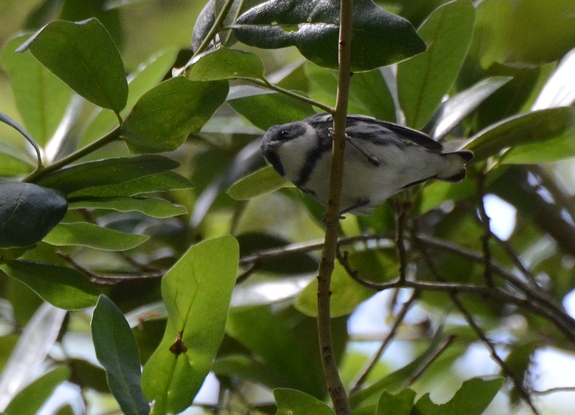

Though not a lifer, Cerulean Warbler was one of the main target birds of the trip for Yours Truly, #7. We had great success, and pleasantly saw a modest number of them.


Also like Golden-wingeds, they were hard as fuck to photograph/see well. Fitting, I suppose, for such a sought-after gem of a bird.


Female Cerulean, showing off her distinct long undertail coverts and almost stub-like tail.


Hella Wood Thrushes that week; we saw hundreds of them. This is not something I expected or have experienced before. Stoked.


When one encounters This Machine Nate on a trail, only one thing can be said for sure: you are in for a treat.


Nate's treat was met by a mix of intrigue and revulsion.


We also spent a lot of time at Hooks Woods. It's a lot smaller than Boy Scout and Smith, but it's the closest patch of trees to the coast, the habitat is good, and the concentrations of Geri there seem to vary between "low" and "bearable". This was the first Blue-headed Vireo of the trip; we would go on to see a handful spread out over the week.

I should mention that birding the road in front of the sanctuary can also be productive; this is where This Machine lifered Black-billed Cuckoo.


Here it is, your friend and mine, SWAINSON'S WARBLER, THE BROWN WONDER. This one was Dipper Dan's lifer. This was a good spring for these skulkers on the UTC apparently.


A surprise to one, Eastern Wood-Pewees adorned the migrant traps in large numbers. Lord knows how many of them were misidentified by Geri and friends.


Veeries were uncommon but dependable throughout our trip. Hooks Woods, and the lawn directly across the street from the entrance, was spilling over with Catharus the entire week. Thrushes were just littering the ground. We even saw some poor completely black thrush that had clearly just taken a bath in an oil pan someone had left out.

What a fucking bummer.


Where there are mulberries, there are Rose-breasted Grosbeaks. Mulberry trees are magic.


On our last day of birding the coast (April 27), Officer Shaw picked out this Olive-sided Flycatcher up in the canopy at Smith Oaks. Though not a late migrant on the west coast, it is in the eastern half of the country. It would be the only classic "late" migrant we would end up seeing; we did not connect with Alder, Willow or Yellow-bellied Flycatchers, or Mourning Warbler. We somehow dipped on Least Flycatcher as well, which seemed bizarre to me. I don't know if they are just not abundant on the UTC, or if they simply weren't moving through the area that week for whatever reason. We had several days with tons of Acadians...migration is weird.

Wrapping up High Island...Dipper Dan and I birded the High Island Historical Park (walking back to Guirdy Road) during the one very brief "slow" period we encountered....it was predictably slow, but I could see it being good when there are migrants around. We checked out Eubanks Sanctuary (mostly because we kept driving by it) on a birdy day and found it to be rewarding, although the habitat is overgrown and pretty much the same throughout the patch. Here is our eBird checklist; of note were Cerulean, Golden-winged and Canada Warblers (a new bird for the trip at the time). There is a pond in the back of the sanctuary that attracts a lot of birds, it is worth loitering around there for a bit. And amazingly, there were no other birders there! So if there are birds around and you want to take shelter from Geri, it is worth taking a look. We never did make it to the Crawford or Gast sanctuaries.

That wraps up our High Island coverage; in summary, it was as advertised. Absolutely ace birding, hordes of Geri, rampant misidentifications, and worthy of revisiting repeatedly.

Anahuac is up next!

Monday, June 23, 2014

Back to Costa Rica: Birding El Toucanet Lodge


Black Guans are very docile for their size...they lack the courage of a chachalaca and the brazenness of a guan, and the unabashed curls of a currasow. Unlike all three, you are much more likely to find this bird feeding on berries up in the trees than running around on the ground like a mutant forest-sanderling.

I bet you didn't see this coming, did you? Well I still have not completed coverage of the BB&B winter tour of Costa Rica (2012-2013), and I thought I would change things up a bit and return to Costa Rica for a post. After all, it is the middle of June...with not much birding to be done, its time to start thinking about that winter trip to the tropics.

When we left off with The Pitta Incident, Stilt, Dipper Dan, Frank (spirit bird: Double-crested Cormorant) and I finished birding on the west coast and retreated inland. After much weeping, Dan and I dropped off Frank and Stilt at the airport and struck out on our own. Where to go? We did what we thought was best and headed south, and for the second time of the trip (after picking up some genital pastries) made our way into the Talamanca Mountains.

We decided to check out El Toucanet Lodge, a relatively cheap birder-friendly lodge that had been recommended by Patrick O'Donnell, the living birding legend of Costa Rica. The lodge sits at a lower elevation than the more popular Paraiso Del Quetzales and the Savegre resort, and not surprisingly had some different birds to offer. Like every other birdercentric place we stayed in Costa Rica, the birding was of a high caliber and everything else was tranquilo. And for those of you with pinche Spanish-speaking skills, the owner is an American ex-pat and knows his birds very well. The property isn't large but the birding along the driveway and along the road up-canyon was very rewarding, and the hummingbird scene is a good one as well.


Brown-capped Vireo! I know, I know, it doesn't look like anything fancy, but it is a bird I really wanted to see. El Toucanet was the only place we recorded them on this trip.


Brown-capped Vireo looks like a cross between a Philadelphia and Warbling Vireo, which is kind of disturbing when you think about it because birders don't fare very well telling those two apart anyway. They really are quite brown above though, so it is a bird with a useful name. I thought I saw one through the fog in an epic mixed flock up in a Mexican cloud forest once, but couldn't bring myself to count it...no problem now though.


In the spirit of birds with useful names, here is a Yellowish Flycatcher. I honestly don't know what to say about it. I'm at a loss for words. It is a flycatcher that is very yellowish. God Bless the Empidonax.


It bears more than a passing resemblance to "Western" Flycatcher, but luckily for the birder, Pacific-slope/Cordilleran don't go south to Costa Rica. Yellow-bellied Flycatchers abound though, so it's good to be Empid-literate if you go down there during winter.


El Toucanet introduced us to our first Stripe-tailed Hummingbirds of the trip, which we also had later at Savegre.


Stripe-taileds range from southern Mexico to Panama, most often at middling elevations. Birds in Costa Rica and Panama are of the egregia subspecies, with two other subspecies being described for populations to the north.


There was no shortage of tiny Selasphorous hummers coming to the feeders at El Toucanet. They were all immatures/females, and all of them that we could identify appeared to be Volcano Hummingbirds (above). I'm sure scintillants show up there as well, but we could not find any.


Here is a more familiar bird you might appreciate. Golden-winged Warblers are fairly common winter residents in Costa Rica, and can be found at a wide variety of habitats and elevations throughout country. We saw many, which was a cause for much celebration.


Common Bush-Tanagers are the anchor for many mixed flocks in Costa Rica. I'm always glad to see them, because you never know what may be lurking in their ranks.


A random view from the deck of their lounge/restaurant. Not bad, eh?


Another perk of hanging out on the deck is the chance to see Magenta-throated Woodstar! I wish I got a photo that did this bird justice, but you get the idea here I hope. This was another species that we relished at the lodge and saw no place else.


The Talamancas are thick with Green Violet-Ears. The feeders at El Toucanet are no exception. I know this isn't exactly a crush, but I cannot deny the appeal of those outstretched "ears".


Look at this...an accidental vagina pastry! I told you we had genital food. They weren't bad at all, and they all looked like vaginas. Accidental vagina pastries are not available at El Toucanet, so it would be weird to ask for them. More from El Toucanet and the Talamancas in the next Costa Rica post (whenever that is).