Showing posts with label short-billed dowitcher. Show all posts

Sunday, July 17, 2016

Split, Lump, Whinge, Repeat


I am now king of the scrub-jays, having seen California, Florida, Island (above) and Woodhouse's. With that milestone, I now just need to become the king of...lots of other things. 

When I first started birding, I had seen one species of scrub-jay. This is not because I hadn't yet been to places like Santa Cruz Island, Arizona or Florida, it is because the only scrub-jay that "officially" existed was the Scrub Jay. Now, the Scrub Jay has been left by the wayside, stripped of its capital letters but gaining a hyphen...and most notably was made into four separate taxa. We've come a long way.

The newest American Ornithologists Union (AOU ) supplement just came out, and a lot of birders are happy with it...you gotta love armchair lifers, or at least I do. Woodhouse's Scrub-Jay was my only addition from north of Mexico, but I got several more from Mexico and Costa Rica. I did not delifer at all, which is how I prefer it when these supplements come out. I'm not anti-lump, I just dislike losing birds. You understand. The vast majority of birders in North America bend the knee to the AOU (the king in the north!) regarding what is considered a full species and what is not, though we are rarely totally happy with what they decide.


Lesser Violetear was one of my armchair lifers. While I am pleased that I now have Mexican Violetear and Lesser Violetear instead of plain old Green Violetear, many are left wondering why the name Lesser Violetear was chosen...there is no Greater Violetear, after all. But hey, I'll take yet another poor bird name if that means a legit split got to go through.

What fascinates me is that there are a number of birders out there who are can't stand all this tinkering with species. They are neither splitters nor lumpers, they just dislike the amount of splitting and lumping that goes on. They are essentially against taxonomic revisions altogether. They dislike the new names, the new species. To them, this is just a nuisance, something they have to endure. Why is this so?

A poor grasp of science comes to mind immediately. Believe it or not, a lot of people fail to comprehend that our understanding of science is constantly changing, and overall these changes are improvements. Like many people, many birders don't really understand basic scientific concepts. People like to pigeonhole things, it's in our nature, at least culturally, and the tendency of pigeonholing is at direct odds with the changing ways we perceive and describe the world around us. We don't want to find out that the planet is not round, that the sun does not rotate around Earth, that American Coot and Caribbean Coot are conspecific. So while a lot of folks are really hung up on things staying the way they were originally taught, science marches on.

There is another reason birders advocate for a static taxonomy...they have trouble being up to date. In other words, they are simply unaware that the AOU is responsible for making these decisions and that it happens annually. A surprising number of birders believe that the American Birding Association (whose primary focus is advocating birding, not science) is "in charge" of splitting and lumping, which is indicative of the general ignorance on this topic out there in birderdom.

Finally, there is a distinction between birding and ornithology. Not all ornithologists are birders, at least not in the traditional sense. One does not simply earn the title of ornithologist after a few years of birding. Almost all birders are not ornithologists (no, "field ornithologists" don't count in this case). Science does not have to answer to the whims of birders; that's just how it is, but some birders have great difficult accepting this.


There is no doubt that birders have a lot to contribute when it comes to the field of ornithology, such as documenting the abundance and distribution of seabirds like Long-tailed Jaeger. That does not entitle reluctant birders to a moratorium on updating avian taxonomy. The AOU does not have a list enforcement arm (unlike bird record committees), so if you don't like what they do, you don't have to play by their lists.

Obviously the AOU is not perfect. If you follow the AOU very closely, you are probably aware there is no shortage of criticisms that can be lobbed at them. One could say that they act extremely slowly, they give birds poor names, they split things that should not be split and they lump things that should not be lumped. However, no one who is well-versed in taxonomic relationships, and science in general, advocates for keeping taxonomy static. There is no reason to release a single AOU supplement every 25 years just to make sure all the whinging birders are ready for it. Advocating for a fixed list of species is basically just saying "Fuck off, science. I don't want to be bothered by things changing"...and that, obviously, is a myopic, selfish and bizarre way of viewing the world. If you want to reject the fact that our collective knowledge of birds is constantly growing and changing, then you can go ahead and reject the names of birds and established species altogether. Call the Common Gallinule an American Coot instead...no one can stop you. Lesser Nighthawk? Pffffft...no, that is a Greater Daybat. Island Scrub-Jay? Napes. Mainland Blue-Flapper.


A lot of species that we now take for granted were once considered two or more species, or lumped in with other species. Long-billed Dowitcher was once considered a subspecies of Short-billed Dowitcher (above).

It all comes down to change...the last thing the world needs are more people who cannot accept the fruit of new studies and research, and the accompanying changes in the way which we understand said fruit. Sure we can be skeptical and not accept everything the AOU does as ordained by the gods of ornithology (though much of what the AOU does is ordained by ornithological gods), but change is going to come and that isn't something to be afraid of. You don't have to agree with it. The science in this field is not always perfect (the infamous Kumlien's Gull study comes to mind), as we are imperfect beings...but all the world's authoritative entities on bird taxonomy (the AOU, the IOC, the Clements checklist) can agree on one thing...taxonomy should be updated regularly. In attempting to refine the relationships between the world's birds, trying to figure out the passenger manifest of Noah's Ark is not going to cut it!


Will Red Crossbills ever be split? There was a lot of hype about it for years...but maybe an 8-way split is just too gnarly, and perhaps it is just simply not deserved...these "types" are thought to have diverged less than 100,000 years ago (for comparison, Eastern and Western Willets diverged 700,000 years ago). Whatever new information that can be gleaned about Red Crossbill types and how they are related will be fascinating to learn. Whole new frontiers of bird knowledge are opening up, and I hope those who would rather drag their sluggish feet in the past will eventually want to keep pace with the rest of us, regardless of whether field guides change or not.

Sunday, June 12, 2016

A State Bird, Spring Shorebirds and a Requirement for Avosex


Early in the spring, I lurked into the Central Valley, where an Emperor Goose would have been a welcomed year bird. Those of you who enjoy their schadenfreude would like to know that the bird decided to leave the night before, but it was a good sunset with lots of Cackling and Greater White-fronted Geese to sort through.

Well, here we are. June. California's best spring in memory has come and gone, with May bolstering the Vague Runt roster with another White Wagtail, Kentucky Warblers, a Buff-breasted Flycatcher, an inner circle Pterodroma caught in a mist net (which is a Meguh) and another mainland appearance by the Kelp Gull. Don't worry, I did manage to at least get out and look for the Kelp Gull...which I dipped on. I also dipped on the Northern Gannet a couple times, which is so unsurprising that it doesn't even bum me out any more. Dip dip dip dip dip dip dip fucking dip.

That said, I did go birding this spring, and I did see some birds, including some good ones.


A friend of mine, "Fob Rowler", is one of the admins of a 5,000+ member birding group on Facebook. His members look up to him like a birding god...and who is to say that he isn't? It often looks like a thankless task, but one day Fob was looking at one of the bazillions of bird pictures that is posted to the group every day and noticed something strange in a flock of flying White-faced Ibis...there, in the corner, was a unmistakable Glossy Ibis. This is a rare bird in California...one that I hadn't seen in the state before. So a week after Fob's Facebook find, it was off to Yolo Bypass Wildlife Area, and I have to thank Fob and Facebook for this sexy state bird.


Yolo Bypass has a healthy population of Swainson's Hawks, which I never tire of seeing. I also got my lifer mink that morning, which was a bird I was not thinking I would get that day. Some kind folks pointed it out to me as it swam out to a patch of reeds, but unhelpfully tried to convince me that it was a small river otter with a short furry tail. The nerve!


Every spring I spend some time shorebirding, partially because I am always hoping to find a spring vague runt plover or sandpiper (which rarely happens) and partially because spring shorebirds are really, really good looking birds. Dowitchers suddenly become exponentially more interesting...you don't have to sweat IDing them by sight, they make weird noises that go unuttered in fall and winter, and they actually are very appealing birds. This is a Long-billed Dowitcher, at Middle Harbor Shoreline Park, Oakland.


Here is a Short-billed Dowitcher. Look at that short bill. It's like rosy Jack Snipe.


Another Short-billed. No one thinks of dowitchers as gaspers, but I will argue that they are worthy of the occasional gasp.


I want to be real with you nerds, so here we go...BB&B is one of the only trendsetters in birding. So with that in mind, let me ask you this...do people take pictures of Canada Geese anymore? No? Good...well I'm bringing them back. Soon everyone is going to be posting Canada Goose photos. Cardinals are going to be over, and the masses will instead glorify the majestic Canada Goose.


One morning Billy and I cruised to Bedwell Bayfront Park in San Mateo County to look at Pacific Golden-Plovers, a decent bird almost anywhere in the bay area and rarely encountered in alternate plumage. They had been roosting on a salt pond for some time, and we found them just hanging out and looking great. This species is a pain in the ass to photograph though, at least in this state...go to Hawaii if you want to crush them, as they are a lawn bird there. It's really trippy.


A rare (for me) spring visit to the Radio Road ponds in Redwood Shores was productive. Short (front) and Long-billed Dowitchers provided a great comparison when we showed up. If only it were always this easy to tell them apart.


There probably isn't a better place in the bay area to see breeding Forster's Terns, which nest on the small islands here relatively close to the edge of their favored pond. On this visit, there was a lot of courtship going on and a lot of birds on nests already.


As always, American Avocets were around, sporting the buffy heads required to convince each other that they should have avosex. The bay area has both long-legged shorebirds in abundance.


This is the other long-legged shorebird, obvi. Black-necked Stilt is another signature, sometimes-annoying shorebird species of many of California's marshes. Like the avocets, they are resident year round and are common breeders at many marshes around the bay. The debate continues over which nesting shorebird is more annoying to be around...Killdeer (dee dee dee dee), avocet (kleep kleep kleep) or stilt (yap yap yap yap yap yap yap).

Thursday, August 13, 2015

The Human Birdwatcher Project Presents: The Democratization of Birding


This is a Broad-tailed Hummingbird. This fact is not disputable, though there are many who would put their disputing caps on and try anyway. Photographed in Miller Canyon, AZ.

Today's post is brought to you by The Human Birdwatcher Project, where "Birders are people too!" and birding-by-vote can lead down a dark path indeed.

In a true democracy, decisions are made by the majority, plain and simple. Most decisions decided by voters are based on personal values.  In these situations, wrong and right is entirely subjective.  You know this, and I don't think it needs any more explaining.

It was not long ago when the words "democracy" and "birding" could never be uttered in the same sentence...but that was Then, and this is Now.  Birders knew the other local birders, gossiped about birds and birders, and went about their business (birding).  The ABA and various Bird Record Committees made decisions, big decisions, in relative isolation and with relative impunity.  For example, I can still remember the uproar that was caused when the ABA (allegedly) forcibly removed Papa Echo Lima from his throne (Editor of Birding), and there was a huge backlash from the birding community.  Many high-ranking birders were furious, and quit the ABA altogether. Think about that for a second, and put it in your pocket...we will take it out for another look later.

The very fabric of birding rapidly began changing in the 90's with the wide availability of the internet.  First, there was email, which led to listservs, and easy communication with birders around the world.  Next came digital cameras; people could digiscope with point and shoots, and then SLRs became more affordable to the general public, and now people can get good images with their phones. Bird photography was suddenly affordable, and not very difficult either. Birding blogs were springing up left and right.  Then there was social media...most birders were too old to jump on the Myspace train, but they latched on to Facebook and never let go. EBird was the frosting on the cake.

With everyone so connected now, there is a lot of communication going on between birders. It's intense. Birders who aren't even trying to sell you something have legions of Facebook friends/fans, and get huge responses to their photographs or ramblings on whatever it is they feel like expounding upon (be it birds or not)...birders just seem to eat it right up, whether it be pure gold or utter bullshit. The ABA's main FB group has over 6,700 members, and it manages multiple groups, a staggering fact.

One of the best and worst things about all of this, be it in a listserv or in a FB group, is that everyone has a voice.  Now some of you might be thinking, "What do you mean worst? Are you some kind of fascist?  Do you hate birders?", and it is those of you who need to hear this the most.  Birding has suddenly become a democracy.  And when it comes to birding, democracy is often not our friend.


Since we are all connected so closely these days, news of something like a stray Barrow's Goldeneye travels very fast. Everyone is connected, and is capable of getting the word out quickly. This is a good thing. Could there be a downside to this new, interconnected Democracy of Birding?  This is a non-stray Barrow's Goldeneye, photographed near Lake Merritt, Oakland, CA.

Look, it is all well and good when, for example, the ABA asks its members to vote on if they want to add Hawaii to the ABA area or not.  That's great, but it's not really what I'm aiming for here.  I'm talking about far more basic things here...bird identification, for example.

Bird Records Committees, or Bird Police, if you prefer, often function to identify birds. They often are quite good at carrying out these tasks because their members are either very knowledgeable, very experienced, or willing to listen to those who know more than they do...preferably all three.  With the occasional exception, they correctly identify birds that are often very difficult to identify.

Now consider attempting bird identification with this model in the public birding arena.  This should not be difficult to imagine, since it happens constantly...but I digress.  There are a lot of birders out there, a lot of new birders...and as there always has been, a lot of birders who are not good at identifying birds.  So what happens when a bunch of random birders get together to identify birds?

Chaos.

This is the fundamental distinction between democracy as a political system and democracy when it comes to birding...there is only one right answer.  The backyard birder's opinion on fall warbler identification is not as worthy as the person who bands hundreds of warblers during fall migration every year.  I'm not trying to be harsh, just stating a simple, logical truth...no reason to get all sore about it.

The Democratization of Birding and the internet go hand in hand. If you are a birder and have spent any time on the internet, you know what I am talking about. Someone will post a picture of a bird somewhere, and disturbingly often a bunch of people will collectively decide what the bird is.  They will vote on it! Even if someone, even if multiple people correctly identify the bird using sound and unassailable logic, they may get drowned out.  The birders getting the bird wrong often inexplicably get their feelings hurt when they are corrected, and claim they are being attacked! It is insane. The level of butthurt that emerges from these minor disagreements boggles the mind.

Democratic birding raises its many-faced head in other debates as well...escapees vs. natural vagrants, the effects of climate change on birds, and all manner of theories on why some birds show up in particular places (do you remember Hurricane Sandy?)...you know, birders can disagree on just about everything. The fact that the vast majority of birders do not have a background in science compounds the amount of confusion in discussions that veer from the topic of bird ID.  The potential for misinformation to spread unchecked is very high and has been sustained for some time now. I'm going through a blatant example this right now in another browser window, looking at SFBirds...are there three Indigo Buntings in Golden Gate Park?  Is the female a Lazuli?  Is the HY bird a Indigo X Lazuli?  Is this the first breeding record for the county?  Did they even breed in the park?  Bunting Chaos.  Luckily, the birder known as The Rustic Bunting Hero has stepped in, in an attempt to quell the masses...but a flareup of Bunting Unrest is just around the corner.


When you are a birder and pay a lot of attention to listservs, the Birdosphere, and Facebook groups, it's all too easy to want to make like a dowitcher and dunk your head under water for an unhealthy period of time in order to keep the thousands of voices at bay. Fortunately for these Short-billed Dowitchers, they will never know the pain of getting in to an internet fight with a bitter birder thousands of miles away. Middle Harbor Shoreline Park, Oakland, CA.

So what is the mechanism for all this confusion?  All this hate?  It is twofold. First, some birders mistakenly believe that everyone's opinion is equally important when it comes to bird identification, where a bird comes from, etc. Well...a bird can only be one thing, and some of us are better equipped to know that bird's story than others.  There is only one right answer, and that is usually in our collective grasp.  Most birds are not first cycle, heavily worn hybrid gulls, nor are they distant murrelets with confusing facial features seen from a mile away, nor are they Yellow Grosbeaks of questionable provenance (providence???). Most birds are knowable.  Clearly, we should always tend to defer to the most experienced, most trustworthy birders, because they are the ones who will mostly like get the identification right, which is the primary goal here for most birders. A dozen beginning and sketchy birders are usually not as qualified as one good birder to tell a Lesser Yellowlegs from a Greater, a Semipalmated Sandpiper from a Western. Second, being unfamiliar with the reputation of other birders can make one assume that they aren't highly skilled.  That is totally excusable for beginners of course, not being around for very long and whatnot, but that doesn't mean we can't give people the benefit of the doubt when debating ID with unknown birders. I even know someone, a very capable birder actually, who stated that he doesn't trust field guides (I mean books, not people) if he doesn't personally know the authors...gross. Lets not go that far. If everyone who doesn't personally know Steve Howell opens up Rare Birds of North America and thinks "this guy is a complete wanker", then the wonderful world of birding as we know it would simply not exist.

So what is the solution to all of this?  Unfortunately, I don't have one for you.  This is why we so badly need the Global Birder Ranking System to release its data on the world's birders.  The fact that they have all the world's birders skillsets catalogued (from social skills to subspecific storm-petrel ID), with ranks updated daily, is truly a tremendous feat...but the day they go public may never come.


If I posted this photo to whatbird.com or any number of Facebook birding groups asking for ID help, there would be wild conjecture.  Good guesses with good evidence would just get lost in the shuffle of folks crying out for TENNESSEE WARBLER! or ANOTHER VOTE FOR LEAST FLYCATCHER!...and I don't think that is constructive for anyone.  Since I know you are wondering, this is actually a Bell's Vireo. Funny to see that single new feather coming in, since this shot was taken in spring. Photographed at South Padre Island, TX.

On the flipside, why don't you take that fateful decision regarding Papa Echo Lima out of your pocket. If that decision with that editor happened today, in 2015, the ABA would face a catastrophic backlash as soon as the news broke. Hundreds of people would be taking up arms on Facebook, denouncing them for what they had done, shaming and trolling to no end.  The birdosphere would be aflame with hate. For good or ill, it probably never would have happened if the birding community has the collective voice that it does now. The new Democracy of Birding is not inherently evil, but it's getting a little too close to The Dark Side of Birding for comfort...but perhaps we will have to live with that if we continue to take advantage of this open and free exchange of ideas.

Actually, no...there is room for improvement. Don't be a dick. Don't get butthurt. Think before you type. Don't throw your bullshit hat into the ring if you know your hat is covered in bullshit, unless you admit it up front (people actually do this a lot, it does not go unappreciated). If you are going to challenge experts, by all means do (it's quite fun, actually), but back your claims with evidence. When someone posts a picture of a real Gray Hawk, do not reply with a hilariously dismissive "not convinced" and then quit the Facebook group after you are corrected (this really happened). Simply, be excellent to each other. With so much we can all learn, I hope birders carry on with this haphazard democracy in the right way, but only time will tell.

Tuesday, May 19, 2015

Total Chaos


It's been a while since I've done one of these posts, and I will go ahead and admit it up front: this post is nothing but old-fashioned TOTAL CHAOS.  Anyone remember that band?  Not sure why anyone liked them.  Anyways, this post is nothing but random birds that have not yet found their way into any other posts yet, but here they are.  There is no rhyme or reason, just a smorgasboard of bay area birds from earlier this spring.

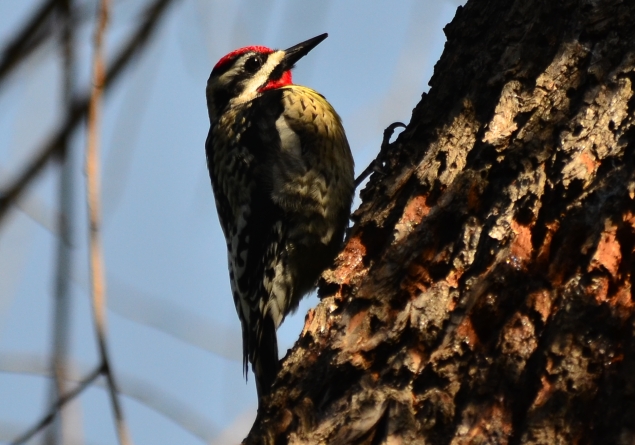
Let's lead things off with a Yellow-bellied Sapsucker.  Yellow-bellied Sapsucker is a rare bird here...nothing anyone would shit their pants over, but it's a good bird to bat leadoff in today's post. This bird has wintered at Don Castro Regional Recreation Area the past few years and I thought it would be best to pay it a visit.


It was hella cooperative, loafing on a tree next to the trail, occasionally sidling over to its sap wells for some sugary goodness.


Did someone say...gulls?  No?  Phew.  Can you imagine if it was gull season year round?  Fuck, that would be brutal.  Luckily, despite how well-adapted gulls are to humanity, they still migrate away from where I live for half the year.  This male Thayer's Gull is a long, long way from here right now.


Despite the identification challenges involved, birders love Thayer's Gulls.  They really do.  That's why I post so many of them on here.  Unlike most birders, I have the opportunity to walk right up to them and crush them with reckless abandon, without any regard to my personal safety.  Why do I do it? Because being scared of a Thayer's Gull is a ridiculous notion.


Far less inspiring, I am also not afraid to get close to Herring X Glaucous-winged Gull hybrids.  It's pretty gross though...I am always left feeling so...impure.  Note the yellowish orbital on this abomination.


Like silent gulls, silent dowitchers can always provide an identification challenge.  The bird coming into alternate plumage on the left (yes, the one with the short bill) has distinct, fine spotting on the breast, which is mellow for Short-billed Dowitcher.  The bird on the right has some different patterning on the breast, but since it is molting I'm not quite sure what to make of it.

A dowitcher is half the size of a Marbled Godwit, if that, though that doesn't seem to prevent them from wanting to unnecessarily roost inches away from one another...maybe the dowitcher was using the godwit as a wind break? At any rate, if this scene doesn't represent total chaos, then I don't know what does.


From one vantage point at a local park here in the east bay, the voyeuristic birder can watch feeding shorebirds directly beneath you on the rising or falling tide.  Western Sandpipers in high spring fashion have fantastically intricate back patterns that are hard to ignore.  I've said it before, but I don't understand the birder who doesn't have the stomach for sorting through shorebird flocks.


Look at those linear chevron patterns on the mantle.  This is really an underrated bird if you ask #7...look at one of these little cripplers for too long, and it will break your will to look at any other birds the rest of the day, abundance be damned.  Feeding in bubbles isn't helping things.


Forster's Terns have finally quit looking horrible and regained their simple yet elegant form of spring.


Up Mendocino way, this Golden Eagle greeted our crew of vagrant-starved nerds as we set out to see the Brownish Shrike.  As far as omens go, it's hard to top a Golden Eagle, and the cooperative shrike popped up after only a couple minutes of waiting.


You may look upon this image and think to yourself, "well this is certainly rubbish"...but you would be wrong.  For this is not a terrible picture of an American Robin, it is actually a profound photograph of a Varied Thrush.  The Varied Thrush is a bird of the ground, and a bird of the shadows.  This image captures the very essence of the Varied Thrush, and you know what that means...you are looking upon art.

Monday, August 4, 2014

More From The Valley: Aquatic Texans


No megas to report on today, although I did miss being on a Hawaiian Petrel boat on Saturday. It hurts, I won't lie. The only Pterodroma I've seen in California was a Murphy's Petrel, and it was so bloody far by the time I got glass on it that I couldn't make out any field marks to speak of (thus I do not count it, for I am an honorable birder). But before BB&B goes into full fall seabird mode, here is some more terrestrial spring coverage from Texas instead. After all, Texas is notorious for it's awful pelagic trips...not that anyone can blame the birders who organize and lead those trips, but let's face it; the Gulf is a desolate place compared to waters off California or North Carolina.

Right. Sorry Texans. Despite being impressively unadorned, semi-aquatic Northern Waterthrushes are quite variable in appearance. This is a "yellower" bird with legs on the pink end of the spectrum. South Padre Island, TX.


And here is a "white" individual, with duller legs. This isn't an uncommon variation, despite what some field guides and a lot of birders will tell you. It even appears to have some color on the flanks, LOWA style. Note how heavy the streaking on the breast is compared to LOWA. South Padre Island, TX.


It took me a long time to see a White-rumped Sanpiper...I had seen a grand total of 3 before this year. Thankfully they are a plentiful spring migrant in south Texas, and I even got side-by-side comparisons with Baird's Sandpiper. Pretty sick. Near Boca Chica Beach, TX.


This bird isn't quite as far into it's alternate plumage. Seeing a fish-eating Calidrid is not an everyday occurrence.


Long wings. White rump. Classic.


Hey, it's a Wilson's Plover. Did you know there is a Collared Plover in south Texas right now? It's the second U.S. record. Dan Jones found it, who you may know from the Global Birder Ranking System's Lower Rio Grande Valley Honor Roll. I called up the GBRS statisticians to do some math for me, and it turns out that on average 0.91 Collared Plovers actually occur in Texas every year. Why are they not found? Two reasons...the large amount of shorebird habitat available, and the impressive number of low-ranking birders in the area (mostly visiting birders) who misidentify COPL for other species. A lethal combination, if ever there was one. Near Boca Chica Beach, TX.


Fulvous Whistling-Ducks...birds I have not seen since the 90's. We had quite the reunion. Bummer that these birds are essentially gone from California now. Lake Harlingen, TX.


Fulvous are dwarfed by their more abundant black-bellied counterpart. On one of my last days on my Texas work site, there were hundreds of Fulvous Whistling-Ducks flying around (Willacy County). It was a vexing experience, to be sure. Other spots I turned up FUWD were at Estero Llano Grande and South Padre Island.


Least Bittern. I've had better looks at these skulky bastards, but never with sherbert lores! What a delicious flavor of facemelt. Estero Llano Grande WBC, TX.


The bittern unleashes a deafening bellow in the direction of some prey. Within seconds, a 7-foot alligator went belly up in the pond. Adult alligators are the preferred prey for Least Bitterns...it is known.


Lesser Yellowlegs are quite stylish a few months of the year. South Padre Island, TX.


Graduating the yellowlegs course is an important first step for beginning birders. Overcome this hurtle (Greater vs. Lesser vs. Solitary Sandpiper), and you will find yourself skyrocketing up the GBRS ladder...until you have to take the dowitcher test, that is.


Not only is the south blessed with winning wading bird diversity, the birds themselves are far more tolerant of humans. Here is a fearless Green Heron. South Padre Island, TX.


Maybe the next sushi craze will be consuming fish in this manner (swallowed whole, head first, in the ancient tradition of the Ardeidae).


I'm still looking for a Reddish Egret crush. I should have just crawled out there on my belly like the nerds below, but I was too busy birding and not wanting to wallow in mud. South Padre Island, TX.


Stately, but frantic when it comes to feeding. I wonder what a Reddish Egret would do if prescribed Ritalin. My hypothesis? Starve to death.


The challenges of dowitcher identification seem never-ending. This Short-billed Dowitcher, which actually has a short bill, is probably a male. A few things to note on this bird are the spotting on the sides, steep forehead and gentle (yet noticeable) decurve of the mandible. South Padre Island, TX.


Another Short-billed. Take a look at this comprehensive article on dowitcher ID, you might learn a thing or two.


Like Fulvous Whistling-Duck, Least Grebe is one of the birds that brings in birders from all corners of the country. They're not much to look at compared to some of the valley specialties, but if that doesn't put you off you can get a hell of a look at Sabal Palm Sanctuary (where this bird was photographed).


Hard to get better looks than this.


I failed to photograph Speckled Racer on this day, so this Rio Grande Leopard Frog (I think) will have to do. Sabal Palm Sanctuary, TX.


Look at these nerds crawling around in the mud. I feel bad for the girl they dragged along, through the mud, who has to carry their shit. Crazy photogs.