Showing posts with label Hooded Warbler. Show all posts

Tuesday, March 5, 2019

Belize! Part IV: Crooked Tree to The Tropical Education Center


By our last day at Crooked Tree, I already considered our visit there Great Success, and if and when I go back to Belize, I would absolutely be down to go back...especially in February or March, when the lagoon is seething with birds and Agami Herons are more dependable. As railer as it was to leave Agamiless, Hooded Warblers were a heartening sight, and brought me comfort on most days during the trip. Come to think of it, I'm almost always having a good time when there are Hooded Warblers around.


This American Redstart was exceptional, pivoting back and forth at this one spot, keeping its attention on me and tail fanned the entire time. Maybe it was trying to tell me something, like "You will never see an Agami Heron" or "Oh hey we met at Point Reyes a few years ago" or "Nikon sucks go Canon".


Yucatan Woodpecker was a prized lifer, one of *nine* I was able to squeeze out of the Crooked Tree area. A marvelous mini-Melanerpes...perhaps belonging in its own genus, Mellownerpes.

Eventually it was time to leave Crooked Tree and see a new part of the country. We got Bird's Eye View Lodge to drive us back to the airport, where we were dropped off at Hertz. After a few minutes we got into our sweet new diesel Isuzu (I didn't know they still made Isuzus, let alone diesels) and were off to the Belize Zoo Jungle Lodge, aka the Tropical Education Center, aka the TEC. I chose to stay two nights at the TEC for four reasons: 1) its proximity to the Belize Zoo, which we figured would be fun for Annie to visit 2) since it was on the way to Black Rock Lodge, it eliminated a long driving day, which is ideal when you are driving around with a toddler 3) it isn't expensi and 4) it gives good access to pine savanna, and the chance to clean up on any specialties of that habitat we missed at Crooked Tree.

The drive from Belize City was easy and uneventful. We ate lunch at Cheers, which is just past the TEC/Belize Zoo on the George Price Highway, and also an eBird hotspot. The food was deec but I suspect something I ate there didn't treat my stomach well later that night...it was brutal, actually...but it was the only place where we saw Tennessee Warblers and Giant Cowbird for the trip.

Eventually we got checked in to the TEC and did a little exploring before sunset. The TEC itself provides good birding opportunities and an extensive, well-marked trail system. One of the highlights of our time there was the evening parrot flight. The number of parrots flying over, commuting to evening roost sites, was really impressive...not massive flocks mind you, but a constant, dispersed stream of birds.


The vast majority were Red-lored, which seems by far the most abundant parrot species in much of Belize. Thankfully their calls are easy to learn, so most birds could be identified by ear before they were close enough to see well.


They were all in pairs. Many of them flew quite low, giving good looks, which is not something to take for granted when it comes to parrots in flight.


Great birds they are.


Besides all the Red-loreds going over, we also had a single adult Yellow-lored Parrot squawking in a nearby tree. It was nice to see a brightly marked individual after seeing Drabby McDrabberson at Crooked Tree earlier in the day.


While looking at the Yellow-lored Parrot, I heard a distinctly new parrot noise, more screechy and raucous than anything I heard before. With jaw clenched, hands trembling, lip quivering, I raised my binoculars with sky high hopes...YELLOW-HEADED PARROTS!!! They were flying low and right towards us.


In fact, they came a little too close for crushing purposes, but that's not something I will complain about. This was a great LIFE BIRD, one I had been really hoping to see. While they have declined greatly and disappeared from parts of their historic range due to habitat loss and the parrot trade, they are still readily findable in much of lowland Belize.


Not an ideal photo, but it is an ideal lifer. This was the only pair we saw on the trip.


The TEC is in a huge swath of pine savanna, good Yellow-headed Parrot habitat. It's also where Black-throated Bobwhites make their bobhomes, and I spent quite a bit of time and energy looking for them, but that pursuit ended in bobfailure. Luckily, wandering around in this habitat did at least connect me with a lifer Plain-breasted Ground-Dove (I'll spare you the awful picture), which also ended up being the only one of the trip.


A handful of Yellow-crowned Night-Herons lurked at the pond. I also heard Boat-billed Herons both nights we were there, but couldn't locate their day roosts.


In retrospect, the TEC was not quite as birdy as it maybe is at other times...it looked great, but birds were simply not as abundant as I thought they would be. That said, one of the commonest birds in the area was, of all things, Thick-billed Seed-Finch. Frankly, I was unprepared for their sheer abundance and sweet, casual songs...I won't make that mistake again.


I did have one mixed flock at the TEC that left me glassy-eyed and slack-jawed...it wasn't massive, but it contained several Yellow-backed Orioles (life bird!), another target I had been drooling over. I don't really associate orioles with conifers, so it was interesting to see these big facemelters take their time foraging in the pines. The flock also contained Yucatan Woodpeckers, Green Jays, a Hepatic Tanager, a Golden-olive Woodpecker, and a surprise Gray-collared Becard, which I've only seen once before and are fairly rare in Belize. It wasn't exactly an "it's happening" flock but it was fully gripping, and in retrospect included an impressive three species I didn't see on any other occasion on the trip.

After the flock oozed away from the trail, I then pished up my lifer Green-backed Sparrows...everything was coming up Steve!


Elaenia. Have any of you considered naming your first/next daughter "Elaenia"? I think it's legit. First of all, no one else is going to have that fucking name, so 10/10 for originality, and it isn't nearly as bracing/esoteric/wince-inducing as "Apple" or "Blanket" or some shit, nor is at as trendy as "Wren" or as common as "Phoebe". It basically sounds like an established name with a nice exotic-but-modest flourish at the end. For real, you can use it, go ahead, just give credit where credit is due.

Granted, elaenias aren't extravagantly beautiful, or talented singers, or really anybody's absolute favorite birds, but they are perfectly fine birds...and in the end, isn't that all we can hope for from our children? That they turn out to be perfectly fine beings? This is a Yellow-bellied Elaenia, a great example of a perfectly fine bird.


The TEC has a range of lodging options that are pretty reasonably priced; we stayed in one of the two houses overlooking the pond, which was pretty sweet and no, the mosquitoes were not that bad. Annie and Billy weren't so into the rain and falling tropical fruits banging on the metal roof at night, but I thought it added character.


AGOUTI AGOUTI AGOUTI


TEC has a lot of confiding agoutis, which are like mini capybaras. They don't get hunted around there so they are pretty nonchalant, as are the Russet-naped Woodrails. A gray fox there early one morning was another nice sighting on mammal front.


I was hoping to have some more amphibian encounters but they were relatively few...and yes, it was for a lack of trying. Having a toddler with you in the tropics is not conducive to night hikes or night anything really. I saw a rad reddish toad (raddish toad) here at TEC but didn't have anything on me at the time to photograph it with...so all I have to share is this very humble frog. Brian Freiermuth suggests it is a juvenile Leptodactylus. Having no idea how to identify any frogs found in Belize, or almost anywhere else frogs exist, I am not one to argue.
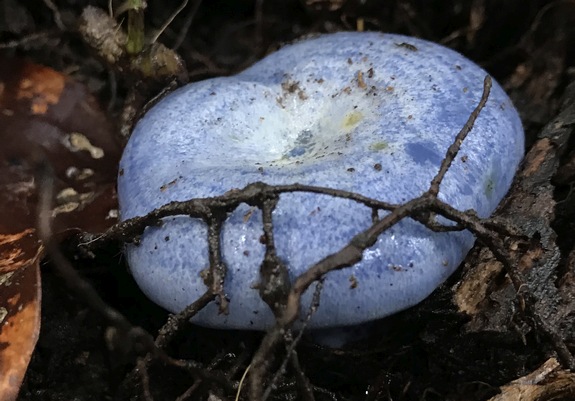

The fungus scene in Belize was good, there were a lot of mushrooms out, not that I could say anything intelligent about them. This smurf thing was one of the best ones.

Oh yeah, I doubt they will read this, but my boys Juan Carlos and Gilbert really helped us out and went above and beyond their duties when we had to deal with some medical stuff (I ate the smurf thing). Thanks TEC!

JK I didn't eat the mushroom but we did have to semi-urgently take care of some stuff.


We spent a morning at the mostly-great Belize Zoo, where Annie got to see things like tapirs ("mountain cows"), real Jabirus, this wooden Jabiru, and Harpy Eagles, which she oddly did not have much interest in but the big female had a great deal of interest in her. I had seen one or two Harpy Eagles at a zoo before but it was a privilege to be in the presence of this one, who had chosen to sit on a perch very close to us. I felt like I should bow or something...talk about a spellbinding animal, I can only hope I see a wild one someday. That is some bucket list shit right there...

Right, the zoo. The zoo was good. Great for kids, unless your kids hate animals. All wildlife native to Belize. They've got everything from Ferruginous Pygmy-Owl to jaguars. Anyhow, I didn't see any unusual free-flying birds at the zoo but I don't doubt that good stuff is possible there. BTW I've read in a couple places that in the past the zoo has been really aggressive about making photographers with vaguely professional looking gear pay $$$ to have their cameras out there, but I got a copy of their current photo policy and that shouldn't be a problem any longer.

After leaving the Belize Zoo/TEC area, we took a detour down the Monkey Bay Sanctuary access road on our way to Black Rock Lodge. On that road, destiny had a cruel twist of fate planned for me...my six month old (and apparent piece of shit) Nikon D7200 died after I took a single exposure of a Crane Hawk. Crane Hawks are magical beings, it is known, but I suspect Nikon is to blame this time. Life was mostly pain on the photography front after that, just as the birding really picked up again.

Thursday, November 29, 2018

The Best Birding of The Year: April in Sabine Woods


I'm not sure if anyone has noticed, but I am pretty awful at finishing trip reports in a timely manner. However, I love trip reports (though they seem to be dying) and I love fantastic birding, so I would be crazy to not make one last installment from this year's trip to Texas. Our second trip to Sabine Woods not only warranted a blog post, it was the best birding I experienced the entire year. So hop on in to the BB&B time machine one last time, as we make the quick leap back to April of 2018...

The day started out innocently enough. After Great Success earlier in the week at Sabine Woods, Dipper Dan and I headed back, hoping for a repeat. The southerly winds that prevailed over much of the previous day had switched to winds out of the north, so conditions were right for a good morning, if not a facemelting one.

At dawn we started the birding the trees at Texas Point National Wildlife Refuge, which is right on the way to Sabine Woods. It's not an impressive looking patch (some pieces of private property in the area appeared better suited as migrant traps), but since this is the UTC it should be checked! It was really slow at first, but after a while we began to see sweet sweet migrants coming in off the coast. Not many were stopping, but it was encouraging. The Northern Parula above was very accommodating, and ended up being the only one we would see that day.


After exhausting the relatively small Texas Point patch, we returned to Sabine Woods. Birding was on the slow side at first...acceptable, but not anything crazy. The forest floor was not crawling with Ovenbirds and thrushes, like it was when we visited earlier in the week though. This Canada Warbler that Dipper Dan found was an early highlight.


After talking to BB&B reader Steve from Kansas City for a while and learning about how terrible fans of the Kansas City Royals are...and looking at the Cerulean Warbler he pointed out to us...I found this Blue Jay getting high on sunbeams in the forest floor. Things were getting interesting.

Incrementally, the birding got better and better as the morning progressed. What began as dull birding became mediocre birding, which turned into decent birding which turned into good birding. A few hours after we arrived, the number of birds in the patch had seemed to double, then triple. By about 2PM there were simply birds all over the place. Woods totally empty of Ovenbirds earlier now were filled with them. The birding had gone from good to great; migrants just seemed to be piling in to the patch.

Eventually, we came to that rare and special realization that it was happening, much like it was at High Island the first day of the trip. This was the birding I had come here for, the birding I had hoped to experience but dared not expect. There were simply too many birds, too many birds to look at, mainly thrushes, vireos and warblers. Migrants galore. At one point, Dan and I split up for a while, and he encountered this Swainson's Warbler (left). It was only a few feet from him, falling asleep inside a bush, so the only photo he could get of it was with his phone. Obviously, the bird had just dropped in from who-knows-where and needed a nice nap before turning up the skulk meter to normal Swainson's Warbler parameters.

Well, when it's happening, it's happening. This is the sort of thing that happens when it's happening.


I missed Dan's sleepy Swainson's by a few minutes but managed to find my own in a different part of the patch. It was slightly more cooperative than I expected, which I was happy about. The brown wonder was a lifer only a few days before.

We birded vigorously through the afternoon. It was great. Not a fallout...lots of very approachable but otherwise normal-acting birds...but I had difficulty thinking that the birding could be much better than it was.


Eventually, we were fully saturated by migrants and the day was drawing to an end. We made our way back to the entrance, where a confiding Worm-eating Warbler greeted me...


...and promptly flopped down to the pavement. I love seeing warblers flopping around on the ground...it is a sign of excellent birding. Sure, some warblers are inherent ground floppers, and some may flop at any height...but it can be a sign. Worm-eating Warblers aren't exactly ground-phobic though, so I merely appreciated the bird's gesture and went on my way.

But I didn't get far. The day's final act was about to unfold, and the few tattered remains of what was once my face were about to melt off completely.

Right next to the entrance, some birders were looking at some Blackburnian Warblers...certainly not an unusual event but I felt these Blackburnians needed some special attention.


It turns out these Blackburnians were especially tired. They were in full just-crossed-the-Gulf mode and treated us with the same amount of caution they would give to an oak tree...in other words, we might as well have been invisible. I've met some confiding Blackburnians before, but these really took it to another level. When one of them started passing out on an open branch about 15 feet away, I knew that not only was it happening, it was happening really hard.

In short order they flopped to the ground and did their best Brewer's Blackbird-in-a-parking-lot impressions. I've been lucky enough to be really close to Blackburnians before, but this was a different level of close.


Incredible.


Here is an uncropped photo - the dark blob on the right is my shadow.


I looked up into the trees and saw a Bay-breasted Warbler, then two. They had been fairly common the past few days, but it was strange to see them perched just a few inches from one another; I got the clear impression that they had just fallen out of the sky together, their long Gulf crossing just completed. The Worm-eating Warbler on the ground had foreshadowed what was unfolding before my very eyes...


Warblers were now flopping around on the ground in front of us. This adult Tennessee Warbler, a known ground hater, flopped about without apologies.


Another Tennessee jumped into the ground frenzy. The growing terrestrial congregation of fearless warblers wasn't completely surrounding us, but were very focused or concentrating on an area in front of us about the size of a small lawn.


A Hooded Warbler, known to groundabout, was especially floppy.


The pair of Bay-breasted Warblers descended from the trees to join the growing flock of warblers in the grass for soul-satisfying looks.


Considering all the warblers on the ground, gravity must have been especially strong. This Blue-winged Warbler felt the pull but mostly managed to stay a few feet above it.


Gravity's pull was so forceful here that it was holding on to a leaf with one foot for dear life. Clearly, this was some sort of Bermuda Triangle for warblers.


This crippling Chestnut-sided Warbler materialized a few feet above the ground-fray.


The Bay-breasted Warblers in particular had little interest in going back up into the trees.


We should probably make sure a combo gets in here...Blackburnian/Bay-breasted ground combo is a sweet one. There were other warblers here in groundtown as well, but this post has to end eventually!

I'm still not sure how to describe this event. This was not normal. Kansas City Steve, who had logged a great many years of springtime birding at Sabine Woods, admitted he had never seen anything like it. It was like what I expect a full-blown fallout to be like, except happening on a weirdly small scale. I have always maintained that there is no such thing as a small fallout, but it appears time to reexamine that position. Keep in mind, of course, that there were huge numbers of birds in the patch that were not acting like this, but I'm thinking a small wave of extremely exhausted migrants had arrived at the edge of the patch just as we were leaving, giving us....well...a micro fallout? It makes me wince to read that but I can't think of a better label for the event. No matter what it was, it was unlike anything I've experienced before, things will never be the same, and I really hope a springtime return to the Gulf Coast happens sooner than later. We ended up getting new high counts in eBird for Acadian Flycatcher, Swainson's Thrush and Ovenbird at this heavily birded site.

I did have one more day to bird in Texas with Dipper Dan and Officer Shaw at High Island, which was ok but nothing like what happened at Sabine Woods the previous day. We then went to Shaw's, where we drank incredibly good beer, I had an incredibly bad allergy attack (how embarrassing), and a freaking Chuck-will's-widow flew over his suburban yard in broad daylight!

This will conclude BB&B's coverage of 2018's fantastic foray to Texas. Thanks to This Machine Nate for coming all the way out to the coast, shortly before being banished to the depths of an uncharted corner of Ohio. Thanks to Dipper Dan for being my ride or die and coming out from SoCal. Thanks to Officer Shaw for meeting up with us (twice!) and letting us crash in the Land of Sugar. You all battled Geri, you all won, and you are all birding heroes.

Wednesday, January 31, 2018

Episode VI: RETURN OF THE GERI


Seagull Steve has returned to the state of Texas in an attempt to rescue his friend This Machine Nate from the clutches of the vile Geri Birders.

Little does Steve know that the GERIATRIC EMPIRE has secretly begun amassing an unstoppable army even more powerful than the dreaded hordes that swarm South Padre Island.


When assembled, this ultimate army of Geris will spell certain doom for the small band of birders struggling to restore good identification skills to the birding galaxy...


How does that grab you? I don't really have the capacity to do an opening crawl in blog format, so this will have to do. Though the Jedi were obviously the protagonists in Return of The Jedi, the Geri are decidedly not the heroes of Return of The Geri. They are the rising darkness, and we are the light to meet it. 

Always in motion is the future, but I can see it now. The mosquitoes will be thick, and Geri will be thicker. Photographers (Geri and otherwise) high on bird lust and low on almost everything else will inspire anger, fear, aggression. When brightly colored birds in plain view within spitting distance are pointed out, Geri will struggle mightily to locate them and demand more instruction so I cannot enjoy watching the birds myself. Birds will be misidentified constantly. Black-and-white Warblers will become Blackpoll Warblers. Tennessee Warblers will become Philadelphia Vireos. Eastern Wood-Pewees will become Acadian Flycatchers. Ovenbirds will become Wood Thrushes. All Catharus thrushes will become each other. Red will become blue and one will become two. There will be squadrons of Geri to wade through at many of the sites, indeed, an army I feel I may not be able to defeat. But does it spell certain doom? Perhaps, but much like Lando Calrissian, Nien Nunb and Wedge Antilles defied the odds and destroyed the second Death Star, we may be able to find a way around the legion of Geri and get into some fantastic birding. That depends on the birds, the weather, our birding strategy, and a lot of luck.


Geri may be a force to be reckoned with, but a confiding Hooded Warbler can become more powerful than you could possibly imagine. 

Cheesy/stupid intro aside, we are excited to announce that BB&B will be returning to Texas this spring. Ostensibly, I will be leading a custom trip organized by the up and coming MAX REBO BIRDING TOURS ("No one can find Ortolans like Ortolans!"), and meeting up with famed Bicknell's Thrush expert and Jawbreaker scholar, This Machine Nate. But the real reason I am going is to bend the knee and worship at the altar of Spring Migration. Like most of you, I have never seen a proper fallout...I've been around for some good waves of migrants (what some would call "modest" fallouts perhaps, which seems oxymoronic to me), but not the genuine article...warblers littering the ground, ungodly hordes of exhausted migrants, too much for one birder to possibly take in...one of the great climaxes of North American birding. I've been close enough to the real deal to develop a strong appetite for it though, and so I must head east.


I like to see Indigo Buntings. I like to see lots of them, at extremely close range. For the birder looking to get high on Indigo, spring in coastal Texas is the time and the place to do just that. 

Now, as you may have heard, I am the #7 birder in the country...it's not like I am going into this situation blind. Even if I was going to spend weeks out there (I'm not), I'm not expecting to be so lucky, or for the birds to be so unlucky. I will be completely happy just to reconnect with a bunch of different species and be there when a decent number of newly-arrived migrants drop in to the woods.  I am expecting some slow, perhaps excruciatingly slow, days on the passerine front...but this is what one must endure to have the best chance at being around for an iconic migration event. Or just plain old good birding! It's not like I require 25 species of warblers in a day to be satisfied.


I found this Scarlet Tanager in the middle of the day ("best time to make for great birdwatch", according to one notorious birder), smashing a large moth in the middle of a suburban street with nothing resembling respectable stopover habitat in sight. I shot this crippling lens-cracker out my car window. No doubt this is a bird that meets all standard fallout criteria (tired/voraciously hungry/in weird coastal habitat/totally oblivious to people/facemelting), but unfortunately one bird does not make a fallout.

Aside from seeing a lot of birds and getting some crushing in, I do have one particular target bird in mind - Swainson's Warbler. I have never seen a Swainson's Warbler, and I hope to rectify that unfortunate situation by the time I return to California. While pretty much everyone else is looking up for yellow, green, blue, orange and red, I will be looking down for brown...at least some of the time. I am merely mortal, unable to resist the canopy-loving species, and one in particular has a special draw. If you are new to BB&B, you may not know that I dream about Cerulean Warblers more than any other bird, and I dream about birds with embarrassing frequency. I think it's a fantastic bird to dream about! Just last week, in a dream, I had male Cerulean and Blackburnian Warblers in the same binocular view...what a combo! You could even call it a dream combo. Will these birds make the jump from my subconscious to my binoculars in a few months? And if they do...what are the implications? Can anyone be ready for something like that? If you missed it from back in 2014, From South Padre Island to The Astral Plane: A Cerulean Warbler Vision Quest is a pretty good read. It is completely accurate account, with no fiction or exaggerations of any sort. Big lenses may be raised against me in anger once again, but I am not afraid...

Right. The mind begins to wander. Possibilities of glory on the scale of an exploding Death Star or failure the size of Alderaan seem equally plausible. Is my fate intertwined with that of the Cerulean Warbler? Is my entire life just a Franzenesque cliche? A lot of questions may be answered on this trip.


When the Geri-to-warbler ratio is askew in the woods, there will be no shortage of other great birds to look for instead. Upland Sandpiper is one of a great many shorebird species that use the area in spring, and I haven't seen them since the last time I was in the Lone Star [Beer] State.

Well, now you know the main plotlines we will be working with. Top priorities are freeing This Machine from the carbonite, lifer Swainson's Warbler, ask Cerulean Warbler about interdimensional travel and astro-projection. Eastern Whip and Black-whiskered Vireo are both needed birds as well, but I reckon a lot of luck would be required for either and my expectations for those are not high. Most of the time, it will be all about year birds! And our clients, of course...MAX REBO BIRDING TOURS is famous for going above and beyond to coddle (not cuddle) clientele, and this trip will be no exception.

I guess I should wrap this, considering nothing has even happened yet and it is still winter. The passerines in this post were photographed on South Padre Island, and the UPSA was in some ag fields north of Harlingen. All in Texas, obvi.

Tuesday, May 13, 2014

Red-headed Woodpecker...Blackpolls and Butthurt...One for the Herpers


This is the celebrity Red-headed Woodpecker that spent some time on South Padre Island this spring. I've only seen a few ever before, so you can bet I was deep into the stoke when I saw this. What made it even better was that when I first heard about it, I specifically did not chase this bird, even though it was only a block away. A big crew of geri were sprinting/scuttling/hobbling/limping over to the woodpecker and I thought it would give me a better chance to find the Cerulean Warbler that was in the area. This tactic failed miserably, but at least the woodpecker was still present several days later.


Unlike everyone else who were practicing their wildlife harassment skills on this bird, I just stood next to a tree it liked and was within a few minutes rewarded with a crush. What a crippler!


One thing that this bird made painfully obvious was how annoying and indifferent photographers can be with birds. Although you can easily witness this yourself on any spring day on South Padre Island, this bird seemed to constantly have some tool mercilessly chasing it around the convention center, for days on end. It's not like flushing a bird is a big deal (well...sometimes it is), but this woodpecker had a whole harassment crew to keep it as bummed out as possible. Wankers.


People don't seem to realize that birds will often just beg you to crush them if you don't try to chase them out of the state. Pictured is a Scarlet Tanager, not giving a fuck.


To all the colorblind birders out there...I am truly sorry. You have my sympathies.


This female Scarlet Tanager that spent a weekend at the convention center was one of tamer birds I've met this spring. Once she became addicted to oranges, she would do anything for a wedge.


Blackpoll! How poignant.


My, what crisp plumage you have. Such orange legs you possess.


A Blackpoll Warbler utters an otherworldly bellow from the convention center's water feature. It's pretty funny hearing all the seething photogs whine and pine for how the water feature used to be set up, when the birds were more exposed and had to come closer to people to take a drink or bathe. There is some serious butthurt going on out there.


Speaking of butthurt, that's how I was planning on feeling if I didn't get a good look at a Gray-cheeked Thrush this spring. I had only seen one ever before, and that was for a whopping 10 seconds, about 10 years ago, at Marblehead Neck in Massachusetts. Well, my butt does not hurt and my ass does not ache. Gray-cheeked Thrush has become pretty predictable on SPI, for the time being.


More than one birder has told me, discreetly, of his/her fixation with vireos. Well, this one is for you. I thought I would be seeing a lot of Red-eyed Vireos this year...that has not been the case. I reckon this is my best photo of one for the year (it's been weeks since I've seen one), and I'm pretty happy with it.


Have I seen my last Hooded Warbler of the spring? Yeah. It's a sad state of affairs.


The Hooded Warbler is enthusiastic about being near the ground. Not so much as an Ovenbird, but if you get warbler neck from looking at a Hooded Warbler, you are either suffering from an extreme case of stunted growth already or you are misidentifying the bird entirely. While many birders suffer from various renditions of stunted emotional growth, I find the latter scenario more likely.


Finally...one for the herpers. I was told this is a Laredo Striped Whiptail, which one can find many of at the Sheepshead lot on South Padre. Most I have seen have not been this large, or so cerulean. Whiptails are parthenogenic, aka have Virgin Mary powers. The mind reels.