Showing posts with label varied thrush. Show all posts

Tuesday, May 19, 2015

Total Chaos


It's been a while since I've done one of these posts, and I will go ahead and admit it up front: this post is nothing but old-fashioned TOTAL CHAOS.  Anyone remember that band?  Not sure why anyone liked them.  Anyways, this post is nothing but random birds that have not yet found their way into any other posts yet, but here they are.  There is no rhyme or reason, just a smorgasboard of bay area birds from earlier this spring.

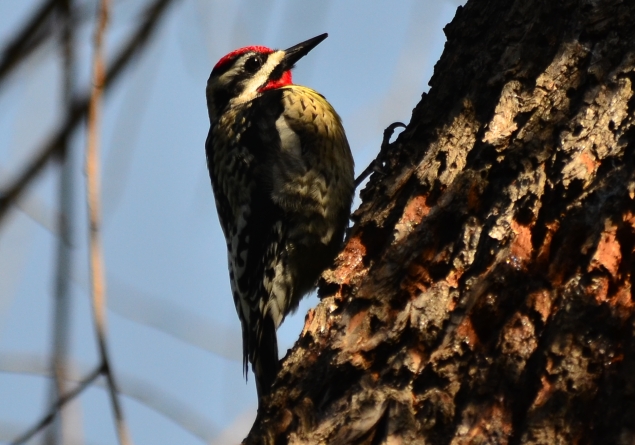
Let's lead things off with a Yellow-bellied Sapsucker.  Yellow-bellied Sapsucker is a rare bird here...nothing anyone would shit their pants over, but it's a good bird to bat leadoff in today's post. This bird has wintered at Don Castro Regional Recreation Area the past few years and I thought it would be best to pay it a visit.


It was hella cooperative, loafing on a tree next to the trail, occasionally sidling over to its sap wells for some sugary goodness.


Did someone say...gulls?  No?  Phew.  Can you imagine if it was gull season year round?  Fuck, that would be brutal.  Luckily, despite how well-adapted gulls are to humanity, they still migrate away from where I live for half the year.  This male Thayer's Gull is a long, long way from here right now.


Despite the identification challenges involved, birders love Thayer's Gulls.  They really do.  That's why I post so many of them on here.  Unlike most birders, I have the opportunity to walk right up to them and crush them with reckless abandon, without any regard to my personal safety.  Why do I do it? Because being scared of a Thayer's Gull is a ridiculous notion.


Far less inspiring, I am also not afraid to get close to Herring X Glaucous-winged Gull hybrids.  It's pretty gross though...I am always left feeling so...impure.  Note the yellowish orbital on this abomination.


Like silent gulls, silent dowitchers can always provide an identification challenge.  The bird coming into alternate plumage on the left (yes, the one with the short bill) has distinct, fine spotting on the breast, which is mellow for Short-billed Dowitcher.  The bird on the right has some different patterning on the breast, but since it is molting I'm not quite sure what to make of it.

A dowitcher is half the size of a Marbled Godwit, if that, though that doesn't seem to prevent them from wanting to unnecessarily roost inches away from one another...maybe the dowitcher was using the godwit as a wind break? At any rate, if this scene doesn't represent total chaos, then I don't know what does.


From one vantage point at a local park here in the east bay, the voyeuristic birder can watch feeding shorebirds directly beneath you on the rising or falling tide.  Western Sandpipers in high spring fashion have fantastically intricate back patterns that are hard to ignore.  I've said it before, but I don't understand the birder who doesn't have the stomach for sorting through shorebird flocks.


Look at those linear chevron patterns on the mantle.  This is really an underrated bird if you ask #7...look at one of these little cripplers for too long, and it will break your will to look at any other birds the rest of the day, abundance be damned.  Feeding in bubbles isn't helping things.


Forster's Terns have finally quit looking horrible and regained their simple yet elegant form of spring.


Up Mendocino way, this Golden Eagle greeted our crew of vagrant-starved nerds as we set out to see the Brownish Shrike.  As far as omens go, it's hard to top a Golden Eagle, and the cooperative shrike popped up after only a couple minutes of waiting.


You may look upon this image and think to yourself, "well this is certainly rubbish"...but you would be wrong.  For this is not a terrible picture of an American Robin, it is actually a profound photograph of a Varied Thrush.  The Varied Thrush is a bird of the ground, and a bird of the shadows.  This image captures the very essence of the Varied Thrush, and you know what that means...you are looking upon art.

Monday, March 30, 2015

A Pygmy Horned-Owl, Blossoming Blossoms, the Halloween Thrush.


Seeing a Northern Pygmy-Owl usually tops any day of birding; seeing one that you can walk right up to puts your day in a whole other birding league.  Mines Road, Alameda County, CA.

Well now that I have gotten the obligatory winter is ending/spring is coming post out of the way, I don't have to talk about that shit anymore.  So other than migrants, what is the good word?

The birding world has been bereft of much new controversy lately, for good or ill, though there has been some intrigue...your life list may get a bit shorter soon, and there is still a Brown(ish) Shrike lurking 3 hours north of me...maybe I should try to see it or something.  I say Brownish because it does not really look like the Brown Shrike I saw in Humboldt County a few years ago, and Red-backed Shrike could potentially reach North America.  Equally plausible, it is a different subspecies of Brown Shrike, it is an intergrade of different Brown Shrike subspecies, or most horribly of all, it could be a hybrid. Who knows how the Bird Police will rule?  I know how....WITH AN IRON FIST!!!!!  Naw not really, they are nerds, sorry guys (and Kristie). Anyways, I may be #7, but this is out of my birding wheelhouse.  Old World birders, you are our only hope!


This bird was sitting directly above a moderately used road, completely ignoring traffic and only briefly acknowledging Cass Grattan and myself with a few seconds of eye contact.  It was silent the entire time, and was completely zoned in on a handful of shrubs on the other side of the road.  No playback required for this one.


While it is not too difficult to figure out where Northern Pygmy-Owls might be found, I rarely get to see them...in fact, I don't even remember the last time I saw one.  What an epic bird to hang out with. The tail almost looks like an afterthought of sorts.  It never flushed, and when we came back an hour later, it still had not moved.  Patience rewards the hungry pygmy-owl.


This bird actually had horns out for a while. Did you even know that pygmy-owls had horns?  I think it's worth showing such a shitty picture just so you can see what I'm talking about.  Life plumage feature for #7.


Other things besides birds are appearing now.  This is a Castilleja, some kind of owl's clover. Maybe dense flower owl's clover?  Castilleja is the same genus that Indian paintbrush belong to, but I don't get to see owl's clover nearly as often. Mines Road, Alameda County.


Dodecatheon, shooting star, is another beloved wildflower around these parts. Del Valle Regional Park, Alameda County, CA.


Sometimes it's hard to think of a caption for certain birds...Northern Rough-winged Swallow is one species that presents such a challenge.  They are adherent to the Economy of Style.  They don't make remarkable noises.  Unless you are someplace where Southern Rough-winged Swallow also occurs, they are easy to identify, and there is probably not a soul in the world whose favorite bird is this bird. It's nice to see them perched on something other than a power line though. Lake Elizabeth, Fremont, CA.


Stll, no one can deny that NRWS is a pleasant bird...it's just so mellow.  And hardy...they are one of the very first spring migrants to arrive in the spring, though the last few years a bird doesn't exactly have to be hardy to spend a winter around here.


Phainopepla, the bird in the shining robe.  Many birders associate Phainopeplas with desolate, arid landscapes, but they can are equally at home in oak woodlands.  You show me mistletoe and I will show you Phainopepla. Del Valle Regional Park, CA.


I wonder how male Phainopeplas became black. They sit in conspicuous places within often bleak landscapes, and frequently live in areas with triple digit temperatures...yet somehow manage to avoid predators and don't overheat. They got dressed by the same force that dressed Bronzed Cowbirds, ostensibly...they both even have red eyes.


Last fall and this winter was an INVASION YEAR for Varied Thrushes in much of California, with more than one bird making it all the way to Imperial County, where there is absolutely no Varied Thrush habitat to speak of...the one I saw was foraging in palm trees. This bird was in Golden Gate Park, San Francisco, CA.


One of the big birding perks of living in northern California is being able to see Varied Thrushes regularly, and getting to listen to their wondrous and soothing songs. No other bird commands your attention as much in a redwood dawn chorus.


They are fabulously constructed birds, even their undertail coverts are interesting to look at.


A Red-tailed Hawk sits above Highway 101 gridlock and ponders the idiots below. San Francisco, CA.

Sunday, February 26, 2012

A Weird Time Of Year


Golden-crowned Sparrows are often found in blooming willows and fruit trees this time of year, bucolically devouring flower petals. Golden Gate Park, San Francisco.

Late February. It's a weird time of year. Some people hate February. Winter has been around for a while now, and people in colder climates are starting to get sick of it. The sharp and jagged pains from a million Valentine's Day disasters are felt from coast to coast. Birders have been staring at the same birds for months, and desperately look forward to spring migration. A kind of catatonic depression begins to sink in...long, loving relationships fracture and explode into flames...The Fear sets in, fingernails are chewed off...who are these bastards watching me from the shadows anyway?...and we ask ourselves how much more we can really take...

Well, I'm sure that's the case for some people anyways. Personally, February has always been a month of transition for me, as every year I typically cease my Perpetual Weekend and go back to being a field biologist. At this time last year I was taking up residence west of Veracruz, Mexico, standing on a roof all day looking for raptors and being force-fed caguamas at night (in this case caguamas are 40 oz beers, not tortoises)...but at this point, I've managed to completely fail at lining anything up. Life is pain, as they say, but my luck is bound to change.

Yup...February. Today's blog is a quick snapshot of birding around the bay area this time of year. And before I dive in too deep in to the philosophical bowels of the month, I must assist The Great Ornithologist Felonious Jive in finishing his next 10,000 Birds post, before it is too late. See you soon, bird geeks.


Next month most Western Grebes that intend on breeding this year will begin retreating from the coast to inland lakes. Once there, they will commence spectacular courtship dances and making grotesquely adorable babies. Lake Merritt, Oakland.


Clark's Grebes will do pretty much the same thing as Westerns...they used to be the same species, ya know. Lake Merritt, Oakland.


Hooded Mergansers will be departing in a few weeks. It is a great shame. Golden Gate Park, San Francisco.


Black Phoebes and other "resident" passerines often begin nesting earlier than the migrants. By the way, this is my best Black Phoebe shot to date...Californians may feel insulted to have to look at another phoebe, but maybe the rest of you will appreciate it. Golden Gate Park, San Francisco.


Varied Thrushes are uncommon winter visitors to much of the bay area. They won't be around much longer, as the urge to retreat to the redwoods grows stronger every day. Golden Gate Park, San Francisco.


Raptors, like Peregrine Falcons, often get started breeding during the winter months. This one won't be bumping cloacas quite yet though, it's too young. Point Reyes.


Seawatching birders will be detecting northbound migrants soon, if they haven't started already. Pacific Loons are one of the commonest spring migrants along the California coastline. Half Moon Bay.


A few miles offshore, Cassin's Auklets occupy California waters year round. Much like me, they are probably growing tired of just hanging around for the past several months and doing nothing but socializing and eating...it's time to breed! Well, I don't actually intend on doing that, but you know what I mean. Half Moon Bay.


February is a great time of year to look for weird gulls....herring runs can trigger thousands of gulls to accumulate along stretches of coast for days at a time. I thought this beefy beast was well-proportioned for a darker Herring X Glaucous Gull (aka Nelson's Gull), although it could be a Glaucous-winged X Herring. Fort Baker, Golden Gate National Recreation Area.

Thursday, December 22, 2011

Shampoo Of Egret Poo


Great Egret. It was right above a footpath, with several oblivious walkers going right under the bird. My hopes and dreams of watching somebody get a shampoo of egret poo never materialized though. Golden Gate Park, San Francisco.

It's full on family week here at BB&B headquarters. What does that mean? Staggering amounts of stress and annoyance on everyone's part, not to mention limited internet access.

By the way, thanks to everyone who's been checking in on The Great Ornithologist Felonious Jive and I, it's strange that more than a dozen people actually look at this.

Right. As always, if any ecolodge or bird tour company wants to get some exposure, feel free to kick me down a free trip. Sure, saying things like that may be a touch whoreish, but I'm not known for being able to hold onto anything like dignity when it comes to birds. So, you people in the birding business, I would love nothing more than to sample your local avefauna (and booze)...I am Funemployed, after all.

However, seeing as I will be confined to the West Coast for the rest of the winter, here are some more invigorating local birds for your enjoyment.


The hallowed Varied Thrush, aka The Robin Of The Shadows. Golden Gate Park.


Red-tailed Hawk. Ano Nuevo State Park.


Barrow's Goldeneye sandwiched by Common Goldeneyes. Mmmm....sandwich. Redwood Shores.


Canvasbacks. Radio Road, Redwood Shores.


A pensive Raccoon. In Golden Gate Park there is a spot that always seems to have a raccoon family lately, and last time I was there I found a photographer sitting right in the middle of them. I don't know what he was thinking, as he seemed to be more concerned about the Mallards and Pied-billed Grebes in front of him than these beasts milling around a few feet away. That's not how I would've done it.


The east coast has more colorful songbirds than we do, but at least we have Townsend's Warblers. Pine Lake Park, San Francisco.


American Avocets. Radio Road.