Showing posts with label American Robin. Show all posts

Monday, March 13, 2017

Humboldting: Rarities From Far and Near (?)


In birding, one of the few certainties we can cling to is that little is certain. I will now provide you with one of these rare certainties...

Every winter, an extremely rare bird will show up in Humboldt County.

Don't believe me? Since 2013...

Little Bunting (2013)
Gyrfalcon (2013-2014)
King Eider (2014)
Brambring (2014-2015)
Snowy Owl (2016)
Great Gray Owl (2015-2016, 2016-2017)

Oh, and these were just the chaseable birds...in winter. Never mind the rest of the year. Oh wait, I forgot one...

Common Pochard (2016-2017)


Common fucking Pochard. Until this bird was found, this was one of the biggest blockers in California...there has only been one chaseable bird in the state ever...oh, and other than Alaska, there has also never been one in any other states or provinces. Talk about a MEGUHHH!!! Sweet, sweet, Siberian action...it doesn't get much better than this bird, and I am still trying to get out the stains in my pants from when I first learned about this bird.

Of course, not only would this bird be a lifer for me, it is a totally bizarre bird in some respects, something good to look at and ponder...a bird that seems to perfectly fit in the center of the Canvasback-Redhead spectrum. Since the Old World has neither Canvasbacks or Redheads, this somehow makes sense.

However, Billy was about to have a baby...my baby, in fact...so when the pochard news initially broke, I did not actually think I would see the bird. Going to Humboldt at this time would be absurd. But Billy knew my severe gripoff pain and we went north, and we got the bird at a most frigid dawn at the Redwood Creek Oxbow without difficulty. Though I spotted the bird before she did, it is safe to say that I owe Billy a luxurious HJ.

Distant but good looks at this lifer with Redheads and Ring-necked Ducks were had, and after chatting with Officer Fowler of Fowlerope Birding Tours, we took a walk through the facemelting old growth at Prairie Creek Redwoods State Park. No Gray Jays or Pileated Woodpeckers appeared, but the forest was as ridiculous and grandiose as ever.


I couldn't help but give a Steller's Jay a mild crushing on our way out. Sure they are abundant and eat Marbled Murrelet eggs, but think back on the first one you laid your squinty nerd eyes on...crippling, eh?

There was plenty of daylight left, so we lurked down to Arcata Marsh, since that is always the default place to bird if you have nothing to do. This time it was hosting a couple rarities to provide extra motivation for a visit.


Billy came up with a nice group of Redheads feeding close to the trail. It's hard to see these birds up close in California, so I was chuffed. Not pochard chuffed, but chuffed nonetheless.


Ahh, sweet, succulent and locally uncommon Redhead, it is much better to observe you up close. Remember, if you meet any pochards in your travels, try to convince them to stay on this continent. It is the flyway less travelled...if you are a pochard.


Those Redheads will probably never meet a pochard, but they were acquainted with another Sibe. While I was staring at the Redheads, Billy got on the most popular bird at the marsh, a totally incognito female Tufted Duck. I've seen a handful of female Tufteds before, and this was by far the most indistinct individual I have seen, though she had the classic small, dusky white spot at the base of the bill. She really looked quite scaup-like though, and would not be eye-grabbing at all from a distance.


I'm no Tom Johnson when it comes to flight shots (in fact only Tom Johnson is Tom Johnson in that regard) but I was pleased to collect this girl's soul as she took wing on her way to Allen Marsh. I did not expect her to have the head shape of a Rhinoceros Auklet, but there it is.


Most of you know I lived in Humboldt for a long time...a long time. It has a special place in my heart, so much so that I am all about county listing there. Some years ago, while getting things up to speed in eBird, I actually had to reconstruct my Humboldt list using actual checklists, which is just about as novel as it can fucking get. Amazingly to me, I could never find any record of seeing Blue-gray Gnatcatcher in the county...which was finally rectified when some rando birders got me on the one wintering at the marsh. Local rarity! County bird! Victory!

A life bird...in Humboldt County...and another Humboldt County bird in the same day...with a bonus Tufted Duck. What a fucking day! But we weren't finished yet...


Next to Arcata Marsh is the infamous V Street Loop, a classic car-birding site. Short-eared Owl used to be a gimme here, but with much of the former grassland now converted to tidal wetland, they aren't nearly as dependable. Northern Harriers are still abundant though.


This hell of gray Savannah Sparrow caught my eye next to the road; I don't see birds like this very often. I wonder where it's from...any ideas? It was accompanied by 1-2 similar individuals.


Almost no color in the lores. So plain, but so striking. So Economy of Style. This bird gives credence to the argument against that old adage, "Life is Savannah Sparrows".


Finally, it was time to look for yet another absurd bird...a Great Gray Owl on the edge of town. Unbelievably, this was the second in Humboldt County of 2016 (and no, I do not think it is the same bird from Prairie Creek). The closest source population for these birds is not in the Sierra Nevada, it is in southern Oregon (i.e. the Ashland area, a mere 115 miles northeast as the owl flies), but obviously there is no way of knowing where Humboldt's birds originated. I presume Great Grays occur more often than we think in Humboldt, Del Norte (no records in eBird) and especially Siskiyou (no records in eBird) counties, which all have vast areas of potentially suitable habitat that get no coverage by birders. There are quite a few records in Oregon within 20 miles of the Siskyou County line. Interestingly, there are no coastal records of this species in Oregon, where there are considerably more Great Grays than there are in California...Humboldt County alone has what, four individuals now? Only in Humboldt...


More important than speculating about the One Bird Theory and source populations is seeing a Great Gray Owl. It is a spectacular bird. Photos do not do them justice, it is a bird to be seen to be truly believed.


The weather deteriorated after this ridiculously good day of birding, though we did make it out to get better looks at the owl again. On the way back south on 101, we were greeted by a fully legit snowstorm. Unfuckingbelievable. Those of you who are familiar with the San Francisco-Arcata drive can appreciate this...I have never seen anything like it. We pulled over along the Eel to take it all in, and were treated to a real fallout...of robins. Hundreds were falling out of the sky, pouring into the roadside vegetation from upslope. Too much snow for [good] photos, but it was nothing like I've ever seen.

Another great Humboldt visit in the bag. Life bird! County bird! Great Gray Owl! Bonus Sibe! Snow! Billy didn't go into labor! I couldn't ask for much more.

Monday, May 2, 2016

An Ancient Harlan's Hawk, Newt Problems, Shades of Merlin


As any California birder knows, Humboldt offers a lot more than just the (very) occasional Great Gray Owl. There is no shortage of good birding spots to scour during the winter, so of course I had to check some other shit out while I was up there. I birded Arcata Marsh, since it is conveniently located right in town and just about anything can show up there...the dependable Swamp Sparrows I was looking for were not very dependable on this day, but the much more range-restricted Golden-crowned Sparrows were there in predictable abundance.


Unlike most birding spots, the marsh continues to grow in size and simply gets better and better when it comes to shorebirds and waterfowl, possibly to the detriment of the local Short-eared Owl population. This Greater Yellowlegs was feeding right in the face of this Green-winged Teal, foraging on little inverts the teal was stirring up with its bill. When you have a height of only a few inches it must be strange to have a yellowlegs looming over you, but the teal did not seem to mind.


This was apparently a successful foraging technique, as the yellowlegs did grab something while I was watching.


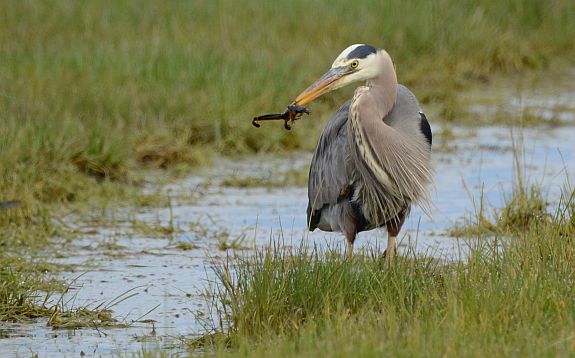
Over on the V Street Loop, this Great Blue Heron had gotten a hold of a much more interesting prey item...a large newt.


The heron did not appear to have a good idea of how to go about eating the newt, repeatedly dipping it in water, bashing it against the grass and not giving attempting to swallow it at all while I was there. This is an awkward thing to prey on at best, extremely toxic and deadly at worst. Native Americans in the Pacific Northwest used newt juice as a poison...


On the far side of the loop a cooperative Merlin was posted up on...a post. This bird struck me as being fairly pale, with no mustachial stripe...in the field I thought it was a female, but looking at the photos now I don't feel so sure about that. Interesting bird, I'm not quite sure what to make of it as far as age/gender/subpecies.


Elsewhere in the bottoms, I came across another, especially confiding Merlin. This bird was noticeably darker with heavier markings on the breast and belly than the first Merlin of the morning, but I'm not enthusiast about pulling the trigger and calling it a "Pacific" Merlin (I would expect a darker face and even more streaking/barring on the breast and belly). The vast majority of Merlins I've seen over the years usually zip by, giving shitty looks...I'd like to have more time to watch these birds and get to know each subspecies more.


For all you robin-strokers out there, here is an American Robin. There are thousands in the Arcata Bottoms in the winter. It is known.


Much, much more interesting than the area robins was this Harlan's Hawk. This bird has been wintering along the Highway 101 corridor between Eureka and Arcata for over a decade (!), usually near the Jacoby Creek Cutoff. In the past, I had only seen it while on the freeway, getting a quick naked-eye glimpse of it perched on a billboard or something and thinking "Oh, that was probably the Harlan's", but I finally managed to get great looks at the bird on this trip.


The bird is extremely dark, lacking any "warm" tones whatsoever. Fitting for an Alaskan bird. The uppertail (not visible in any of my photos) appeared dark gray without a hint of red, with a prominent dark subterminal band.


Although I never saw it fly, this bird definitely provided the best looks I've had of any Harlan's. Hopefully it will make it back to Humboldt this fall once again.

It was a relatively quiet winter in Humboldt as far as rarities go, but with a Snowy Owl (that I gleefully did not chase) showing up shortly after I was up there, the winter Vague Runt season ended for local birders on an extremely high note. What will show up next winter? Steller's Eider? Gray Wagtail? Black-tailed Gull? Siberian Accentor? The possibilities boggle the mind.

Sunday, November 8, 2015

San Francisco Runts and Grunts


Fall is slipping away, my fiends and friends. Where has it gone? Though gulls (goddammit), raptors and fowl of water will still be pouring in for the next few weeks, most my grunts have passed us by, bound for Central and South America. Gone are the days where I can head out to Point Reyes and expect to see a warbler rarer than the dreaded-but-still-appreciated Palm Warbler. Nor can I sort through a flock of peeps, grinding my teeth in anticipation of a stint to pop out. No...those days have passed, and we are hurtling toward winter faster than we would like to admit. Before we know it we will be donning our armor and diving into hectic internet battles, trying to diffuse bombs...meaning convincing people that a certain bird is just a damn Herring Gull, not a backcross Yellow-legged X Iceland or some similar nonsense. Gulls...they are coming...will you be ready this winter?

The sudden passing of fall is particularly sad for me in Y2K15, as I've had the pleasure of nabbing a couple of lifers, a state bird, and a healthy number of rarities as birds are heading south. September was almost a dud until the last week of the month, but the momentum of rarities was strong for quite a while, and October was seemingly raging with Vague Runts. I would have seen more of them if I was still living The Perpetual Weekend (White Wagtail immediately comes to mind)...but alas, I am not.

Here are some assorted runts and grunts from San Francisco earlier in the fall. Some are rare, some are typical, but they are all Good Birds.


I had just seen the Painted Bunting in Golden Gate Park, and was walking around in a euphoric, blissed-out state...but the sky was overcast, and it was the end of September for Christ's sake, and I would be an idiot to not keep birding...so it was off to North Lake, which seemingly always has migrants, and has the added bonus of being popular with Western Tanagers. Why does that matter? Because I've never seen a Scarlet Tanager in the state, and North Lake seems like a perfectly reasonable place to find one. So I lurked around, looking through migrants, when I met this bird. At first, I had only a head-on view, seeing a short bill, gray wings contrasting against a yellow breast...could this be the bird? But quickly the bird turned and showed a decidedly reddish tail, and Scarlet Tanager was quickly shot down.


It was a bizarre bird, a female-type Summer Tanager, but decidedly duller than any one I (or most birders, for that matter) have ever seen. So, not the tanager I was looking for, but a satisfying self-found rarity nonetheless. Though it was too dark for crushing, it sat out in the open for quite some time, dismantling this yellowjacket. I seem to recall the last Summer Tanager I saw in SF was also feasting on meat bees.


As hoped, there were obscene numbers of Western Tanagers at North Lake that morning, so it made sense that something different was lurking in their midst.


I thought this shot came out pretty well. It was good to see so many of you this fall, Western Tanager, I fear we may not meet again until next year.


This is the best American Robin I've ever seen...talk about a rarity. What a cool bird.


Townsend's Warblers have been holding down the bay area for a couple months now, they love it here.


When an adult male Townsend's Warbler dangles itself in front of you, it is impossible to look away.


On the contrary, there are no shortage of birders who would gladly look away when an Orange-crowned Warbler dangles itself similarly. Beginners hate Orange-crowned Warblers because they are drab and resemble half a dozen other warblers. Power birders hate them because not only are they abundant, they are insultingly dull to look at. Even their song is boring. But I am not most birders; I am #7. And goddammit, I will look at Orange-crowned Warblers.


There was a time, a long time ago, when I would post a picture of a bird and write some kind of caption for what the bird might be thinking, if said bird had a full grasp of the English language and also had the exact same values, worldview, and sense of humor as myself. What a coincidence! But I stopped doing that when I suddenly noticed EVERYONE was doing this, both in blogs and on Facebook, and 99% of these captions made me wince, they were so bad. This has nothing to do with this Orange-crowned Warbler, just an observation.

Ok, fine, for old time's sake, I'll give it a shot. I might be a bit rusty, but here goes..."Oh fuck look at this spider web! There's go to be one of those tasty fuckers in here! I am going to find that little shit and fucking kill it, even though it might be the size of my goddamn head. I don't give a fuck. Christ I'm hungry."

How was that? Was that ok?


Have I even posted a Chestnut-backed Chickadee on BB&B? I don't know, I may not have, although that seems weird. In case I have not, here is one. They are cute and super common and mellow and I like them.


In early October, a Mourning Warbler showed up at Ferry Park in San Francisco. You easterners reading this do not care, but locally, this is a hell of a bird. In a bizarre twist of county listing and geography, there have been dozens of records of Mourning Warbler in San Francisco County...but until now, all of these birds have been found on Southeast Farallon Island. Not a single one had ever been seen in mainland San Francisco, so when this bird was found it brought widespread panic among local birders. In typical fashion, a hilarious majority of my attempted photos of it looked something like this. Mourning Warblers do not want to be photographed, it is known.


Here is a highly pixelated, but ultimately acceptable portrait of the bird. I've only seen one of these in California before (almost 20 years ago!), so this was a great rarity to be able to catch up with here on the west coast.


My, what a heavy bill you have, Mourning Warbler. The bird spent a lot of its time scurrying around some short, knee-high plantings, but eventually was foraging 20 feet high in a poplar with a mixed flock. Bizarre. Great bird, stoked I got to see it.

Blogger is still giving me formatting trouble, so I'll go back to my old school photo layout for the time being, we'll see how it goes. Hope you all had a good weekend, and enjoy fall while you still can.

Sunday, June 10, 2012

Friday, March 23, 2012

Death To The Perpetual Weekend


An immaculate looking Ring-billed Gull. Look at that orbital ring! Lake Merritt, CA.

Well, this it...Bourbon, Bastards and Birds' final transmission from the beloved bay area. I've been here since September, living The Perpetual Weekend...but as a seasonally-employed biologist, my departure has been pre-ordained. In fact, I have not stayed ever stayed here this late into spring...so although it pains me to do so, I must go.

Here's a smattering of shots taken from the last several weeks. Have a positive weekend!


It's been a good year for Black-legged Kittiwakes in California. A lot of them have been spending time in Humboldt Bay, like this one, where they can conveniently be watched and photographed from shore. King Salmon,CA.


Tidal slough at sunset. Arcata Marsh, CA.


Hordes of Aleutian Cackling Geese are staging on the northwest coast this time of year. Strange to think that this subspecies used to be listed as endangered! Humboldt Bay National Wildlife Refuge, CA.


A Bewick's Wren assumes classic Bewick's Wren posture. Albany Bulb, CA.


Just what the blogosphere needed, another picture of an American Robin. I really like this picture for some reason, I think the catkins add a lot of depth. Humboldt Bay National Wildlife Refuge.


Shorebirds wheel, lurk and generally amass on some east bay mudflats. Albany Bulb.


Although there are many signs of spring in the air, many wintering species like this Lesser Scaup are still holding down the bay area. Lake Merritt.


Unlike the scaup, the local Canvasback population has plummeted recently...they have begun to wing their way back to the prairies for the summer. Lake Merritt.


I'm not sure if I've ever put one of these on BB&B before...it's a California Towhee. Heinously common for some readers, strange and exotic for others. Albany Bulb.


Horned Grebes in different stages of molt. Last time I went out a lot of Eared and Horned Grebes were coming into breeding plumage or, in the case of Clark's and Westerns, already doing courtship displays. Lake Merritt.


Another first for BB&B..behold the Brant. Humboldt Bay is one of their most important staging and wintering sites in California. King Salmon.