Showing posts with label common merganser. Show all posts

Monday, November 11, 2019

It's Getting Late Early: November in The 5MR


This Common Merganser bellows a simple song: FIVE MILE RADIUS! FIVE MILE RADIUS! Photographed at Almaden Lake in San Jose.

And then it was November. Suddenly the heinous notion of the year 2020 is not such a far-fetched idea after all...it is a terrible reality, just waiting for us right around the corner, lurking in the shadows cast by the specter of what Hunter S. Thompson would surely call "this foul year of lord, 2019." By the time we realize it is here, it will be too late.

But Hunter has been dead since 2005, and from his point of view...maybe that was for the best. Here we are in golden weeks of 2019, an age when Hope is Dead and Idiocracy is Real. But one phenomenon swept over birders in 2019 that has changed many hearts and minds forever, and the world is not a worse place for it. No, it's not ID by democracy or identifying everything as a hybrid, it is the FIVE MILE RADIUS. It's high time BB&B checks in with my 5MR, which is running smoothly after a grinding start to the fall.


You may recall that I connected with an Eastern Kingbird in my YARD of all places back in June. July delivered a radial gift on a similar scale - a self-found Red-eyed Vireo, which I found by walking out my back gate out to the ponds behind my house. Red-eyed Vireo is a MEGA vague for Santa Clara County and the first I'd seen in California in many years, though they are more expected in coastal counties. Like the kingbird, it was a one day wonder and easily one of my top 5MR birds ever, let alone this year. Photographed at the Los Capitancillos Ponds.


But after a surprisingly productive summer, things really slowed when fall migration was supposed to get under way, at least on the year bird front. August had but a single new addition to the 5MR year list (Scaly-breasted Munia, ew), and September had only two, a Willow Flycatcher (clutch - they are very uncommon and come through for a brief window) and American Wigeon (a "gimme" I knew I would run into eventually). By the end of September, I was wondering if my radius would actually be fading in fall instead of lighting up. September was good for Vaux's Swifts at least, like this one at Los Gatos Creek County Park.


Incredibly (to me), on this day many swifts were foraging *on* several conifer trees - they would make contact or "land" briefly among the needles as they presumably gleaned insects. I have never seen a Vaux's Swift previously make contact with anything denser than air. Here you can see a swift entangled in the foliage, and yes, this is a Vaux's Swift-Anna's Hummingbird combo.


More gleaning swifts. There is also an eastern gray squirrel partially hidden in there, which I didn't see at the time. I love me some novel swift combos.


The fall rarity drought vanished as soon as the calendar changed to October. I successfully chased this spiffy Clay-colored Sparrow, which was also a county bird. Not only was it a county bird, it is the species that sparked the entire Lori Meyers fiasco from last year! Not the vaguest vanguard but a very nice rarity for the county. I would also go on to find two more Clay-colored Sparrows of my own last month, all in my 5MR! In the fall of 2018, Clay-coloreds went unrecorded in the county entirely. Photographed at Vasona Lake County Park.


This was the last Western Wood-Pewee I saw this year. Sadly, I likely will not be adding additional flycatchers in 2019, although I hold out hope for a vague runt Eastern Phoebe or something of that sort. I will most likely finish the year with a middling 9 flycatcher species, with Eastern Kingbird headlining that group and Western Kingbird and Olive-sided Flycatcher being new for the 5MR. I missed a locally rare Cassin's Kingbird last winter, and its likely Hammond's Flycatcher passed through undetected. Photographed at Vasona Lake.


One day, while sitting on the couch vacantly staring into my backyard, I saw a yellow-green bird appear next to the Rancho de Bastardos bird bath. I almost didn't look at it with binoculars, utterly convinced it would be yet another Lesser Goldfinch, but I am the Global Birder Ranking System's #7 U.S. birder, and one of the reasons you all look up to me is because I practice and preach DUE DILIGENCE. So I went ahead and hopelessly glassed the bird as it plopped down into the bath, and almost fell off the couch when I saw it was in fact a TENNESSEE WARBLER...which was not just a yard bird, not just a 5MR bird, but a county bird! And the only one seen in Santa Clara County in 2019. It was also the first warbler of any species to use the bird bath since April! I was, and still am, astounded. Don't you just love geri birding?


Minutes later, a Western Tanager dropped in. I had seen and heard them from the yard a number of times, but this was the first one *in* the yard. Quite the day of geri.


The yard has continued to produce good birds ever since baptized by the Tennessee Warbler. This Northern Pintail (left, Gadwall on the right) was not only a yard bird, it was a new radius bird! Cackling Goose, Greater White-fronted Goose, and Pine Siskin from the yard all were new recent 5MR year birds.


Ok, this is the last yard bird, I swear. Though I've seen one from the yard once before, a California Thrasher has been a totally unexpected addition to the yard flock, and it has been here daily for the last couple weeks. It's a nice bird to have in the 5MR, where they are fairly common at a few places, but it's a weird yard bird considering the less-than-marginal habitat in the area.


Seeing this normally retiring scythe billed friend casually hanging out with the sparrows, towhees and doves all the time has taken some getting used to. It seems to relish our wood chip situation, as it really flings those things with reckless abandon. It's not particularly wary. When in Rome, right?


I'm lucky to have a little bit of grassland at the edge of my radius. I recently hiked up here in a desperate bid to get a new radius bird (I had a few targets in mind) and was rewarded with a Prairie Falcon, my latest and greatest new 5MR bird. I got it only because I was doing a stationary count in a spot where a White-tailed Kite was sitting nearby - the falcon appeared out of nowhere and started tangling with the kite. This was part of the November 5MR Challenge, but of course you knew that. It was a steep hike so I didn't bring a camera (and I knew I would see something good if I left it at home) so here is a picture of the area from earlier this year when things were green - this is a good microcosm of my radius, awesome open space on one side colliding abruptly with urban sprawl.


Not new, not rare, and not photographed in my yard - I just like Red-breasted Sapsuckers and so do you. Glad they will be around again for the winter. Photographed at Vasona Lake.

I'll finish with 10 target birds I've got for the rest of the year, we'll see how it goes. Some are more likely than others, but all of these could be present...simultaneously...in my 5MR as you read this. A disturbing thought indeed.

American Bittern
Snow Goose
Ross's Goose
Greater Scaup
Western Gull
Mew Gull
Golden-crowned Kinglet
Varied Thrush
Swamp Sparrow
Evening Grosbeak

We'll see if I get many (any?) of these in about 7 weeks! My self-imposed 5MR bourbon challenge is still in play and I may find myself forced into buying whiskey any day now...my goal for the year in my 5MR is 185 and I'm so close I can taste it. Good luck to all you radius birders out there for the rest of 2019...you're gonna need it.

Thursday, March 8, 2018

The Five Mile Radius

The Five Mile Radius. Is there anything more chic in the birding world right now? Let me answer that for you...no. No there is not. But if you are still in the dark about this transformative approach to birding, I am happy to enlighten you.

The lists birders keep are mostly based on temporal (big day, year, big sit) and geopolitical (ABA, country, Lower 48, state, county) boundaries that were generally decided on by people who are long dead. The big exception is, of course, patches. A patch can be anything...a tiny park, a huge national wildlife refuge, a whole cluster of sites...there are no rules or borders to conform to. A list for your Five Mile Radius (5MR) is basically a cumulative list of all the birds you can find within five miles of your house - a patchwork of local patches, if you will. Simple, right?


Unlike my last 5MR, which had close to no fresh water birding spots at all, the new 5MR has numerous ponds and a couple of lakes. Stoked - this certainly helps compensate for the lack of saltwater in my new radius. I've already had all three merganser species within the 5MR, including this snazzy leucistic Common Merganser. Photographed at Almaden Lake.


Here is the pasty wonder with a typical female for comparison.


The idea (my interpretation) is that you should bird a lot within your 5MR, because almost everyone should be birding more locally than they already are. Less fuel burned, less time in the car, less going to the same old places where everyone else goes. If you think it is fun to get to know the birds of your county (let's face it, that is definitely your idea of a good time), then just think of the joy and ecstasy of mastering the status and distribution of birds within 5 miles of where you live! Plus it gets you exploring more, and what can be more rewarding than finding a gem of a hotspot or a gem of a rarity in your own backyard, so to speak? If you are wondering what your own 5MR may encompass for you, it can easily be displayed in Google Earth, which you can download for free (use the ruler tool, then select the circle tab). The simple but radical concept of a 5MR was created by Flycatcher Jen of I Used To Hate Birds, and after simmering a couple years in the hearts and minds of other birders, its popularity is beginning to boil over. The birding Zeitgeist is moving on from big years, and right into the 5MR!


Red-naped Sapsucker is a nice, low-level rarity in much of the state, but a great bird for a 5MR! This is also the only one I've seen in the county so far. Photographed at Almaden Lake, where it also wintered 2017-2018.

As a major arbiter and birding trendsetter, BB&B is more than happy to be a proud sponsor of the 5MR, and as a sponsor I have been very active within my own 5MR lately. I moved to San Jose less than a year ago, leaving behind a rather short-lived 5MR that included the Berkeley Hills and extensive bayshore areas in Alameda and Contra Costa counties - this is where the now-classic Five Mile Challenge went down, where I trounced Flycatcher Jen in Portland, OR, and This Machine Nate in Austin, TX. It wasn't a fantastic 5MR, but it was pretty good. So what is up with this new Santa Clara County 5MR? Well, that's it right there at the top of this post, you can see what it looks like. Basically, more than half of my radius is terrible, soul-crushing urban/suburban sprawl with a handful of greenbelts and one potentially interesting county park that I haven't been to yet. Pretty shitty from a birding/ecology perspective, there is no way around it, though I'm sure there there are some other parks up there that could yield some surprises. But the southern half of the 5MR looks very different....much of it is comprised of county parks and publicly accessible open space.


Western Bluebirds are abundant in the southern half of my new 5MR, seemingly present everywhere I bird. Can't complain! Photographed at Vasona Lake County Park.


Visiting birders often want to know where to find California Thrasher - for years I didn't have any great recommendations, but now I have spots for them within my very own 5MR! There is lots of readily accessible chaparral and scrub in my radius, and so there are readily accessible thrashers. Photographed on the Alamitos Creek Trail.


Human-tolerant Green Herons can easily be found at many sites. Photographed at Vasona Lake County Park.


Black-crowned Night-Herons abound as well. My hopes and dreams of discovering a wandering Yellow-crowned have so far not been met, but I am going to keep looking and looking and looking and looking. And looking. This half of the state is overdue for another one. Photographed at the Los Capitancillos Ponds.


Shorebirds are extremely hard to come by in my 5MR, but I am happy to say there is no shortage of gulls. There are several sites where one can comb through 1000+ gulls (with Herring being the most abundant), and to be honest, the rarity potential is scary high...I would be surprised if there wasn't a Slaty-backed or Lesser Black-backed somewhere around here. Iceland Gulls are pleasantly common as well. Photographed at Los Gatos Creek County Park. 


There are hordes of Canada Geese about, which act as bait for other species of geese to settle in. This young Greater White-fronted Goose was at Los Gatos Creek County Park. This is another species I've seen only in my 5MR in the county.

A handful of statistics; out of the very modest (sub-modest?) 225 species I've seen in this county so far, I've recorded 143 of those in my 5MR, which is 64% of my entire county total. Not so bad eh? My previous Albany 5MR was left at 149, and god willing, the Rancho de Bastardos 5MR will top that in a few months. I no longer have saltwater habitats available, which are powerful weapons to deploy in 5MRs, but the sheer number of ponds and semi-intact upland habitats I have at my disposal should get me there soon...spring migration is already underway, after all. Of course, my incredible yard list has a part to play in all of this too, but that is for another post.


I couldn't find any when I went to the east coast in October, but luckily a Black-throated Blue Warbler was waiting for me when I got back home! Brilliant. Without a doubt, this is the best bird I've seen in my new 5MR so far and it seems unlikely that I will be seeing another one in the county any time soon. Photographed next to the Santa Clara Valley Water District pond.

So what do you have to lose? Dare to be different. Draw up your own 5MR and start tearing it up. Bird it relentlessly. Become one of those "local experts" you've always heard so much about. Reap the rewards (and savings!) of being a patch-pummeler. If you want to be weird and do a 3MR or a 9MR instead, no one will stop you (not even the bird police!)...or you could be part of the 5MR movement, and join me in shaking up the birding world with a new kind of list. It's a lot more fun to compare your 5MR with someone else's, after all. To that effect, birders in Los Angeles County are even doing a year long competition of sorts with a bunch of new 5MRs sprouting up, which is fantastic!

Come join us and draw up your 5MR today. Depending on where you live, birding your 5MR may not be the most glorious kind of birding, but you will quickly find it scratching an itch that you may never have known you had.

Monday, August 28, 2017

The Serpentine Sparrow, The Frog of The Falls


At the end of March, Billy and I were growing bolder about where we would take Annabelle, as she was a couple of months old and seemed like a fairly robust little creature, at least compared to her ultra-larval state that she was in back in January. We decided to go for a hike out on the Pine Mountain Fire Road in Marin, where I could potentially get a precious Marin county bird and there was a good chance we would see some decent wildflowers. A few Band-tailed Pigeons crossed over the ridge and into another drainage when we arrived.


Look at this sick habitat shot...BB&B is "not just a bird blog", eh? EH? Sound familiar to anyone? Anyhow, it didn't take long to figure out we were in a serpentine zone, as evidenced by the soil color and interesting plant community that made up this large, impressive swath of chaparral. A Black-chinned Sparrow was found out here after I moved south to San Jose, can't say I was surprised.


I reckon this is Bolinas ceanothus (Ceanothus masonii), which is a serpentine-loving Marin endemic. It was blooming all over the place that morning.


Less endemic but more familiar, a handful of red larkspur (Delphinium nudicaule) was in bloom down near Carson Falls.


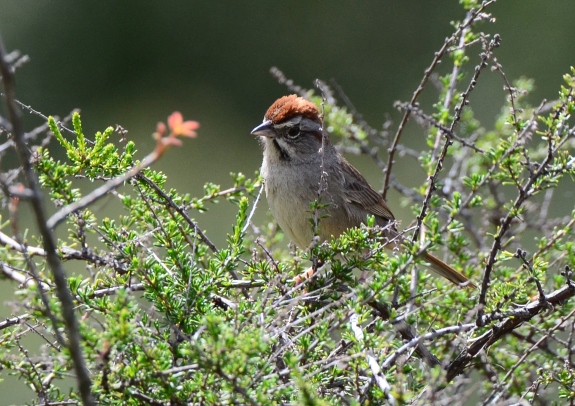
Rufous-crowned Sparrow was the main draw for me that morning. We managed to find one pair, but oddly they weren't in any of the huge chaparral patches. They were frolicking in a grassland just downslope from a modestly sized patch of chaparral.


Rufous-crowned Sparrow is very uncommon in Marin, so it was great to check out a new zone and snag a desirable county bird at the same time.


We unwittingly found another highly local being, this one even rarer (but perhaps more dependable) than the sparrow. Carson Falls still hosts foothill yellow-legged frogs, which have been extirpated almost everywhere else in the county.


These stream-loving/pond-hating frogs love a good current and some good basking sites nearby. COUNTY FROG!!!!!!


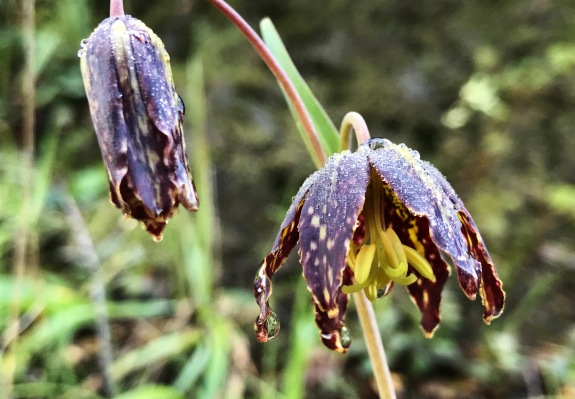
This was the best flower of the day, checker lily (Fritillaria affinis), looking all dewy and soothing.


Little crippler!


My bastard girls with some nice yellow-legged frog habitat. There's so much good stuff in Marin, it was great to be so close for a few months. Now I am in the process of discovering the good things Santa Clara has to offer. There's no Point Reyes...or ocean...but the shorebirding is great. If only there were some sod farms...


On another day in March I was back at the Las Gallinas Ponds. Cinnamon Teal were still looking as Cinnamon Teal should back then. All the ducks are currently recovering from eclipse plumage now, and don't look like a whole lot.


What a strange body type you have Common Merganser.


This is a long bird. Beware.


A Bewick's Wren offered itself up for a solid crush, which I was obliged to partake in. I'm sure I've mentioned it before, but I can't help but mention it again...Bewick's Wrens are so abundant and adaptable in California, it's strange to think that their eastern populations have fared so poorly in comparison. Is competition with other species (other wrens?) to blame?


Bewick's Wrens have little to fear from Marsh Wrens. By this time Marsh Wrens were belting it out in full force, beckoning the Least Bitterns (local legends) to return. It only works when you do the splits though, which this bird knows. I did snag one of the bitterns for my YOHOMBSLBFTINFOLF eventually, though it was heard only.


Pied-billed Grebe is one of those birds I see constantly but photograph rarely. This extra-fluffy one was too good to pass up.


No wings. Only fluff.


Adults in alternate have a solid black throat, which I admittedly forget about sometimes since I don't spend a lot of time looking at Pied-billed Grebes, despite all the opportunities I have to do so. How would you describe the voice of a PBGR? Jon Dunn (via the Natty Geo field guide) says they deliver "a loud series of gulping noises". Pretty good, they are certainly loud, though American Bittern is considerably gulpier. I would go with loud and hollow "coos" and "cowps", and a series of nasal, rapidly uttered "hey-hey-hey-hey-hey-hey-hey-hey" delivered in the same pitch. Ugh, I can't imagine having to describe a field guide's worth of bird vocalizations.

Monday, April 17, 2017

Las Gallinas - Zono Zone, Let The Kinglet In, The One You Least Suspect (LISP)


Sorry for the lack of output lately buddies. Unsurprisingly, it becomes harder to blog when you are hanging out with a baby all the time. I've gotten plenty of good birding in this winter/spring though, so I have no shortage of material to work with...shit, I even have flowers.  But before I could even blog it, the Quasi-Perpetual Weekend (QPW) has come grinding to a halt...it's back to work for me. I've been off since my daughter was born in January, so this is going to be weird.

One of the things I've been able to take advantage of during the QPW was my proximity to Marin. Among northern California birders, few counties hold the appeal that Marin does. While I've lived in a number of places in the bay over the last ten years, I've never managed to live in Marin, which is widely considered the best birding county. That said, my current home in Albany is just a quick 15 minute drive over the Richmond Bridge to the Promised Land. I've spent a great deal of time birding in Marin since last fall, which has paid no end of dividends in terms of rarities and quality outings.

The Las Gallinas Ponds is a default birding location on the Marin bayside...you can rack up over 60 species pretty easily for much of the year, it has rarity potential, and a lot of the birds are highly crushable. Indeed, if you enjoy running into photogs who can't identify the birds they are shooting (who doesn't?!), then spend some time here!

Marsh Wrens are extremely common here (not unusual), but there are so many of them that you are bound to get good looks at a couple (unusual).


Common Gallinules are a highly local species in the bay area, and there is no better place to see them than at Las Gallinas. They are totally fearless here, even more so than the coots. Close observations of gallinules will lead you to conclude they are more interesting than coots in almost every possible way, except their feet are not as cool. Coot feet are hard to top. I'm not sure why gallinule feet are so simple in comparison, considering their niches and behavior overlap so much.


Did someone say "common"? Oh good, now I have a reason to post a White-crowned Sparrow. We have them year-round here, but they still are very much a scourge of winter.


Your friend and mine, the Great Egret.

This photo begs a question...without googling, does anyone know what bird species has the longest neck? Either in proportion to its body, or actual length? This seems like important trivia to know.


Don't worry locals, I managed to slip in one rarity in this post. After a substantial time spent dipping on this bird, eventually I connected with the Harris's Sparrow at Las Gallinas. Though not a MEGUH by any means, this is a solid rarity in California, and since I didn't see any last year it made for a fine yankee bravo, as well as a Marin County bird. Unfortunately it disappeared after about 30 seconds, and I was left wallowing around in more common birds...


Golden-crowned Sparrows are abundant and often very confiding...too bad most of them don't look very impressive until April or so. But what they lack in aesthetic appeal, they make up for in humble plumpness.

Wow, did I just throw up pics of three Zonotrichia? Perhaps it is time to brush up on these horsemen of the apocalypse.


Unlike Zono sparrows, Cooper's Hawk is not a bird I encounter up close very often. Practically everything at Las Gallinas is begging for merciless crushing.


I am not above posting the occasional House Finch photo...and by occasional, I mean this is the third one BB&B has ever posted since 2008. It was time. Come on, I know you are programmed to not even look at it, but it's a pretty bird, admit it. It looks good with that lichen...this is something you and I have to accept. Hey, if you are ever going to find that vagrant rosefinch, you're going to have to look closely at some House Finches.


Now that we got that out of the way, we can let this Ruby-crowned Kinglet into the empty cavities of our hearts. Don't be afraid...just let it in.


This is, without doubt, the best Ruby-crowned Kinglet photo I have ever taken. This is not a boast (that would be embarrassing), just simple fact. I dig how yellow the tail looks on this individual, that's not something I notice in the field very often.


Lincoln's Sparrows often fit the descriptions of murderers that you hear about on local news stations...they are quiet, nice, keep to themselves. Wouldn't harm a fly...or so you would think. No one would ever suspect them of breaking the law at all, let alone capable of killing nine people.


This is definitely a species pulling stakes right now; I've probably seen my last of the spring already. I've mentioned here before how they never sing at wintering/stopover sites in California. Do they just fail horribly the first few times they sing each year? They are probably spot-on, but I like the idea of them having to sing out the rust.


A few minutes away from Las Gallinas is the Marin Civic Center. There's a big, weird artificial pond there which attracts some gulls and ducks and has pulled in a couple interesting birds in the past. I recently discovered that it has tame Common Mergansers, which is heck of novel to me.


I've never seen them so close before. That is probably an odd notion to some of you, but now you know you can become #7 without ever getting close to Common Mergansers. As you definitely can tell, they were looking for delicious bread handouts (that's why they evolved serrated bills, obvi), but they are pretty striking birds regardless of the lowly intentions of these individuals.

Ok, I think I used up all my blog stamina. I've got to save energy for the next post, as that will deal with something I've been needing to tell you about for a long time....a long time.