Showing posts with label Puerto Rican Flycatcher. Show all posts

Wednesday, February 22, 2017

Puerto Rico Winter Tour Y2K16: Refugio de Vida Silvestre de Boquerón, Cabo Rojo


It's been a weird winter here in the bay area. It seems to rain constantly, and I am in a persistant daze due to the newborn baby that strangely requires frequent attention. However, I can't bitch about not getting to the tropics this winter, because it was only back in December that our group from MAX REBO BIRDING TOURS were slaying Caribbean birds in Puerto Rico. The trip report must go on...

It is about time I posted a picture of one of my first lifers of the trip...Greater Antillean Grackle. I somehow did not get to crush them as well as I could, so I had to settle with photographing them while sitting around eating lunch after we birded Laguna Cartagena. An old lady with bad Parkinson's was feeding them rice, so I stole a few grackle souls.


These are one of the most abundant native birds of Puerto Rico. They are quite small, more like a Common than a Great-tailed, and haven't totally abandoned native habitats in favor of streets and parking lots. They are also much less cacophonous and obtrusive than Great-tailed...I ended up liking them a lot, considering they are literally a trash bird.

After lunch we decided to check out Silvestre de Boqueron, a coastal site that is not mentioned in a single trip report that I could find, but boasts a very robust (for Puerto Rico) site list in eBird. We found the entrance road easily enough and parked at the admin buildings. Here, there is a boardwalk trail through the mangroves, and longer trails that go to the south and to the west. We chose to walk the southern trail, which ended up being very rewarding...almost immediately we got our first White-crowned Pigeon of the trip, which was a lifer both Officer Searcy and Dipper Dan. They turned out to be fairly common there, and one of the dudes who works at the refuge says they nest next to the other trail that we did not take.


White-crowned Pigeon did not turn out to be the highlight though...a few minutes later, we were blessed with an increasingly rare group lifer (#grouplifer)...at long last, we had found a Lesser Antillean Pewee!  YESSSSSSSSSS!!!!!! This was a major target bird of the trip (again, all Caribbean species were targets for us), and I was getting worried that we might end up dipping on it. The Puerto Rican birds population may be treated as their own species someday, so it was a very bankable bird as well.


We saw multiple pewees on this trail, in a habitat where none of us were expecting them...they are not exactly considered a mangrove species from what I could tell. Though the birds would rarely sit in crushable light, they were bizarrely cooperative, which I appreciated very much. Their buffy underparts and trusting ways were most mellowing. We would not go on to see them anywhere else, though I did hear one at Bosque Susua.


Puerto Rican Woodpeckers were common and widespread. This eye-catching endemic is built to last, occupying many different habitats...unfortunately I never got the crush that this bird deserves. It is much, much more interesting than your average Melanerpes.


The most surprising thing about our time at Silvestre de Boquerón was how fucking birdy the place was. Almost everywhere we birded on the island was somewhere between not birdy and kinda birdy, but there was a lot of activity here. Northern Parulas were very common, showing up in almost every mixed flock we crossed paths with.


As with most sites, Puerto Rican Flycatchers were holding it down.
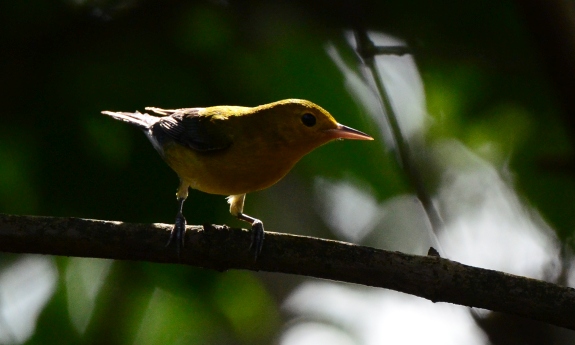

Unlike the pewee, Prothonotary Warblers are known to be lovers of swamps and mangroves. This dimly-lit (but still facemelting) rarity was another excellent trip bird; a Black-and-white Warbler near the parking area was another new North American migrant for the trip list. Good times at this place...if you are interested in checking out this site, our eBird checklist can be viewed right here. Note that during the hunting season the refuge is not accessible seven days a week. We were also told that it was ok to park outside the entrance gate and walk in to bird outside of normal hours.

We had some daylight left, so it was back to Cabo Rojo to continue the never-ending search for trip birds (other than the mythical Masked Duck, we had run out of lifers to get in immediate area). Our spot that previously produced a huge peep flock and Franklin's Gull earlier was almost devoid of birds, which did not surprise any of us. Still a bummer though.


This friendly Merlin provided some consolation. I don't know about ya'll, but friendly Merlins are few and far between out here. Oh, and while I think of it, how come Merlins seem to be so unpopular with falconers? Seems like the next logical bird to graduate to after a kestrel, and they are fun as hell to watch hunt. Oh well, leave them in the wild, suits me.

Our search for waterbirds took us all the way to the end of the road, at the parking area for the hella popular beach. Despite a great deal of good habitat, there was little to see...maybe the tide was too high?


We did see some cool terrestrial snails at least. Who doesn't appreciate a good snail?

On the way back we pulled over where some shorebirds and a group of icterids were roosting; Dipper Dan noticed some Yellow-shouldered Blackbirds in the flock, so we hung out and looked around.


The trees along this stretch of road were clearly the site of a significant night roost for Icterids. It was fantastic to see Yellow-shouldered Blackbirds in a more natural setting than the La Parguera hardware store.


A little while later, we refound the Franklin's Gull picking at shit out in the lagoon...a nice bird, but there was a lot more to look at...the closer to sunset it got, the more and more birds we noticed began to arrive...and that is when we realized it was happening.


Thousands of icterids flew south down the peninsula to roost next to where we had parked. Shiny Cowbirds (above) comprised a large portion of these birds, which I had mixed feelings about; they are a major factor in the decline of the blackbird...but they were also a bird I had just lifered only days before. We also started seeing Prairie Warblers fly in to roost (!), which was a most fetching thing to watch.


Luckily for us, Yellow-shouldered Blackbirds came streaming in over our heads with the grackles and cowbirds. Ace.


Amazing looks at these hell of rare birds. While it is easy to think of them as just a Red-winged Blackbird with a different wing patch, there is another major difference between the two species, phenologically speaking...the sexes have identical plumage. Yup, these might be females. Astounding, no? I wonder how this unisex plumage evolved.


Flocks of Stilt Sandpipers and Lesser Yellowlegs wheeled around over the laguna while we watched the blackbirds fly in, adding to the birding ambiance.


The laguna and distant Guanica Dry Forest glowed beneath afternoon storm clouds in the fading light. Our time here at the blackbird roost was one of the definite highlights of the trip, and I would highly recommend attempting to see the blackbirds here (17.954779°, -67.198514°) in the late afternoon instead of the mutant bread-lovers at the hardware store.

Sunday, January 8, 2017

Puerto Rico Winter Tour Y2K16: Guanica Dry Forest, Cabo Rojo NWR


This is going to be a massive post...hopefully friends who are about to head to Puerto Rico in the coming days will appreciate it. So without the usual preliminary bullshitting, here we go...

For our first morning on the west side of the island, we checked out the famous Guanica Dry Forest. The habitat here is unique and occupies a very small area; the endemic Puerto Rican Nightjar is almost completely dependent on this habitat, and a number of other great birds are found here as well. We accessed the main entrance (17.979549, -66.881285), which was very straightforward, and birded two different trails. One of the main trails that goes east from the parking area (17.972138, -66.867011) was the most productive...Adelaide's Warblers were singing all over the place (we had still yet to see one) and we heard multiple Key West Quail Doves, a lifer heard-only for all of us. Another Puerto Rican Emerald put in an appearance, which I failed to photograph yet again, but possibly the best bird we saw was this Antillean Euphonia.


I had no idea this was such a facemelting bird! I've seen quite a few euphonia species in Mexico and Costa Rica, and can confidently say that only the legendary Elegant Euphonia tops it in crippleness. Euphonias aren't the most attention-grabbing birds in most of their tropical range (they have a lot of competition), but this species is an exception. Not only did we have great looks, it was also the only one we would see on the trip! Clutch bird.


Guanica is littered with Adelaide's Warblers, and we got plenty of good lucks finally. The Grace's Warbler resemblance is strong. The area was devoid of any North American species.


As with many places on the island, we got more good looks at the bizarre and confiding Pearly-eyed Thrashers. This bird won't make your brain roll over in your head, but it will stick with you nonetheless.


Officer Searcy bends the knee to some Caribbean mushrooms. The dry forest was not all that dry when we were there, but presumably looks quite different later in the dry season and lacks much in the way of exotic fungus.


You were expecting tody pictures, so here are some tody pictures. These are truly hilarious, lovable birds, and are absolutely not worried about hanging out right next to the trail. I suspected that they might be awesome before the trip, and my suspicions were confirmed. Luckily, they are common and widespread on the island, and though they can be hard to spot they are easily located by their little fart sounds they frequently utter.


This bird got remarkably close to us. Better views not desired. Mission accomplished.


Unlike the todies, Puerto Rican Bullfinches do not want to be close to you or let you admire their goodness, so I was stoked to get this shot. Though not at all rare, it is one of the best birds on the island I reckon.


Nerds strut through El Seco during a gluttonous morning of lifering.

If you want to glance at the eBird checklist, it's right here. Not hella species on there, but they are almost all excellent birds and include quite a few lifers for us. The screech-owls on there were vocalizing late in the morning (bizarre), and that was the last we would hear or see of them on the trip.

After this Great Success, we went to do what we do best, which is bird someplace really hot in the middle of the day. Our choice for deploying this highly recommendable tactic was Cabo Rojo National Wildlife Refuge, near the southwestern tip of the island. It turns out Cabo Rojo is a pretty big place, so if you are wondering we birded the trail at 17.980970, -67.168364. This area consists of scrub, grassland and open forest, with a couple small ponds, perfect for birding in the middle of the day with blazing sun. The birding was very slow at first (shocker) but by the time we got back to the car we had seen some decent stuff. There were massive numbers of butterflies around the whole time though, so do check out this area if you are into that sort of thing.


Sometimes when there aren't birds to look at you look at robber flies doing inappropriate things.


We lifered Antillean Mango earlier in the day at the dry forest, but got slightly better looks at this one. Like a great many pretty crippling hummingbirds, they look like shit in bad light, but we caught occasional glimpses of their brilliance during flybys. Getting Antillean Mango meant we swept all five of the island's hummingbirds in four days! This was very relieving considering my hummingbird failure that was the Mexico trip from earlier in the year, which still haunts me to this day. Amethyst-throated Hummingbird, Bumblebee Hummingbird, Mexican Hermit, and Sparkling-tailed Woodstar are going to have to wait. Little bastards.


This little pond on the trail looked like it might have some Masked Duck potential, but as expected there was no Masked Duck.


There was a pair of Least Grebes (trip bird!) with chicks though, which was a soothing, cute and family-friendly consolation. The other trip birds we got were Yellow-faced Grassquit and Indigo Bunting, which have much to offer but lack the character of an ani...


Smooth-billed Anis galore! They are very common in areas with any open habitat on the island and Cabo Rojo was no exception. Anis have almost nothing to offer but character and some greasy shagginess.


Officer Searcy found this very pleasant little nest, which I assume was constructed by an Antillean Mango, though we had emeralds there also.


Near the parking lot we got looks at Caribbean Elaineas, another bird we had lifered earlier in the morning at the dry forest. They have a conspicuous, vireo-like song, and like vireos they were unafraid of belting them out in the middle of the day. Here and the dry forest were the only places we'd get this bird.


Presumably this is the caribaerum subspecies of American Kestrel endemic to Puerto Rico and the Lesser Antilles. Lots of new subspecies available for visual consumption on the island.

After our long, hot mid-day walk we decided it would best to bird more instead of do something reasonable like eat lunch or drink beer. There was a potentially very good shorebird spot just a few miles away, so we lurked over there (17.968347, -67.178826) in the quest for more trip birds.


A Puerto Rican Flycatcher teed up on a power line, but the real draw was the salt flats and lagoon on the other side of the road.


A massive flock of peeps here contained Least, Semipalmated and Western (trip bird!) Sandpipers. Other than this flock there weren't a whole lot of shorebirds though. But we didn't let a few Greater Yellowlegs get us down...Dipper Dan found a distant gull! A gull! The first gull of the trip! We hemmed and hawed over Laughing vs. Franklin's Gull (Laughing is expected, Franklin's is considerably rarer), but I finally settled on first cycle Franklin's, due to the dark and well-defined hood and lack of any gray wash on the nape, neck and breast. The bird did have a bizarrely large bill (not that you can tell in the photo below) but everything else fits Franklin's nicely.


It swam around contentedly picking bugs off the water; we would see it again a couple days later as well, doing the same thing further west. This is, presumably, the rarest bird of the trip. Though we didn't know it, according to eBird someone actually found it earlier in the morning, so I guess we can't really take credit.

There was still one more group lifer we would get that day, but this post is too damn long. ¡Ya basta!

Tuesday, December 20, 2016

Puerto Rico Winter Tour Y2K16: Humacao and Ceiba Country Inn


December 3: Again we woke up fighting the blear (do you blear what I blear?) that always comes with getting up hella early in tropical places with jetlag and without coffee. We birded briefly around Ceiba Country Inn before breakfast. We have realized by now that Zenaida Doves are abundant and widespread (though I did not come back with good enough photos), and a couple were poking around the driveway early in the morning.


Red-legged Thrushes are also easy to find in areas with second-growth forest. Unfortunately, most of the birds we saw were on the shy side. The one bird that sat 10 feet away in the sun glowing like a bastard chose to appear while my camera was out of reach (typical), though Dan and Adam got to crush it (also typical). If you go to PR, don't expect these birds to be hella approachable unless you blunder into a tame mall bird like we did.


Loggerhead and Gray Kingbird combo! A pair of Loggerhead Kingbirds briefly hung out near the inn, which we had not seen the day before. They remind me of a cross between an Eastern Kingbird and a large Eastern Phoebe.

After breakfast (toast AND cereal this time...luxurious!) we rolled down to bird Humacao ("Reserva Natural de Humacao" in eBird) on the east coast, a site that can be good for waterbirds and the two "eastern" hummingbirds of the island, Antillean Crested Hummingbird and Green-throated Carib. According to the birder's guide, this area was good for West Indian Whistling-Duck and Masked Duck, but eBird suggests that this has not been true in recent years - as both species are prone to wandering, Humacao may eventually become a good spot for both species again. Unsurprisingly, we did not see either species here.

The access situation is a bit odd - there is the "official" access along Rte 3, which has limited hours and is closed on weekends, but immediately east of there is some kind of park (across from the tire store) with concession stands and an information kiosk that essentially allows access to the same areas. This is where we entered (18.150726°, -65.772021°), and it worked out quite well. We did not try birding the northern part of the reserve (north of 3), where it looks like there is a lot of good habitat as well.

The birding here was interesting; the habitat looked very good, but it wasn't a particularly birdy place. It seemed like Humacao would be dripping with North American warblers, but as we noticed the previous day at Ceiba and El Yunque, there were relatively few migrant warblers (Northern Waterthrushes, redstarts, a Prairie Warbler, and some dude playing an Ovenbird tape). This would become a theme for the entire trip; we only found two sites that had more than a handful of warblers, but that would come later. The one exception to this rule of warbler scarcity was Northern Waterthrush, which were abundant in mangroves everywhere.


The first birds of note were white-shielded American Coots, which until recently were Caribbean Coots. Soon afterward, we got on two White-cheeked Pintails in one of the lagoons...what a refreshing lifer. I haven't seen a new duck in a long time...a long time.


As with practically every vegetated place in Puerto Rico, there were Bananaquits galore, though this photo was taken in El Yunque. In Puerto Rico, they seem to have a foothold in a wide array of terrestrial niches.


Puerto Rican Flycatchers were widespread and common during our trip at lowland and mid-elevation sites. This is another very Eastern Phoebeish bird from certain angles.


It was here at Hamacao that we had a run-in with our second Reluctant Lifer of the trip, in the form of Tricolored Munia (the first was Bronze Munia/Mannikin back at Ceiba). None of us were interested in going out of our way for filthy, disgusting exotics, but it was inevitable that we would be dealing with them. Much more interesting than the munias were our first visuals of Mangrove Cuckoos of the trip.


Mangrove Cuckoos are surprisingly common in Puerto Rico, and can be found in many different habitats.


I'd only seen them once before (in Costa Rica), so this was a nice bird to get to see almost every day.


Most sites were teeming with lizard or frogs or both. In the lizard department, we saw a lot of whiptails.


This big one was rocking an indigo belly patch. I'm into it. It could be a different species than the yellow-striped duder above or just an adult. It's not like I'm #7 in whiptails, cut me some slack.


We plodded through the mud, slowly accumulating trip birds. Dan got looks at the first Green-throated Carib of the trip, while Adam and I were gripped off and forced to stew in our juices. Further on down the trail we ran into a patch of Antillean Crested Hummingbirds (lifer!), one of which Adam brought in by hanging an orange bag in a tree. Brilliant.

On the way back to the car, we noticed the tree behind Adam (above) had a lot of yellow blossoms, and waiting around the tree ended up producing both Green-throated Carib (lifer!) and another Antillean Crested Hummingbird. I was very fucking relieved to see these birds, as we had missed them the previous day and they are much harder to find on the west side of the island, where we would be spending most of our time. The night before, in a dream, I thought I found a Carib...but it turned out to be some sort of weird Anna's Hummingbird hybrid...talk about a fucking nightmare. I took it to mean that we would be doomed in finding this bird, but fortunately it was probably just the fruit of all the emotional baggage I have with Anna's Hummingbirds. Anyways, it is worth mentioning that there were hardly any flowering trees at Humacao when we were there, and we found hummingbirds at all of them.

Having succeeded with multiple target birds (our eBird checklist is here), we decided to try the Fajardo Inn to see if we could put the crush on any hummingbirds there (there didn't seem to be much blooming across from the police station at the time, another suggested spot). It seemed pretty barren for a while.


This large, plain anoley thing was one of the few noteworthy finds at the hotel.

Eventually, Adam got on an Antillean Crested Hummingbird in a bottlebrush tree next to the tennis courts, where we had some mild success in getting photos of this little facemelting bastard with flash.


What a good bird.


These things are tiny and blackish with short little bills, quite different from the island's other hummingbirds. The males have amazing crests that glow blue in natural light. I dig the subtle iridescent feather tips on the underparts you can see here too.

That night would be our final night staying in Ceiba, so after we got back from farting around Fajardo we put on our rally caps and started looking for Puerto Rican Screech-Owls, our last remaining local target, which again seemed to be very quiet compared to our first night there. After doing many laps around the inn (these are very short laps) and walking all the way down the driveway and back up again, we got visuals of two Puerto Rican Screech-Owls next to the parking lot. Talk about grinding out a bird! Getting long looks at these birds turned out to be clutch, as not surprisingly we would not see any more during the trip. For those of you thinking about staying here, Ceiba Country Inn is a very good place to get the owls, and one of the guys running the place seemed surprised that we failed to see them our first night when they were constantly calling. Though it was hard to recover from this ruthless browbeating, we took advantage of our final chance and got quality looks.

Having secured all our local target birds in the nick of time, it would be time to move on in the morning. Up next, the nerds go west on a Plain Pigeon odyssey, and make the long sandwichy trash fire trek to Guanica.