Showing posts with label little gull. Show all posts

Thursday, January 26, 2017

Multiple Birdgasms: The Ventura Little Gull


Before I was #7, before I was Seagull Steve, I was the Ventura County Kid. I began birding in Ventura, California, when I was 12 years old. My dad and I wandered into the Ventura Settling Ponds, and I saw a shitload of ducks that I'd never seen before...I was already bird-curious, so this was a tipping point...I had no chance, and it was too late to go back. I got a lot of life birds at the Ventura Settling Ponds back in those days and have seen a couple rarities there, so when Billy and I were down in Ventura for Thanksgiving with nothing better to do, we lurked into the ponds for a check up. No one thinks of this place as an amazing vague runt trap, but these are the sewage ponds of my heart.

This site is not quite as birdy as it used to be, in part because it used to have some additional ponds that were entirely removed. As we walked out, I lamented the loss of these ponds, which always used to have a flock of Bonaparte's Gulls...which are mellow, entertaining and elegant birds in and of themselves, but when you have Bonaparte's Gulls, there is always hope for rarities like Black-headed and Little Gulls. Bonaparte's Gulls were a thing of the past at this location though (and practically anywhere in the county, in numbers anyway), and so was almost all hope of ever getting Black-headed and Little Gulls again.


I pitifully bemoaned the loss of the Bonaparte's ponds to Billy as we walked out...and within 30 seconds, lo and behold, there was a flock of Bonaparte's feeding in front of us. Not 30 seconds after that, a small gull zipped by with a neat black cap and a giant black "M" across its wings...could it be? No...it was too good to be true...

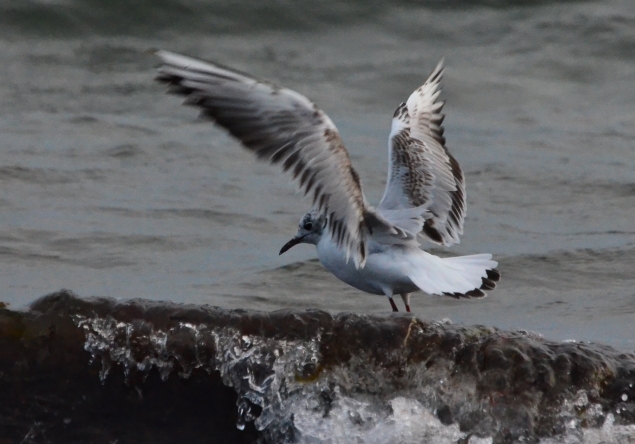
I continued to watch the bird as it flew back and forth. Surely I was having a brain aneurysm and was hallucinating some field marks...no, they are real, this was no mutant Bonaparte's...maybe this is a young Black-legged Kittiwake then, because surely it can't be what I think it is...no...it is a juvenile Little Gull. What the fuck? Not only was this a self-found state bird, more importantly I knew it was the first Little Gull to be found in Ventura County since the 80's!


I couldn't believe it...a sweet sweet Ventura County bird, and a sweet sweet California bird...those milestones are not supposed to intersect anymore. It was also only the fourth Little Gull I'd seen anywhere...brilliant. Once my mind finally accepted what my eyes were seeing, my body was rocked with multiple birdgasms. I'm not afraid to admit it. This wasn't a crippler, not a facemelting bird, but it was absolutly stunning...once again, I was reminded of the true power The Economy of Style can unleash on a hapless birder.

Little Gull is a Bird Police review species in California; while there are a small handful of sites where they have shown up multiple times, in most of the state they are considered a MEGUH, at least on a county level. In Ventura County, this bird has long been thought of a major blocker...if you were not one of the few birders to see the first two birds back in the day, you were probably never going to see one in the county at all...they are just absurdly rare anywhere on the California Coast.


What are they doing in California at all? They aren't "Sibes" in the traditional sense; you won't find them along Russia's Bering Sea coastline, or in Japan for that matter. They have a tiny breeding population in North America, so there is a possibility that most (all?) of California's records are from misoriented migrants bravely barging their way east from the interior East Asian population.


Here is a first-cycle Bonaparte's Gull in comparison. Bonaparte's molt out of juvenile plumage very quickly, and by the time young birds reach California in fall almost all of them are well into their first pre-basic molt. The dark trailing edge of the underwing is not present on Little Gull in any plumage.


I found my hands were shaking as I went to text some local nerds about this bird. That's not hyperbole, that's just embarrassing. It's been some years since a rarity has so readily disabled me.


Luckily, the bird stayed put in the same pond for the entire day, and as far as I know everyone who looked for it that afternoon got good looks. Even Officer Searcy made it in time, all the way from Edwards Air Force Base. It was good to Share The Rare with old birder friends, and to find one of Ventura's top birds of the year during a brief incursion to my ancestral county...comparisons to Douglas MacArthur were made, and understandably so.


The Little Gull fueled up on hapless bait fish all afternoon. The next day, Thanksgiving, it had vanished, and many birders who ditched family to make the chase left empty-eyed and broken-hearted...their sacrifices and family betrayals were all in vain.  Indeed, for the birders who were seeking the Little Gull as a substitute for friends and family, it was truly a tragic day...but to be fair, spending time with a vague runt Little Gull could be a lot more appealing than being trapped with ornery relatives.

What a bird! Hopefully it will not take another twenty-seven (27) (!) years for one to grace the shores of Ventura County again.

Sunday, June 14, 2015

Maynerayge Day 3.5: Slipping The Clutch


It was late in the afternoon, and Nate and I decided to head out to the beach at Pine Point to try our luck with the continuing Little Gull and for more looks at Roseate Terns.  It was sadly dark when we got out to the jetty...a big cloud bank was blotting out the sun and Maine was cold again, and any photos to be taken were to come out dark and grainy.  But there they were...the Bonaparte's Gulls, frolicking in the surf, just where they were supposed to be.  Where was the Little Gull?  Scanning the flock repeatedly brought no such thing...in fact it only brought Roseate Terns, which Nate always informed me were flying very close by behind me whenever I got too distracted by the gulls.  It was agonizing.

Since it did not seem to be around, the thought occurred to me that I should do something other than focus on finding the Little Gull that I thought I had previously found...I should really find my own Little Gull. So I stopped looking for the tiny black-headed wonder and kept scanning the Bonaparte's flock. It wasn't long before a bird lifted off the beach with a really bizarre wing pattern...could it be? My redemption? My destiny? It landed out next to the end of the jetty, so I Nate and I troglodyted out to where another group of Bony's was feeding. Within a few minutes...we had our reward. Another Little Gull!  I love it when a Vague Runt plan comes together.


Due to the awful light conditions, essentially none of the birds around were crushable, but we had good looks at this bird as it foraged and flew around the tip of the jetty. This being only the third Little Gull that I've ever seen, I wasn't going to complain.


This is a young bird in first-summer plumage, overall pretty shabby-looking but it really stood out both on the water and in flight. With such a bold wing pattern, it was impossible to miss when it was on the wing.

While we were out on the jetty, we noticed another birder had shown up back on the beach, and he was clearly on the hunt for the other Little Gull. After our young bird disappeared, we saw him running down the beach toward another Bonaparte's flock, clearly in hot pursuit of the adult Little Gull that he had just relocated. Nate and I decided to parasitize him, and he led us right to the bird.


There it was, our other little buddy.  We had seen it three days in a row now...Vague Runts are good birds to know, especially in this case where it is especially runty.  It gave good looks in the fading light, and eventually flew out to the river mouth to feed.

I thought the day was at an end.  I was mentally packing up and getting ready to go, and did the prerequisite last scan of the flock of birds in front of me...and then all time stopped. My heart paused between beats.  Gulls were frozen in mid-air.  What the fuck is that bird standing there?  Holy shit, it's a Black-headed Gull!!!!


For the last several minutes, this Black-headed Gull had been standing right in front of us, just a few feet away from the Little Gull, without anyone noticing! Indeed, in one of the last Litttle Gull pics I took that day, I can see the Black-headed standing in the corner of the frame. Compared to the Bonaparte's, it was huge, and after spending so much time looking at Little and Bonaparte's Gulls the last few days, it was instantly recognizable. Like the first Little Gull of the day, it was a first-summer bird, a life plumage for me. Check out the leg color (and girth!) compared to the Bonaparte's standing behind it.


Nate and I couldn't believe our luck. We summoned the other birder we had previously been parasitizing, Josh Fecteau, and were able to pay him back handsomely with this ace Vague Runt. The bird moved off the beach and foraged in the little breaking waves, giving great comparisons to Bonaparte's Gulls. Check out the different wing patterns between the Vague Runt and a Bonaparte's of the same age. Remarkably, Dipper Dan and Flycatcher Jen had stayed back at the vacay house the entire time, seeing none of these birds. Even sadder/funnier, Nate and I had taken the rental car, so if they wanted to see this bird they would have to hoof it all the way from the house before it was too dark to see. Is that fucked or what?


Dipper Dan and Flycatcher Jen eventually showed up in time, while the Black-headed continued to be hella cooperative. All was well in the world. Note the extensive black in the inner primaries.


The bird was clearly larger than a Bonaparte's with a longer bill (reddish in good light) and traces of a hood that came up much higher on the head than a Bonaparte's, and way way higher than on a Little Gull.  A field mark that I did not remember on basic-plumage birds (I've only seen one of those, cut me some slack) was how white the bird was on the hindneck compared to a Boney.  That was one of the first things I noticed about the bird, back when it was standing on the beach.


The Black-headed also was pretty dark on the underwings.  As with Little Gull, I've only seen Black-headed a handful of times before, so this was a victorious find.  According eBird, this is only the second recorded in Maine this year, and the only one other folks were able to chase successfully.


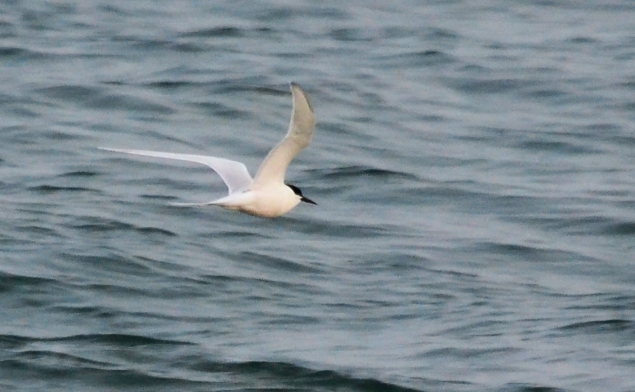
As I mentioned earlier, I somehow managed to not photograph every single Roseate Tern that flew by closely, and the shots I did get made me wince when I looked at them.  At least you can actually see the roseate hue and strikingly pale upperwing in this photo.  This was one of my top target birds of the trip (I've now seen every expected tern species in North America and the Hawaiian Islands except Blue-gray Noddy...don't know how I'll bump into one of those things), and it was nice to see a number of them flying around off the Pine Point jetty. Looking forward to the next time I get to meet this tern.


Common Terns really are common in Maine, no shocker there.  It's been a long time since I've seen so many. Being a decidedly uncommon bird in California, it was great to spend some more time with this species, all of which were in alternate plumage.  Solid.


The typical pot-bellied, short-tailed look of a Common Tern.


It wasn't so long ago (though it seems like it now) that I was in the Least Tern business, down in the whale's vagina. Since we are no longer business partners I am no longer afforded the chance to see them every day of the week, so I was pleased to see so many Least Terns around Scarborough Marsh and Pine Point. It's crazy to think that some of the birds I've seen on Midway Atoll I've also now seen in Maine...along with Least Tern, Ruddy Turnstone and Green-winged Teal are the others. Least Terns even breed on Midway...the mind reels.


Least Terns are gray in the uppertail and rump, whereas Little Terns are white. Remember that, and you might be a birding hero someday.


Just offshore from the jetty and the mouth of the Scarborough River, a large flock of terns and Bonaparte's Gulls were feeding the entire evening.  No doubt the abundance of food right next to the beach was behind the number of quality birds present.  Considering the warbler show earlier in the morning, this was probably my best day of birding for the entire year. Birding in Maine is good birding.

Sunday, June 7, 2015

Maynerayge, Days 1-2: Maine is Hot, Maine is Cold, Iced Coffee For All


And then it happened...I was in Maine.  On a birding trip.  To say that I needed this would be the most severe understatement.  The spring birding I've been able to do here at home has mostly sucked, I needed a break from Oakland, and I was ready for the chance to get some sweet sweet life birds. And so four nerds assembled: one Seagull Steve, one Flycatcher Jen, one This Machine Nate (Nate is open to another nickname by the way, if you have any suggestions), and one Dipper Dan.  None of us had birded Maine before, and the potential for lifers for all of was alarmingly high.

The first day we arrived, Dipper Dan and I took a cab from Portland down to Pine Point, which sits at the mouth of the Scarborough River and the massive Scarborough Marsh to meet up with Nate.  We had rented a house there for three nights, since as a group it was affordable and we were within walking distance of high quality birding.  A couple of Nate's friends who were in town had went out to the beach to walk their dog, and so we three nerds decided to follow.  "I'm going to leave my camera here so we can see something good", I said, and Nate and Dan decided to do the same.  It turned out to be a very wise move.


It took me 15 years of birding before I ever saw a White-rumped Sandpiper...now, of course, I don't go through so much pain to find them so we are able to hang out with some regularity.  Because I suffered for so many years in White-rumped Sandpiperless agony, they now hold a special place in my heart and I will always spend some extra time with them.  Photographed at Pine Point, ME.


The orange base to the bill is an extremely helpful field mark for birds in alternate plumage, something I don't think field guides emphasize enough.  Yet another bird who looks remarkably good while staying within the notorious confines of The Economy of Style.


Although the beach had a number of people walking around, it wasn't long before we started picking up on some birds.  A large raft of sea ducks feeding offshore turned out to be a mixed flock of White-winged and Black Scoters, the latter of which was a life bird for Nate, the first of many that our group would be getting.  We walked down to a large group of Bonaparte's Gulls feeding in the surf, and I mentioned the distant possibility of a Little Gull being mixed in with them.  I have seen one Little Gull ever, and I think that was over ten years ago...seeing another one would be a relifer of sorts, a great birding victory. Despite the fact that I was looking specifically for this bird, I could not believe it when I saw a bird with jet black underwings alight on the water...there it was!  A Little Gull in high breeding plumage...what the fuck?!  Good thing I didn't bring the camera...ugh.


The bird was both incredibly good-looking and incredibly cooperative, constantly showing off its unique wing pattern and eventually coming up to the beach to preen right in front of us.  At such close range, the bird really did stand out from the surrounding Bonaparte's Gulls...the bill was even a deep, dark reddish color, something I did not expect to see on this bird.  The light was fantastic.  We felt bad for Flycatcher Jen, who was not there and getting gripped off horribly because United Airlines decided to delay her flight over and over again.  Had we brought our cameras, we could have absolutely slayed it...these photos were taken the following morning from some distance, but they will have to suffice.


I later found out that the bird had actually been discovered by other birders earlier in the day, so although it was an awesome self-found rarity it wasn't actually a found rarity, oh well.  This bird was easily one of the highlights of the trip, and a tremendous way to kick off our spring tour.  We celebrated with Nate's friends in Portland that night with tapas, cocktails, and the first of the million beers that would be consumed during the trip.

On Day 2 we kicked off our birding back out at Pine Point, where to everyone's relief Flycatcher Jen lifered the Little Gull and several of us lifered Purple Sandpiper and Roseate Tern.  The Purples looked more distinct from Rock Sandpipers than I thought they would, and I was surprised by how much the Roseate stood out from the surrounding Commons...it is a tern that is far more elegant than an Elegant Tern and a tern far less roseate than an Elegant Tern, if you ask me.


One of the most visible birds in Scarborough Marsh were Glossy Ibis, a bird I haven't seen in a few years.  We had one flock foraging relatively close while searching for sharp-tailed sparrows, which was a good thing considering how uncooperative the sparrows were that morning.


The last time I thought I saw a Glossy Ibis, the bird turned out to be a hybrid...no doubt about the genetics of these birds though.  A blue face is a good face.


Those who live in the east are probably wincing looking at this mediocre Common Grackle photo. Well, I don't get to see many Common Grackles!  As you can probably guess, these birds are widespread and common in much of Maine.  Photographed at Pine Point, ME.


After birding Pine Point and Scarborough Marsh, we spent the afternoon looking for migrant passerines.  One of our stops was Evergreen Cemetery in Portland, which had a few nice birds including some Wood Thrushes.  Wood Thrushes are one of my favorite birds...some say that Hermit Thrush is the best singer among the Catharus, but hearing a Wood Thrush always strikes a special chord with me.  A couple were foraging out on a lawn and allowed better looks than usual. 


Yeah, I know, pretty far from a crush but I'm enthusiastic about these birds, what can I say? We didn't run into any big migrant flocks here or at Capisic Pond, but there was plenty to keep us entertained.  Flycatcher Jen was lifering birds at a remarkable pace.  Too bad we never got to bird these sites during the morning, but we had our hands full wallowing in other good birds.


Pink Lady's-slipper is wonderful plant to gaze upon, and has a winning name as well.


If this were another blog, this is where I would make some grimace-inducing euphemism about squirrels liking each other. That is not science. What is science? Boning. Boning is science. These squirrels are boning. They were hella into it too, constantly flipping over and changing positions. The best part of it was that that there was another squirrel about 3 feet away watching everything very intently.  Maybe it was a cuckold?  You may doubt the complexity of squirrel kink, but who are you to doubt an animal that is known to masturbate with great purpose?