
As any California birder knows, Humboldt offers a lot more than just the (very) occasional Great Gray Owl. There is no shortage of good birding spots to scour during the winter, so of course I had to check some other shit out while I was up there. I birded Arcata Marsh, since it is conveniently located right in town and just about anything can show up there...the dependable Swamp Sparrows I was looking for were not very dependable on this day, but the much more range-restricted Golden-crowned Sparrows were there in predictable abundance.

Unlike most birding spots, the marsh continues to grow in size and simply gets better and better when it comes to shorebirds and waterfowl, possibly to the detriment of the local Short-eared Owl population. This Greater Yellowlegs was feeding right in the face of this Green-winged Teal, foraging on little inverts the teal was stirring up with its bill. When you have a height of only a few inches it must be strange to have a yellowlegs looming over you, but the teal did not seem to mind.

This was apparently a successful foraging technique, as the yellowlegs did grab something while I was watching.
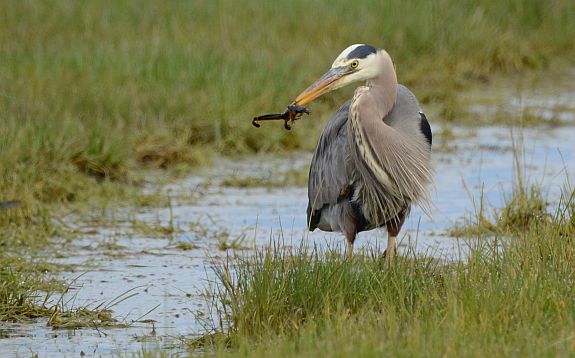
Over on the V Street Loop, this Great Blue Heron had gotten a hold of a much more interesting prey item...a large newt.

The heron did not appear to have a good idea of how to go about eating the newt, repeatedly dipping it in water, bashing it against the grass and not giving attempting to swallow it at all while I was there. This is an awkward thing to prey on at best, extremely toxic and deadly at worst. Native Americans in the Pacific Northwest used newt juice as a poison...

On the far side of the loop a cooperative Merlin was posted up on...a post. This bird struck me as being fairly pale, with no mustachial stripe...in the field I thought it was a female, but looking at the photos now I don't feel so sure about that. Interesting bird, I'm not quite sure what to make of it as far as age/gender/subpecies.

Elsewhere in the bottoms, I came across another, especially confiding Merlin. This bird was noticeably darker with heavier markings on the breast and belly than the first Merlin of the morning, but I'm not enthusiast about pulling the trigger and calling it a "Pacific" Merlin (I would expect a darker face and even more streaking/barring on the breast and belly). The vast majority of Merlins I've seen over the years usually zip by, giving shitty looks...I'd like to have more time to watch these birds and get to know each subspecies more.

For all you robin-strokers out there, here is an American Robin. There are thousands in the Arcata Bottoms in the winter. It is known.

Much, much more interesting than the area robins was this Harlan's Hawk. This bird has been wintering along the Highway 101 corridor between Eureka and Arcata for over a decade (!), usually near the Jacoby Creek Cutoff. In the past, I had only seen it while on the freeway, getting a quick naked-eye glimpse of it perched on a billboard or something and thinking "Oh, that was probably the Harlan's", but I finally managed to get great looks at the bird on this trip.

The bird is extremely dark, lacking any "warm" tones whatsoever. Fitting for an Alaskan bird. The uppertail (not visible in any of my photos) appeared dark gray without a hint of red, with a prominent dark subterminal band.

Although I never saw it fly, this bird definitely provided the best looks I've had of any Harlan's. Hopefully it will make it back to Humboldt this fall once again.
It was a relatively quiet winter in Humboldt as far as rarities go, but with a Snowy Owl (that I gleefully did not chase) showing up shortly after I was up there, the winter Vague Runt season ended for local birders on an extremely high note. What will show up next winter? Steller's Eider? Gray Wagtail? Black-tailed Gull? Siberian Accentor? The possibilities boggle the mind.

